For me the word becquerel itself requires some additional brain power points to write. Is it bequerel or becquerel? Do we capitalize it or not? Not when written, but Bq is capitalized, so it's indeed kBq. But then again, is it per second? No, the unit, has per second in it already... And we not need to confuse it with B for byte. I thoroughly enjoyed the article but there's no need to complicate the world further. rps is perfectly fine.
It's surprising to see an OS, dominant as a sever platform, now optimizing catering to people who are unsure whether they've pressed a button on their keyboard. What's next, replacing asterisks with a progress bar?
Apple is no longer about Jobs' "simplicity as the ultimate sophistication". It feels like a bunch of kids with no proper design education competing for the security of their salaries. Apple is dead without Steve. The company has no focal point. They're running solely on the inertia from Mac OS X and the first generations of the iPhone.
That's a pretty extreme take. I've been using the Mac since about 2001. I like Tahoe and a well designed Tahoe app can look really nice on the platform. There are bugs, inconsistencies and other issues, but it doesn't feel that different than many previous macOS / OS X releases
Sorry for the off-topic, but what a bliss to see Windows 2000 interface. And what an absolute abomination from hell pretty much all the modern UIs are.
Fantastic news. As ACP is no longer in development, I am starting to slowly look for a replacement, and a few things that come up in my mind:
- Will it work with MaximDL to acquire images and autoguide, or will it simply not need it at all?
- Will it work with PWI3 for autofocusing?
- Will offset tracking (at custom dRA, dDec rates) be implemented at some point to track artificial satellites?
- Will it at some point implement targeting using TLEs and MPC elements?
- I am extensively using #WAITZENDIST and other #WAIT directives to wait for an object to be at certain altitude - would be really good to implement that in observation plans (a single plan can do a number of things sequentially.)
- Can plans launch custom Python scripts and read/write stuff from/to files?
I probably want too much at this point, but sincerely wishing you best of luck with this incredible project, will definitely follow all the developments!
The whole thing seems like it was designed in a parallel universe, or at least it reeks of some kind of a sunk-cost-fallacy design-by-committee thing.
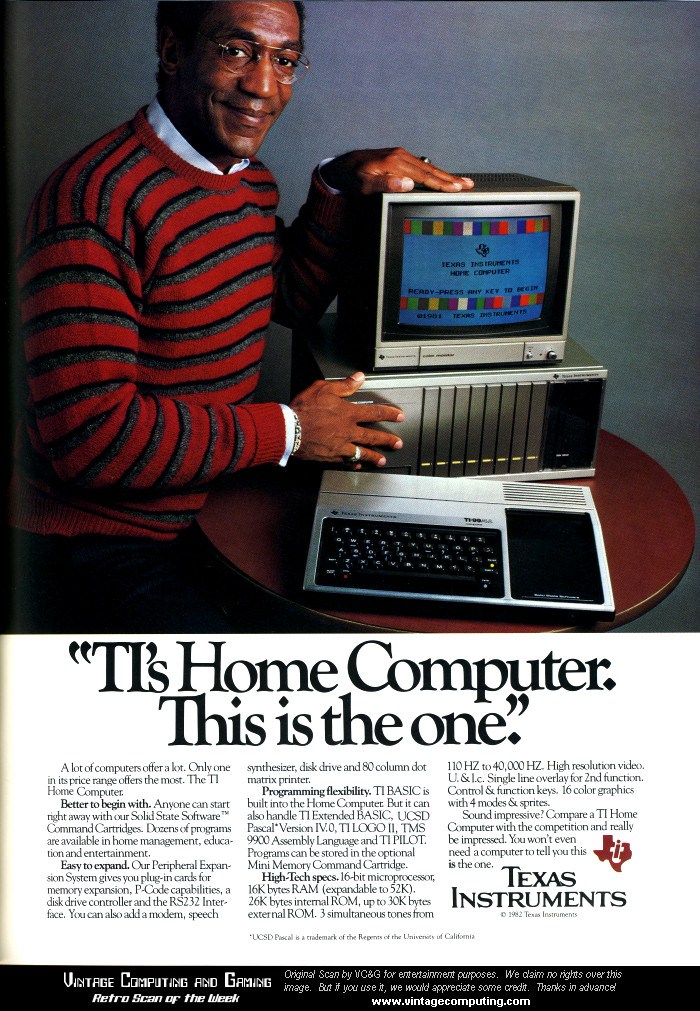
Supposedly what happened is that the system was originally designed to have either an 8-bit CPU, or a 16-bit CPU with an 8-bit bus (cf. 8086/8088) like TI's own TMS9985, but at some point it was decided that they should instead cram their full 16-bit TMS9900 minicomputer CPU (!) into the thing. This decision basically tanked the whole architecture.
It was too late/too expensive to redesign the 8-bit support chips to 16-bit counterparts so they had to make some really out there decisions like "talk to the graphics chip and give it an address to read/write every time you want to use memory" and "software is written not in machine code, but in GPL (Graphic Programming Language), which is then interpreted by the CPU and turned into actual TMS9900 machine code"
Software on ROM cartridge for the system is stored in GPL and is fetched from ROM by the CPU (but wait! The ROMs are not in memory space like they would be on a sane computer; they are SERIAL ROMs read 16 bits at a time with memory mapped I/O) and interpreted to machine code. This is slow. When you write your own software in BASIC, however, this gets worse: now you're writing BASIC, which is being interpreted and turned into GPL, stored in video RAM, and then fetched back from video RAM and turned into machine code by the CPU. THIS IS EVEN SLOWER.
Needless to say, the BASIC on the TI99 is dramatically slower than the already slow implementations on other contemporary micros.
It DOES have a full 16-bit CPU which is theoretically much more powerful than a 6502 or Z80 but this wild-ass implementation of... well, everything, makes the system probably the least capable machine of the era.
RAM was very expensive then and 16 bit CPUs weren't that much faster to justify the cost if you were aiming for the home market.
Both true, which makes this an even more baffling choice -- why pick the more expensive, state of the art 16-bit CPU* that you're getting little or no benefit from + 16K of extremely slow-to-access combined video and system RAM? You could have used a cheaper 8-bit CPU and maybe for the same budget have fit 4K or 8K of system RAM on the bus + some amount of dedicated video RAM for the VDP. This would have been faster and more useful in nearly all real world applications, make for a much cleaner board design, easier development, and probably cheaper. That's what everyone else did.
Then again, what was this machine's target market?
* The reason is probably that TI wanted to show off their state-of-the-art CPU tech and be able to point to the spec sheet and say "look, it's 16 bit! All our competitors are only 8 bits -- that's half as many bits!"
The design "decisions" are easy to explain. The 9985 failed. They had a development prototype with a 9900 emulating the expected CPU. The 9918 VDP was the cheapest way to add 4K later 16K of DRAM. And that was what they shipped after the 9985 was killed.
------------------------------
From 1977 they expected a 9985 to succceed the cheap 40-pin 9981, both having an 8-bit external bus (1). It would have 256 bytes of RAM onboard. I speculate it would have the 9900 microcode optimizations seen in the military SBP9989.
Anecdotally, the 9985 failed seven tape-outs. It was killed. The Bedford UK team was tasked with starting over: eventually this produced the 9995.
But the Home Computer had been prototyped using a 9900 board. So that was forced into the 99/4 (not A) with some external 256 byte SRAM.
Memory was expensive. The 9918 VDP, made by a team in 1975 with junior engineer Karl Guttag, was the cheapest way to interface 4Ks DRAM which TI made and sold to itself. By the time it reached market, 16k in 8x 4116s was optimal.
Various efforts to cost-reduce and upgrade the 99/4A ran into the '82 price-war with Commodore.
Every design iteration that added more RAM (2 or 8 or 16K directly accessible from the CPU) was "paid for" by reducing the cost elsewhere (PALs for instance.) BOM was around $105. [3]
But in the price war, engineers were told to deploy the cost-savings without any new features: this was the 99/4A 2.2 or QI for quality improved. [3] The 99/4A was already a loss leader by Q4 1982 [5].
In 1981, Karl Guttag's new 9995 passed first silicon [2]. It used the new optimized 99000 CPU core which also famously passed on first tape-out. The 9995 was available in quantity in 1982 [3] when new consoles were started around it: 99/2, 99/8.
The 99/2 was supposed to be cheap enough to compete with Sinclair. [6]
The 99/8 was a technical beast for the high-end, having 64K of directly accessible RAM. Its fancy memory mapper drove 24 bit external addresses. It supported 512K off board, which the P-Box had been designed for. It had Pascal built-in. Yet there was no Advanced VDP for it: stuck with the same 9918A.
In early 1983, TI assembled a team of two dozen engineers to write software for it: Pascal applications, new LOGO, a database, new word processor, TI FORTH, and complete accounting package, and a rumored superior easy-to-use interface. Pascal was supposed to deliver many benefits. It would be a small business machine. (4)
Of course, in November 1983, all efforts ceased as Home Computer was cancelled--just as the consoles were to be unveiled at Winter CES.
-----------
(1) An 8-bit bus was always going to be optimal--even the IBM PC 8088 saw that. 16-bit peripheral chips were never going to be made: the package size would prohibit that.
(2) Electronics Magazine and EE Times articles
(3) Internal memos of Don Bynum, program manager
(4) TI Records, DeGolyer Library, SMU : Armadillo and Pegasus
(5) "Death of a Computer", Texas Monthly, end of 1983?
(6) BYTE Magazine June 1982-ish
Based on research for my book: _Legacy: the TI Home Computer_.
Thank you for this, this is very interesting detailed context.
Do you think there is a possible world where TI would have swallowed their pride and considered not-invented-here options like a regular 8080/Z80/6502 as the CPU?
I have a few ideas but I think they were set on using their own chip.
There was a memo asking if TI should support those other CPUs in their AMPL prototyping system (990 based tools and in-circuit emulator). That investment was rejected.
Anecdotally, Don Bynum was unhappy with slow progress on defining the Home Computer, and hacked together a Z80 based machine. The engineers redoubled their efforts... supposedly...
There's politics between the Calculator division (all consumer products), Semiconductor, and Data Systems Group.
Still, TI had a TMS8080 (and later their own 486).
I'll work on this idea, thanks...
----
As a child, I knocked some books off a garage shelf once and was plonked on the head with copies of The 8080 Bugbook. What the heck was a Bugbook? Or an 8080?
Some years later, a 9995 data sheet fell on my head and I thought how hard can it be to wire up a computer?
"Section 1.23 of the IBM Agreement states that IBM Licensed Products "shall mean IHS Products ..." The only logical conclusion is that the parties meant those IHS Products specifically identified in Section 1.2 of the Agreement. Section 1.2 does not limit the products to IBM designed products."
"Therefore, IBM has the right to act as a foundry and to make, use, lease, sell and otherwise transfer the microprocessors in question to Cyrix free of any claims of patent infringement."