Not really a huge surprise given that the debris was confirmed as a 777 flaperon a few days ago.
However, It does mean that the Inmarsat positional analysis about the final location of the plane is likely correct. This should give a bit of confidence to the sailors who are running the naval search operation in the indian ocean. They were never quite sure that they were looking in the right place. I suspect their lack-of-results must be quite demoralising for them.
It also discounts some of the nuttier theories such as the plane landing in Russia or Afghanistan.
The satellite position analysis only says where the plane likely was near the end of its flight. How it ended up in the water matters greatly. For example if there was someone conscious in the cockpit then it could have glided way outside of the search area. Even an uncontrolled spiralling into the ocean describes a potentially large area.
One thing that keeps resurfacing is that the whole affair is unlike anything before. Suicidal pilots have crashed quickly in all other cases, various things have involved extraordinary good luck or extraordinary knowledge (eg avoiding various radar coverage), explanations for satellite systems going offline/online require precise fiddling with various electrical busses, there aren't any credible explanations for deliberate act or accident, the Malaysian government has either covered things up or is very incompetent (or both), and it goes on.
Air France 440 was also shrouded in mystery (but nowhere near this degree), and turned out to be very poor airmanship by one pilot.
For anyone curious about more of the technical aspects behind the scenes then Jeff Wise writes about it frequently. http://jeffwise.net/
> Air France 440 was also shrouded in mystery (but nowhere near this degree), and turned out to be very poor airmanship by one pilot.
It was poor airmanship by two pilots (and other factors, including the feedback mechanisms and the lack of training for this particular high altitude scenario).
My understanding is that the pilot in the left chair didn't realize that the pilot in the right chair kept pulling his stick back. In boeing planes, the sticks move together, so that wouldn't be possible. And the pilot in the right chair clearly didn't understand that in the alternate law the fly by wire system was running in, his stick movements put the plane at risk.
Yes, it was a completely incorrect reaction by a single pilot, combined with a catastrophically bad design for the controls, which caused that crash. It is completely insane to me that anyone would think that averaging inputs from two pilots and providing no feedback would be even remotely a good idea.
I mean physical feedback. In any rationally designed aircraft, the controls are physically linked, such that moving one moves the other (or at the very least this arrangement is faked with servos). When two pilots attempt to give contradictory inputs, they immediately know it because they can feel the other one fighting.
Yes, in the Air France tragedy, the aural warning clearly wasn't enough. Through fear and panic, the pilots failed to understand what the plane was telling them. But the feeling of having a control yoke fight against you doesn't require much mental effort to process.
Aural warnings are so easy to ignore. There are a ton of stories that go like, "What is that annoying buzzing sound? Well, no time to worry about it now, I'm landing. <CRUNCH> Oh, it was the gear warning." Happened to a friend of mine, even.
I think it ultimately comes down to engaging with the primary sense you're already using. If you're doing something visual, then a visual warning (on whatever you're looking at) can be effective, while an aural warning won't. If you're listening to something then interrupting it with an audio warning will work great. Hand flying is a tactile experience, so that's the sense you want to work with.
Yes. You give an example of someone ignoring a single aural warning. The case of AF447 was much worse.
There was a cacophony of different sounds and noises in the cockpit of AF447. All the various alarms are deliberately made to sound different. But when someone knows he's a minute from death, there's no way his reptilian brain can make sense of a plethora of simultaneous alarms. It will, instead, strive to tune them all out.
I remember a documentary where Duke Cunningham discussed his experiences as a fighter ace in Vietnam. In high stress situations he would switch his intercom to allow him to speak to his RIO, but not be able to hear his RIO. He didn't want the distraction. (Note: sadly, Cunningham disgraced himself in later life).
I built a gear warning system for my glider. The usual ones just have either as steady tone or a pulsing tone. I made mine do a pulsing tone with different speeds, then it actually spells out "WARNING GEAR UP" in morse code. I don't know morse code, but I figured the irregular pattern would make it more identifiable and harder to ignore.
I've seen it advised to turn off the aircraft radio when it's not useful and you're in the middle of something tricky, like climbing out from a low altitude, or landing in a field.
> I've seen it advised to turn off the aircraft radio when it's not useful and you're in the middle of something tricky, like climbing out from a low altitude, or landing in a field.
That's correct (even though he did mention "watch the height" and could have followed up on that). If I remember correctly, even the left chair pilot also applied nose-up inputs at some point in time.
IMO The mystery of MH370 is partially due to some incorrect assumptions, which can't be proven or disproven until the main wreckage is found, and/or the blackboxes recovered.
Where the wreckage ended up could depend several factors.
eg. glide ratio of a 777 (~18:1), or how the 777 Fly-by-wire control system works under certain failure modes. There hasn't been a crew incapacitation crash in a fly-by-wire airliner before.
A small fire in the electrical bay could disable aircraft systems in unexpected ways, and possibly even burn out on its own, and the damage doesn't actually cause the jet to crash immediately. If the cockpit crew were incapacitated at cruise altitude, the jet could still end up 100 miles away from the point the engines flamed out.
Turning around is a common procedure under mechanical events and mechanical explanations for what happened to MH370 are still one of the leading 2 theories.
Not an expert, but doesn't the flap already indicate that they crash landed? As otherwise plane would have sunk to the bottom ocean in one piece? I guess further analysis will say whether flap detached via chafe or on impact.
Also is there a chance they will be able to detect smoke debris on it (to confirm or deny chemical battery fire theory)?
Unless (puts on tinfoil hat) that piece of wreckage was placed there with the intent that it would be discovered. Nutty people will believe whatever they want.
> It does mean that the Inmarsat positional analysis about the final location of the plane is likely correct.
Does it though? I'm not saying the analysis is incorrect, just wondering how predictable these ocean currents are. I understand that the debris surfacing at Reunion doesn't rule out the current search location, but that's different than confirming or proving it. I mean, can they just 'play back' the ocean currents and arrive at a specific spot? I wouldn't be surprised if there's so much uncertainty that all they can say with certainty is that it must have crashed somewhere in the Indian Ocean. Which isn't exactly new information.
The Inmarsat data seems pretty solid, but it's not very precise. There was always the possibility that the plane actually went down somewhere on the northern arc, rather than the southern arc as was assumed. The northern arc was never very likely because the plane would almost certainly have been noticed on that path, but this debris finding rules it out entirely.
"the Doppler shift due to the satellite’s motion is not removed by the plane’s terminal when it pre-corrects the frequency of transmission, and thus there is an asymmetry between the BFO which would be produced by a plane flying north of the equator (and thus situated to the north of the satellite) compared to one flying south on a similar track."
It's a perfect example for "science, it works." They managed to conclude quite a lot from a miniscule amount of data with the information that was never planned to be used for such purposes.
Sadly, people will attempt to overthink that. E.g. jeffwise.net was cited earlier as a forum discussing AF447. But read this from Jeff concerning the Inmarsat data:
   case 3. The plane did not go south at all.
   If this is the case, then the satellite
   communications system must have been compromised
   by hijackers who either flew the plane north to
   Kazakhstan or China (if only the BFO values were
   spoofed) or somewhere else within a huge circle
   encompassed by the 7th ping ring (if both BTO
   and BFO values were spoofed).
Yes, it's possible that occurred. But even Inmarsat itself didn't have a good understanding of this data. It's very very farfetched to think that some sinister elements, as part of a nefarious scheme, spoofed the data being sent to the satellite. IMO the probability is less than 1 in a million. So many other scenarios make more sense.
It appears to me not like overthinking, but like completely failing to understand the way the analysis I've quoted was done (if he wrote the details I've quoted were published). Nobody knew, before the analysis was done, that it would be even possible to use the Doppler effects of the communication recording.
The Inmarsat position data was very controversial when it was first announced. This was because the flight path, the last radio contact and last radar signal were all recorded over the South China Sea; a completely different ocean to where the debris was found. Indeed, the first search operation was over and around the designated flightpath, which was literally oceans away from where the plane likely came down. Thanks to Inmarsat, we have a much better, though not completely accurate, understanding of what happened.
Note that the plane was tracked on military radar flying west from the South China Sea, across the Malay Peninsula, and over the Andaman Sea before it flew out of range. Despite this fact, the Malaysians allowed search and rescue efforts to remain focused on entirely the wrong ocean for two days before they finally told anybody that they might be looking in the wrong spot, and it was four days before they actually revealed that they had a full hour of additional radar data that showed the plane had definitely not ended up anywhere near its intended flight path.
Of course, even then the search was subsequently done in the Andaman Sea area under the assumption that the plane crashed near the position of its last radar contact, as the Inmarsat data wasn't announced until several days later.
IIRC it was controversial as it implies that the 777 was in controlled flight for several hours after it lost contact, making it a deliberate act rather than accident. Radar data released by the Malaysian military showed clearly that the plane turned west then south.
All I'm saying is that this might support the Inmarsat conclusions, but that's not the same as proving it.
If my hypothesis is that all swans are white, finding a black swan would disprove it. Instead this is another white swan. It supports the hypothesis, but it doesn't prove it.
Note by the way that I have no reason to doubt the Inmarsat analysis. I think that was truly groundbreaking use of the data. All I'm saying is that this find doesn't really prove the analysis, nor help with narrowing down the search.
Officially, it's a "very strong presumption" and has not been officially confirmed. Apparently there are some things that don't add up for the U.S. NTSB.
"A person involved in the investigation said, however, that experts from Boeing and the National Transportation Safety Board who have seen the object — a piece of what is known as a flaperon — were not yet fully satisfied, and called for further analysis.
Their doubts were based on a modification to the flaperon part that did not appear to exactly match what they would expect from airline maintenance records, according to the person, who was not authorized to discuss the matter publicly and requested anonymity."
It wouldn't be the first part ever installed in an airplane that didn't match print, or the first set of aircraft maintenance records that wasn't complete. I intend no snark here -- just saying, this discrepancy doesn't necessarily mean anything.
But this is not an argument against further investigation. For a tragedy such as this, any discrepancies should be investigated to their fullest extent, as you never know what tiny piece of evidence may reveal what happened.
There aren't any other missing 777's, so all they really need is to conclusively determine the part came from a 777 and process of elimination takes care of the rest.
Still, I understand them wanting to be extremely cautious.
To be definitive, though, you need to find evidence that proves that the piece you found was present on the aircraft for the flight where it went missing. You have to have some way to say, "Ah, yes, this flaperon is a Boeing part number, with serial number #XXXXXX. Maintenance records show that this exact serial number was installed on the aircraft in question, and its configuration as found matches the configuration of record for this part on the aircraft in question." Then you know for sure to a degree that will stand up in any inquiry.
Well, not quite, right? If you wanna be paranoid, it could be a maintenance/replacement part from another 777, deliberately planted. (Not that I believe that's likely, just saying.)
How would one go about verifying that the debris comes from the missing plane, assuming plane-specific serial number is not found?
Any expert care to shed some light on this?
Any part more complicated than a screw or rivet likely has a serial number / part number on it, and if it does, could be traced back to the exact aircraft it was installed on.
And even if there are no serial numbers, there are detailed maintenance records for the aircraft; you can see if a bolt has been replaced, trimmer adjusted or a hole fixed, and you'll find matching records in the books.
Yes of course, "in the books" was just an idiom here (perhaps not the exactly correct one). What has been done to the plane is a matter of record and can be checked.
There is just one 777 airframe that is unaccounted for.
There have been 5 777 hull loss instances (all since 2008) Two crashed just before the runway (Heathrow and San Francisco) one was destroyed by fire while sitting at the gate (Cairo) one was shot down over Ukraine and one disappeared somewhere over the Indian ocean.
That was the only complete airframe missing, but couldn't there be lost repair parts?
Container ships lose something like 10000 containers at sea annually. Some of those break open and spill their contents. I'd guess that most major airlines stock repair parts in their maintenance centers, and so such parts are shipped across the oceans, and so could get lost at sea.
If, say, Air New Zealand ordered some 777 flaperons to stock their maintenance center, and those got lost in the Indian Ocean, would Air New Zealand just file an insurance claim and order more flaperons from Boeing, and everyone would generally forget about the lost flaperons drifting about in the area?
Or is there some registry or database or some such that tracks these things so that people looking for lost aircraft can check it and find what kind of lost parts they need to be careful to watch out for so that those parts won't mislead their search?
All maintenance on aircraft is closely tracked. They can probably find evidence of maintenance operations that were conducted on the found piece and confirm that it matches the maintenance records for the aircraft. It's a similar idea to identifying people by dental records.
The idea that "everything has a part number" is generally correct but has a few exceptions. You won't find serial numbers (or often, part numbers) on small consumables, like washers, or things like rivets. But it's very common for bolts to have part numbers.
Something as large as a flaperon would definitely have a part number (which would tell you if it was part of a larger assembly), and might be serialized and directly trackable.
Disclosure: I don't work on commercial aircraft, but I do work on military aircraft.
One thing that is not clear to me is if this part is mostly aluminum or mostly carbon fiber. If it's carbon fiber, the fact that it can float might not be so surprising. Another interesting question is just how high it was floating in the water. If it just barely reached the surface then it would experience very little windage, so its path through the ocean would be almost entire driven by currents. I don't know that that would simplify drift analysis, but it seems like it might.
Are any parts on the 777 carbon fiber? I was under the impression that composite parts were a very new thing on commercial jetliners, significantly post-dating the design of the 777.
Not a new thing at all, the A320 has used a lot of composite parts and it's been in service since the '80s. Planes being built using predominantly composite parts for the fuselage and wings, such as the 787, is new though.
The first use of carbon composites for commercial aircraft structures was the A310/A320 vertical tail. The A320's horizontal tails also used carbon composites. The A320 Neo uses carbon composites to an even higher degree to try to reduce weight and improve fuel economy.
While I don't doubt that it is sealed, I wouldn't think it would have to stay completely sealed to float: I'd expect that a sufficiently large air pocket trapped iinside could do the trick of keeping it afloat just enough for it to travel somewhere.
It may be an easy decision for a part that's all metal and low density to be sealed to add a bit of buoyancy in case of a water landing, to give the passengers more time to get off.
So currents pushed debris toward Reunion, but is it possible that things drifted non linearly and scattered everywhere or will they be able to find the remains in a short time now ?
Even if a) currents and winds where 100% known and b) we could perfectly compute how they interact with objects, the parts still could end up in widely different places.
Different parts will have had different starting positions (even a few meters can make a huge difference. The part found made it to Reunion, but if it had floated a few meters further, it might have missed the Island and, over time, float hundreds of more miles, or it might have landed on an island that it now completely missed)
Also, the shape, weight, etc. of pieces affects where they float; a mostly submerged part will not see much impact from wind, a sailboat-like part will see lots of impact from it. Even identical pieces may float in different directions if they end up in the water at different orientations.
"Knowing the paths of the currents, though, is not enough. Other factors such as shape, size, and buoyancy may also determine an object’s course. Curt has observed with fascination that different beaches specialize in different types of debris. One beach may collect light bulbs while another collects tennis balls. Even right and left sneakers end up in different places"
There is an image at the bottom of the article which shows simulated debris movement over time. According to that, the stuff could be spread in a wide band from Madagascar to Tasmania by now.
I imagine some fascinating papers will come out soon from people who will do the math/simulations to hone in on a tighter search area than what the Inmersat data has given us.
I'm sure the PM is overjoyed that this story kicked up again right now. Anything that distracts the press from his embezzlement scandal is likely very welcome.
The funny thing is that the PM also put out an arrest warrant for a British journalist (Gordon Brown's sister-in-law) for covering the corruption case. If he hadn't done that, I wouldn't have heard of his whole scandal before this.


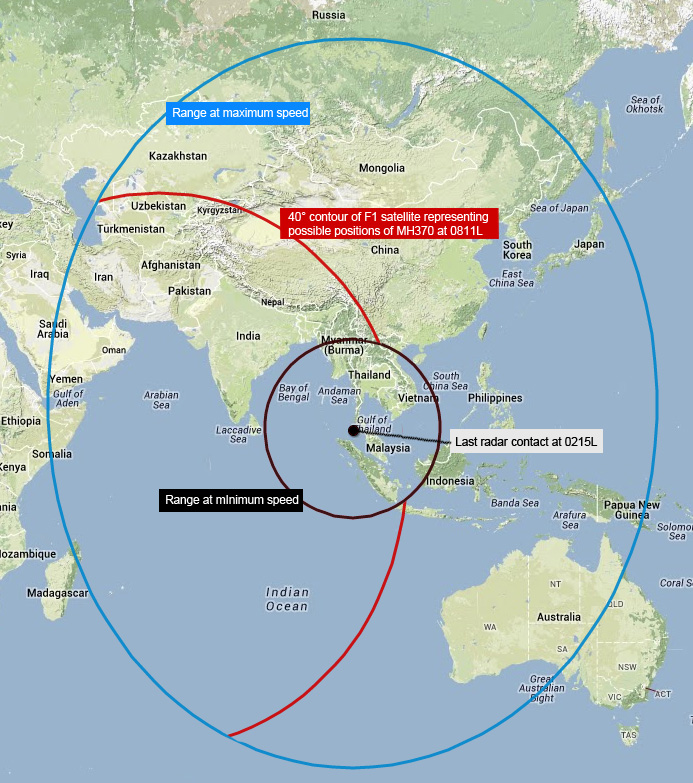
It also discounts some of the nuttier theories such as the plane landing in Russia or Afghanistan.