Just looking at the delivery/cooking truck, I'm suddenly reminded of the opening chapter in Snow Crash:
"""
The analysts at CosaNostra Pizza University concluded that it was just human nature and you couldn't fix it, and so they went for a quick cheap technical fix: smart boxes. The pizza box is a plastic carapace now, corrugated for stiffness, a little LED readout glowing on the side, telling the Deliverator how many trade imbalanceproducing minutes have ticked away since the fateful phone call. There are chips and stuff in there. The pizzas rest, a short stack of them, in slots behind the Deliverator's head. Each pizza glides into a slot like a circuit board into a computer, clicks into place as the smart box interfaces with the onboard system of the Deliverator's car. The address of the caller has already been inferred from his phone number and poured into the smart box's builtin RAM. From there it is communicated to the car, which computes and projects the optimal route on a heads-up display, a glowing colored map traced out against the windshield so that the Deliverator does not even have to glance down.
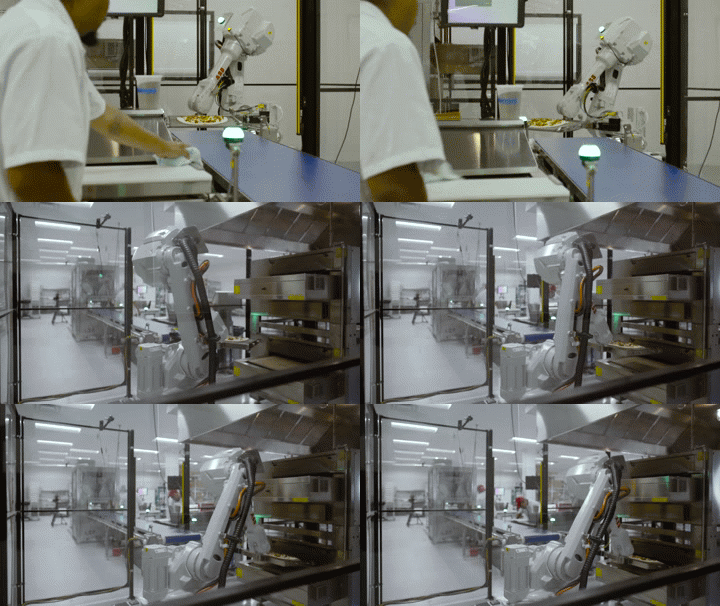
Puff piece -- the idea of cooking pizzas in a truck is a good one, but the whole 'robotics' angle is a little trite. The only automated part seemed to be the sauce (which Costco does) and moving the pizza to the oven.
I like the moving-pizza-truck idea, it's a shame this had to go the route of 'robotic pizzeria' since it's so blatantly a puff piece.
I think this article is actually more interesting because it shows you something about how a good tech PR strategy works. Bloomberg undoubtedly saw, on-site, how ridiculous the robotics narrative was, but they went with it anyways, because it makes for a more viral story. This kind of PR is a collaborative effort and win-win.
If you have a tech startup you should really think about the narrative before you call in press. Think about what the audience wants from a story, and sell that. The goal of PR is to get your company noticed ... so long as you don't turn off genuine customers, you can actually go pretty far away from reality before the average user picks up on the fact that the story is mostly bullshit.
I think they should have kept the CEO out of this video. He comes across as a bit too much of a shuckster. A CTO type would have been a better type. Also, instead of positioning the business as increased profit, he should have presented the reduction in labor costs as savings for the customer. That always makes a better story. The CEO's brain probably doesn't work that way, but the PR firm he hired should have given him that tip.
The idea of cooking on the road is great, but those wire conveyer racks that they're cooking on look like a nightmare to clean. I suspect cleaning all of those ovens will not be automatable for now either.
on a different note, mini pizza ovens seem to be the best part of this startup, seems as though it could be a great product when combined with 'artisinal robot made' frozen pizza.
It looks like the individual ovens allow them to cook each pizza for a precise amount of time:
    At precisely 3 minutes and 15 seconds before
    arriving at the customer's location, the cloud
    commands the oven to turn on and--" Garden made
    the symbol of a large explosion emanating from
    his brain-- "BOOM, the customer gets a fresh,
    out-the-oven pizza delivered to their door."
I'm guessing this was less complex than trying to move pizzas in and out of a larger oven in a moving vehicle.
Baking pizza in a moving vehicle doesn't seem feasible to me. The sauce, cheese, etc. in a 600 degree oven are like soup. Turn the corner or need to make any kind of a rapid stop and it will all slosh to one side and ruin the pie.
Plus they keep forgetting that people are cheaper robots. A VC our family knows designed in 90's SmartMart: a convenience store that was totally automated. You order at fuel-pump looking Kiosks, robots pull it from stock, and machine delivers it to your car as you pay. To think grocers brag about mere self-checkouts. Unfortunately, the SmartMarts cost around $10 mil versus about $1 mil for stores underpaying & overworking humans. It folded.
Depends on cost of a machine. Plus, McDonalds is a weak even if common example. Many companies push employees go focus on good service or at least sales (esp upselling). Computers still arent as good at that with a good chunk of customers rejecting them outright in such uses.
Far as machines, depends on how cost of installation, maintenance, and licensing vs humans it replaces. Varies case by case.
McDonald's was used as an example due to their work at automating their franchises, and their comments about increasing this to full automation due to the $15 minimum wage[0].
The bigger point (and the dirty secret of globalism) is that nobody can really afford labor, especially multinationals.
"The bigger point (and the dirty secret of globalism) is that nobody can really afford labor, especially multinationals."
That's a lie they tell you. McDonalds may not to some degree. I've worked with many companies that are low-margin, including food companies. The low-cost, food industry is tough enough that tradeoffs can be harsh. $15 might be too much to ask for them. But better than minimum wage, crazy scheduling (below), pushing them to skip breaks, and so on? Yeah, they can do it but don't want to. What's common in most of these are tons of highly-paid, corporate people with expenses, catered meetings, jets, 8-digit CEO's, and so on. Almost all I've ever worked for could afford all that but not labor that generates revenue. Strange, eh?
Anyway, I like citing rebels from low-margin industries to disprove the general claim that people can't be paid well. I mean, we had an article on Hacker News recently showing all the big companies used to do it but switched to a shareholder focus. But what about companies making pennies on the dollar? Two favorites:
These companies operate in a very-rough industry where margins usually range from below 1 to about 3.5% for Walmart. Most companies in it are clear people can't and shouldn't be paid almost anything unless they're management, executives, or board members. Yet, these two do the opposite with more profit as a result than most of them. Also show you can get good executives in 6-digit range instead of 8-digits. Lean, too, with Publix having a 200 to 1 worker to manager ratio without breaking a sweat. Motivated people and their supervisors, esp with financial stake in earnings, tend to manage themselves mostly.
So, even if I conceded McDonalds after seeing detailed accounting, I'd still like to take a closer look at the books and management practices of most of these other companies that say they can't afford labor. I think they probably can if a lower-margin business can. Just a hunch.
I take it you're not speaking from knowledge in regards to this. The reason online ordering with Pizza Chains receives more per ticket is the fact that algorithms are much better at upselling than a cashier behind the register.
I know quite a few that make their money on service. There's others that can use algorithms. Again, food is an extreme example whose operational and labor tradeoffs don't apply to most markets. There's usually more flexibility or margin involved where paying people more might make sense.
I'm sorry why are you still typing? You apply anecdotal examples and your feelings with regards to this topic in the face of actual data. I've written some of those upselling algorithms, 2016 is a long ways from the comparative decade of the 90s you're offering up. Algos and robots can do many of the things you seem to believe to be too expensive, and they do so more cost efficiently and with a greater degree of consistency
This is either going to end up dominating the food delivery business (unlikely, but possible) or present yet another case study in Silicon Valley delusions.
It's entirely possible, easy even, to automate the pizza making process. You can go to the grocery store and purchase frozen pizzas which have never been touched by human hands. Exactly none of them are made by industrial robots. Industrial robots cost more than a pizza assembly line does, and they don't do anything that the line can't do. The only way this could make sense is if they could get them robots to make lots of other things, but, well "best of luck with that." At $18 for a pizza, they obviously aren't saving enough money on labor to pass this on to consumers.
I can get a cheap, shitty pizza for 8.50 out the door, with a max wait of 10 minutes at the local Lil Caesers.
Thats a human made, human served pizza. How is this pie equivalent in price to the more premium pizza I can have across the street at Round Table, also served and made by humans?
Questions for people with some knowledge of engineering (I got none). It is about the 56-oven pizza truck:
- How much power (or propane or whatever) do you need to run these ovens?
- How much heat they emit in the truck, as a waste? Looks like some cooling is required. How much power for that.
- What is the power source for the above items. Fuel, propane, batteries?
- It kind of looks dangerous to have fuel or propane or batteries next to a bunch of running ovens? If so, where to put the fuel and where to put the engine.
- Having flammable cardboard where the ovens are looks too dangerous. How do they get the pizza from the oven to the cardboard? I hope it's not the poor driver squeezing between a bunch of running ovens to get to the right one and get the pizza out?
> You can go to the grocery store and purchase frozen pizzas which have never been touched by human hands. Exactly none of them are made by industrial robots. Industrial robots cost more than a pizza assembly line does, and they don't do anything that the line can't do.
What's an industrial robot? Why is a fully-automated assembly line not considered robotic?
I guess I don't understand what is really novel about this. Don't brands like Digiorno and Freschetta already have highly-optimized pizza assembly lines? Is it really that hard to make the topping/sauce dispensing dynamic instead of static?
I also don't understand the appeal of having the pizza be super hot-n-ready. If you have an efficient baking-to-delivery pipeline, and an insulated container for the pizza, then how much are you really improving the quality? Ten minutes of sitting still in an insulated bag is fine with me.
And how do they handle the hand-off issue with an AUV? You get a notification and then the car sits there waiting to deliver the pizza for several minutes while you walk outside? At that point, the pizza is just as cold as it would have been if you had a human bring one to your door-- and at least the latter doesn't make you put on shoes.
Just seems fraught with issues that really require what you might call "AUV-complete" or "robot-complete" tech. If you have a very smart, powerful drone that is capable of picking up a pizza, keeping it warm, and effectively delivering it to people's doors with 99.99% reliability, then this sounds obvious. Otherwise, this seems like an idea that's too soon to succeed.
The beauty of getting a super fresh pie baked in a blisteringly hot oven must be experienced to be understood. The reason for this is that when a pie is fresh out of a super-hot oven, the exterior of the crust is very crispy, while the interior is so moist and light it's like biting through foam. As the pizza sits, heat continues to travel from the exterior to the interior, and moisture travels from the interior to the exterior, resulting in a crust that has a slight leathery character, and an interior that is firm and quite chewy.
Unfortunately, there is no way to prevent this process, heat retaining delivery bag or no. You just have to get it and eat it fast :)
One issue is that most Americans aren't used to that sort of pizza, like a proper neapolitan fresh out of a hot oven - rather we're mainly already used to the delivery style pizza which generally has been made to be more forgiving of the rigors of the delivery process.
There are dozens of pizza spots within a couple of miles of me. The ones that are my gotos for delivery are not the ones I'd go to in person and vice versa. The best pizzas are in the latter category, but getting those delivery quickly moves them very far down the rankings.
Yea, I don't see what's new here, a lot of pizza assembly lines exists that can do it faster and better, for example this does the sauce faster, and can do the toppings too, (and guessing from the music :) it's an old machine)
Yeah, that advert for automated pizza manufacturing is a few decades old at least, judging from the title fonts. Apparently Pizzamatic Corp, the company behind those automatic pizza-production machines, have been in business since 1962 - not a new invention at all.
So if you are a deep pizza nerd, the pitch that you'd have a neo-neapolitan style pizza at your door in short order is a great pitch.
The issue with fulfilling this pitch is that pizzaiolos are expensive, hot ovens are hard to get close to people, etc. etc. Trying to solve all this is probably at one level a 'passion project' for a Valley engineer.
A true 90 second Neapolitan pizza does not age that well, the crust is going to be soft under the tomato sauce, and it will get a bit nasty if it sits long. It's supposed to be oven to plate to mouth very quickly.
On the other hand, could this be a business, not a passion project? Most restaurant gross margin is under 50%, declining the fancier the restaurant. That's before labor and other fixed costs, meaning restaurants are generally a pennies business.
Pizza though, pizza has like 90% gross margin. If you could get rid of labor, you'd have a huge advantage economically against competitors.
> Pizza though, pizza has like 90% gross margin. If you could get rid of labor, you'd have a huge advantage economically against competitors.
That's true, but this company looks like they have a lot more labor than a typical pizza chain. If you ever watch a big chain make pies it is astonishingly fast, way faster than this "robot" version (which is really not robotic at all, there are so many people involved!).
Disagree. I worked at a Dominos franchise for a couple of years. It didn't make much money. Delivery pizza is insanely competitive and relies heavily on discounts and coupons. Most of the labor cost is the delivery personnel who can realistically on average make about three or four round-trips an hour. You need a lot more drivers than you need in-store personnel and I would doubt that the amortized cost of a robot kitchen is much less than a minimum-wage human.
> Most of the labor cost is the delivery personnel who can realistically on average make about three or four round-trips an hour.
This sounds high to me. Just to be clear, are you talking about one trip out delivering to four different addresses before returning, or four trips out each to a single address all within one hour?
I guess it could vary a lot depending on how the store is set up. We had a limited delivery area that was generally no more than 10 minutes drive radius from the store. At the time we had a 30 minute guarantee so we tried to get the pizza made and out of the store in less than 15 minutes. Anything that went out over 20 minutes old was likely to be a giveaway.
So, 10 minutes out and 10 back is 3 round trips an hour. Often you could take more than one order per trip if the locations were along the same route.
Many common delivery locations were well under 10 minutes from the store so on average 3/4 runs per hour was possible for an experienced driver who knew the area and didn't get lost -- we had no mobile phones or navigation devices -- and didn't waste time.
there isn't a lot of money in delivery. Uber is trying to get 20% margin. And pizza delivery is break even at best. you charge $2.50 and if someone makes 2 deliveries during a slow hour ($5 or more after taxes, insurance etc.)
The current pizza box design is horrible for pizza quality. It's one of the worse things to do to a pizza as it will sog the crust. Having it finish the car is a solid idea, and will lead to a much bette finished product. However it seems they are positioning against dominoes and such, which isn't what is want. A high quality pizza would benefit the most from this tech.
What's novel is cooking in the vehicle while it's being delivered. With multiple vehicles circling around neighborhoods, that potentially cuts the time from order to delivery to ONLY the cooking time.
It's only finishing cooking while it is being delivered. It first has to be assembled and par baked, which means unless you order a very common pie (say a large cheese) you will have to wait like we do now.
I agree. This doesn't look particularly innovative in that regard. Pizza sounds like a pretty easy food to assembly-line. I guess the difference is really fresh vs raw end goal?
I tried this, as they had a coupon for a free pizza in Mountain View. The pizza was just ok, and considering the many choices around here for really good pizza, I probably won't actually pay for one of theirs unless I have some indication that the quality has improved.
That's what I care about. Interesting to hear it's only ok. There's another startup called pi (app is now called Pythagoras) that's also trying to reinvent much about pizza, and theirs is currently my fav pizza in SF (certainly for delivery). Plus it's delivered within 15 min from request!
as far as I can tell they arn't doing much from an automation side other than contracting with a kitchen and using an app with UberRush. Also, there charging $20 for a pizza with a very small deliveyr area.
Don't know about automation (unimportant to me) but boxes are specially designed with a non-standard material, pizzas are premade and par-baked earlier in the day so that they can do last 3 min and then deliver to you (within 15 min), centralize the initial cooking then decentralize the last for faster delivery, have 15 min delivery at all, pizza dough has been researched with former head Google chef for what works best with their pre-cooking method, they only have 3 kinds of pizza in order to make all this work, and various other things along the chain.
$20 delivery for this quality and size is pretty decent/normal in SF.
The kitchen opens today at noon. Instead of speculating about whether having an oven in the delivery truck makes a better pizza, I'll order a pizza today and then order the exact same pizza in August when they start using their oven truck and see if I notice any difference. If anybody else wants to try, you can use my referral code (https://zumepizza.com/#/r/593698), which will give you a free pizza and give me a free pizza credit to fund the August portion of my experiment.
I just hope nobody from Zume reads this and intentionally sabotages today's pizza.
I'm genuinely curious, what's the difference between robots replacing American jobs and foreigners replacing American jobs?
Politicians go to great lengths to protect the sanctity of American jobs by passing strict immigration regulations and instantiating border checkpoints hundreds of miles inside the border. They don't seem to be mirroring their actions for robots.
When it comes to outsourcing or moving manufacturing overseas, there is no difference between robots and foreigners. Some economists who study international trade like to emphasize this point, that there is no fundamental difference between trade and technology.
On the other hand, immigrants interact with the country they migrate to in a whole bunch of ways. E.g. someone who earns below minimum wage is very unlikely to pay taxes that account for their increased burden on the government. This issue is often ignored by pro-immigration economists who only consider some narrowly defined set of govt services like welfare. Furthermore (and I acknowledge that here I am going against mainstream economic opinion) economists often justify immigration using ponzi-scheme like logic [1]: even if the immigrant is a net economic negative, they are younger and therefore are a net positive while they are working, and presumably even more immigration in the future will pay for this generation's retirement.
[1] Technically this is referred to as "overlapping generation" models. While these models are not all ponzi-like, a lot of the popular models assume that the net production of humankind for all time has infinite present value, so we can borrow a (finite) amount from the infinite future and make everyone better off.
Inevitability and lack of resources. We can all agree that robots are in the process of replacing many careers regardless of immigration. When the robot needs replacing you purchase a new robot. When the low skilled worker you imported is made obsolete by an even cheaper robot, now that worker must be taken care of by the state. Chances are that worker also plans on reproducing during their life, creating more unnecessary workers
> Migrants themselves can often be quite frank and astute observers of cross-cultural differences:
> “Men have weaknesses and when they see someone smiling it is difficult to control,” Mr. Kelifa said, explaining that in his own country, Eritrea, “if someone wants a lady he can just take her and he will not be punished,” at least not by the police.
From the video it appears your stereotypical stoned college student working the late shift at Dominos could make pizzas at about 5-10x the rate of that robot assisted assembly line. Their "automated" method uses more people than a manual operation!
I think the upside of this method is not only the efficiency of reducing the human labor cost, but the consistency of eating something made by robots. Above all else, many Americans prefer consistency, which helps explain the popularity of many chain restaurants. Companies like Starbucks and McDonalds go to great efforts to ensure product control and proper training with minimal variability in the product quality. Also other exciting options include A/B testing which can provide a better feedback loop than manually tinkering and trying to tease out consumer preference.
A consumer isn't going to care about the automation. Does the pizza taste good? I'm especially interested in how these "mobile ovens" will work out. If a delivery is 1 mile away vs 5 miles away, length of time in the oven will be different, yet you don't want to deliver under-baked dough or something that is burnt.
The video in the article says they automatically turn the oven on when they're 3 minutes from the delivery (they have like 50 ovens in the truck). I think that's actually the coolest part of their idea.
That many ovens seems ridiculous considering the pizzas need assembled and par baked before getting loaded into the truck. If I order my pie I have to wait until 50 other people get theirs, the driver returns to the store and loads up another 50 and then I get mine?
So.... when all the people who were cooking the pizzas are out of work, who will be left to buy the pizzas? The same goes for all low wage jobs that are being automated away.
I'm not sure how many people have really thought through the long term implications of what happens when you automate all the "grunt" work. As a successful business, your income comes from customers. Your customers need to make money somehow. All this automation seems like it will actually kill market liquidity.
Edit: the obvious response is "a new market will move in. disrupting the old." However, I don't think the radio->television (and so on) analogy actually applies here, since it is demonstrable that there the new technologies replaced old technologies, rather than employees.
The same thing that happened to stable boys, bank tellers and farmers. In 1870 53% of the labour force were farmers, by 1970 that was 4.6% (https://www.agclassroom.org/gan/timeline/farmers_land.htm). If you told someone in 1870s that 50% of the labour force will be changing their job, they would have a similar reaction.
Granted the speed with which changes are occurring now is much more rapid; if we consider the largest number of people affected in the smallest period of time, it's probably self-driving cars & trucks that will make the greatest impact.
Driving or making pizza isn't exactly high-skill work (in terms of time taken on training), hopefully the transition happens slow enough for these people to retrain for other work.
> Driving or making pizza isn't exactly high-skill work (in terms of time taken on training), hopefully the transition happens slow enough for these people to retrain for other work.
This doesn't address the joblessness concern. The trend I see taking root in its infancy today is job stability tending to flow increasingly only to highly-skilled and highly-experienced staff, and many times not even that imparts stability. This has downstream impacts upon complexity management, retention, etc. that are out of scope of discussion in a format as limited as HN.
The game changer is that software and computationally-enhanced hardware delivers the ability to re-use pre-existing infrastructure. Earlier transitions at least required significant infrastructure changes and/or outright new infrastructure be built, and that formed the opportunity and basis for disrupted workers to work within the transition. We might be talking about a Zume that requires new infrastructure today, but make no mistake, a solution reusing pre-existing infrastructure as-is will come down the pipeline. This yanks out the traditional "relief valve" of earlier large-scale technological transitions' disruptive patterns.
When we replaced horses with cars, there was massive infrastructure added for roads, roadside entertainment, oil and oil refining distribution-to-retailing, pipelines, eventually shipping, oil discovery, etc.
When we replaced steno pools with word processors, the "infrastructure" was basic typing skills (shorthand skills were dispensed with, to our detriment IMHO) imposed upon a new generation of workers as a new baseline skill (along with many other baseline skill upgrades with no commensurate increase in wages over the past decades, I might add). The physical infrastructure of steno pools however, was repurposed.
When we replaced the extra cashier at gas stations with card-accepting gas pumps, the infrastructure initially rode on the back of the pre-existing telephone network, then upon the new data networks. The major infrastructure replaced was the gas pumps themselves, and usually only as they gradually wore out so the infrastructure draw for new labor was a net negative when the lost cashier jobs' hours were taken into account.
When we eventually replace the plurality of in-house small-business system administrators with cloud-based services, the physical footprint of the servers will be re-purposed to maybe a storage closet.
We're also using metrics in this discussion the wrong way. Instead of talking about number of jobs lost/gained, we should be talking about absolute wages over time and per capita, with an additional factor expressing stability over long periods. Using number of jobs as the metric loses information about the quality of the jobs, stability over working life, and dispersion of the quality and stability throughout the general working population. If we are being honest with ourselves within the software industry, then we are major enablers to devolving the quality and stability of what jobs that do exist. For example, through the delivery of software that enables decision makers to take what used to be highly unprofitable processes of manually scheduling staff and following up attendance to ensure only part-time employment, and making it not only feasible, but highly profitable.
As long as there is constrained supply vs. demand there will be a need for some kind of process to allocate goods. Money has seemed to do that better than anything else we've tried.
The problem with basic income is it transfers the source of the paycheck from a company to the government. Right now, if I have an issue with my paycheck, I can go to the government for recourse. If my paycheck comes from the government, how do I achieve my check and balance?
Also, it's already been established that Silicon Valley is not so happy with the government, so displacing an entire working class and making them dependent on the government would grant the government a power that seems against SV's interests.
Then you need to rely on the checks and balances between branches of the government. As you said, the checks and balances are ripe for disruption or at least improvement.
Keep in mind the class distinction between someone working for the government on their own volition (police officers, military, etc), versus someone using it as a resort-- welfare recipients, SSI, veterans, etc.
The other thing to keep in mind, when you work for a company, at least in theory you hold a leverage of being able to quit and go to another job. If you're getting checks from the government (and possibly not working), you lose this leverage.
> How Much Do New Robots Cost? Complete with controllers and teach pendants, new industrial robotics cost from $50,000 to $80,000. Once application-specific peripherals are added, the robot system costs anywhere from $100,000 to $150,000. Reconditioned robots are a less expensive option. Typically, used robots cost half as much as new robots. Used robot prices can range between an estimated $25,000 and $40,000, and systems with application components cost between $50,000 and $75,000.
Just checked out a random pizza hut and seems to be open 11 AM - 10 PM daily or 11 hours a day or 77 hours a week or 4,000 hours a year. That'll cost about 30k a year at minimum wage not counting overtime, training, hiring cost, taxes, etc.
What you're leaving out is that the robot can only do one thing. The Dominos employee can do whatever is necessary including cleaning, restocking ingredients, handling customer/delivery issues, etc.
Also if the robot breaks down or otherwise stops working properly it's costing you anywhere from $250-$1000/hr in lost business plus cost of emergency repairs (robot techs on call at 10pm are generally not making minimum wage).
Probably not, or at least it won't be at scale. Dominos employees need managers, benefits (of some sort), payroll, legal and HR.. liability insurance for when they get pissed off and do something nasty to another employee or a customer.. they cost a lot more than the hourly.
There's nothing intrinsically expensive about a robot arm. It's few motors, sensors, metal, plastic, and something like a raspberry pi. With cheaper components and volume production a robot arm could cost less than a Domino's employee makes in a week.
I was planning on doing exactly this idea in the next 3-5 years, and had told nobody about it. I considered pizza made on the way to the customer's door to be the ultimate realization of our Snow Crash future, but without all the human-related problems that come with it. Plus, one could probably clone/license Jeff Varasano's recipe[0], and deliver a better product to the customer.
Unfortunately this means that Domino's will be competing in the space very soon, which I hoped would be open for disruption for another few years; but at least I have the comfort that comes from knowing that Canada is 5-10 years behind trends, even with multinational corporations (Apple Pay just got here, for instance), giving me plenty of time to get a Blue Ocean strategy developed while everyone fights over small parts of the (ahem) pie.
If Zume moves to Canada rapidly, I'll definitely start to sweat. Right now, I'll be cheering them on while sitting on the sidelines. The sooner that crap pizzas like Dominos or Pizza Hut are outclassed by smaller startups the way that Uber outclassed taxi companies, the better we all are as a society.
They shouldn't want to be in the pizza business. They should want to be in the pizza-robot (-truck, etc.) business.
Actually opening a restaurant and serving pizzas is not a path to riches, even if you can trade all your labor costs for capital investment in a lease. This restaurant is/should be just a proof of concept. The route to wealth is having other people buy your equipment to set up their own robopizza shops, all over the world.
Does anyone know how much automation is happening at a frozen pizza bakery/factory? The bakery industry has fairly elaborate robotics already, the ones in the video don't seem that revolutionary to me compared to an episode of "How it's made".
I'd gladly eat robot pizza, though. Good luck to these guys.
He wants to take over pizza delivery industry but charges $18 for a pizza? Dominoes charges something like $10 for 2 mediums. The pizza delivery market is about acceptable quality, fast delivery, and low prices. Is he doing the elon musk strategy, where eventually he will undercut dominoes on price?
What about the machine learning algos which suggest pizzas based on previous purchases. What about the convolutional networks to recognize that each spray of sauce is truly unique and 'artisanal?'
Where was the speech recognition for ordering and the oven encapsulating drone delivery swarm?
> "Just imagine Domino's without the labor component," said Garden. "You can start to see how incredibly profitable that can be."
So that quote leads me to imagine crappy pizza that's maybe a little cheaper than other crappy pizza. Doesn't exactly make me want to rush out and try it.
It appears that millions of Americans prefer Dominos pizza considering they command 25% of the US pizza delivery market and sell 1.5 mm pies a day. Sorry their pizza isn't up to your standards.
IDK. I order Dominos a lot because I sometimes work weird hours and literally nothing else that delivers is open. That doesn't mean I prefer Dominos. I definitely don't. But it delivers to a large geographic region almost 24/7.
Interestingly, Dominos pizza used to be pretty good (or at least, better than it is now) about 30 years ago. The dough was a simple recipe of flour, water, yeast, salt, and a little oil. They used real baking ovens at that time and each pie had to be monitored by a halfway skilled baker who would watch for and pop excessive bubbles in the dough, turn the pie so it would bake evenly, and pull out the pie when it was done but not burnt (a difference of about 30 seconds time span).
Now they use a conveyor belt convection oven which requires very little skill but it's like baking the pizza under a big hair dryer. It dries out the crust more, and they had to change the dough with additives to reduce bubbles. The result was a lower quality pizza, less flavorful crust, that required less skill to bake. For them a win, I guess.
I think Domino's pizza is great. I don't think you're the target market for McDonalds but they feed a lot of lower income Americans. If they can reduce costs and help those Americans save a little bit of money, it would be greatly beneficial.
It's consistent, cheap and fairly good. They re-formulated their pizza a few years ago and it is considerably better.
Pizza is very regional and if you're in an unfamiliar place, you take a risk by going to a small "artisanal" pizzeria. Considering that they have such a large market share, their pizza can't be that if that's what millions of Americans prefer. It's also similar to the style of pizza many American's had growing up. Taste is subjective afterall
I can't imagine any small "artisanal" pizzeria being a "risk," especially if the other option is dominos which is about as big-agro "food product" as you can get.
I've had bad pizzas at locally owned mainstream pizza places. Also good ones. But I can't say I can remember having a legitimately bad pizza at an "artisanal" place. Otoh, Dominos, Sbarro, etc. are in my experience reliable. Reliably sub-par.
Some fast chains like In-n-Out burger are pretty good in my eyes but generally I'll take my chances with reliable looking local food in most cases. I rarely regret it.
I don't buy the low cost argument here, because they don't feed them nutritious food, they prey on them by selling them predominantly high chemical, low nutrition addictive junk food that leads to diabetes and obesity, which is now the leading cause of death. Are we automating doctors next?
I get that everyone in Silicon Valley right now is obsessed with unfictionalizing Snow Crash, but the best way to make cheap food is to buy real food and learn how to cook it. There's a discount grocery store a block away and I frequently buy Actual Food there for prices that even a robot welding machine programmed to move pizzas around can't compete with.
They do feed people nutritious food considering its probably the cheapest most convenient prepared calories you can buy that happens to taste very good. It may come as a shock but a lot of people like McDonalds. McDonalds doesn't care what it sells you, it just sells you what sells best. There is no global conspiracy to make Americans fat. Yes, there is a trade off between eating too much food like McDonalds and early death but that's a trade off people make. No different than the trade off higher income Americans make when they go to boozy brunch and buy homes that they likely can't afford. Are bars serving over-priced artisanal cocktails to upper income Americans "preying" or is lack of autonomy and free will only a feature of those in a lower socio-economic class.
I'm not losing sleep with excitement about rich hipster junk food either, but thanks for the straw man.
Don't pretend this stuff doesn't affect me. People "free willing to choose" to ruin their health on trash food (among other things) drives up the cost of everyone's health insurance, punishing everybody so a few players in the junk food industry can cash in. My insurance now costs 35% of my rent, this is not a minor problem. A similar situation is where Walmart abuses government welfare to underpay their workers. There are social consequences to "innovations" like this that are not exclusively individual.
I get excited to see economic investments put into improving people's health and increasing their longevity, not destroying them mentally and physically with addictive garbage. I'm not saying we make it illegal, but I see no reason to get excited about investing into it. This new company is not innovative in the slightest. It's a continuation of the industrial revolution trying to figure out how to turn plastic into food and make us crave it, while in the process automating out every single last worker.


"""
The analysts at CosaNostra Pizza University concluded that it was just human nature and you couldn't fix it, and so they went for a quick cheap technical fix: smart boxes. The pizza box is a plastic carapace now, corrugated for stiffness, a little LED readout glowing on the side, telling the Deliverator how many trade imbalanceproducing minutes have ticked away since the fateful phone call. There are chips and stuff in there. The pizzas rest, a short stack of them, in slots behind the Deliverator's head. Each pizza glides into a slot like a circuit board into a computer, clicks into place as the smart box interfaces with the onboard system of the Deliverator's car. The address of the caller has already been inferred from his phone number and poured into the smart box's builtin RAM. From there it is communicated to the car, which computes and projects the optimal route on a heads-up display, a glowing colored map traced out against the windshield so that the Deliverator does not even have to glance down.
"""
https://chnm.gmu.edu/courses/omalley/120f02/victory/snowcras...