I agree that it's impossible for the rates of economic growth and lifestyle improvements we saw since the late 1800s to continue indefinitely, but the key to growth is investment. And from the late-1800s till the mid-1900s, there were huge government investments made in building new and innovative infrastructure in the US--railroads, the phone network, state universities and K-12 public education, electricity generation and distribution, highways, airports. Those investments in common infrastructure allowed private investment to piggyback and provide the enormous success the US economy has had in the time detailed.
But today, we've forgotten the formula. Education funding is falling, basic maintenance isn't being performed on much of the infrastructure, and we aren't investing enough in the new things that can provide growth for the next hundred years. High-speed and light rail could help address the limits of airport and highway capacity, and provide better mobility in and between cities. Investing in clean electricity generation, a national power network, and improved battery technology could revolutionize how our homes and cars get their power. Very-low cost higher education was a thing in mid-20th-century America--it was possible to attend your in-state university for a few thousand bucks in today's dollars. What happened? As long as we pretend these things are too expensive to invest in, then we're sure to enter a long slow decline.
> What happened? As long as we pretend these things are too expensive to invest in, then we're sure to enter a long slow decline.
I'll go on the Marxist side of things and say that "quantitative differences have turned out into qualitative ones". What I want to say is that scale matters. Regarding investment in higher-education, it was relatively ok and feasible to give Government subsidies for all the students attending university when only 1%-2% of the students finishing high-school were going to university (I think that happened up until the mid-50s, but maybe I'm wrong), but once you've got 30-50% of the students finishing high-school going to university then the money just isn't there anymore.
And to add to that, it always baffled me how Malthus's name has always had such a bad reputation. The economics for handling a planet inhabited by 1.5 billion people in the late 1800s (we only reached 2 billion people in 1927) are totally different from the economics of a planet inhabited by 7+ billion people, going on 10. Our resources are finite, no matter how much we try to hide it.
> And to add to that, it always baffled me how Malthus's name has always had such a bad reputation. The economics for handling a planet inhabited by 1.5 billion people in the late 1800s (we only reached 2 billion people in 1927) are totally different from the economics of a planet inhabited by 7+ billion people, going on 10. Our resources are finite, no matter how much we try to hide it.
I still don't get how Malthus's name got that bad rep in the first place. As for the difference between the late 1800s and now, it's smaller that one may think. Back then people were hitting the ceiling of Earth's capability to feed people. We got through that, and grew beyond 2 billion people, thanks to a series of scientific and technological flukes, like Haber–Bosch process[0]. We were lucky then, this doesn't imply we'll be lucky this time.
The implication is that some sort of population control might be necessary, if psych/soc pressures don't stabilize the population by themselves. Population control is antithetical to western individualistic values, so people reject the premise because one of the potential policy consequences (population control) causes an emotional melt-down. If desire to believe in an abstract principle is strong enough, facts will be rejected.
"if psych/soc pressures don't stabilize the population by themselves."
Since at the moment, the evidence strongly suggests that they are, "population control" measures sound even more evil to me than they did before.
The problem is that when you go to concretize the abstract question, you end up with the question "Who gets the power to decide who lives and dies?" (or reproduces) and one need not study history for very long to become very nervous about the possible answers. Those of you who casually assume you'd be on the "live" side are unjustified in your confidence.
It has been of questionable utility since the decline in fertility began before the policy was implemented. In fact, the policy was conceived to counteract Mao's pro-natalist policy where a large(r) population was supposed to be a hedge against nuclear war with the Soviet Union.
People forget that resource pressure acts as a population control measure, and it isn't an 'if'.
It is to be noted that resource pressure is not the same thing as poverty. A lot of poor regions produce more babies than say people in Manhattan, because people in Manhattan have higher life quality expectation for their kids, than people living in a poor region.
You do realize that crop yields have grown exponentially as well?
And I hope you also realize that "natural resources" is not an intrinsic property that some things have, it's just a way of describing things around us and for which we figured out use cases.
It's like when someone says that a certain phenomenon is mysterious. That's not a description of the phenomenon itself, it just describes the state of knowledge of the person making the claim. Likewise, the reason gold, iron, oil and wood are "natural resources" is because we figured out stuff to do with them.
Worrying about running out of resources is basically worrying that we exhausted all the ways we can rearrange atoms to better achieve our purposes.
> You do realize that crop yields have grown exponentially as well?
I do realize that, yes, only that nowadays people are not content with only eating bread and making it to the next day (which, I agree, we have enough resources for) but they instead want to have a "Western"-style of life, meaning middle or higher education, a car, some electronics (phones, TVs), air-conditioning etc. I'd say our planet doesn't have enough resources to provide a Western-style of life for 7 billion people, feel free to prove me wrong on that.
I'll also say that the recent immigration-related issues are resource-related, meaning the poorer parts of the world (places like Pakistan or sub-Saharan Africa) don't have enough resources to provide a Western-style of living for people from there. I remember reading an interview with a 16-year old from Gabon (I think), who was waiting at the Italian-Swiss border hoping to make his way to Germany, and the reason he gave for making it all the way there from his home country was that he wanted to attend University in Europe, he didn't mention not having enough bread to eat at home.
70% of the globe is covered by Ocean which is minimally used. If we covered 10% of that with solar we get .7 * .1 * 196.9 * 10^6 mi * 2.59e+6 (miles to meters) * 100 watts/meter average * 20% efficiency ~= 713959400000000 watts / second. Or 100kw 24/7 per person for a population of 7 billion. That's plenty of energy cover loss of fossil fuel, and to upgrade everyone's lifestyle for the next billion years.
Granted, nothing keeps up with exponential growth. But, world population does not seem to be on that trajectory long term.
Yes. The ‘”Western”-style of life’ needs to change.
The intellectual conservatives are aware of this, and react negatively. They believe that nobody should tell them how to live their lives. Rejecting human-driven climate change is a way out of their cognitive dissonance.
As for me, I don’t have air conditioning, I don’t own a car, I reduce and reuse before recycling, I don’t buy on credit. (Electronics are astonishingly cheap these days, and once you filter out the noise, the Internet is a vast trove of knowledge.) Westerners might say that they believe in global warming and all that, but when it comes to the cost of lifestyle changes, they balk. I have the “advantage” that I started out cash-poor, so I didn’t grow up assuming that I would need anything.
Just something I was thinking about, related to gentrification, urbanization vs NIMBYs, and Elon Musk’s Tesla master plan.
I don't necessarily "blame" air-conditioning, it's just that in order to have AC you need to have a functional power distribution network that works at country level, which in turn requires having the initial capital for building it and then (I say most importantly) the necessary political and economical stability in place in order to raise the power distribution poles and, generally speaking, keeping the power distribution network up and running.
I know that us people in the "West" now take this for granted, but I'd say that in a great part of the world the conditions for putting that in place will not be met in the next 30-50 years.
I speak from first-hand experience (I spent my childhood in communist Eastern Europe in the '80s, when the going got tough) but one of the first things to go when a regime/society is economically and politically crumbling is the power distribution, meaning country-level power black-outs.
Solar powered AC works just fine without a power distribution network and even tends to track production and demand. Heating on the other hand needs power in the darker parks of the year and needs fuel, much larger investments, or a power distribution network.
> Solar powered AC works just fine without a power distribution network and even tends to track production and demand
It's pretty hard close to impossible to scale that to large and dense communities. I know for sure that my Eastern-European city (population: ~1.8 million) has enough problems as it is when in the summer heat people turn the AC on at the same time. And we're a pretty ok country in terms of power distribution, I'd dare to say, we have hydro, nuclear, wind, and of course coal-based energy.
More to the point, I fail to see how you can provide power to an African city with a population with 2 million (let's say) only using solar. I know that there's a lot of sunny days in sub-Saharan Africa, but you need to have huge solar farms, for which you need political stability (so that people don't destroy said farms), you need power lines that would bring said solar-generated power to the city (which also requires political and economical stability), you need engineers (preferably locally-trained, that way the costs are manageable) in order to manage all that, you need to make it easy for people to pay for it all (again, this requires institutional stability) and so on and so forth. I'd say that there are still large swaths of the world where all these conditions don't apply.
I'd say people here on HN have a slightly skewed perspective on things. Most of them have grown up (and some of them still live) in American suburbia where having the possibility to install your own solar-power thingie is totally feasible. But American suburbia it's not the whole world.
> I know for sure that my Eastern-European city (population: ~1.8 million) has enough problems as it is when in the summer heat people turn the AC on at the same time.
I assume though that your city has a district heating system that works fairly reliably in the winter. If that is the case, why can't a district cooling system work just as well? All you need is a source of heat (which you already have, courtesy of district heating) and a heat sink--either cooling towers or a large body of water. If a society is prosperous enough to provide district heat, then it is prosperous enough to provide district cooling.
> in American suburbia where having the possibility to install your own solar-power thingie is totally feasible
It's actually easier in some ways to install solar panels on a residential building in sub-Saharan African country because regulatory restrictions either do not exist or can be circumvented with a wad of cash. A reasonably priced solar setup on a house or flat may not be able to satisfy its entire electrical load, but it can certainly provide enough energy for air conditioning.
People are actually doing this right now due to terrible power distribution networks.
If you work out power needs, you can do AC with rooftop solar up to ~5 story buildings. Building past that point need real infrastructure. But, getting water and sewage is much harder to get working in a city that size than power.
A larger issue is solar has a relatively large upfront cost which is prohibitive in poor areas and ripe for theft.
The low end for AC is probably a 1kW system which can keep ~1,000+sf reasonably cool and runs some lights for well under 3,000$* in materials and the solar should last around 15-25 years. Costs will go up if you have a lot of people or equipment in that space, excess humidity, or want large temperature changes but this is just a baseline. Wiring up for more apartments is fairly simple, but your going to run out of roof for tall buildings.
*Costs without battery storage or grid tie in are far lower.
PS: Most people would want more than just AC and very low power lights. But, costs actually drop per watt as you scale, and installation does not take much in the way of training.
Near the equator you’re going to get minimal power that way, but further north or south you can get a fair amount of power on one side of a building assuming you’re not shaded by other tall structures. Street level in Manhattan for example gets less sunlight than you might think. You also run into a tradeoff with windows.
Not only were only 1-2% of high school grads going to college, but the proportion finishing high school was lower as well. And all this was okay by the lights of the time.
Malthus got a "bad reputation" because Malthus made a prediction of a continued state of affairs that was very wrong. The prediction itself became dangerous. Color (organic) chemistry met agricultural production, engines replaced muscle and what happened was quite the opposite of Malthus' prediction. You can see the effects of this in the 1920s during the famine in Soviet climes.
Malthus's arguments may have made some sense when he made them, the green revolution may have been difficult to predict back then. But any neo-Malthusian arguments don't pass the smell test today.
1) If we were running out of food it would be reflected in the price. The price of wheat in British pounds has stayed relatively constant for ~800 years, staying within the range of 1-5 pounds per bushel. That's right, we've had inflation in everything but the price of food.
A bushel of wheat contains approximately one month's worth of calories. You used to be able to buy a slave for ~100 pounds. Today that buys about a day's worth of labour, but it still buys the same amount of wheat.
2) It's trivially easy to grow more food per acre than today's farms do. There are probably hundreds of different ways we could do so. We don't do any of them because they are all too expensive. If the price of food rose, those techniques would become viable. For example, we can increase production several orders of magnitude in temperate regions by building greenhouses.
We had a food price spike 5 years ago, the price of wheat went to about $10/bushel, a historically unprecedented level. Farmers responded by farming more intensively, and now the price is below $4/bushel.
3) To a first order approximation, food is created from energy and water. We use raw solar energy for food production because it's the cheapest, but we're reaching a point where it's starting to become feasible to use other forms of energy. Given desalination, our water supply is also only limited by our energy supply. Virtually all of the other secondary inputs to food production are basically transformed energy: diesel, fertilizer, herbicides, et cetera.
And every other element required for food production usually has its prevalence expressed as a percentage of the earth's crust. For example, Potassium is 2.6% of the earth's crust. So for all intents and purposes, unlimited. The energy required to extract the potassium is the limiting factor, not the potassium itself.
Is our world energy supply finite? Yes, but we can expand it using nuclear & solar faster than we can expand the world's population.
If you increased our energy consumption by 1 % per year, we would all be dead in less than 1000 years because at that point the surface temperature of the Earth would have reached the boiling point of water.
EDIT: In case the down votes are for the numbers. The total emission of an ideal black body with surface area of 510.1 million km² at 373.15 K is 560,791 TW. The world total primary energy supply in 2012 is estimated to have been 155,505 TWh which is 17.75 TW on average. That is a factor of 31,591 from what Earth could radiate into space at 100 °C or 1,041 years of 1 % growth per year.
If we increased our energy production to 20000 times our current production (roughly 1000 years at 1% growth), I highly doubt we would still be stuck on Earth.
Leaving Earth does not really help that much - the number of stars and planets you can reach only increases with the third power - assuming an homogeneous distribution - and after some time more like with the second power due to the flat shape of the Milky Way and is in consequence quickly overwhelmed by exponential growth. You would not really get that far from Earth before you would already have to consume all the resources of the galaxy assuming some constant rate of growth on the order of 1 % per year.
>Regarding investment in higher-education, it was relatively ok and feasible to give Government subsidies for all the students attending university when only 1%-2% of the students finishing high-school were going to university (I think that happened up until the mid-50s, but maybe I'm wrong), but once you've got 30-50% of the students finishing high-school going to university then the money just isn't there anymore.
Well, other countries like Germany etc can do it just fine, so...
> And from the late-1800s till the mid-1900s, there were huge government investments made in building new and innovative infrastructure in the US--railroads, the phone network, state universities and K-12 public education, electricity generation and distribution, highways, airports.
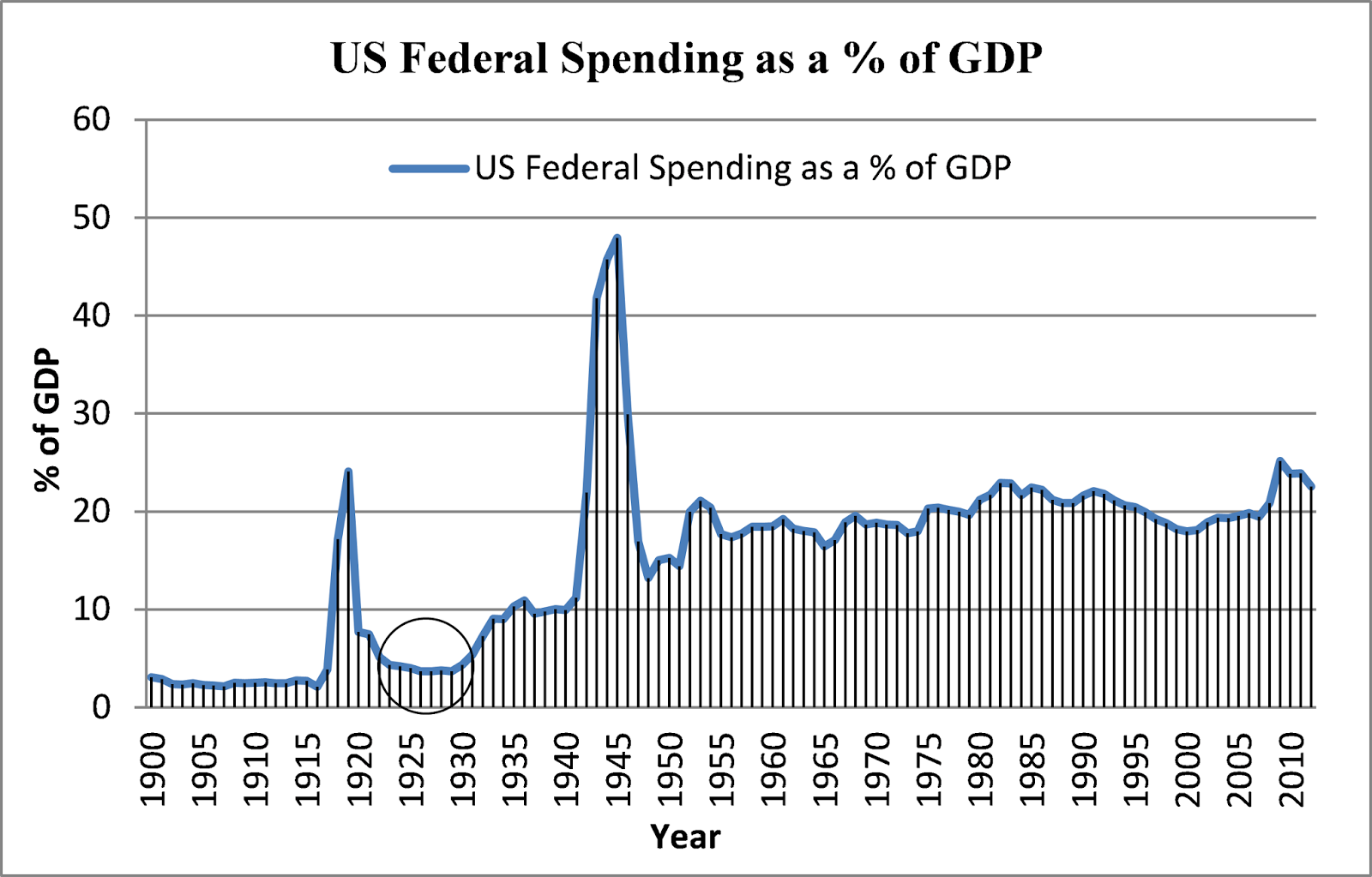
Excluding the world wars, US government spending was much lower during that period than it is today. It increased greatly with the New Deal in the 30s, and has continued to increase until the present day.
These are two different measures. It's entirely possible for governments to spend more money without building more infrastructure. Either by spending it on different things, or badly.
Can you really exclude the wars? Wasn't a huge amount industrial infrastructure built up during WWII, and then re-used at a lower capital cost basis by industry for future production?
>Very-low cost higher education was a thing in mid-20th-century America--it was possible to attend your in-state university for a few thousand bucks in today's dollars. What happened? As long as we pretend these things are too expensive to invest in, then we're sure to enter a long slow decline.
I don't think your point about education makes sense. You want more investment, but then bemoan the fact that it costs more, as if that signifies low investment. People are investing in their education at record levels!
Maybe you think student loans are a problem for other reasons, but they certainly aren't stopping people from going to college. Again, they're going in record numbers and spending record money to do so.
> People are investing in their education at record levels!
They are investing in formal qualifications. Certificates.
As Thiel points out, a university degree has transmogrified from "investment" to "insurance" to "tournament".
The reality is that the previous generation knows jack shit about the environment facing the current generation. Their 'common sense' can be thrown out nearly entirely with few exceptions. In today's environment most of them wouldn't stand a chance.
"Public investment in infrastructure sits at its lowest level since records have been kept because of underfunding across all levels of government."
And the lead into the second graph, which shows real-terms per-capita public investment is:
"On a per capita basis, real government spending on structures is the lowest it has been since at least 1950."
Given statements like that, I don't see how you can make the leap from "Spending on infrastructure is going up." to "The issue is not lack of investment, it's out of control costs."
That is the mood affiliation of the post - it is in fact the only position on infrastructure that is within the overton window.
But I'm citing the graphs, not the mood affiliation. The graphs show a large increase in spending on transit/water infrastructure and a large increase in costs.
There is also relatively flat per-capita government investment in structures (a broader category which includes buildings/similar things, and is not the typical power/transit/water cited by the parent).
Since 1992, federal spending (in real terms) on transportation/water infrastructure has doubled. State spending has increased by 2.5x. Population has increased 25%.
Maybe it's a red herring, but I always wonder how much infrastructure spending that would have gone into surface building (roads and bridges) has instead gone into subsurface building (deep underground military bases and the tunnels connecting them). Spending for the latter is buried in the black budget so actual numbers aren't available but it has to be huge and it's been going on for decades.
Getting educated in what? Corporate law, advertising and marketing, journalism, HR, French literature...
If most of these jobs are replaced by proper blue-collar occupations, we would see far more tangible results – most importantly, cheaper construction and housing.
It's difficult to make construction in the USA cheaper without greater acceptance of prefabrication and panelization in the residential sector and lowering of permitting costs.
Not to mention breaking public sector unions, eliminating "Buy American" provisions, and just generally removing all the unique things that no one else in the world does.
Delhi built phase 2 of her metro for $2.9B in 3 years (85 stations, 77 miles of track). NYC build Hudson Yards in 9 years for $2.5B (1 station, 1 mile of track).
Various tricks: Delhi didn't wildly overhire and overpay workers, they bought standard train cars/other equipment from Japanese and German corporations that have a proven record in supplying such things, and eliminated a bunch of red tape. It's almost as if Delhi built a metro with the goal of having a metro rather than with the goal of funneling money to MTA workers.
All the things you mention are true and important, but they're all second derivative. The first derivative to growth between 1870 and 1970 was cheap energy - primarily oil. What happened in the 70s? The oil embargos and drastic increases in prices. Since the 1970s whenever growth gets started, oil prices rise given the new demand which triggers recession which lowers demand and on and on.
Growth can continue when we develop new energy sources that are relatively inelastic to demand.
> Very-low cost higher education was a thing in mid-20th-century America--it was possible to attend your in-state university for a few thousand bucks in today's dollars.
I went to a state school in mid 2000's and paid around $1700/sem in-state tuition for full-time course load.
I also went to a 2 year school first and paid around the same.
When I transferred to a 4 year school the tuition doubled to a little over 3k. At the time I wasn't making anything waiting tables so I qualified for the Pell Grant. Graduated a few years older than usually graduates but with 0 student debt.
It's most definitely an option but most students are fine with Student debt. Many people I've met have student debt more than the first house I want to buy.
Whether obscure deals or aid make things possible today, I don't know. Put simply: today's students are not looking at the same options as those just a few years ago.
Thanks for the anecdotal data, glad to know there are still options. The overall stats in the chart may be skewed by the expensive institutions becoming that much more expensive, but still… my anecdote is that the regional state school I graduated from in 2004 (not a community college, but not a top-ranked place) is in the $5k-$6k range for 15-credit in-state semester today. And I checked that its below average for in-state tuition, all the state schools are in that range.
If your "transfer…" comment refers to community college, that's a smart financial decision but not exactly the topic of the post I was replying to.
Railroads were privately funded for the most part, same story with phone networks, same story with electricity. Universities and public education are debatable as to whether they actually fuel growth.
Our economy depends on growth, and I think this will cause lots of problems.
I saw a quote by a US congressman blaming young people today for our financial problems because many of them are unwilling to put themselves into debt for homes, cars, etc. An outrageous statement, blaming people for doing what they believe to be in their own self interest.
If the value of production mostly stayed with the people and local businesses then I can imagine our society thriving with minimal growth.
In my opinion, the requirement for growth to keep the financial sector going is like a cancer. Wall Street, central banks, etc. grow in power and consume more of the productive segments of society like a cancer.
You buy a stock, create a company, build a house, because you expect it to increase in value and be a worthwhile investment. If growth stops it will be increasingly hard to do this, because all stocks that are still increasing in value will be bought up, until they cannot anymore. So you keep your money. Deflation. System collapse.
OK, that's a rough argument that needs fleshing out. Has the rigorous argument actually been made and is widely accepted by economists or is this just a meme that's accepted and repeated without much basis?
Adam Smith makes the argument well in A Wealth of Nations. Essentially, the only reason to invest is that you expect to earn something above on top of the risk. Then add that up over everybody in the system. They cannot all get something extra, unless there is growth. That growth is spread over everybody as return on investment. So, if there is no growth, then investment stops earning that extra, so there no point in investment, so nobody hires anybody or builds new machines.
Importantly, it's growth in total value, not growth in number of things. Hence, it's okay that growth is infinite without gobbling up the universe - we can always be better. Stuff can always be sexier.
Same goes for food, etc. my point was that not everything has to be for financial gain -- we have basic needs that are higher in the priority stack and will always be there.
About homes specifically - they have a life span too so they eventually have to be rebuilt or, as others have pointed out, maintained.
There has got to be some ways in which this basic economic assumption is wrong. Like with cars, I can buy a car and when I sell the car it will be worth much less. But I will buy that car anyways because I need a car.
Or for a business perspective, I buy a dairy cow as an investment, when I sell the cow it will be worth much less than what I bought it for, but I don't mind because the cow has provided a steady stream of milk based income over the years.
So in these ways at least, it doesn't seem like economic prosperity is always dependent on growth.
Maybe in some economic circumstances cash might be a better investment or worth more than my dairy cow, but such a circumstance can't last for long because supply and demand affect money too right - so if enough people get rid of their dairy cow for the cash, eventually that would decrease the supply of milk, increasing price which would put me and my milk business back on top again would it not?
Owning a new car seems like a good investment. You get a bit more car than when buying a used car plus you get a bit more status. When prices of cars drop and better means of transportation arrive you would just keep your cash and use an Uber for example.
With the cow I think the problem is that many people would buy a cow to fulfil the basic need so margins would be extremely thin. People would soon stop buying cows again.
I think this would be generally the case in such a situation: Everything would be a commodity and margins would approach zero. You need only very few people to produce commodities. The majority of the population would be unemployed.
This is not a bad outlook per se, my argument is just that our current system needs growth. We would have to gradually adjust the system once we realize that there is now way to create growth any more.
But surely people invest for "maintenance" purposes too, where nothing extra is expected. I invest in maintaining my house. I don't expect any "return" from that investment, besides the roof not collapsing.
Maintenance is obviously limited to the number of things maintained and cannot stop deflation, because costs will be approaching zero due to innovation and competition.
Edit: And you do expect a return. You maintain your house, because it has a value and rent costs money, so you have more house in the future if you maintain it now. Imagine a world were rent and the value of your house is approaching zero, would you maintain it? You would have more house if you just kept your money and rented a house.
Because you liquidate all your assets if there is deflation. No companies, no jobs, no food.
Edit: Obviously I am speaking in very extreme terms and ignoring the fact that there is a government acting and that not everything will happen instantly. These are just long-term forces.
You don't have to, it will be worth more next month. It would be stupid to invest into your retirement fund if cash is increasing in value faster, so you take the cash. It makes total sense individually, but when everybody does it, the system will collapse.
Yes, I can see why a deflationary shock can cause behaviour that is individually rational but destroys the economy in the long term. I do not see why there cannot be a steady state with no growth. Presumably if this is widely accepted by economists there must be a standard textbook reference that you can give me?
I am not an economist and would be interested in such a reference, too.
My guess is that as long as there is even tiny growth, central banks can react with negative interest rates/taxing cash. It will take quite a while until there is no growth at all on the whole world. I think even Western countries have room for growth by mandating green standards.
When less and less growth is possible any more, I imagine we would have to start socializing industries, which reached that point, so they are taken out of the equation. People would then get a basic income and use it to pay for state provided services, which would not deflate, because the state does not have to care about market prices, it can just regulate competition. I think the problem here is more to find the right time for it, not the solution itself.
As I understand it, such a thing is hypothetically possible. However, as long as populations grow and people want change in their lives, it is not desirable.
Then there would be growth. What we were debating was that we need growth, otherwise eventually the described things would happen.
That growth by population growth is not sustainable should be obvious, somebody in here made a good argument why this is true even if we populate the universe.
The problem with this argument is that it mixes global effects and personal effects.
A person could have an appealing investment - for example building a more attractive fruit shop, with better customer service - taking all the sales from the current fruit shop .
Here's an interesting theoretical argument that growth can't continue forever (not saying this applies now):
"[I]f energy became arbitrarily cheap, someone could buy all of it, and suddenly the activities that comprise the economy would grind to a halt. Food would stop arriving at the plate without energy for purchase, so people would pay attention to this. Someone would be willing to pay more for it. Everyone would. There will be a floor to how low energy prices can go as a fraction of GDP."
Well, it does. If there is a limit on how small X can be as a percentage of the total economy (because we value it), and the amount of X that can be produced is finite, this puts a limit on the size of the total economy.
My understanding is that our economic structure and model is based on the expectation of growth fueled by continuous innovation, growing efficiency, growing workers productivity; the pie grows, and the slices become bigger for everybody.
If (when?) that stops, we'll have to change our model. We already have big problems with the pies not getting bigger for a big part of the population.
"Most reviews have focused on the “fall” indicated in the title: the last hundred pages or so, in which Gordon predicts that the future won’t live up to the past in terms of economic growth. I strongly disagree with him on that point, as I discuss below. But I did find his historical analysis, which makes up the bulk of the book, utterly fascinating"
Something I've always tried to understand is the value of these digital things. How much would it cost, in 1970, to have a library of all the worlds music? Today it's 10 bucks a month.
How much value do we put on information? What is the value of the bits of information that make up the Wikipedia page "Smallpox vaccine"? How about in 1960? Can you even put a dollar value on it?
The answer is these things have an immense amount of value. To even say the value of technology an average person accesses today is double that of 1970 is wrong, it is a lot more than that. Much or even most of that value is underutilized.
I think a combination of the following lead to a completely perverted understanding of money:
- politicalization of economics
- the reflexive nature of markets
- the tendency of both academics and professionals to seek the assignment of natural laws to market behavior
- time lags in the market making it take years or even decades to discover something was worth a lot less than the amount invested
Fundamentally money is just meant to be a way to account for limited resources between trading parties. If the trading parties are doing something destructive, money doesn't know that. I've also used the analogy before that the trying to measure things in prices as money supply changes is also like trying to use a yard stick which changes in size frequently. Simple if you have some metrics from the central bank, but actually not so simple because of all the complex moving missing pieces (including what other currencies are doing.)
The real global fear factor right now is that a great deal of institutions and individuals have a strong interest in inflation rather than deflation. These are groups whose future is based on prices for things largely going one direction, up. If you earn a living by spending borrowed money -- or being paid by earned interest -- you need this.
A lot of people thrive in situations where someone can hand them a blueprint of what to do along with a bunch of money. They follow it, copy, and get the output. That is largely what current growth numbers measure.
The reality is, of course, everything can't grow forever. That isn't a bad thing.
What I think is the greatest concern right now, the greatest danger, is not 1% global growth or even -1%. Instead, it is how nation states decide to react to slow growth. Quite a few are trying to finance their way out. Others may attempt to do disruptive things such as wars. I think we are more than a decade in to these reactions, by the way.
If fossil fuels are as dangerous as we think, a global slow down or contraction may end up saving us. Right now the countries which are growing are still copy and pasting their way to a pretty non-sustainable future.
There is another situation where real growth is negative but available money supply is increasing and prices are going up. That is very painful to be in, but a real future possible outcome.
There is an industry that directly prices information, but it's not music or Wikipedia. In fact it's not very popular. It's the finance industry. Financial instruments are made of information, and their value changes directly in response to new information.
Also, can I just point out that a library of all the world's music is definitely not available for $10 a month? For $10 a month you get access mostly to the western popular music whose labels have done deals with that particular streaming service. Big difference, usually.
Thomas Piketty is so important about this because he shows how exceptional America was in that it had plentiful capital in terms of land, so that labor was unusually valuable vs capital when compared to Europe. It shapes American's thinking in a positive way, but we need to acknowledge things have changed. Formerly, almost anyone who was willing to work hard and take a risk could build a homestead. Now the conditions for opportunity are available but more restricted.
With respect to Piketty, the industries in which the U.S. is a world leader today include finance, entertainment, software, pharmaceuticals, and industrial equipment. None of these depend on the availability of land or other physical capital.
That is totally orthogonal to his point. He isn't talking about what industries succeed. He is making that point that because land was relatively cheap, labor was relatively valuable.
> Now the conditions for opportunity are available but more restricted. <
Restricted, yet it beats rest of the world hands down in terms of opportunities.
When the rest of the world looks at America, they just see a nation which got lucky with land and capital. But the fact is, America had people before it was discovered by the Europeans, and there was no great civilization here unlike almost everywhere else in the world, which leads you to believe that maybe it isn't really all about the geography.
America is a plentiful place where individuals who wanted to achieve something (the 'American way of thinking') they arrived here. This still holds true, and will continue to hold true as long as this American way of thinking remains around.
That belief is widespread in America, but is unsupported by data. If you look at how hard it is for an American to rise out of the conditions they were born in, they're worse off than if they'd been born in (for example) France, Germany, Canada, or Denmark:
I didn't mean to disparage the U.S.A., just to share Piketty's point that it was particularly exceptional two hundred years ago because of reasons of geography and development.
Considering we live in an infinite universe I do not see why economic growth can not continue even accelerate.
Especially seeing that sometime this century we will get cheap space travel (getting there) and AI (getting there) and transition from fossil fuels to renewables and fusion (getting there)
Tho' yes seeing how some of our best and brightest are working on how to serve more ads and how to get people spend their free time locked in their walled garden...
I also think that we underestimate the amount of unused resources that we haven't tapped into yet (e.g. planets in our solar systems) and the resources that we might not even know about yet (e.g. new forms of matter or "new" laws of physics). Also, it seems likely that paradigm-shifting technological breakthroughs will continue pushing the boundaries of our growth further out. An interesting read in that respect is "Thinking in Systems" by Donella Meadows. In the 60s and 70s, the systems thinking approach outlined in the book also predicted that our planet would soon hit it's "carrying capacity" and further growth would be stunted. A major reason this didn't happen was (IMHO) the rate of technological change, which moved the carrying capacity of the planet well beyond what would've been possible 30 years ago. The same processes that were at work then are still at work today and constantly change the technological background against which we make our assertions, which makes systemic estimates of macro-economic systems a very tricky business.
As they say, the stone age didn't end because of the lack of stones ;)
Starting with 7.4 billion people in 2016 and a population growth rate of 1 % per year we will reach the carrying capacity of Earth in less than 1400 years - the body heat alone will raise the surface temperature above the boiling point of water.
Once we reach the carrying capacity of Earth - no matter when that is - and decide to move into space we have 2685 more years until we run out of places to live in the Milky Way assuming 400 billion stars and one Earth-like colonizable planet per star.
Unfortunately 2685 years is not nearly enough time to reach all the stars in the Milky Way even if you would be traveling at the speed of light, you could cross just about 2 % in that time.
There are very real limits to the possible growth and we are talking about centuries or a few millennia. With a growth rate of 0.1 % per year one can push that to tens of millennia but that is still the blink of an eye in the grand scheme of things. And while I used population growth, things of course don't change if you substitute energy consumption per capita.
It is very unlikely the population of earth will continue to grow at 1%. In the best scenario, we will have worldwide development followed by a fall in fertility that it inevitably brings. In the more morbid ones, climate change, wars etc. will result in a large amount of the population getting destroyed.
My assumption is that all economic growth has some component that is based on matter and energy. Even if it's just firing of a neuron inside consumers head.
If that assumption holds, growth is limited by matter and energy. Assuming that you consume all matter and energy and leave behind maximum entropy (thermal radiation) the growth is limited by the area of an expanding sphere.
Unless the wealthy somehow manage to consume all the excess production the average can't buy because they're too poor, wealth will have a hard time increasing without general economic growth. There is a pretty hard limit on how much even the most ostentatious trillionaire can consume.
We are on a course for a confluence of some major technologies this century which could result in another great leap forward.
Anyways i forgot why i dont bother to reply much on this site, got down voted for my above comment yet no indication as to why (is it my comment about working on advertising? its ok that's what I work in too myself have to pay bills somehow, but would rather do something more interesting).
The observable universe is very much finite. (And if speed of light is a barrier, than the observable universe is about the biggest thing we can ever influence.)
Sure, there will be lots of nice technology coming over the next century. No doubts about that.
Lets assume we develop technology to travel at near light speeds and go mad colonising the universe, what exactly contains us to the observable universe, move 4 light years in another direction and your observable horizon shifts
Because we haven't gotten a way to get fuel outside earth yet (that I know of), or a solution to long travel times. As such we are practically still bound to earth, which is finite.
If we're willing to deal with the (technologically but not politically manageable) consequences, nuclear rockets are a proven technology and can reach most of the solar system within a year's traveling time.
By definition, growth is unsustainable in the long term.
GDP growth is totally, completely correlated to energy consumption. In the future, energy availability will at best plateau, or more probably decline. GDP growth then will be a blip in a long trend of stability, and steep decline is ahead to fall back to a sustainable level (i.e. entirely from renewable resources, as it was for the past millions of years).
Freakonomics made a good podcast with the author of this book regarding this topic [1]. I can't say I agree with it, but it's an interesting listen nonetheless.
Maybe growth has slowed, not because of an inherent limit of technology, but because we just don't have problems as big as our great-grandparents. The biggest enemy we have left is ourselves. We crave attention more, overeat, and look forward to a retirement where our minds waste away.
There are some exciting advances we need to extend the modern world to all of humanity without destroying the planet. But for those of us already living with the best humanity has to offer, our biggest limitation is ourselves.
I keep trying to come up with a reason for how recent advances are improving our lives without increasing GDP. Does anyone have a compelling one? Things like wikipedia are valuable and don't contribute to GDP. But then shouldn't people be happier than 20 years ago?
>I keep trying to come up with a reason for how recent advances are improving our lives without increasing GDP. Does anyone have a compelling one?
GDP/GNP is not a measurement of happiness or standard of living.
>Gross National Product counts air pollution and cigarette advertising, and ambulances to clear our highways of carnage. It counts special locks for our doors and the jails for the people who break them. It counts the destruction of the redwood and the loss of our natural wonder in chaotic sprawl. It counts napalm and counts nuclear warheads and armored cars for the police to fight the riots in our cities. It counts Whitman's rifle and Speck's knife, and the television programs which glorify violence in order to sell toys to our children. Yet the gross national product does not allow for the health of our children, the quality of their education or the joy of their play. It does not include the beauty of our poetry or the strength of our marriages, the intelligence of our public debate or the integrity of our public officials. It measures neither our wit nor our courage, neither our wisdom nor our learning, neither our compassion nor our devotion to our country, it measures everything in short, except that which makes life worthwhile. And it can tell us everything about America except why we are proud that we are Americans.
-RFK, Speech at the University of Kansas at Lawrence (18 March 1968)
>> But then shouldn't people be happier than 20 years ago?
A few years ago there was a survey among the amish, and it appears that they are as happy as modern day billionaires.
On the other hand, another survey have shown a decrease of 20% ! in empathy among college students, between 2000-2010. And it have probably became worse since than. And empathy is core to so many critical things.
But when you don't aim society at nothing meaningful, just more money, what do you expect to get ?
Growth and progress are dehumanised meaningless terms when divorced from quality of life of all citizens on earth. You can have massive unsustainable growth that only filters to the top percentages and destroys the environment. This is quasi feudalism.
Currently we seem to have an economic system whose sole purpose seems to make a few wealthy. Any technological, social and political progress is a side effect to sustain the primary purpose of wealth for a few, and should any of the side effects come in the way of the primary purpose it will be quashed, which seems a tad uncivilised. These billions are just a social number more than anything else, and do not do anything meaningful, apart from affording power, privilege to sustain an inherently exploitative cycle with serious environmental consequences.
Capitalism by its very nature can only reward the top percentages, the moment demand rises with scarce resources prices rise too, leaving a small exclusive group with disproportionate wealth and power always in control.
The market cannot decide anything without heavy constraints, and will take us quickly to a gridlock. In a non functioning traffic intersection, humans will always act not in enlightened self interest or common interest but short term immediate self interest which is neither good for them, everyone else or their environment, evidenced in the ensuing gridlock that will leave everyone including themselves stranded. Yet we set up a system that rewards this uncivilised base individual behavior to get ahead at all costs nevermind anything else. If low cost drives choices it only means the market will rush to exploitation and plunder without constraining rules. If someone is plundering the environment or using slaves an informed choice can only happen if the consumers know about it, cares about it and by the time this happens irreversible damage to the environment or social structure may already be done. Power could ensure information is not available, propaganda or lack of choice for alternatives. Capitalism cannot deliver an egalitarian enlightened sustainable society and is not designed to, only promise to while the small elite control the cycle.
Currently the elite will always support the system out of self interest nevermind the consequences for everyone else or the environment while others seek a way to break into the club or an alternative way. This is inherently unstable and will lead to periodic purges or paranoia and control of the population. Like the old quote goes there is enough for everyone's need but not for their greed.
This. Finally. People on HN think that startups, technology and economic growth have unlimited potential. This is pure stupidity at its finest. Observations of the natural world show a general trend: that everything, from physical resources to energy has limits. It is a mistake to believe that this general observation does not apply to technology and the human imagination.
While we can comprehend what a limit in oil production is... we simply cannot comprehend exactly where or what a limit to the human imagination or technology is... This leads to a false illusion that there is no limit... The reality is: An inability to comprehend something does not lend any evidence to the idea that human potential is unlimited. Like science, true understanding comes from observations of the natural world and as all things observed in the natural world... it is far more likely for humanity to eventually reach a limit in technology.
Whether that limit is among us is debateable. Computing has shown dramatic improvements in the past decade but outside of having an app for everything in my phone, nothing has really changed in the past two decades.
The comparison you make with the natural world is interesting. If you consider natural systems to be innovators in the space of making new organisms then what have we seen?
First, there were eras of explosive growth into new areas - for example, the first organisms to be able to live on land had a huge new area to grow on. Although the Cambrian 'explosion' may not be as rapid as once thought, the diversity of body plans when multicellularity was invented shows what can happen in moving into a new area.
So the current technological era might be a lot like modern biology - there's never going to be a repeat of the discovery of how to use oxygen, but species will live and die as before. Except of course for humans.
Confusingly here, the metaphor catches up with reality - humans as organisms have become humans as technological innovators, which has the potential for unlimited changes to biology. We could wipe out nearly all life, we could make endless new variants of existing or imagined organisms.
Finally, there's intelligence which got us here. If we succeed in making a truly artificial intelligence, then that could explore the limits of what intelligence can do. Perhaps there are even limits to that - certainly there are physical constraints - but we're not at that limit quite yet.
This is some of the shallowest, most misleading insight I've ever read.
"Human achievement will probably reach a limit at some point" is effectively an empty statement. Even if you could take its truth for granted, it is completely useless information.
There is zero actionable difference between a limit that doesn't exist, and a limit that is unknowable and unguessable. Your behaviour should stay exactly the same either way - i.e. try to achieve as much as you can - until that limit becomes known or guessable in some way.
(This argument is basically a very slight variation on Russell's teapot.)
I think the strongly worded logic in your post is questionable.
> There is zero actionable difference between a limit that doesn't exist, and a limit that is unknowable and unguessable.
Thought experiment:
Situation 1: I rely on a single food source, which I know is unlimited.
Situation 2: I rely on a single food source, which I'm not sure is unlimited, but I can't guess when it'll run out.
> Your behaviour should stay exactly the same either way, until that limit becomes known or guessable in some way
Really? Because if I was in situation 2, I would be preparing a contingency. Trying to find another food source. By the time the limit of my current source became knowable, it might be too late and I would starve. The right time to prepare is from a position of strength.
That's an actionable difference - do you think this is a valid counterexample to your logic? Or is something not appropriate?
Yes, I was referring to the subject at hand - human achievement / technology / innovation - not making a universal statement about everything that may have limits.
But I can see how my post could read that way. I'll make that clearer.
Your argument applies to science fiction and other works that make grand speculations about the future. The future is not knowable thus it is useless and misleading to speculate according to your argument. Your counter argument is far more shallow and misleading.
Our progress towards the future happens regardless of a limit. So why write science fiction? Why write fiction at all? Because we're human. I speculate, therefore I am.
Either way your argument doesn't address the heart of the matter. Is my speculation correct? Or is it incorrect? You have failed to logically address this argument. On the other hand I have only said that one outcome is far more likely than the other, I have not been definitive about it either.
The simple logical flaw in GP's argumentation is that it summarizes rather abstract phenomena (human inventions, potential of startups) to compare it against concrete, limited phenomena (oil production). To make that jump, that assumption would have to be proven.
It is only seemingly a flaw. Concrete phenomena and abstract phenomena are in fact the same thing. For abstract phenomena to even exist they must be concrete and thus limited by the concreteness of the physical world.
> Computing has shown dramatic improvements in the past decade but outside of having an app for everything in my phone, nothing has really changed in the past two decades.
If you exclude making the Internet accessible to hundreds of millions of people, critical improvements in AI and robotics, and all the other stuff about which computer scientists write thousands of papers each year, then yes, nothing much has changed.
Oh, there are some very simple adjustments we could make right now (without even any new technology) to get a great amount of real growth. Just open some pretty standard economics textbooks:
On the demand side: target nominal GDP to all but eliminate recessions. (Or at least target the long term growth of the price level instead of letting bygones be bygones.)
On the supply side: completely shift the tax burden from labour and capital onto land. Remove barriers to free trade. Review and simplify economic regulations---start with silly zoning laws perhaps. Lower barriers to entry in most industries. Invest in public infrastructure and education. Cut stupid spending, and the most distorting taxes.
(Land taxes can probably even yield enough to pay for a lavish social welfare system. They will definitely recoup all sane investment in public infrastructure. Without distorting the economy even one bit.)
Of course the problem is that all these reforms are politically infeasible.
There might be a technological limit to real growth, of course, but we are far from it.
Why not keep them and invest in remote working instead of packing even more people in major cities. You probably work most of your time with remote people anyway and tech is definitively there.
Also it is a lot easier to organise plenty of small towns (think hospital, school, road infrastructure, ...) rather than a megacity where you can have literally thousands of people per block.
Let the people who want to be packed live in major cities. Than we have more space left over for people who prefer sparser living.
Singapore and Hong Kong seems pretty well organised. Even other big cities like New York seem to work reasonably well on an organisational level. Hospitals, schools, road infrastructure are more efficient with shorter distances and diversified over more people's demand.
This sort of dystopian hand-wringing seems to have a certain cachet aomong some crowds, but seems to mostly stem from profound ignorance and a failure of the same imagination you find so limited. What makes humans different than all of the other parts of the natural world is that same imagination and technology that you seem to fundementally misunderstand. We can change our environment, and more importantly we can change the scope of the environment: if the resources of a small area are insufficient we can bring in more, if the resources of an entire planet are insufficient to meet our imagination we can dream bigger and actually execute on those dreams.
Imagination itself is only limited by our technological progress and there are few limits beyond physics itself to stop us there. Two centuries ago our dreams were merely to fly like birds or travel swifter than horses, now we can dream of travel among the stars. Imagine what we will dream of in a century from now.
>Imagination itself is only limited by our technological progress and there are few limits beyond physics itself to stop us there.
What is the difference between the natural world and physics? I would argue that there is no difference. I use the language "natural world" as a synonym for "the nature of existence" and "physics." I would assume that in your vernacular, the meaning is the same.
Thus your own statement above validates My argument. You state physics limits technology and technology limits the imagination. Thus in turn imagination is limited by physics. This is exactly my argument.
> Computing has shown dramatic improvements in the past decade but outside of having an app for everything in my phone, nothing has really changed in the past two decades.
I suspect this says more about your ignorance of other industries, than anything else. Modern pharmaceutical research or medical imaging would be impossible without powerful computing. CRISPR is impossible without powerful computing. Self-driving cars are impossible without powerful computing.
Heck, GE has an entire series of ads about the impact of computing on their industrial technologies like turbines, locomotives, etc., which mocks the "technology is just apps" mindset.
While it's definitely true that many a time certain crowds tend to have lost touch with reality regarding the potential of a specific activity (as illustrated in repeated economic bubbles), to say that economic growth is limited suggests that economy is in principle a zero sum game. I don't believe that to be the case. Any attempt to predict the absolute limits of economic potential is an attempt to limit the potential of creativity (and I'd say of reality itself). We are nowhere near understanding that potential and I assume we never will. Whether we will be able to continue to tap into that potential instead of self destructing is another question.
All observations point to limits and thus suggest that reality and therefore the economy is a zero sum game. You talk as if limiting reality doesn't make any sense when scientific observation describes a reality that is in fact limited.
Conservation of energy, conservation of mass, the speed of light, these are limits built into the fabric of existence.
I think it's a bit premature to conclude we have uncovered what the fabric of existence is made of. History has repeatedly shown we have no idea how much we don't know (just until recently we thought we understood more or less what the universe is made of and we now realise we understand less than 5% of it) and the reality keeps delivering surprises.
But just for the sake of the argument, let's suppose we do know how everything works. There's enough matter and energy out there to supply endless economic growth if creative minds continue to come up with ideas on how to leverage it.
Besides that, from a quick research, I see many economists with a much deeper understanding in economy then myself are convinced that economy isn't a zero sum game. This doesn't necessarily make it true, but I'd study their claims before dismissing it.
>I see many economists with a much deeper understanding in economy then myself are convinced that economy isn't a zero sum game.
These are idealized models. To simplify calculations. The sun will burn out in a billion years so one can assume in a model that it will never burn out.
The fact of the matter is, the economy runs on resources. Resources are limited. Thus the economy is limited.
"nothing has really changed in the past two decades"
If we discuss consumer products, then I would be willing to agree up to a point. Except, for example, we are finally getting electric cars that drive by themselves. This not just an improvement in computing. Geneticists just got crispr which means there will be an explosion in gene altered organisms.
I'm not sure what kind of big changes you are crawing - these do not reflect the state of the art in sciences but rather what products are manufactured and marketed for consumers. Two decades are actually a really short time for any sort of significant development in any field - although improvements tend to come in bursts.
Except that the technology itself can be used to create technology. That's the whole point. If we were talking about raw human creativity, we already surpassed that capability a long time ago. And it seems likely that we can get the technology to a place where it can improve itself with little enough human effort that growth can be kept up for longer than any of our life times.
Having technology recursively create technology does not lead to unlimited potential. Such infinite structures lead to stack overflow and do not exist in the natural world without limits.
But how many people actually think the potential is unlimited? Clearly there is a limit, but its likely far enough away from our current position that it doesn't particularly matter.
to add, I would say, the limits of human imagination are cognitive limits posed by the physical limits of our brains. Let's say cognitive biases, you can't completely unbias yourself. You could argue, that with coming technology, we can modify the biological basis (those limits), but just go more meta. We will have limits about how to modify those limits.
Limits are never reached, they are only approached asymptotically. Thus most people will never observe a limit in human innovation in their lifetimes, instead they will only observe an eternal slow down as innovation spends forever converging with the limit. This makes it impossible to prove (or disprove) that there is a limit to technology. One can only make an educated guess.
Have we reached the limits of human colonization? Are we approaching a limit? Mars may be possible, but it is an order of magnitude harder than colonizing the Americas. Colonizing the west happened only a couple years after Columbus discovered the new world. Mars was discovered 3 centuries ago... are we at a limit? How long will it take to colonize the nearest star?
Sounds like an interesting book. From the linked review, the main thesis that many improvements from 1870-1970 are one-time-only events seems sound. I also agree with the assessment that 'singularity' theories are hokum. (That may be more controversial here on HN!)
It does sound like he might underestimate the effects of the coming AI/robot revolution. Over the next 75 years, any job definable by its output may be taken over by a robot. What is left are service and creative occupations where the human presence and artistry is valued. But this will entail a huge economic upheaval.
The other giant quality-of-life advancement that might be out there is slowing or eliminating the effects of aging. That would also come with giant problems of inequality (if it is narrowly available) or population pressure (if it is widely available). But it would surely be another huge advancement for its beneficiaries.
Modern money is created by keystrokes[1]. We(the US) are no longer on the gold standard(a good thing). In order to have conditions for economic growth(say GDP growth) to occur aggregate income must increase. There are only two possible drivers: Government goes into debt or the private sector goes into debt where debt = spending more than ones income. If government policy makers were to use fiscal policy based economic models that paid closer attention to aggregate debt and aggregate income balances we could have much smoother business cycle and avoid deep recessions where the private sector wants to deleverage. The only thing to fear is inflation and we have never truly sniffed demand pull inflation in the US ever. The 80's was supply shock petroleum based inflation.
The Federal government needs to put its foot on the accelerator and not the brakes but the politicians don't know where the accelerator is.
There are many breakthroughs waiting to be made in medicine, energy production, geoengineering, space exploration, transportation, etc. Automation and AI will increase productivity and leisure time, which will allow the market for entertainment, travel, and luxury to grow much larger than today, and be accessible to many more people.
But if we succumb to this pessimism, it will be a self-fulfilling prophecy.
It seems to me that the amount of time people work stays broadly constant, but automation changes what is considered "work".
To a farm labourer from 500 years ago, sitting on factory production line attaching two parts together doesn't feel much like work.
To a production line worker from 100 years ago, sitting at a computer typing emails to people and going to meetings doesn't feel much like work.
To us today, sitting around while the 3D printers in your factory print whatever your AI engine says they should, doesn't feel much like work. But I have a feeling that future generations will get tired of constantly analysing their performance and adjusting parameters.
Isn't that his point? 500 years ago, nobody would be willing to hire Steven Hawking. Period. He simply isn't capable of doing anything resembling what they would have considered work, even with the use of the modern tools he uses to interact with the world. Today, however, he is able to be a completely productive member of society because the work we need to do is completely different – and the work we need to do 500 years from now will unlikely resemble much of what we do today.
Mostly because it's the gains from automation that goes to Wall Street and not Main Street. The idea that you or I could personally enjoy the benefits of automation beyond the trivial devices we buy (IoTs, Washers/Dryers, etc) frightens the capital owners because that means we too could be competition. We too could produce for our own needs and not their designs on our needs. Keeping us away from automation is as much important to the capital owners as them utilizing it to reduce labor inputs to grow their expected ROI. It's a strange situation I think Wall Street has found itself in. It needs automation but equally fears the outcome of it (where people just take automation away from them and care for themselves).
Most people under 40 can't afford a house in many western countries. Compared to 20 years ago, most people could (at least in the two countries I am familiar with - the UK or Spain).
The more, more, more does seem to wind up with fewer people.
I'm skeptical of the unaffordable housing arguments, though. People only talk about a handful of cities. At least in the US, there's plenty of cheap places to live. They just aren't trendy.
To keep discussion grounded. We should think this trough economic growth models. What model we use is not that important. You can use simple neoclassical Solow-Swan model as starting point and add more factors as you go.
Techno-optimists often argue naively that technological progress or increase in human capital works like magic without understanding how they dynamically interact with more basic factors of production like capital, output and labor.
>It took a couple of decades, but unemployment eventually fell to 4 percent, most people's standards of living actually rose, and greenhouse gas emissions decreased to well below Kyoto levels. The economy reached a "steady state." And if the model is accurate, then something like it, say some ecologically minded economists, may be the only way for humanity to survive in the long term.




But today, we've forgotten the formula. Education funding is falling, basic maintenance isn't being performed on much of the infrastructure, and we aren't investing enough in the new things that can provide growth for the next hundred years. High-speed and light rail could help address the limits of airport and highway capacity, and provide better mobility in and between cities. Investing in clean electricity generation, a national power network, and improved battery technology could revolutionize how our homes and cars get their power. Very-low cost higher education was a thing in mid-20th-century America--it was possible to attend your in-state university for a few thousand bucks in today's dollars. What happened? As long as we pretend these things are too expensive to invest in, then we're sure to enter a long slow decline.