This is like the old trick of auctioning off a $20 note with the twist that the two highest bidders must both pay even if they end up losing. I saw this play out in a Negotiation 101 tutorial once, for real money, and the bid got up to $40 or so before one person finally bailed (i.e. around $80 spent on a $20 note).
It's a game of chicken. The earlier bids are a sunk cost. You hope you can spend an extra $1 to win the $20.
Sounds insane to even start bidding, right? But then you see things like this play out all the time in the market. For example, the war between Blu-Ray and HD-DVD had a very similar dynamic.
Yep. Very similar patterns show up in the decision making and politics that drive the deadliest wars as well. Apparently it is very easy for both sides to convince themselves that they are made of tougher stuff than their enemies and that if they can just bear down and take the losses they'll come out on top.
3] More lethal wars last longer: Richardson, 1960, p. 130; Wilkinson, 1980, pp. 20–30.
4] Weber’s Law for perceived deaths: Richardson, 1960, p. 11.
And a couple of relevant quotes:
> In these simulations, the destructiveness of a war depends mainly on the territorial size of the combatants and their alliances. But in the real world, variations in destructiveness also depend on the resolve of the two parties to keep a war going, with each hoping that the other will collapse first. Some of the bloodiest conflicts in modern history, such as the American Civil War, World War I, the Vietnam War, and the Iran-Iraq War, were wars of attrition, where both sides kept shoveling men and matériel into the maw of the war machine hoping that the other side would exhaust itself first.
...
> I already mentioned some evidence from Richardson’s dataset which suggests that combatants do fight longer when a war is more lethal: small wars show a higher probability of coming to an end with each succeeding year than do large wars. The magnitude numbers in the Correlates of War Dataset also show signs of escalating commitment: wars that are longer in duration are not just costlier in fatalities; they are costlier than one would expect from their durations alone. If we pop back from the statistics of war to the conduct of actual wars, we can see the mechanism at work. Many of the bloodiest wars in history owe their destructiveness to leaders on one or both sides pursuing a blatantly irrational loss-aversion strategy. Hitler fought the last months of World War II with a maniacal fury well past the point when defeat was all but certain, as did Japan. Lyndon Johnson’s repeated escalations of the Vietnam War inspired a protest song that has served as a summary of people’s understanding of that destructive war: “We were waist-deep in the Big Muddy; The big fool said to push on.”
From your own citation:
"with each hoping that the other will collapse first"
This in no way demonstrates a belief that both sides thing they are made of tougher stuff. In fact, it says explicitly that both sides are "hoping" that the other side "collapses first". This is in no way indicative of any self value of positive strength and thus a premise of your argument is false. Therefore you conclusion is false. If you would like to submit another attempt at providing reasonable evidence to back up your claims, I'm more than happy to review them.
This subject is one of my (very amateur) interests so I'd be happy to, but I don't think I understand our point of disagreement. Would you mind expanding on it or rephrasing it? Is it the difference between belief in one's own side's strength and hope in the other side's frailty?
It's simply in the rules that you must pay if you're high bidder #2, even if you pull out.
Basically, it will immediately devolve into the two highest bidders each bidding over each other, in an attempt to not be the one who has to pay money and get nothing at all in return. At some point, one will have to take the fall and accept that they've lost money with nothing to show, and the other will also have lost money, just slightly less. Both people lose.
Everyone else sits there happy that they avoided being one of the two highest bidders.
In the penny auctions, however, you can have multiple people who have spend hundreds or thousands of dollars on this stupid auction, who all hope that at least if they win, they'll get something in return for their losses.
Unless you try it with a group familiar with game theory, when one person says "You and I bid one and two cents, and everyone else shut up and don't bid, and we all split the $19.97 profit evenly."
Story time: A couple of friends and me played on a competitive Minecraft server for a while. You could form factions, build protected bases and compete on various player vs player events. The last part didn't interest us at all, since we were all a bit older and went there to relax after work. So we did all kinds of other creative things like automated shops using redstone. The server also had an in-game currency which you could only obtain by mining. One day we got the idea to do a penny auction to finance the expansion of our protected area. So I quickly put together a Flask based site that parsed the Minecraft client chat log in realtime. Other players would send me in-game money which would result in a chat message my locally running python script would pick up. Everyone could then see the auction happening in realtime on the website (Example screenshot: http://i.imgur.com/yg2V3iS.png). It was really successful, everyone had fun and hopefully learned that you should never bid on penny actions :-)
I worked for one of the biggest penny auction sites. I'll address some things in this thread.
One key thing the author left out was "free bids". You can win auctions that give you bids. So, for instance, you spend 10 bids and get lucky and win a 2500 bid pack. When bidding on the auction, an outside observer can't tell if you're using a bid you paid for or a "free bid" you won on the site or gained in some other mean (some auctions may be a product + free bids). So while it looked like the guy spent $3,500, he may have only spent $100 of his own real money.
Some sites even stop you from spending over the retail value of the site. The one I worked for let you buy the item if you spent bids that equaled the retail value. And we were fair with the retail value of items. We had people whose job it was to source products so we could afford to sell items at retail. If you lost the auction, you could also pay the difference between the value of your bids and the retail price and buy the item that way. So if the item was $150, and you spent $100 in bids but lost, you could pay $50 and get the item anyway.
Yes, some of these sites use bots. You can buy pre-built penny auctions sites and you will see they contain bots. The site I worked for never used bots while I worked there. I'd be surprised if any of the bigger sites use bots, as it's not needed and can be pretty obvious to detect with basic statistics. And you definitely have a certain type of person on this site who is running statistics and trying to beat the game.
These sites can actually be used to find a good deal, if they offer the retail option I mentioned above. Imagine you plan on buying a 65" TV. You try out a penny auction site and win it for $100, or end up having to pay retail for it anyway. The main loss would be paying shipping, which admittedly for a TV would be a lot. Personally, I never used one of these sites. It's just too stressful and slow for me (auctions can last for hours).
You keep telling yourself that they are in any way ethical. They are not.
Letting people get it "if they spend the retail value" is hardly generous or benevolent. Other people will have also spent a bunch of money, and if you haven't already spent a ton of money and the total spent on the auction will be outrageous. Never mind that if you don't spend the retail amount, you're just out money for nothing.
Unlike a legitimate auction site where if you don't win the auction you don't spend anything.
I'm a little confused by your last paragraph. You seem to be presenting the "good" penny auction sites as if there are two possible outcomes: a very good deal, or retail price. But isn't the most likely outcome that you bid and get nothing?
For the average person, yes. I was speaking in consideration of the HN audience. Rather, people with enough intelligence to know what they are getting into and how they might take advantage of it.
But most people are curious, try it out, lose some money, and quit.
This kinda sounds like the old tradition of dicing for double or nothing over purchases (though whether it's only a tradition in novels I don't actually know) - except with the addition of people who can't afford the original purchase price as extra suckers to help add to the house advantage/profit margin.
Not sure I'm entirely fond of the idea but it just seems like yet another borderline form of gambling to me, and no morally worse than the rest.
Not sure I'm entirely fond of the idea, either. Luckily the place I worked for was led by good people that actually wanted the users to have fun, and not just take their money.
However, it definitely feels more like gambling than a fair or straight auction to me.
Similarly, I once also looked into such a site, collecting data from on-going auctions. While the interface showed very little information about the bidders, the underlying JSON data carrying the real-time bids had addition fields such as user ID.
I remember that while my user ID, along with other players that seemed human (i.e few and far between bids) had user ids that were 2000+, there were several users, that bid thousands of times, sometimes for 16 hours straight (there was no auto-bid option), all of which had a user ID of 1000-1010...
If one bidder spent more than $3500 in bids for that tablet, it's either a shill account or a credit card scammer. Neither one is particularly surprising with sites like this.
Exactly right. Most of these sites have automated scripts that keep the bidding going until the item has received enough paid bids to be profitable before they allow the auction to end. Many others don't actually deliver anything at all - the script ensures that all items eventually go to shill accounts, and all revenue from bids goes straight to the bottom line. I know of one such site that sold for more than $35K on Flippa.
I wouldn't mention the site publicly, and it wouldn't do much good anyway because there are literally hundreds of them that do this. There was a template floating around several blackhat marketing forums for a while with this functionality built in (the Flippa site I mentioned was based on this template).
I'll give you a whitelist instead of a blacklist. Unless you're seeing expensive, national ad campaigns from a given penny auction site and they are based in the US, more likely than not, there are no actual goods to be won. Even then, many use shill accounts to keep the bidding going until the item has reached the desired profitability from real, paid bids.
He's bidding penny by penny, so once he's at $180 (the cost of the tablet) he's not getting them back. So he might be thinking "OK, it's more expensive that in a shop but the $180 being lost already I might as well put one more penny. Then one more. Then one more." etc.
Basically, many people prefer to make a bad deal, or take an otherwise bad decision than recognizing that they just wasted money for nothing.
That's not obviously the sunk cost fallacy. The $180 is gone, the only relevant question is "how much more do I have to put in before I win?"
If you think that amount is more than $180 and you continue to play, because you've already spent $180, that's the sunk cost fallacy.
If you think that amount is less than $180, continuing to play is (to a first approximation) the correct decision. You can either get a tablet for less than $180 here, or for $180 in a shop; also, you've just burned $180. If you were to stop playing, in order to avoid committing the sunk cost fallacy, that would be the sunk cost fallacy fallacy.
It seems likely to me that the mistake being made, after spending $180, is the same mistake that causes people to start playing in the first place. (I couldn't say precisely what mistake that is.)
You're right, except in the case that someone who has spent >$180 in bids so far might actually realize what a horrible scam this is, and might see that it would be irrational for a person to start bidding at this point, and yet chose to go on because they've already spent $180 and want to at least get something in return for it.
In this case, the sunk cost fallacy is what would drive them to keep going, even once they've realized what a terrible trap this "auction" is.
There's a lot more to these sites than this article goes into. I'll say right up front; these sites are total scams who target poor people who usually have a poor understanding of economics, statistics and math.
One of the features of these sites is that they will put up credits on the site as an item for bid. So the person who spent "$3500" bidding might have won a "10,000 site credit" auction at some point for $190.00 "winning bid" where a bunch of people actually spent "$50,000" on it. Which in turn might have had some site credits involved, etc.
These sites have been around for a while now and the fact that they've never been regulated is a great sign of how dysfunctional our government is and its inability to protect poor people from being ripped off.
Conversely it shows that we need to protect ourselves and not depend on a government to keep us safe... And no matter how many laws are made, scammers will always be 1 step ahead.
It is in our best interest to keep as many people safe as is possible. Society as a whole is better when there isn't an underclass perpetually exploited and predated on by others.
I could also be argued that education is the best way to keep them safe. Unfortunatly, most people (myself included) don't like to hear that what they are doing is retarded.
You should sometime in your life learn "If it's too good to be true, it probably is".
See a $180 tablet for $18? Assume it is a massive scam. Only after a TON of googling and talking to people should you even consider it, but even then, it is too good to be possible and you should just skip it. Either save the $180 to buy the real thing, or don't have one.
So many scams are not possible of the end user is not greedy. Nigerian Prince, etc. etc.
> If they are so stupid to spend my taxes on greedy scams like this
Then our society has collectively failed in educating them. We could just let everyone fend for themselves and eat the weakest, but I don't mind my time and money directory or indirectly going towards helping others. Call it altruism.
No, but we're not going to get anywhere just calling them lazy and telling them to make themselves smarter. There's no point in condemning them and then turning around and doing nothing to help them. What does that accomplish?
There's plenty done to help them. Most of them just don't want it. They prefer to buy lotto tickets, bad food and watch TV and in their spare time, fall for greedy scams like this one.
You can forcefully take something from a person, you can never forcefully give them anything. Stop with the delusions.
Poverty as we know it today was created the instant money came into existence.
The only way for a tiny group of people to become obscenely rich is for huge masses of others to be kept chronically poor.
Darwinian evolution only explains the propagation or elimination of random genetic mutations via sexual reproduction.
It does not explain economic/memetic evolution. Ideas can be created by one person working alone, or millions working in concert, even asynchronously, where someone might synthesize a line from the epic of Gilgamesh with a line by an 18th century poet, a drawing from a 19th century industrialist, and an article by a 20th century biologist, to create something useful to a 21st century customer.
As humans now employ that mode of development, we do not need to produce offspring to test the fitness of a new strategy. It is actually in our best interest to throw every conceivable idea at the wall to see what sticks, yet still preserve every failed idea on the off chance that it could be made to work under different circumstances.
We use specialist economics now. Every person, no matter how fit, can still advance human society as a whole by exclusively doing the one thing they are best at, and trading for everything else. The only limiting factor is the cost of keeping a human body healthy enough to perform useful labor. Because of that, the endpoint of specialist economics is single-purpose machines performing all labor, and humans inventing new labors for the machines to perform.
Stephen Hawking is fit enough by genetic evolutionary standards to have three children. But by memetic evolution, he has thousands of students that have read his work, and millions who know just a bit more about the universe--and black holes in particular--as a result of it. Without the support assistance of human civilization, he would have died long ago. It was in our best interest to hook him up to whatever machines were necessary to let him do the one thing that he could still do best: think.
Therefore, there are no unfit organisms to be culled in a civilization of generalists who may reprogram themselves into specialists. Every living human can dream up something new and unique that can be done. But our knowledge and creative capacity is finite. Every moment of effort spent solving and re-solving the problems of human necessities cannot also be spent dreaming up ideas not immediately relevant to survival or happiness and researching them into reality.
If we had more people allowed to dream and do, instead of pressing their faces to the grindstone, we would have more impossible dreams coming true. And some of those dreams will coincidentally benefit the Darwinian fitness of all Earth species, because they will become multiplanetary species.
This is why Social Darwinism is crap. We have not only horizontal meme transfer, but vertical as well, from written records. Every new idea may be combined with any, all, or none of the old ideas. This creates a combinatorial explosion of possibilities, where the unfit ideas must be culled, not the unfit thinkers. This means that it is in society's best interest to debunk lies, unravel obfuscations, and aggressively destroy deceptions as early as they may be detected, lest they become an immortal influence on all ideas that will follow.
In this way, the device doesn't even have to exist.
What you're really doing, then, is creating a simulated auction viewing experience which participants can watch or participate in. If a real person actually ends up buying something, you just go out and purchase it on Amazon and ship it to them.
Amazing that this isn't considered a scam by the authorities.
> Amazing that this isn't considered a scam by the authorities.
Enforcement in this area is largely complaint driven, and the target market for these sites is, I gather, generally not the most aware of their rights and likely to complain.
And, the sites may have favorable internal dispute resolution processes that assure that the kind of people that would complain are kept happy, so that complaints to government authorities don't happen.
It's still a valid article to analyze the site and point out that even if everything they're showing is true, it's still a scam. Since the best possible case is still "stay the heck away from these things", it can only get worse from there once you start mixing in outright fraud.
True, however, it does give an indication of potential losses (even if it's an order of magnitude smaller), compared to just going out and buying the thing :-/
Poker and sports betting are considered gambling despite being sufficiently complicated processes st. a small minority of participants achieve regular profits against virtually any field. I would be happy to bankroll Phil Ivey to play poker Tony Bloom to bet on football.
Lowest-bid auction:
"In a lowest bid wins the auction it alone in having placed the lowest bid and not the one who placed the highest bid. In this way, it is largely a matter of chance decides who wins. We therefore believe that the lowest bid auctions are a lottery and not an auction."
Penny auction:
"In our opinion this is not a lottery in the legal sense, because it is the highest bid within a certain time "wins". It is not chance that determines who gets the goods. In this way, a penny auction works the same way as a normal auction."
(Google Translate, may do a proper translation later.)
I remember a game circa 1980s called Inside Trader, a stock market "simulation". There were a bunch of fake stocks that fluctuated in value randomly, and one could choose to trade honestly or based on tips. Tips carried the risk of penalties and jail (losing the game). I eventually figured out that while the prices did go up and down, they never went below zero. Therefore, one could trivially beat the game by purchasing penny stocks. Unfortunately, the real market does not have a meaningful lower bound on losses.
Yes! That rings a bell. I really miss my old IBM PC. 20MB of drive space and a lot more fun than I've had since, plus it taught me how to make money on penny stocks --har har.
There was a similar trading game that I played on the ASX (Australian Stock Exchange) when I was in High School. I tried to do it by just buying regular stocks, but when I looked at the leaderboard the people at the top were always buying 100,000's of a penny stock and selling when it went up. So they could win or lose the game based on luck and how much they bought of that particular penny stock within the game window.
Looking back now on that stock trading game, especially because it had a fixed window of time, it really favoured taking the big risks with these penny stocks. You weren't playing with your own money, and you weren't playing the long game either as there was a time you were effectively cashed out. I'm not sure that's the sort of wise saving & investing for the long term that one should be teaching teens/children. It's more for the ASX itself to train another generation of traders, which will make the business richer.
> Unfortunately, the real market does not have a meaningful lower bound on losses.
I don't understand what you mean, here. Are you saying that stocks never went to zero? Because real stocks also don't go below zero (though you can use leverage to lose more money than you put in, I suppose).
OK, the lower bound on losses you can make on one stock purchased without leverage is == your investment. With repeated activity and/or leverage, there's no hard limit.
It's entirely possible that it's scams all the way down.
In recent memory, there was one penny auction site that was essentially a justification for a ponzi scheme, where people were buying thousands of dollars of "bids" (not using cc, but cashier's checks and money orders. i.e. non-reversable funds) because there would be riches of payouts on the other side.
Having seen all the gambling site scams for Valve games (see CS:GO streamers faking wins on their affiliated websites), it would come to me as no surprise that they are abusively pushing users to bidding wars by counterbidding 'fake money.' If they win the bet themselves, they can always reauction the item at a later date.
"All-pay auction" is the technical term, a penny auction just being a particular instance. In politics, the person who spends the most doesn't necessarily win, but I can see the analogy.
It would be interesting if someone created a site that helps users of these penny auction sites collude. Imagine, if the site queued up each user as they registered, and the user as the head of the queue gets a guaranteed win on the item because everyone else stops and don't bid... So if you wait in the queue long enough, you'll get your turn and get the item really cheap.
I once found a security problem in a site that exposed bid data for on-going auctions. I very much verified they were completely fraudulent and would magically bid to win in the last couple of seconds.
I've always wondered this. I assume it's because it causes at least a 10x increase in server load by changing the bid and reload dynamics, and with so many auctions going on at once it would have a material effect on their systems. So instead you are supposed to use the 'reserve' feature and not DDoS them.
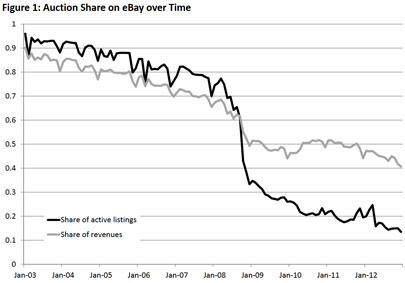
Also, I think they found most people really don't want to spend all day sitting in front of a screen trying to buy something. 'Buy It Now' was a really big deal for eBay, it makes up an increasingly large percentage of their revenue. [1]
Because it discourages people from bidding the maximum price they are willing to bid up front, increases the sensitivity of the whole system to short-term communication problems, and denies both bidders and sellers a firm end-time.
It really only makes sense if you are running a system which is designed to make money off the number of bids, and which artificially restricts bidding to maximize the number of bids.
eBay uses a second-price auction system. Each bidder is allowed only a single bid, which reflects the absolute maximum that they are willing to pay. The highest bidder wins the auction, but only pays as much as the second highest bid. The value of the actual highest bid is kept secret, so the "current bid" displayed on the site is actually the second highest. If you try to win an auction by outbidding the "current bid" by 1 cent at the last second, you will succeed only in becoming the second highest bidder and pushing the price that the actual highest bidder has to pay up by 1 cent.
Well, technically you are just changing the amount of your existing bid. This is not really a useful distinction for eBay on its own, but is when looking at other auctions where number of bids has an effect on the result.
All information you have as a player is misinformation, as demonstrated. As a result, the single factor that makes you "win" is whether the other players stop playing, letting the timer hit its limit. There are two reasons for them to do so: exhaustion or cost. Some players may have stolen cards or plan on denying the payment, making cost potentially limitless. Some players newly join and some are bots, making exhaustion a non-issue. As a result, the game is completely random.
The only winning move is to be the house.
There is one small vulnerability in the website they tested, which is that when the system senses player exhaustion, it sinks the price to attract new players. It happens twice at the end of the graph. When the price is on a downward slope going past a certain point, it probably means that few players intend to pursue.
To me this seems effectively like a slot machine, where people keep feeding in money for someone else to eventually win some sort of prize. I would equate the lowering of the price to a small payout so that the person keeps playing for a bit longer.
Assuming a constant cost per bid, given that every time you put in a bid you lose money, and the site owner can always get a guaranteed win, you need to minimize the number of bids you make:
Optimal number of bids is 0. Since we're constrained to play, bid once. (It doesn't matter when, you won't win).
I don't know if game theory is the branch of mathematics that can help you out here. Game theory usually rests on matters of "If I do X then my opponent(s) will do Y", but in this situation you don't even know how many opponents you might have.
Your best shot would probably to be just to sit there and collect a shitload of statistics about under exactly what circumstances you're most likely to be the final bidder, and then only bid under those circumstances... and then hope nobody else has been collecting the same statistics and coming to exactly the same conclusion.
A friend I used to know actually got reasonably skilled at getting stuff from penny auctions. I personally witnessed him net gain from the exchanges (and bought some electronics from him for very cheap, since he had several of each at that point...)
He never shared his methods, but did say that one of the most important considerations is the target audience of the item in question and at what times they are likely to be bidding. You can glean that information by continuously observing many ongoing auctions.
The basic strategy was "hold off until people have stopped bidding, then put one bid down. If it doesn't work out, go have a picnic in the park and try again later."
This may have been before such sites offered pre-configured bots.
This game is difficult to formalise because of the real time bidding aspect.
Say agents pre-commit to bid or not in discrete time periods, one Nash Equilibrium would be symmetrical mixed strategies such that each agent has 0 expected payoff from bidding.
Eg if 10 players, $0.4 fee and $0.5 bid then would need players to bid with probability p st:
0.9 = 180 *(1-p) ^9.
This changes if agents value winning more/less than $180 in present/future (patience, risk neutrality, value placed on tablet + process of playing gambling game).
Thinking a bit more about this, the real time bidding aspect isn't really a problem. You do need to know how many other players there are now/in the future though.
Symmetrical strategies:
bid_cost(t) = object_value * (1-p(t+1))^N-2 for all t, for all agents not currently winning auction is a MSNE.
What's the argument that this is gambling? Or rather, that this is gambling while eBay is not?
I understand on a rational level that this is less fair to bidders and a bad model if you want to just buy things, but I don't see where this is a game of chance instead of a consequence of who is participating.
I suppose because you pay a small amount of money and you may or may not get something valuable out, which makes it effectively gambling from the bidder's point of view.
> but I don't see where this is a game of chance instead of a consequence of who is participating
From the point of view of an individual bidder, "who else is participating" is a matter of chance.
Not sure where to find a reference, but ISTR it's been shown that the bidding sequence in penny auctions is functionally indistinguishable from a random process (provided that bidders aren't colluding to throw the auction to a predetermined winner), in much the same way that die rolls or coin flips are functionally random even though they're determined by a person applying mechanical forces. And unlike conventional auctions, all bidders end up paying. They don't pay the final "auction price", but they do pay a fee for placed bids. So the practical upshot is that this functions like a raffle or lottery, with the "auction" elements basically being window dressing.
eBay involves naming a price for an item, which you pay only if your price is accepted and you receive that item.
Penny auctions involve naming a price, purchasing a bet nobody else will name a valid price after you, and you receive the item only if your bet wins, in which case your "prize" is actually an option to buy the item at your named price.
What's ridiculous beyond belief is that the "skill level" involved is sufficient to make it not gambling when poker is a regulated game...
I agree. Others here are making arguments as to why they think this is akin to gambling, but there is a specific legal definition of gambling (at least here in the U.S.) --
"A person engages in gambling if he stakes or risks something of value upon the outcome of a contest of chance or a future contingent event not under his control or influence, upon an agreement or understanding that he or someone else will receive something of value in the event of a certain outcome." [1]
This is not a contest of chance, and there is no future contingent event. Other participants future actions within this event do not count as a "future contingent event."
Not knowing what your opponent will do does not make it a game of chance. For the purpose of defining gambling, the component of chance must be exogenous to the participants.
> For the purpose of defining gambling, the component of chance must be exogenous to the participants.
There are many different legal definitions of gambling (even in the US -- each state that regulates gambling has at least on definition of its own, as well as the feds, and the same jurisdiction may have different definitions in different laws) but the one you posted upthread requires only that the future contingent event on which one participant is at risk be out of control of that participant, not that it must be "exogenous to the participants".
I agree there is no skill involved, but it is not a contest of chance either.
Assuming the house is not cheating and using shill accounts (which does happen, but IS illegal) then the last person to continue bidding wins. So in that regard it is by definition not chance. You just continue to bid until no one else bids and then you win.
As others mentioned, placing a bid on eBay doesn't cost you anything.
More importantly, these penny auctions lack is transparency. The argument is that they're not gambling because it's a game influenced by skill, but for that to be true you would need transparency into who many bids have been made, by which people, with what timing. This doesn't appear to be possible without running an aggregation script.
I would argue that it depends on how predictable the output is for a given system that determines if it is a gamble or not. A simple rule system with numerous agents can produce output that is really hard to predict.
How does one person spend 3500$ on a 180$ tablet: write a bot. You tell it to "buy any item at ≤10% retail price if the remaining time is ≤1s". Sounds reasonable, even if you pay a few cents for the losing bids, right? ;)
How does one person spend 3500$ on a 180$ tablet: write a bot.
Each time someone makes a bid on your penny auction have the bot automatically make a pretend bid using a fake user. When people finally stop bidding, make a final bid from another fake user that has never bid before and win the auction for $0.80.
Unless you are the person running the penny auction. In which case, keep sniping until people stop paying and then have a final fake bid to win the auction.
I feel like there's a bit of explanation missing in this article. It only seems to make sense if bids cost a penny at the time they are made, rather than needing to pay at the time the auction is won. Is that the case?
Does the winner have to pay the existing bid total too, or do they benefit from the spending if other bidders?
The "auction price" isn't actually a price. It's just the number of bids so far, and it's meaningless. They're just advertising it as a price to confuse and market.
Them saying "this tablet is up to $11.42" just means "there have been at least 1142 bids for this tablet", (assuming "penny" is "one cent", I never could learn the weird American names for the small currency).
Dollar is the base name. Cent (idollar) is 1/100th of a dollar. Mill (idollar) is 1/1000th of a dollar. Values larger than a dollar are denominated by common name, e.g., 5 dollars, 10 dollars; the set of denominated bills is (usually): 5, 10, 20, 50, 100.
On top of this system is overlaid a decimalized imperial notation, the octal Spanish system, and a materials system. Thus penny=cent; nickel was used for five cent pieces; a dime is 1/10th a dollar; quarter is 25 cents (two bits; a bit is a dime and five ha'pennies), etc.
The problem is that the US was one of the first countries to "decimalize" (including defining the actual measures, which were not defined previously) in the 18th c., and chose to reuse the old names.
As to our measures: weights and areas are base-4 (which made manufacture of the standards easier); length is based on easily divisible numbers for common lengths; official measure is done decimalized (thus the notorious "decimal inch"). The foot is based on the second, which was fundamentally superior to the meter which was based on the earth's geodesy for practical matters, etc.
While I certainly think that Penny Auctions are less than useless, I really don't see how they can be classified as gambling. I think that the salient point here is that there is no element of chance. Sure, you don't know how your opponents will behave, but you also don't know how your opponent in a chess game will behave. The nondeterministic behavior is not endogenous to the game itself.
I think if you were playing chess on a chess board of indeterminate size, of which you can only see the places occupied by your own pieces, against an indeterminate number of players, any of whom can add additional pieces to the board at will... it would look a lot like a game of chance.
You can place your bet with knowledge, despite not being able to influence the result.
See also: poker, insider stock trading, etc.
Edit: Given that they have bots stealing the items, I don't think this is actually gambling--it's actually just entirely wasting money.
If it worked as-presented, I would say there's a marginal amount of skill involved, which would have its effect magnified over time, as happens in poker.
That's not clear to me. By that logic, any game in which players took one turn each, sequentially, would be gambling. The fact that you can no longer control the outcome does not make it gambling. You need to have a nondeterministic component that is exogenous to the players.
Doesn't matter if it's skillful really. Both sportsbetting and poker clearly are (there are many long-term winners) and that doesn't stop them being gambling.
If I recall correctly, an effectively designed strategy performs at least as well as a random number generator when playing against a random player, and can do better against a non-random player.
So if someone used the metastrategy of entering a shill competitor that always chooses rock, in a field where everyone else is perfectly random, then a true competitor that always chooses paper would win the competition. Without the shill, the winner would be random.
Therefore, you have to assume there is at least one strategy in the competition that can be consistently beaten, and that perfectly random players cannot be beaten by strategy and are therefore ignorable as part of the overall field. So the winning metastrategy is to design a non-random, yet unpredictable strategy.
As I recall, "Iocaine Powder", which created an internal model of the behavior of the other players and then played to beat the model's prediction, was an early dominator. There have also been players that won by "cheating", such as by examining the stack of the other player's program. Either way, the best way to win is to read your opponent's mind.
So after Iocaine Powder wins, the next year's competitors could put a copy of it into their programs, so that they can detect whether Iocaine Powder 1.0 would be able to play to beat them and then change their play to something else. Meanwhile, Iocaine Powder 2.0 also has a model of Iocaine Powder 1.0, and whenever it detects that someone is playing to beat IP1, it plays to beat that instead.
After several years, everybody knows that everybody knows that everybody knows that everybody knows that everybody knows that you were going to play rock, so I was going to play paper, so you were going to play scissors instead, so I was going to play rock instead, so that you had to play paper, so that I had to play scissors, so you end up playing rock. It's way more complex than "international rock-paper-scissors competition" makes it sound. If a human competitor entered, the bots should be able to predict what that person would order for lunch for the next week. It's crazy.
The other hidden scam in this is that [some/many] these sites will give you X number of free credits when you first sign up. Not only is this to get you hooked and using the site but it cheats people who are already hooked and paid for their credits because it allows others to bid and "take away the winning bid(s) of actually paying customers) for free!
For that to be true, the Arsenic user would have to have some way of cashing out at least a large portion of that $3500. The only way that could happen is if they were actually on the payroll or otherwise being paid for goods/services from the auction company.
In some country that kind of auction is considered gamble indeed and it's against the law (most EU as far as I know). From a Mechanism Design point of view, they are maximizing their own profit and they also expect their players to be not very rational entities and so they don't nee to use a truthful auction.
There are also reverse Dutch auctions which you bid to drive the price down. The winner ends up paying the remaining cost of the item. You buy a bid for 50 cents and the bid drives down the price by 2 cents. If the remaining item is $15 for a $2000 item. You pay $15.
It's an interesting topic but I unexpected some analyses or conclusions at the end :( maybe the OP is going to release the raw data for the interested? Quite curious how would that turn out.
Excellent content. I was surfing your web page and it seems ridiculous interesting. Tomorrow I will read everything, do you make all your source code available ?


It's a game of chicken. The earlier bids are a sunk cost. You hope you can spend an extra $1 to win the $20.
Sounds insane to even start bidding, right? But then you see things like this play out all the time in the market. For example, the war between Blu-Ray and HD-DVD had a very similar dynamic.
EDIT: See https://en.wikipedia.org/wiki/Dollar_auction