A few years before he died, I heard Kim Peek speak at an event. He was a savant who retained 98% of everything he read. He would memorize phone books simply by reading them once. When he read, his left eye would read the left page while his right eye would read the right page at the same time. He could tell anyone the sports scores listed in the newspaper on the day they were born. He was also severely socially impaired and couldn't carry on a conversation.
His father described his condition as being due to having his left and right hemisphere fused together where as most people's are separate with communication channels between them.
My problem with that sort of demonstration of amazing memory powers is that I have no way to check the sports scores on the day I was born as quickly as the person who says they're retrieving them from memory does so.
Even if I could just google them (there might be some online sports results archive or something- it would still not mean much unless I could find an identical copy of the exact listing the mnemonist memorised- like, a archived copy of the same newspaper they read on my birthday.
So, I don't know- is this really a thing that happens even under at least semi-rigorous testing? Or is it more like a parlour trick that's only good for entertainment value?
Sports scores aren't different between papers, and the order, or the specific way it was printed in the paper, doesn't matter. There are many archives where you can easily look this information up.
I was born August 9th, 1988. That's baseball season. On that day, it's a non-controversial fact that there was a double header between the Red Sox and the Brewers. The Sox lost the first game 2-3 and won the second, 5-1.
Let's assume you look up the scores on your birthdate and just ask the guy "Okay, on this date, there was a one double header -- which teams, who was home, who was away, and what were the scores?" He should be able to tell you. Doesn't matter what paper he read it in.
The point is that not all newspapers are going to be publishing the exact same amount of information on any event, including sports scores.
So, for example, if a person is saying they remember that the Red Sox lost 2-3 to the Brewers, and that they read that in The New York Times, you can check the NYT to see if they published that result on that day.
I mean, if they say they remember reading that in the NYT, but it turns out that's not where they read it, then that calls the whole "super memory" thing into question, doesn't it?
What difference does it make? If a person can recall from memory the scores for any major sporting event on any arbitrary day, who cares which source they originally memorized them from? Regardless it is easily verifiable, even pre-internet, and regardless it qualifies as super memory.
It matters because if the source is not what they say it was, then either they didn't memorise the fact from the source they say they did, in which case maybe they just looked the fact up very recently instead of on the day they say they did, or they don't remember where they read the fact in the first place which means they don't have such a good memory as you think they do.
For example - if you tell me you were born on October 24, 1812, and I tell you that on that day the Battle of Maloyaroslavets took plase near Moscow, and that I read it in the papers on that day- how do you know that I really read it in the papers on that day? You don't. You only know that I know the Battle of Maloyaroslavets took place on that day and year.
That's my claim: "I read in the papers, on 24 October, 1812, that the Battle of Maloyaroslavets was taking place near Moscow". Here's my evidence "I know that on 24 October, 1812, the Battle of Maloyaroslavets took place near Moscow".
One does not follow from the other, so you really have no way to tell whether I really read the papers in 1812, or whether I'm just bamboozling you about my amazing memory powers.
You're saying it doesn't matter, and I have amazing memory powers anyway, because I remember the Battle of Maloyaroslavets. Except, how do you know when the Battle of Maloyaroslavets took place? That's the other half of the claim- and it's easy to fake: I can fail to recall a fact a million times and get it right once, and people will still be amazed by my memory powers and tell each other I got great memory because I remembered it the once.
Except that logically if there is ample evidence of a person meeting people for the first time and telling them verifiably true information about their birthdates, it is very unlikely that he just happened to luckily review that exact info the night before. So either it's a massive conspiracy with multiple independent media entities in on it, or he actually does have an excellent memory. I know which seems more likely to me.
... or, the people that person met were working for him and they asked him about facts they knew the person had memorised. It's not that hard to imagine and it's actually the done thing in mentalist shows, even to the point that, as I say in another comment, there is a name for people planted in audiences to do that sort of thing: "shill".
So maybe that "ample evidence" was fabricated.
There's all sorts of other possibilities between "it's a conspiracy" and "it's a miracle" (both of which are equally unlikely btw). For instance, my favourite trick requires nothing but a dozen or so pieces of paper. You write the word "boy" on half and the word "girl" on the other half, seal each in an envelope and hand them to a dozen pregnant women, telling them to open it only after they've given birth (it makes no difference that they'll open it before anyway). Once they start giving birth, it's very likely that you'll have hit the right gender a couple of times or so. After that, those couple of "hits" will probably become ardent supporters of yours, and the best advertisement for your medium business. "How did she know?!" Well, you didn't- but it doesn't matter. It only matters that you appear as if you did.
And anyone looking on can go around saying things like "either it's a massive conspiracy or that lady really has extraordinary abilities!".
The outcomes of historical, national, sporting events are not subjective. It would be easy to check and verify even if you couldn't do it that second you could still after the fact check and call out anyone pretending. With or without the exact identical text the "memorizer" used.
To clarify my original comment - when someone claims they can memorize a certain text, the way to verify the claim is to find the text. If you check the content, but not the source, you are only checking half the claim.
Why is it important to check the source? For the same reason that, when someone adds a reference to a paper, or a wikipedia article, people will often follow the reference and look for where it is exactly that it says what the referrer says it does- and complain if it turns out it doesn't.
So, for instance, if I mention that the minimax algorithm runs in time exponential to the number of nodes in a game tree, and you ask me how I know, and I reply that I read it in the 3d ed. of "AI: A modern approach" by Russel and Norvig, you are well within your rights to open the book, search for this information and, if you fail to find it, ask me whether I'm sure I got my refs right.
And that is true regardless of whether my claim about the running time is true or not- because that's only half the claim. The moment you add a reference your claim goes from "X is true" to "X is stated to be true in Y" and you have to be able to prove that "X is stated to be true in Y", not just that "X is true". And if "X is stated to be true in Y" is not true, but you go on to assume "X is true", then any other claim you make after that is up in the air, because you haven't yet told us how you know that X is true.
Which is important to know, because once you screw up your facts, as you inevitabley will, you (and everyone else) can at least trace your error back to all the things that you know, and the sources you drew that knowledge from, and have a glimmer of a hope to identify the error in your thinking.
Accordingly- if someone claims that "I memorised X from Y", you can check that X is stated in Y. If it is, then fine. If not, not fine.
OK, so how can you ever verify with any degree of certainty where and when someone acquired a memory? If I can just look up those details somewhere else, at my convenience, then how can you ever be sure I didn't?
By asking for details from a set of arbitrary, random dates, such as people's birthdays. A set of dates the questionee could have no way of knowing. In order for him to know the answer to trivia on multiple arbitrary dates off the cuff would require him to, you know, have memorized the trivia for all the dates -- which kind of proves the point.
Unfortunately, just having someone tell you something doesn't prove anything, unless you have a way to check that the fact is true- and for most of Kim Peek's life this was not the case.
For instance- his article on wikipedia mentions that he "enjoyed approaching strangers and showing them his talent for calendar calculations by telling them on which day of the week they were born and what news items were on the front page of major newspapers".
I assume he did that throughout his adult life, so when he was in his 30s an 40's, in the 1980's and 1990's, how would the person he approached this way check the news that Peek told them were on the front page of X newspaper? They couldn't very well google it on their iPhone back then.
Besides, this is not very clear in his wikipedia entry, but it seems to me like he made a living out of his skills, so you know, it was at least partly entertainment (without trivialising, or in any way shape or form ignoring, the fact that the guy had obvious disabilities).
So I'm saying, when a guy tells you he can recall for you a bunch of facts you dont' really remember yourself and you can't very easily verify, and by the way you're welcome to a donation, you can take what he says with a big pinch of salt.
> but it seems to me like he made a living out of his skills
People are downvoting you, maybe for manner in which you're expressing skepticism, but a lot of the issues you bring up are a constant concern in psychology. For example,
1. Clever hans, a horse that was supposed to answer people's questions, turned out to just be responding to auditory/visual cues (seeing people gasp).
2. In the book, Mind of a Mnemonist, the author documents a guy who uses a memory technique to remember a lot of information. However, the guy also plays up the idea of his having synesthesia (crossing of perceptual modalities, like "hearing" visual things, etc..). The author is concerned that some of the things the guy says are motivated by his desire to make a living as a performer.
3. A lot of cases, like Kim Peek, raise the same concerns about the person being made larger than life, for whatever reason. Or the person having learned (whether intentional or not) some very specific skill for remember certain types of information. With practice, a person can learn to memorize phonebooks pretty quickly.
Often it's clear that people are exhibiting exceptional memory, but teasing apart the exceptional bits among media hype, people having a lot of unaccounted study time, and past accounts gets pretty tricky.
How can you tell I'm being downvoted? My posts aren't greying-out yet.
I'm a bit surprised at the downvotes. I've said things I thought would get downvoted in the past and in the end it turned out I got more ups than downs. But today, in this thread, they're pouring down like rain and it's very unusual.
So, quite aside from the fact I'm losing my high score (hey, I like a game like the next person) I guess I've said a few things that people strongly disagree with. I wonder if it's what you say- the way I express my skepticism, but I'm not commenting in a different style today than in other days. If anything, I was even a bit more guarded today than usual, because there's the matter of disability and all.
I think what's up is that people know Kim Peek as the Rain Man, from the movie, a guy who had a severe disability but nevertheless had an amazing talent, and they're upset at me for saying that maybe he was faking it after all (edit: faking the talent, not the disability; and I'm not even saying he was faking it, just that, like you say maybe he was made larger than life).
The way I read them, a few of the comments in this thread are basically saying that, cooks and entertainers aside, Kim Peek was the real deal. Well, I don't know the guy. I googled him, I looked him up on wikipedia. There are some claims of extraordinary ability. But, if he only did the same things that entertainers do, then his skills were not that extraordinary, only unusual. The fact that he had a mental disability makes them more unusual, but still not so far outside ordinary human potential that he should really get his head scanned by NASA.
So I dont' think I'm being unreasonable to remain skeptical, and demand evidence. I think what's unreasonable is that most other commenters in this thread are simply demanding that I agree with them, just because they know and everyone they know knows that what they say is the way they say it is. Well- sometimes you just have to stop and think how you know what you know.
You don't seem to get it. These sorts of things are all examples of verifiable facts. Calendar calculations are trivial to verify with a computer, and news archives existed long before iPhones and ubiquitous internet access.
You don't think given his fame, that his talents were rigorously tested and verified?
If you're that skeptical, shouldn't your first step be looking up more details on how he was verified to be legitimate? Rather than saying in a comment thread that there's no way to know?
I had a look on wikipedia. There is a section on some "tests" conducted by NASA, but "the intent was to create a three-dimensional view of his brain structure and to compare the images to MRI scans done in 1988". That doesn't tell me much about why they thought he had an interesting enough brain to try to image, i.e. why they were convinced he was a savant.
Does your comment mean you know why NASA (and others, I guess) thought he was legit?
No, I just wonder why you came in here doubting it. It's so unlikely that nobody ever thought to check. It's not impossible, but it's certainly unlikely.
What do you mean "why I came in here"? I post here very frequently.
Likely mid-western colliquial (I'm from Indiana). It means that you originally posted with the sole thought of doubting it. It has no bearing on how often you are there.
For example, a regular at a bar might get told one day, "You came in here looking for a fight!" - it speaks of intentions, not frequency.
Broken_Hippo is correct. "why I came in here" means "you seem to have come in here wanting to doubt it, even though there's very little reason to do so." It seems very disingenuous.
Why is it so important that the person check the facts the instant the demonstration is done as opposed to taking the time and checking them later (e.g. by going to a newspaper's archive)?
Because by the time you get the opportunity to verify the accuracy of the "recall", it's too late to challenge the mentalist about it. That's how those tricks (when they're tricks) work.
Imagine it like this: say you're at some mentalist's show, and she picks you out of the crowd. She asks you your birthdate, you tell her, she concentrates (silence in the audience) then suddendly she starts riffing off headlines from that day's newspapers. Why, she can even remember the crossword hints from the Times of Pallookaville! And even their answers! (well just one of them but-) Music! Lights! The audience clap their hands! The mentalist moves on to the next target.
Did you, at any point during all that, have any chance to challenge the accuracy of the mentalist's recall? Not really. Would you do it even if you could? Most people will dread so much being the asshat that ruins the show everyone paid to watch, that they'd never say anything, even if they had a tattoo of that damned crossword on their butt, solved and done.
And does it make any difference if you go back to your house and google the information and it's all made up? What 'you gonna do? Call up each one of those 1200 people who watched the show and tell them the mentalist is a fraud? 'Course it's a fraud. It's entertainment!
That's one setting and it's a bit formal, like, but ceteris paribus, the same goes for any situation where someone is pulling that sort of trick on you- the whole trick is to move fast and not give the mark time to think and react.
At the extreme end, you could try a site like http://lesswrong.com/ . If someone bites, you probably can't expect a more rational argument from anywhere else.
It wasn't a parlour trick. He was a savant. If you have read anything on Kim Peek, this would be clear. We wouldn't want that nor could do we do that - he suffered more than hev benefitted.
Kim Peek was an extremely well documented individual. That he retained seemingly inhuman amounts of information is not under dispute, even though such charlatans do exist.
The problem is that I'm well aware that charlatans do exist [1] but I've no idea why you say that his skils are not under dispute. Does this mean you know of some sort of test, some demonstration in controlled conditions etc? I'd like to see it, too, please.
Edit: How was he well-documented? Where is that documentation?
Five-year-old savant from LA who displays signs of being telepathic - and is already learning seven languages - is being studied by scientists after his mother filmed him 'reciting numbers written in secret'
  + Ramses Sanguino, aged five, was filmed seemingly displaying telepathy
  + He correctly recounted numbers that were written down 'out of eyesight'
  + Videos were posted online and attracted the attention of a neuroscientist
  + Ramses is now part of a cutting-edge telepathy study by Dr Diane Powell
  + His mother insists the footage of her autistic son's 'talents' is not trickery
Not just a savant, but a telepath to boot. And there's a neuroscientist involved.
Look, it's not my fault that a lot of that stuff about savants is a bunch of hooey. If that guy, the original Rain Man, was legit, and we know for a fact he was legit, I want to know why it is that we know it.
Because you can put him in a room alone and ask him questions. Many, many people have interviewed and investigated him. He was also severely disabled mentally, he's not a normal guy who is really smart. He was a mentally retarded person who could not care for himself. There was a documentary in which he spoke to neurologist VS Ramachandran and they showed how he was unable to grasp the concept of a metaphor, taking idioms of speech literally. I don't think he was capable of magic tricks. This is also well beyond small areas of knowledge. The guy was a walking wikipedia. His FMRI also showed an extreme malformation of the brain. He was completely missing the corpus callosum and several other very important structures. https://cdn.psychologytoday.com/sites/default/files/blogs/11... It's pretty damned hard to fake an FMRI like that. Essentially Kim Peek was not filtering any information that got into his head. It was all equally important and it's questionable how much he really understood the things he memorized (which he did hours and hours and hours of each day).
Yeah, I don't know about his fmri and its interpretation. I'm always very skeptical of this sort of "evidence". In the past people have used fmri data to support any old hackneyed, half-baked theory they wanted, like for instance, that bit about women not being able to park cars as well as men because they have a worse spatial sense [1].
As to his mental disability, I agree that if it's true that some people are mentally disabled (to any extent) in one area, but not in another, that's something surprising and possibly useful to research further.
But- is it true? That people really have an extreme level of development in one faculty, but not others? How do we know that it's true? What are the experiments done that confirm it, if you want to be scientific about it? What is the standard of proof?
Let's look at Kim Peek- people say he did pretty amazing things beause he could calculate your birth day from your birth date and he memorised facts.
OK, well, calculating your birth day is through and through a parlour trick. Here's a guide that says how to do it: [2]. If he had been guessing the card you picked out of a deck, nobody would think he was a savant, but people probably wonder "how the hell did he figure out the date"? It's an algorithm.
The same goes for his powers of recall (it's a parlour trick and something you can train at) except it's also possible to fake it, in the way I suggest above, because nobody really keeps that sort of fact handy and they'll probably not be given the time to check.
So the question really is: was the guy really as mentally disabled as to be unable to learn how to perform those quite traditional parlour tricks?
Right off the bat, the very fact that the two things he's remembered for -calculating birth days and recalling news items- are standard entertainment numbers suggests to me that he trained. Otherwise it's a bit of a coincidence that his unique superpower just happened to be exactly the same one exhibited by trained professionals.
Which also suggests to me his mental disability was not as severe as people think it was, and that instead media reporting has severely distorted our image of his (real) disability.
And for all of the above, I want to know why people insist that he had ("documented") superpowers. Where is the bloody documentation?
__________________
[1] For a thorough, and thoroughly enjoyable, debunking see Cordelia Fine at the Festival of Dangerous Ideas:
> Let's look at Kim Peek- people say he did pretty amazing things because he could calculate your birth day from your birth date and he memorised facts.
What? I'm not sure you actually know who he is and his abilities. It's not that he knew some facts. It's that he knew the zip code for nearly every street in the country, even inconsistent ones. It's that you could have an auditorium full of people asking him the most obscure questions they could come up with ("When was the birthday of Lincoln's younger Aunt?").
> The same goes for his powers of recall (it's a parlour trick and something you can train at) except it's also possible to fake it, in the way I suggest above, because nobody really keeps that sort of fact handy and they'll probably not be given the time to check.
Also, yes they do. They absolutely did that with Kim Peek. People investigated him with lists of such facts at hand.
> Right off the bat, the very fact that the two things he's remembered for -calculating birth days and recalling news items-
You have no idea what you're talking about. He was known for neither of those things.
That's what's on wikipedia. Why am I absolutely required to know who Kim Peek was? Because they based a film on him, and it sold well?
Also, for the love of god, listen to yourself. People "tested" him with lists of facts? And you don't think it's even remotely possible that those people were planted in the audience?
There is even a word for that thing: the people who do that are called "shills" [1]. In popular shows they're paid for it, from the persons who run the show, to make sure that nobody asks questions the mentalist (or the medium etc) can't answer.
You can't base anything on something that happened in a show! Give me a break.
Question all the things.
Question the Reason of Questioning.
Honestly, if nothing on earth convinces you, and everything is just one huge collaborate conspiracy to invent a mentally retarded guy, who worked like a info vending machine.
I have one final question. If such a savant exists, would you travel to his location and question him in person?
For this unreasonable burden of proof you demand, would you carry that stone yourself, even if it is so heavy that god can not lift it?
You linked to artofmemory.com. Did you ever read Moonwalking with Einstein? The author, Joshua Foer, was a skeptic of memorization parlor tricks. So he decided to try it for himself and actually became the USA Memory Champion, accomplishing memorization feats that he thought were impossible.
The book debunks many myths, most prominently that of photographic memory. The author also expresses his opinion about some famous characters known for their supposed memorization skills. For example, he explains how one guy who claimed to be reciting pi from memory was actually using his hands in a way that evinced the use of a mental arithmetic method, not recall of a memorized number.[1]
But the book is very clear on the fact that you _can_ memorize thousands of digits of pi. And he explores some famous characters who apparently did have perfect recall of trivia. In interviews with scientists, and drawing on his own experience, he draws parallels between their behavior and the memorization methods he and others learn and practice. Which isn't to say those famous characters were charlatans, but rather appear to be people whose brains naturally and uncontrollably applied similar "mental tricks" that normal people can learn and use, albeit with concerted effort and in a more limited fashion.
It also analyzes why these seemingly magical abilities aren't actually as productive and useful as you would intuitively think they are. Why forgetting is actually a very important faculty and remembering too much can be a serious deficit. So if you're skeptical because you're reasoning that anybody with such memorization abilities would be like gods among men, then the fault is in your assumptions about the function and purpose and power of memory in our intellectual and social lives.
Another interesting phenomenon is people who lack episodic memory. It's especially interesting because the use of memorization techniques like memory palaces actually leverages episodic memory. I didn't really make the connection with the particular concept of episodic memory--nor did Moonwalking with Einstein or similar books I've read, IIRC--until I later learned about the definition and distinction between episodic and semantic memory. Episodic vs. semantic memory is an important and well-defined dichotomy applied in the neurological research community.
In a memory palace you effectively create associations between episodic memory and trivia. (That's not the whole of it, obviously.) For most people instantaneous recall of episodic memory comes naturally; but episodic memory is subjective and emotional and highly malleable, not as objective and concrete as trivia. For some people (perhaps most people) with perfect recall of trivia the distinctions between episodic memory and semantic memory are blurred. In fact, some of them don't even have episodic memory at all. They can remember what they had for breakfast 12 years ago[2], but can't recall (re-experience) how they felt at the birth of their first child, even if they were overcome with emotion at the time.
These things are interesting because they expand the horizon of what we intuitively think is humanely possible. But at the same time they circumscribe and limit those possibilities. It's all very fascinating. All the modern analogies we use for memory, particularly with computers, are just woefully inadequate. Even neural networks don't come close to scratching the surface of what's going on underneath. The _depth_ and _breadth_ of the multifaceted phenomenon we call memory is much more extraordinary than we believe. And it's tangled with our other intellectual faculties.
[1] The odd deception notwithstanding, it's still an accomplishment. Con artists aren't lazy people. This guy did a Slashdot interview years ago, I think. He was supposedly gay and on the autism spectrum, but in retrospect he may simply have been a sociopath. I've read several books on that, too ;) He may have been legitimately gay but he seemed to play it for sympathy--to show how different and difficult his life was. Sociopaths don't experience shame or embarrassment, at least not like we understand it, so they can be much more sexually fluid when they want to be. Stripped of cultural values and emotional content, sex isn't qualitatively different than shaking hands followed by a little euphoria, even if you prefer shaking hands with one sex more than the other. But sociopaths lie and excel at manipulation, whereas lying and manipulation are hardly characteristic of autism.
[2] Presumably, of course, as it often can't be proven. The accuracy of much other trivia can and has be proven, so there's little reason to doubt them. Contrast that with photographic memory, where it's been thoroughly studied by several researchers and not a single person has ever passed a test or even come close to suggesting the legitimacy of their claim. Not that those people are charlatans, either. Just under an illusion.
I'll agree that this is not impossible, but the rest is something some guy wrote in a book, which he then sold to promote his business of doing that sort of thing.
You don't know me of course, but I can assure you there is not the chance of a snowball in hell that I'll ever take that sort of opinion into account, when I try to figure out what is real and what is fantasy.
That is especially so when it comes to subjects that fascinate me, and that I really want to understand, one day.
On the other hand, thanks for taking the time to write all that; hope you don't misunderstand my tone.
What do you mean? You can't check the sports result he recalls on the Internet? What do you mean it has to be the same newspaper he read? I'm confused.


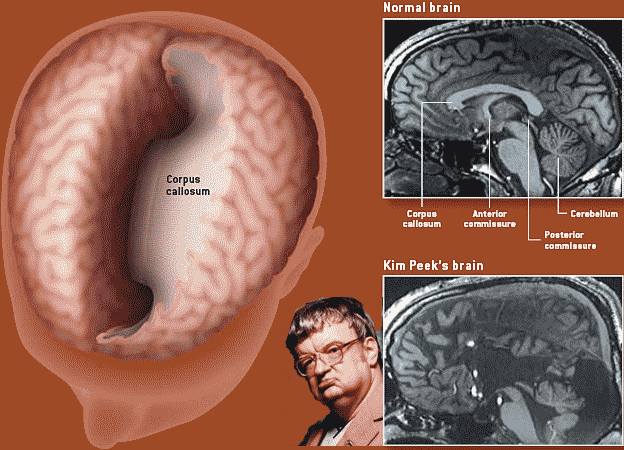
His father described his condition as being due to having his left and right hemisphere fused together where as most people's are separate with communication channels between them.