He was lauded for using "big data" and "data science" to run a successful campaign.
The social media companies picked on this and ran with it. Now this seems to have backfired.
Then there has been the culture of "attack ads", a lot of them based on misrepresenting facts to put it mildly.
So, now Congress and politicians want to do some posturing on Russian "interference". In case they do pass laws banning RT or some special interests from buying ads/bots etc. What then? The can of worms is already open.
People will find a way around. It can be as simple as registering a LLC and then having the Russian "data scientists" work through that. Or even American companies knowingly engaging in this.
The root problem here is the data collection being run by every other company out there. It helps companies and invariably advertisers identify people based on their tastes. So, will Congress and the politicians actually ban outright data collection? My guess is they wont. Posturing this as a Russian and a commie problem gets them enough brownie points.
I've come to the conclusion is that politicians have decided that tech is a safe punching bag for both Republicans and Democrats. Republicans can punch up on tech companies to seem like they care about Russian interference without beating up their own candidate, or examining their own advertising practices, and Democrats are still angry that the election was so close and tech seems like something they can just keep punching unlike Comey or Clinton.
We basically need to weather the storm here and act contrite since no one has come to this topic with good intentions of actually trying to fix our elections.
A concrete step that Congress could take is to publicly fund privacy technology. This is a classic public good that government is ideally situated to subsidize. Unfortunately this technology would conflict with numerous mandates relating to government data collection for national security (e.g. National Security Letters requiring email servers that provide tools for client side encryption of emails to place a backdoor in their software) and taxation purposes.
I'm struggling with the takeaway here. Most of the people on the planet have grown up watching blatant misinformation being broadcast on TV, radio, and print. Specifically, during every single government election of note, anyone recall John Kerry and the swiftboats? Social networks now present a new tool to amplify a message, in addition to TV, Radio, Print. So is this a movement to police the messages? And where does this lead, marketing companies can't do business with international organizations during elections? And who decides what messages are allowed and disallowed? Seems this line or reasoning only leads to infringement of freedom of speech.
I'm not sure how to word this well, but almost everything to do with clinton loosing had nothing to do with fake news. they seem to have this duality where the russians hacked their systems and spread real news and aknowledge it was real, but complain they lost because of russians spreading fake news. talk about a red scare.
- maybe clinton could have done better if her campaign wasnt the archetype of bad data science. sticking to models empirical truth disagreed with, sticking to models that failed to predict Bernie Sanders losses.
- maybe Clinton could have done better by not calling 49% of the country a basket of deplorables.
- maybe the party in general could have done better by calling everyone who disagreed with them a racist bigot, then were surprised how many people disagreed with them because they didnt hear people disagreeing with them.
- maybe the party should get away from identity politics. you can only shame someone so many times for 'white privilege' before they say hey, I'm just going to vote for the other candidate.
The difference is the ease and scale with which identity and source can be hidden or spoofed to exploit trust relationships and herd instincts on the internet.
Whether something is white (e.g. RT, Voice of America, etc), grey (e.g. swift boat vets for truth, astroturfed citizens for X), or black hat propaganda (e.g. Black Matters, @TEN_GOP) depends on whether you represent yourself as (a) yourself, (b) a neutral party, or (c) your adversary.
So yeah, the problem is one of policing identity rather than messages. In other words, how do we make it more difficult for people to get catfished?
Can you explain to me why a couple hundred thousand in ads matter more than a couple billion of super PACs and why those people that spent those billions are blaming it on the couple hundred?
I mean maybe they do, but I feel like in that case you just have to be really shit in marketing and sales, no?
EDIT: you may say: "But I mentioned so many other topics", yes, true, yet the very first in your list is RT. and no I have no skin in this game
In the US establishment politics has had a complete, and absolutely uncontested, grasp of control of control. 'Establishment' in this case is mostly a translation to indenture to corporations and other well monied special interests, including banks. Corporations put politicians into office using their money. Politicians repay them by legislating unreasonably favorably on behalf of corporations. Rinse, wash, repeat.
And to date it's always been easy for establishment backed politicians to win. Give heavily focus tested response and speeches. Call your opponent unelectable in primaries, unpresidential if somebody somehow makes it to the general, and of course pile on the attack ads. And then have the media, which is owned by the same people funding your presidential run, give you biased and preferential coverage.
That didn't work this election. Trump won the presidency on an anti-establishment platform, and Sanders came incredibly close to winning a primary that was completely stacked against him. And he did it running on a platform where he openly referred to himself as a democratic socialist. The DNC no doubt viewed him as something that could help unite the further left individuals into the DNC once he was handily defeated. That his loss was anything but 'handy' is probably something that was never even considered.
It seems the idea is now to try to restrict political speech to only coming from approved sources in approved ways. And I expect in part it's also an attempt to prevent the outright collapse of the DNC. Hillary gained fewer votes in 2016 than Obama did in 2012, and millions fewer than he did in his 2008 election. Just from 2012 to 2016 the US voting age population increased by 15 million - the majority of which ought, demographically, lean democrat. Taking eyes off a failure of that magnitude requires a comparably magnificent distraction. Enter Red Scare 3.0.
> Most of the people on the planet have grown up watching blatant misinformation being broadcast on TV, radio, and print.
Misinformation isn't the new problem. The problem is that people who believe the misinformation can find each other more easily via social media, and amplify the message. Due to a human cognitive quirk, we tend to lend more credence to statements we've heard repeated from various different people. And so, powerful but false messages can more easily spread, and when those messages serve a motivated political agenda...
Bernie Sanders, a progressive, tried to win the Democratic nomination in the primary but he then campaigned for Hillary Clinton, a centrist, in the general. Calling Bernie's campaign anything like Cheeto is sheer nonsense.
Tanushree Mitra wrote a computational paper on this in 2016 [1], finding something similar:
"Using four years of longitudinal data capturing vaccine discussions on Twitter, we identify users who persistently hold pro- and anti-attitudes, and those who newly adopt anti-attitudes towards vaccination. After gathering each user's entire Twitter timeline, totaling over 3 million tweets, we explore differences in the individual narratives across the user cohorts. We find that those with long-term anti-vaccination attitudes manifest conspiratorial thinking, mistrust in government, and are resolute and in-group focused in language."
There's a lot of pushback on these kind of findings from those in the tech industry.
One common argument is "oh, old media is just trying to undermine new players", and sometimes there is some truth to this.
But that misses the point. New media is winning is because it is effective, and misinformation campaigns on social media platforms are much more effective than traditional media.
It's easy to see this, by looking at where advertising spending has moved. If it works for selling contact lenses, it sure works for selling "Don't mess with TX Border Patrol"[1] or "Get ready to secede" or "Being Liberal/Bernie Sanders: Clinton Foundation is a Problem"
How is peer-to-peer misinformation any worse than centralized misinformation?
I've seen a lot of hand wringing from the Legacy media over every other source's misinformation but I've yet to see a story from the NY Times calling bullshit on their own bullshit.
> How is peer-to-peer misinformation any worse than centralized misinformation?
“So by Facebook suggesting all these accounts, they were essentially creating this vortex in which conspiratorial ideas can just breed and multiply,” Ms. DiResta said.
> I've seen a lot of hand wringing from the Legacy media over every other source's misinformation but I've yet to see a story from the NY Times calling bullshit on their own bullshit.
Of all the media outlets you could target for blatantly misleading the public and breeding FUD, do you really want to call out the New York Times? "Everyone is doing it" is just not true, and it's a viewpoint that lacks nuance. There's a huge difference between the NYT and Fox News, a huge difference between Fox News and Infowars, and a huge difference between Infowars and RT. If you don't believe that, then, well, not much else to be said here.
I think one major point here is that reputation is tied to the ability to mislead. Unlike most media today the The New York Times still has an air of integrity. And their writing quality is, if not the best, then certainly near it. These things combined result in ability for the things they say to have a much bigger impact, and they've been becoming somewhat looser with their standards of publication and often in a biased way.
As the eulogy on the events of today has yet to be written, let's look at an older issue. This [1][2][3] is the NYT's reporting on the rape claims against the Duke lacrosse team. Read those articles, and then consider that it was eventually found that the entire event was completely and literally fake. Not as in a 'it happened, but not like that' but literally - it did not happen, at all.
The 'what eventually happened' is nearly as sordid as the reporting on the event itself. The prosecutor who brought charges likely did so for political reasons. He was in the midst of a tightly contested election and needed the black vote, which coming out strongly against the players helped him to gain. They are white, the person that made the claims is black. He won the election by 883 votes with large black support. He was disbarred shortly after his victory as a direct result of his actions in this case. The individual who made the false claims is now in prison after being charged with attempted murder of one boyfriend in 2010. She was let out of prison a few months later after getting off on lesser charges. In 2011 she went all the way and killed another, different, boyfriend and is now in prison serving a sentence for murder. The police supervisor who led the investigation killed himself in 2014.
I dunno - are you really serious about criticizing them for something they published between then 1920 and 1940s? When already "the editorial page vigorously dissented from his accounts."
And I'd also note that the NTTimes post WW2 wasn't pro-Stalin at all, and it's only in the modern era that people seem to expect a whole mea-culpa about that kind of thing.
But I guess it is a credit to them for going back and writing about something everyone else had forgotten, 27 years ago, 50 years after it occurred.
I guess we are still waiting for the corrections from Hearst and Pulitzer over the US/Spanish war, though. Any day now....
This isn't a complaint, but the irony of me being downvoted to obliteration for posting a link to the NY Times calling bullshit on their own bullshit when someone claimed they never did it is gloriously amusing.
It's almost like people don't like bullshit being called on their allegations of lack of bullshit calling.
Covert and targeted disinformation campaigns can be far harder to detect and counteract.
If a media campaign, even a deceptive or attacking one, is made by way of broadcast or display advertising, or flyers or mailers, it leaves traces and can be detected. As it moves to a whisper campaign -- rumors, direct phone calls, etc., the traces become harder to find or demonstrate.
Targeted online advertising -- urban black males in Philadelphia is an example from the 2016 US presidential election -- becomes very hard to detect. If you're not specifically in the targeted group, you don't see the campaign, and unless someone captures a screenshot or audio message, there's no trace left. The scope, size, and targets are unknown regardless. Just such targeting, aimed at discouraging voter turnout, is what happened.
The source is the Trump campaign itself:
Instead of expanding the electorate, Bannon and his team are trying to shrink it. “We have three major voter suppression operations under way,” says a senior official. They’re aimed at three groups Clinton needs to win overwhelmingly: idealistic white liberals, young women, and African Americans"
I'll never understand why people with this mindset always seem to harp on the NY Times. Out of every other available option, the NY Times isn't really an outlet that has noticeable blemishes on its credibility.
I said it in another comment, but ability to spoof source and identity at scale.
Last time I checked, the NY Times was still publishing as the NY Times and placing their writers' names on the byline. When someone catches them printing up counterfeit copies of the Wall Street Journal designed to discredit we can talk about some sort of equivalence.
Whether it's worse or not doesn't change the fact that it's new and needs to be better understood. Misinformation isn't good for society, reasonable people should want it stopped or at least reduced.
You're implying that people are too stupid to know what they want so we have to prevent politicians from advertising to them because they'll be fooled. That's very arrogant. The idea of democracy is people get whatever they want - if they're stupid and get something bad, they'll learn their lesson next time. If they don't learn their lesson, they'll continue to suffer from their own personal choices. That's freedom - you don't have the right to dictate to somebody else what's best for them. They might value things that you don't value and are actually better off with what you think is a wrong choice.
I think this is a common attitude of democrats about Trump voters - nobody could be that stupid, so they must have been fooled by Russian interference or fake news or secret targeted ads. But actually they voted for what they wanted and are very happy now that they've got it. They're not going to get their coal mining jobs back, but that's not the point. The point is to give the middle finger to the "liberal elite" who seem to be oppressing them. That gives a genuine sense of satisfaction.
The issue isn't when people are dumb, it's when they have biases confirmed and expanded by groups with a hidden agenda and no interest in the truth.
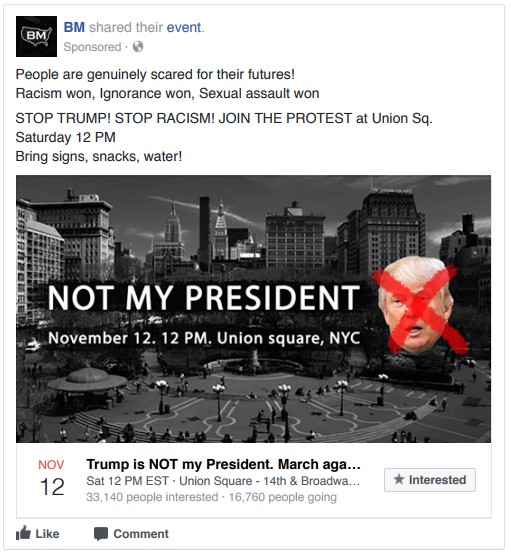
For example, [1] is an advertisement published for an anti-Trump protest by a group called "BM" (ie, a BLM variant).
The same group was also running this advertisement [2] blaming a "BLM Movement Activist" for killing a police officer.
Then they also run [2]: "Don't shoot", a "we aren't against police we are against police brutality" promotion.
They get engagement on the reasonable sounding things, then slowly ratchet it up until groups which sounded reasonable originally are doing things like claiming that the Black Panthers should be celebrated[4]. You can bet that will be used in ads on the other side too, just like "AntiFa" is used as a bogey man at the moment by the right, or "the Mercers" is by the left.
Do you honestly believe this? While ignoring your biases can you say, without a doubt in your mind, that the New York Times is near the top of the list of biased new sources? Thinking of all the other places to get your news, you can't think of a more slanted source? None of MSNBC, Fox, Breitbart, RT, Huffington Post or WorldNetDaily come to mind?
Again, the problem is that "social media" is so centralized.
It seems to me that there is too much focus on "how Facebook and Twitter are doing it wrong". Reliance on Facebook and Twitter to solve misinformation is absurd. We should be focused on alternatives.
You want to hold InfoWars accountable for the accuracy of its stories? A noble intention, but probably doomed.
One of the interesting things I noticed during the election cycle was the amount of vitriol directed at fact checking organizations like FactCheck.org and Politifact. Calling them partisan hacks and just wings of the DNC was commonplace in some circles. It all seemed rather brazen to me, but shockingly it also seemed to work.


He was lauded for using "big data" and "data science" to run a successful campaign.
The social media companies picked on this and ran with it. Now this seems to have backfired.
Then there has been the culture of "attack ads", a lot of them based on misrepresenting facts to put it mildly.
So, now Congress and politicians want to do some posturing on Russian "interference". In case they do pass laws banning RT or some special interests from buying ads/bots etc. What then? The can of worms is already open.
People will find a way around. It can be as simple as registering a LLC and then having the Russian "data scientists" work through that. Or even American companies knowingly engaging in this.
The root problem here is the data collection being run by every other company out there. It helps companies and invariably advertisers identify people based on their tastes. So, will Congress and the politicians actually ban outright data collection? My guess is they wont. Posturing this as a Russian and a commie problem gets them enough brownie points.