Read through the paper. It doesn't reveal anything really surprising, but it's a start. Conclusion was:
- Most people want to change their personality
- People with personalities that are considered "negative" by society (ex: introversion) wanted to become more extroverted
- People that wanted to change their personality, did change their personality slightly, and self reported daily behaviors that worked toward the goal (ex: “I smiled and laughed with others,” “I mixed well at a social function”)
- Personality at the start and the end were self reported, giving way to bias.
Are they changing their personality or are they changing their behaviors? I would think of the personality as the predisposition to certain behaviors.
You can change your behaviors to differ from those you're predisposed to; but it takes more conscious effort to maintain those behaviors than it does to maintain the ones you are predisposed to.
And changing those behaviors doesn't count as changing your personality, though it may change some people's perception of your personality. Changing behaviors is something we all do at least situationally (even the most cheerful, boisterous person will generally manage to be reasonably subdued at a funeral). That doesn't mean we're changing our personalities every time we walk into a funeral home.
Depends on how it would be perceived. I did something similar to the described increased-extroversion. I believe my work proved successful - of sorts.
I still have the personality trait of being an introvert, but when I was specifically working to push myself, my tolerance for "things" was increased. So while my personality hasn't changed, specifically my preferences haven't changed, my tolerances and ability to enjoy things outside of my preferences has been flexible.
I wonder if that's what a lot of these self-reported people reported. "Before I couldn't go to a party and enjoy myself, now I can!" isn't exactly indication that their personality changed. Even if they enjoy the parties and want more, I'd argue that their personality could still be the same - it has been for me.
I also think ultimately my self-identified trait of introvert might not be correct - and likewise many subjects here I wonder if they might be incorrectly self-identified. For myself, what I think I really dislike is not the outside/etc - it's new encounters. I hate them. Really, I loathe them. Even things as simple as driving new places. The unknown area, the frenzied feeling of finding the correct street, parking in cities, etc. I don't like driving because of that, honestly. So am I really an introvert? I actually like going places, it's just that life brings a lot of unknowns, and those are ultimately what I dislike and I have to fight to keep a reasonable hold on.
I think if we were to dig into the reasons someone would want to change their introverted personality, it would be specifically to enjoy or at least tolerate situations they associate with being extroverted.
I wonder if the outcome is what matters. Changing one's personality may or may not be possible, and would certainly be a difficult task if it were, but obtaining the behaviors associated with the desired personality are attainable. Isn't an introvert saying they wish they were an extrovert (for example) really just shorthand for wanting it to be easy to interact and socialize, as they imagine it is for extroverts.
As a personal example, I've recently taken a short sketching course. If only I had the "artist" personality type, then I wouldn't have to put in the hard work to learn to draw. So I wonder if what we regard as contrasting personality types in others isn't a proxy for a form of talent that we either don't have, or don't readily perceive in ourselves. And from the outsider position, it's very difficult to know how much work someone has spent honing a skill. The "natural" may have worked very hard indeed.
>> Isn't an introvert saying they wish they were an extrovert (for example) really just shorthand for wanting it to be easy to interact and socialize, as they imagine it is for extroverts.
Introversion vs extroversion isn't really defined (as I understand it) by your social skills or even your desire to be around people. It's based on where one derives their mental energy. Introverts can socialize but it is mentally taxing and they need alone time to recharge. For extroverts interacting with people is exhilarating and kind of is their way to recharge. In this light, you may be able to change a persons ability to socialize but not so much the effect it has on them. I don't think these are entirely separate either If you're not good at it it's got to be more taxing, but then perhaps ability and self perception are not the same thing!
Perhaps the reason extroverts find interacting with people exhilarating is because it's not much work for them. Or perhaps because their perception of what is at stake in an interaction to be less than what introverts perceive. Better dancers step on fewer toes, as it were. And while I'm sure there are terrible dancers with a thousand hours on the dance floor, they must be a rarity.
Practice won't turn the introvert into the Haile Gebrselassie of social interaction (natural talent exists), but it will help. A couch potato will suffer through every mile of a run, until they give up. A seasoned runner will be energized by a run over the same distance.
I would characterize an extrovert's social interactions as existing in a state of flow. An extrovert has a perception of their ability that closely matches their actual ability. An introvert has too little confidence in their actual abilities, or too little ability.
So my point, and if nothing else, I've convinced myself of this fact, which might be useful in a fake-it-until-you-make-it fashion, is that social interaction is a skill, a learnable/teachable skill. And as such, we can group those who possess this skill into introverts and extroverts.
If you condition yourself to more regularly exhibit a certain behavior, how is that different from changing your predisposition towards that behavior? Certainly, new habits can be formed and over time people come to exhibit new behaviors reflexively if they've made a habit out of them. Some habits may be harder to form than others, and one's environment will always have a major impact on which habits they're able to form, but there doesn't appear to be a strict limit on one's ability to alter their own behavior (even if there may be a healthy limit).
> If you condition yourself to more regularly exhibit a certain behavior, how is that different from changing your predisposition towards that behavior?
In practice, it's often only the same behavior at an abstract level because the drives and sensations involved aren't the same. For example, many gay men have gotten married to women, had sex with them, and raised children with them. Deaf people sometimes seem to hear things because they've trained themselves to look for associated cues that non-deaf people aren't aware of. Colorblind people sometimes go years without anyone realizing that they're colorblind because they learn what colors common objects are expected to be (e.g. the "go" light on many traffic signals will look gray/white to someone with deuteranomaly, but it might not even occur to them to call it something other than "green light").
A personal example of what could describe the difference: Since I was a kid I had a tendency to isolate myself and gravitate towards activities that were compatible (computer stuff, books, etc.) I spent much of my twenties 'practicing' extraversion and felt like I made a lot of progress.
In more recent years, for various reasons, I stopped 'practicing' and it's been kind of shocking how quickly I've reverted to the original 'baseline' hermit-like life.
While of course I hesitate to draw firm conclusions about my 'nature', it does seem as if a good 10-15 years of effort have not made being more extraverted any more natural, just easier and tolerable.
Contrast that with my extravert friends who can barely manage to spend one day alone, and have been this for most of their lives. I'm sure they could learn to tolerate solitude, but I wouldn't be surprised if they have a similar tendency to 'revert' to their extravert selves if they don't put in continuous effort.
I don't know what can change the nature of a man, but I think simply changing your behavior is not enough to do so.
While it certainly is possible to form new habits, but as long as they go against your nature the price to pay for this is high: you could cultivate a neurosis or depression by doing so.
"While it certainly is possible to form new habits, but as long as they go against your nature the price to pay for this is high: you could cultivate a neurosis or depression by doing so."
How can you separate them? From the perspective of an external observer, personality is a set of behavioural traits. Other than self-reported inner insight (which may not be true) there's no other way to establish what someone's personality is or even define it.
I've changed my personality in the past, always for the better (I think). At school I was shy, couldn't talk to women, found it intimidating to socialise in new groups of people, wasn't entertaining, lacked confidence. All the usual stuff. I didn't like any of these traits and set about changing them. I had a bit of help along the way, but it was mostly my own doing.
These days I am confident, can easily entertain women with amusing conversation, do public speaking regularly, can mix in large groups of strangers without problems etc. It's a big change. Once or twice friends who have known me continuously since high school remark on it.
One issue I'm currently pondering is that of personality disorders. To what extent is such a "disorder" something the individual can fix with sufficient self reflection and willpower? My own experience tells me personality is quite plastic. So perhaps I find myself lacking in sympathy for such people. They can and should heal themselves.
Some predispositions are plastic and can be altered over time by behavior, though it is a complicated business. New preferences, new problem-solving techniques, new mental hygiene habits, these can all effect real change at what many people would call the “personality” level.
In my personal observation a lot of discourse over personality stems from the fact that there are two differing ideas that both use the same word - personality - to define themselves.
One idea defines personality as an innate wiring of your cognitive processes given to you based on your genetics.
The other defines personality as the sum of all factors leading up to your current personality state (including your innate wiring).
Both of these ideas are true - there are some innate dispositional tendencies that are very observable, and there are also lots of things (structure, habits, practice, and improvement) that you can do to change yourself.
IMO, most of the arguments in the personality space come from the fact that the word "personality" is defined so loosely.
> One idea defines personality as an innate wiring of your cognitive processes given to you at birth.
AFAIK, there isn't anything special about birth which would freeze brain development at that point. Baby brains are quite undeveloped - they don't experience the world like we do.
Your genetics do fix something at the time of conception, but otherwise it's a continual process based on experience.
Recently, I heard an interesting concept from a long-time clinical psychologist:
"Society constrains and kills you even. You die into your neural configuration. When you're first born you have more neural connections than you will ever in your life, and most of them die. And so, you die into your four-year old self, and between ages 16 and 20, you die into your adult self."
What is personality except a set of cognitive biases? The narratives we use to inform our perceptions, influence the priority of memories/associations, and inspire future decisions are as much our own making as they aren't. If there is friction between views of personality because one group prefers to look at innateness and another looks at influences - and intelligence doesn't seem to determine which group you're in - what other indicator of personality differences do you really need? For me it plugs into that external/internal locus of control stuff, messy as some of the research/conceptions of it are.
I'm of the opinion that most views we think we hold 'philosophically' are, well, personality tendencies expressed formally.
It all gets a lot easier to conceive if one doesn't assume there is such a thing as a unified self, just a bunch of modules our self-describing narrative inhabits depending on what the environment asks for at the time. Specifically 'training your pre-frontal cortex' seems easier to me than 'becoming a more organised person'. Sorry if that seems a little rambly/obscure.
I interviewed at a place (looking for Scala devs) that had me take a MBTI test after several rounds of (I believe) successful interviews and a take-home coding assignment. I tested INTJ, as usual. I never heard from them again.
Given what I could glean about the culture of the place, I presume the 'Introverted' part of my personality was the issue. Though, you would think a company full of extroverts wouldn't have a problem telling a candidate why he was rejected :D
They may have had too many inteoverts already and needed to balance things out (though personally it’s hard to imagine giving a test like that any weight compared to actual interactions with a person).
Whenever I try to fake it and act like an extrovert, I'm pretty sure it comes off fake, weird, and quite possibly creepy in an "uncanny valley" sort of way (i.e., "He's acting like a human being, but something's off").
I'd say it is, but not by directly confronting them with their personality (e.g. saying "you're a dick" every day), but by more subtle behavioural things (like being nice to them when they're not being a dick).
that really depends what you want to achieve, there has been lots of study that shows you can take reasonably well functioning people and break them through repeated stress.
I'm a personality type coach and I help people implement the kinds of changes described in the paper. There are many different models that deal with this kind of change. But taking one step back, I think it should be made more clear up front that "having a desire to change one's personality traits" itself is a trait. There is no need to pressure (most) people to change, and many good people feel a strong pressure to change just by being on the internet. Some seem to have a natural desire to change. They are self-improvers by nature. Some are curious, more open in general. They try this or that and wonder how life would change if they were more of an introvert, or more conscientious. Others are pushed into change, brought to their knees, so to speak, by patterns of poor outcomes in their lives.
One of the often-unspoken realities here is that this growth and change will cause anxiety directly. It's observable in any living organism. (Now think about New Year's resolutions...they can be real anxiety spikers) If any really pleasing dopamine reward is to come of this process in humans, its full manifestation is often very time-delayed as the change process itself takes its course. So depending on the traits and their role in the trait-changer's own systems, models, and beliefs, it is helpful to identify pathways that can involve the trait-changer's strengths and yield some increased leverage. For example, "being open to _what_ is less stressful than being open to _that thing I can't typically stand being open to_?" There's this blended approach.
Beyond traits, I find that typologies and archetypes are very helpful in establishing a quick and dirty template for change. If you identify as a "type" that finds benefit from developing cleverness, even if you yourself aren't very clever _right now_, we may see some surprising success if we try some exercises to identify and harness a latent cleverness in service of your goals. If you are a natural idealist, an idealistic princess who befriends all the little forest creatures, that's actually a very helpful model to examine as well. The story has been shared across cultures for many centuries, and it's a matter of running down the list of type attributes and noting the deltas with regard to your current life. I call my own method Type / Trait Interleave and so far I've been happy with the outcomes for my clients.
With traits we quickly understand the contextual you and your contextually-variant patterns. With type we get at questions of your core self and begin to understand how your contextually-variant patterns could be sabotaging or benefiting some other system functioning in your life. Thanks op for the thought-provoking post, I didn't expect to see it here. :-)
Given your description of your job, I have a quick question:
I have found that when I speak, I rarely command attention and captivate as some others do. Probably something in my speech patterns. Perhaps they are slightly more apologetic / geeky / nice than others. People may interrupt me or turn away, even people who respect me.
When I do get rapt attention, such as teaching a class, I get an impostor syndrome because I'm not that used to it. I don't let it show - and I finish my thoughts. But I feel my speech is more rambling and unfocused than it should be. I have so many asides that I want to get to, and I like to speak using true sentences so I hedge what I say sometimes, and other times don't make overly ambitious claims.
Is there a way I can improve this? What do you see in your experience?
Briefly because I'm pecking this out on an iPod :-)
In your description you have just tipped us off to an analytical gift. I would suggest that you deepen your analyses of your speaking performances, develop and test theories, and refine what you described above into a model for improvement that ever more closely fits your problem like a tightening wrench.
Archetypally, I recommend that you watch films or read books like The King's Speech and note every thought pattern and technique that you can single out. "He talked to so-and-so about X. She encouraged him to try Y. In Y he found that..." (Now, who can I talk to? How will I approach their feedback?) Even if you have no speech impediment, these patterns will probably be broadly applicable to your needs. Good luck!
Try and make your sentences short and to the point. Take one of the paragraphs you spoke, then repeat it over and over and over again until you're at the point and avoided the tangents. I'm no expert but I think that's also why your colleagues stop listening, because you don't get to the point. Avoid fillers too - uhs and ums, stuttering, stop-words, etc - and try to focus on bringing your point across in a single, firmly worded sentence.
So taking your one sentence:
> I have found that when I speak, I rarely command attention and captivate as some others do. Probably something in my speech patterns. Perhaps they are slightly more apologetic / geeky / nice than others. People may interrupt me or turn away, even people who respect me.
You could rephrase (and speak) this as:
> When I speak, I rarely command attention and captivate as some others do. People interrupt me or turn away, even people who respect me.
People have a short attention span. I myself tend to mostly ignore this one colleague I have because pretty much half of what he says is filler, like, a ramp-up to his point ("so uhh, basically, like"), his main point (stuttering and lots of uhs), and end-filler ("you know?"). Mind you that he's not a stutterer as such, he just needs to make noises while he's trying to think of what to say next (like uhs). Not speaking in his native language is also a factor there.
TL;DR: Firm, short, unapologetic statements. "We should do this" instead of "Uh, guys, excuse me but, like, I think we should sorta lean towards this?"
May I forward some advice that was given to me and worked quite well?
Firstly, don't worry about impostor syndrome. Given you're trying to be someone you're currently not, it's entirely normal.
Secondly, and teaching a class is perfect for this, set up a situation where you can plan what you want to say. Not word for word, but the key points you wish to get across. Make sure you're clear, to yourself, what are the key points and what are asides. When you present, it's fine to use words like "generally" and "usually" while you explain key points but stop yourself from describing or explaining asides.
The first few times are uncomfortable but it should get easier. Over time it'll start to feel wrong when you're about to talk about an aside and you should find you need less planning to keep to the main line. You may also find that this will carry over into social conversations too.
BTW if it helps you for a class context, you can always caveat the lecture up front. Something like "although what I'm about to go over is generally true there are a few corner cases that I won't cover. If you have any questions please ask".
Something else that can work is asking people to give you honest feedback about your communication style. Ask them to be completely honest and don't lead them. The key to making this work is to accept what they say at face value i.e. don't argue it, question it or offer mitigations. Just use it as feedback.
However, for this to work you do need to be able to ask for feedback without leading and accept criticism. If you're not completely sure you can do that then it's best not to try.
I have coached 600+ people on how to be more engaging in their speech, for money, over several years and in several countries, as part of a previous job. This is skill, not behaviour, and it can be acquired.
Record yourself and see how people see you from outside. Since you have analyzed yourself that well (from your inside perspective) you'll catch a lot of details from seeing what you do, how do you express yourself, your pauses, your tone... then compare it with other people you admire and see what's different.
Also for the impostor syndrome, do this once in a while and compare old videos with the new ones; you'll be surprised with the result ;)
You are probably just anxious or you aren't thinking about what other people are listening for. A good speaker asks themselves what the objective is, and follows it directly. Other reasons might be: sounding whiney, squeeky, overly descriptive/ornate, or off-topic rambling. Those things are easily remedied by not talking to people about things they would find boring. ie. finding more aligned friends. Anyhow, good luck.
"I have found that when I speak, I rarely command attention and captivate as some others do. "
Be careful with that assessment. You may captivate people like others do but you may not notice. I learned that in toastmasters. I thought that everybody had checked out of my speeches after the first minute but actually people listened and liked the speech.
Attention is often commanded by subject. It could be that with some people you're just talking about something boring, and with others you are literally the only source of information and people paid thousands of dollars to listen to you.
Basically, try talking about something the people you are talking to want to hear.
Try watching some videos of engaging speakers and focus on their body language and arm movements. Body language has a tremendous influence on people, sometimes moreso than words.
I've been thinking about this recently as it pertains to changes in my own life... I've been training myself to be less addicted (in the general sense), and I've noticed several aspects of my 'personality' flip like a switch, in terms of preparedness to deal with uncertainty, fitting extroversion or introversion to the context, sticking up for myself but being more pragmatic in other ways.
You might (probably correctly) say I'm coming out of a depression through my own CBT interventions, though I'm pretty sure I was already on an initial upward trend because of positive environmental changes, so chicken/egg.
What you mentioned about anxiety triggered a lot of associations with Sapolsky's writing on stress (Why Zebras Don't Get Ulcers etc), and how bodily aspects interleave with personality tendencies... I do wonder sometimes if a very 'Cartesian' view of personality is problematic pragmatically and philosophically. I.e., 'I'm just an introvert' can be reached by a bad diet or untreated psychiatric symptoms or low social status or just plain old preferring fewer social contacts, and so it's difficult to really /do/ anything with that conception of onself.
Hey there. I'm a personality type enthusiast and would be interested to chat about some of these things. If you're up for it, send me a note to: trolochecr@hs130.com
This is taken from correlations with facebook likes. There's a lot of interesting observations here. For instance, introversion correlates very strongly with "nerd culture" stuff. Openness seems to strongly correlate with left or right politics. Emotionally stable people seem to like sports and outdoor activities (adding to a weird theory that lack of sunlight and exercise causes depression.)
There is nothing weird in theory that lack of exercise causes depression. The human body needs physical activity, it does not feel as good without it. You don't have to try 10000 people for years to know that, you can do it at home in a week.
While it might not be causing depression instantly, feeling bad in your physical body certainly doesn't help depressive tendencies.
Also lack of sunlight means less Vitamin D production. It's a big problem in northern countries where people have to take Vitamin D supplements.
Some of that stuff is considerably culture dependent, so I don't know that I'd call it "The most interesting", but it is fairly thought provoking to a Western perspective.
What stood out to me was how Rap & hip-hop correlated most with Conservative and Relaxed types, I didn't expect that at all.
“Whether you think you can, or you think you can't--you're right.” ― Henry Ford
I think this is quite on the money. The problem is that many of us don't manage to think "you can".
For one thing, many hold kind of fatalistic beliefs and feel powerless. Others suffer from over-confidence. That's not really thinking "you can" but delusion. I could imagine that this is a nature & nurture thing and that nurture would be enough for most people if only they could find them-selves in an environment that's right for them. The problem is, however, that we still kinda suck at bringing the right people together.
In my own experience, you can teach yourself to be a bit more extrovert for instance, but the change is not permanent and you tend to slide back into your "defaults" very quickly when you stop actively caring about it (e.g. find yourself in a very stressful or low energy period). Very much like fitness, it requires the regular practice to keep it.
Just to clarify a common misconception introversion != shyness. It's a matrix of shy/not shy and extravert/introvert. Introverts prefer to spend more time solo, but certainly don't have to be shy. Not shy introverts tend to be the power players in society. And there is such a thing as a shy extravert. You all probably know one or can remember them from your earlier years. The wallflowers who go to every social gathering but don't really interact with others. As a not shy introvert, I can tell you that I enjoy and need the occasional social gathering, but too much time with others gets draining.
I'd go further - exhibited personality is essentially acting. You can get better at playing parts. There is probably a baseline of the 'real you' that happens when you're not 'on', and we can assert that the real you never changes.
But functionally, almost everybody can learn to exhibit personality traits that benefit them personally and 'commercially'. You can be on for the interview, the meeting, the one-on-one. And you can conserve your energy when working at your desk or at home.
You can execute patches but they don’t run as fast or as reliably as your underlying personality. Over a long period of time, the patches can become habituated and a kind of hybrid personality results. The underlying code remains.
Did you find that the generalisation of this model of software development was supported/not-supported in some way by the results being discussed here?
2) It was perfectly obvious that he was being clever.
3) The analogy was quite amusing.
4) The analogy does ring true... and even this research paper concedes the point that personal change is difficult and has proven elusive.
5) I imagine that if a wealth of actionable research results existed on this matter, that personal change and growth would have become more accessible already.
I'm often fond of saying that idealism is not lost in adulthood, but rather gets patched for real world vulnerabilities. So I generally like the idea of a series of patches making a whole. After all, isn't that what evolution is?
That's not necessarily true - the brain can rewire itself and probably will if some underlying functions are not contributing to your behavior. Maybe not actually deleted, but put into a low-power mode.
But that doesn't change your tendencies and dispositions necessarily, as I'm sure this paper is examing. I think there's a bit of fudging often when discussing personality on exactly what personality is.
Depends take imagination. Im sure there is variance in how imaginative people are intrinsically. But I bet the biggest difference is time dedicated to embracing that trait and expanding ability. Are you naturally a daydreamer, or are you hyper focussed on the here and now and perceive taking time for pure imagination as wasteful or worse puerile. Just a change in attitude and time spent might be all thats needed.
Tangential question - the study calls itself longitudinal and was conducted over 16 weeks. I was not familiar with the word so I googled longitudinal:
> A longitudinal study (or longitudinal survey, or panel study) is a research design that involves repeated observations of the same variables (e.g., people) over long periods of time, often many decades (i.e., uses longitudinal data).
An interesting angle on studying personality is through the lens of research on psychoactive substances. A study on magic mushrooms several years ago found that "just one strong dose of hallucinogenic mushrooms can alter a person's personality for more than a year and perhaps permanently." Previously, it was posited that: "personality rarely changes much after the age of 25 or 30..... This is one of the first studies to show that you actually can change adult personality.."
This raises the follow up question: what is changing? Is there a fundamentally different reaction to the same situation, or is there instead a different interpretation of the situation which is what is leading to a different reaction?
Cognitive behavioral therapy, the "most widely used evidence-based practice for improving mental health," provides evidence that the latter is absolutely a possible answer. "CBT is a psychotherapy that is based on the cognitive model: the way that individuals perceive a situation is more closely connected to their reaction than the situation itself."
Based on this, it seems very possible at least one way people can "choose" to change their personality (as defined by their reactions (feelings, thoughts, and actions) to situations) is to seek to find ways to change the way they percieve the world.
This paper is dangerous. It lets an ignorant mind assume that personality is a choice in some way, so a person with unpopular (e.g. more personal) personality traits will need to change those to more popular and sociable ones. People refusing to do so will be considered selfish and will be punished/excluded from society. Welcome to Orwellia!
What you're describing is actually the way the world is. People who find it easy to be pleasant get further in life, while those with antisocial tendencies experience rejection - even when they're make more of an effort to be pleasant than those for whom it comes naturally. On the other hand, the unpleasant person may discover a billion dollar idea thinking alone in his basement. So it goes.
I agree. Being pleasant is probably a mix of having a good dose of the agreeableness and extroversion personality traits. Both of which are uncorrelated to creativity and IQ, other two traits.
It’s definitely not impossible. You probably won’t have an easy time if you’re someone who requires the approval of a lot of people, for example, being a public figure or exploiting your image.
This is an alarmist response. From my own experience, a person CAN change their personality traits dramatically over time. Simply acknowledging that this is within your power doesn't change anything. Socially imposed "personality requirements" already exist anyway.
Thanks for pointing out the „over time“ aspect! Many people with problems want to do some kind of 30-day-program to get rid of problematic traits. Yet it might take years to really change how you think and what the outcomes are. I, for one, have had active bad personality traits that were holding me back (I wanted to overcome them, but couldn‘t), yet when in my early 30s, I came into a peer group that was very supporting, I finally got the grip and was able to reveal the better parts of me and had good success in life (and boy, life feels so good now). I certainly have not deleted the bad traits, but learned to work around them so they do not affect me much. Time and people were my key factors. Who wants to join a 3-year-program... does not sound that sexy, but is what it often takes to change.
Yes, it definitely takes time. You're right, it requires that you "change how you think". From my experience, the easiest way to do this is to surround yourself with people who have traits you admire. They'll rub off on you!
>so a person with unpopular (e.g. more personal) personality traits will need to change those to more popular and sociable ones.
There is a whole bunch of assumptions here. Why need? If you are ok with the way you are (you chose you are) why do you think people should pursue social status higher than their own choice and views? Also, social and popular traits are constantly changing, it requires enormous energy to keep up with trends. They also depend on society, culture, and a billion of other factors.
The way you should look at it is it gives you an idea that you can adapt your personality the way you want it. You want to be social - get some social traits. Want to be respected - another bunch of traits. Want to be a somebody else - do it accordingly.
>People refusing to do so will be considered selfish
People who want to judge and "consider" other people selfish just chose this trait, aren't they? So it's their own problem, not anybody else's.
>will be punished/excluded from society
Which one? There is a bunch of societies out there, you are probably excluded from many of them already today. Are you in a society of richest people? politicians? religious groups? street junkies? criminals? probably not, you are already excluded. This is how society works, you want to be among a certain group of people - get certain traits. As easy as that.
Is there any reason to think it's not a choice at some level? I doubt it's a conscious choice, and almost certainly guided by environment and habituation, but I also suspect it's malleable to at least some extent.
I'd also say that what you describe is just a more extreme version of how the world currently is - people with more popular personalities _tend_ to get further.
At some point you can consciously reflect on what those personality traits actually are, but you can't be sure what they are exactly. Personality traits are not directly observable, whereas behavior can lead to observation of trends, from which a personality trait can be deducted. So, the first and most difficult part of changing a certain trait is to identify it thoroughly. Also, it depends on who is observing whether a personality trait is actually likable or not. Extreme expressions of such traits are the most obvious. But aren't all traits to be taken into account, because the extreme ones always stem from myriads of nuanced trends in behavior? See, it's not at all that easy to identify a certain trait, not to speak of consciously changing a certain behavior over a long period of time.
Why are some traits more likable than others? Which ones are real and which ones are faked or biased (actors, salespeople, etc)? This paper goes far deeper into those questions than I intended to do. My point was, that there are people out there (and also here) who will take this paper, read the abstract, assume that changing one's personality traits is as easy as drinking a beer and go tooting that misinterpretation of actual facts as alternate facts. It's not a yes or no choice. It's not as quantifiable as a beer. It's an expression of behavioral trends.
Anecdotal: I've found that personality is a choice, to an extent.
If you've ever known somebody who served in the military, you know that they often come back a changed person. I'm not talking about PTSD in combat vets, I'm just talking about simple personality traits like neatness.
On a more self-driven note, I became a less patient person in some specific ways after I lost a parent some years ago. (Because it become painfully obvious how limited our time is...)
>People refusing to do so will be considered selfish and will be punished/excluded from society
There's nothing wrong with expecting someone to change their personality. Even if you want to claim that it's not a choice, it is a choice to at least attempt to change your personality, and that's the very least we should expect from anyone who has negative personality traits.
You certainly mean behavior. Personality traits aren't as easily switched on and off. But you're actually confirming what I just criticized about this paper.
No, I mean personality. Do you think of personality as something being intrinsically tied to a person?. Is a person's personality ultimately what we think of as "them"?
I think for most people, personality, memory, and physical appearance (especially facial appearance) are what they think of when they're forced to ultimately explain what actually constitutes a person.
Most people consider these things unchangeable because the effort and potential risks involved are, to them, unreasonable to the point of being unthinkable. Extensive therapy, psychological conditioning, chemical experimentation, surgery...
Generally, I think people just don't want to change, but they use the argument that it's impossible to change these things as a defense. Then they fall back on "well no one should need to change themselves".
They're perfectly fine as is, after all. How dare anyone say otherwise? You just have to accept them as they are, and if you can't deal with it, that's your problem.
> Is a person's personality ultimately what we think of as "them"?
I would pull up a huge debate right here. Who's perspective are we using? What if people have different perspectives even after knowing the person in the same capacity? What about what the person is biologically dispositioned towards? What about mental illnesses? The list of questions goes on, none with good answers I think.
> Generally, I think people just don't want to change, but they use the argument that it's impossible to change these things as a defense. Then they fall back on "well no one should need to change themselves".
This is again proving the original comments point. In order to make this claim true, you have to assert that you can change your personality. We first have to agree on what personality is, and then see if we can change it. We do not really have good answers for either of these. This paper is an attempt but as summarized well, far from conclusive or without flaw. I would argue that people are changing their actions, not their personality.
>What if people have different perspectives even after knowing the person in the same capacity? What about what the person is biologically dispositioned towards? What about mental illnesses.
I would include all of these things under my definition of "personality".
>I would argue that people are changing their actions, not their personality.
Yes, you're right. I'm thinking purely in terms of internalized thoughts and externalized actions. Going from "I want to do X but I will be punished for it even though it's my first inclination, so I will do Y instead", to no longer thinking of X at all and your first inclination is Y (the "right") thing. To me, your internalized thoughts and the decision-making behind your actions are part of your personality.
The realized actions that actually occur are separate from that. Changing your personality means removing branches from your internalized decision-making that would have existed previously, so they're no longer considerations.
A hard second to this. I would make a clear distinction between personality traits and actions.
This will mix subjects and I don't know enough to plant a flag on this hill let alone die on it, but imagine the moral serial killer who has urges to kill but never acts on them. They can't change who they are (as an adult as far as I know from current research), but they can try their best to affect actions. But their traits underneath are not changing.*
* Ignore the actual claims re serial killers, changing, and how that actually probably isn't personality traits, or maybe it is. Point being, it highlights a key difference between the state / biology of a person and how they act in the world.
Yes. You could be be born with pedophilic tendencies, but through active effort, avoid harming children in any way.
As for changing your personality, it's extremely hard and frustrating even if you're not a criminal, and your traits are, for the most part, harming only yourself. I've tried an extensive array of approaches... Nothing has been able to fundamentally change who I am in a way that will lead me to a happier, more successful life. Having done all the "right things" that people say are supposed to work and having them all fail, it then gets very tempting to go down a darker path.
I fucking wish it was as simple as just making a decision to change, carrying out some well-defined plan, and arriving at the destination. It is definitely not.
>This will mix subjects and I don't know enough to plant a flag on this hill let alone die on it, but imagine the moral serial killer who has urges to kill but never acts on them. They can't change who they are (as an adult as far as I know from current research), but they can try their best to affect actions. But their traits underneath are not changing.*
I firmly believe there is a way to change/cure those traits/urges given modern means, while still allowing the subject to possess complete freedom and agency.
> that's the very least we should expect from anyone who has negative personality traits
Who gets to decide the class of negative personality traits? Is there some objective measure of this "negativity"? It seems there are some gaping holes in your position which are probably impossible to fill.
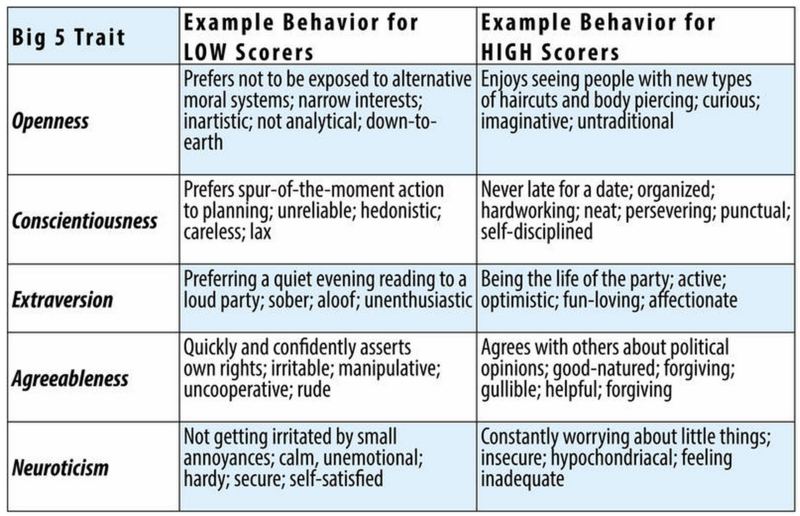
This is based on the "Big Five" personality traits that are fairly well established: Openness, Conscientiousness, Extroversion, Agreeableness, and Neuroticism or OCEAN.
Was listening to a talk on the radio while driving home today by a couple of psychologists/college professors, Southwick and Charney, and it was specifically about resilience but has some applicability to this topic - and they had suggestions for judging your quality of life and how to improve it, and how to make you or your children more prepared for challenges in life. Found the website about it and they recorded it in 2013:
http://www.harvard.com/event/steven_m._southwick_and_dennis_...
From that, it's obvious that some personality traits can be changed (e.g. being punctual and neat) but others will be very hard (e.g. curious, imaginative, self-disciplined, feeling inadequate).
Using Stranger Than Fiction as an example in this paper rubs me the wrong way, maybe because it also accounts for about a third of the conclusion.
I like that movie, but it doesn't really add anything to the paper and even if it does I feel like this is the equivalent of saying "In Harry Potter a boy finds out he's special and goes on a magical adventure. Can we all find out we are special?"
"You can have more than you've got because you can become more than you are. On the other side of that coin: If you don't become more than you are, you'll always have what you've always got"
-Jim Rohn
I believe that anybody who has put in any effort into bettering themselves knows for a fact one can completely change his/her own self-perception, and in-turn, their personality.
On the part of actually changing those traits, one could attempt to use a very precise radiotherapy machine combined with FMRI to find and kill the parts of your brain that bother you.
I'm not really sure I'd want to try to literally hack my brain this way. I have a lot of traits I don't like (hey, I'm posting this here while I should be working... Look! Shiny!) I understand they are what makes me the person my family loves (although some may say it's an acquired taste)
You can, many religious evangelisers are born introverts and self-adjust to extraverts by talking to large numbers of people spontaneously (forced, at first).
I don't think personality can change. What can change is the situation and the people you interact with, and depending on them, discover aspects of your personality you weren't aware of before. Maybe that counts as a change, but it's just better self knowledge and world knowledge.
I also think personality is not unique - we have a whole range of "personalities" we employ depending on who we talk with and what the situation is. Thus, personality is a function of self-values and external situation - we have many masks, one for each occasion.
That guy, how he dresses, the wristbands, the pictures on the wall, steam-punk lamp... Most contrived thing I've seen in a VERY long time. Which is a pity in that I needed to forcibly focus myself on what he was saying, in spite of my bias. Because maybe he might have had something useful to say.
That is frankly one of the weirdest things I've ever heard.
You can't listen to someone because his style and choice of decorations is different? At least you recognize that you're biased, but you should really try to fix that part of your personality.
You'll miss out on a lot in life if you immediately disregard things and people just because they're slightly different than what you're used to.
I understand the feeling, i had the same thoughts first time I've seen the guy on video, i think he just comes across as a sort of salesman-type which can give a wrong first impression on his actual experience and knowledge.
You probably can, but the key word here is "change". I believe you can somehow "change" personality. You can't however "add" new personality. Changing personality requires sacrifice, abandoning the old self and many things that you currently love. And that is truly hard. At least that's what i believe.
If anyone here is looking to change something in themselves, I recommend this book (or audiobook, in my case) "Breaking the Habit of Being Yourself" by Dr. Joe Dispenza.
Sometimes just by being conscious and watching yourself as an external spectator of your own thought can do wonders.
Obviously these traits can change. Although for extraversion it is questionable (extraversion is not a merit, it's more like a gender kind of a "trait"), development of agreeableness, conscientiousness, stability and openness is what defines a character maturity of adult/adolescent person.


- Most people want to change their personality
- People with personalities that are considered "negative" by society (ex: introversion) wanted to become more extroverted
- People that wanted to change their personality, did change their personality slightly, and self reported daily behaviors that worked toward the goal (ex: “I smiled and laughed with others,” “I mixed well at a social function”)
- Personality at the start and the end were self reported, giving way to bias.