This locks toy companies into a challenging bet. Every year, they have to a) predict trends, b) invent them, and c) commit capital to them. All without knowing how the rest of the year will turn out. Since toy trends exist, but don’t last for very long, they have to invent new products every year—but the technological state of the art doesn’t advance very fast. It has all the volatility of tech, without the progress.
Insightful post. This succinctly explains why most toys are movie-related. It's the easiest trend to predict.
Agreed, got some good insights in the article and I will be reading more as well.
Also explains the sequelitis of the video game industry: while new ideas/IP can succeed, it's a risk. People really want more of what they know. Consider a random platformer, or the exact same game reskinned as Super Mario.
A tangent, but this is one reason Nintendo is so successful; they know the characters sell, while at the same time understanding it’s not the characters but the quality of the game and that really matters and brings customers back for more.
That’s why they first experiment and develop a lot of game ideas looking for the most fun mechanics. Then after something is shaping up into a great game, they look at the IP catalogue and see what skin to put on top.
Edit: In general, but not 100% of the time. The Zelda team is mostly consistently the Zelda team and does set out with intent to make the next Zelda game, for example.
> A tangent, but this is one reason Nintendo is so successful; they know the characters sell, while at the same time understanding it’s not the characters but the quality of the game and that really matters and brings customers back for more.
I think you undersell this comment: it’s far more than a tangent.
Nintendo and Bandai the only companies I’ve worked with who I’ve Consistently heard the term “fun” discussed at the executive suite level, or a level below. Back in the Ken Kutaragi days at Playstation (SCEI in those days) this was true as well.
Hasbro seems to value playfulness, but in my more limited experience The higher up the chain the less relevant it was. Could be that the execs took it as a given?
Never came up in any AAA titles I talked with folks about at the companies (but big disclaimer: I never worked on one!)
You don’t have to be Marvin Acme, but “fun” seems like a pretty basic value, while objectives like “engagement” I’d see as a consequence,not a primary goal. I think understanding this is what has made Nintendo so successful for decades, and has allowed them to survive flops.
I used to love reading those Nintendo Power magazines when I was a kid. I can't believe they actually got people to subscribe to it. Most likely, it was parents who bought a subscription for their kids.
As a kid, I always marveled about video games. The wizardry behind it was always fascinating to me. And Nintendo elevated video games to an art form.
Decades later, I finally built my own basic video game, and I finally unraveled the mysteries behind it all. It's like you finally saw the true structure of the The Matrix in its coded form. And you said to yourself, there is no spoon.
I think this is doing a massive disservice to Nintendo. Certainly, they have their "cash grab" franchises, like Pokemon, "New Super Mario Bros <x>", and arguably, Mario Kart/Mario Party.
However, Nintendo has always done a phenomenal job in reinventing their franchises - sometimes to the dismay of fans of that franchise. For example, take the 3D Mario games. They have continually reinvented the series, from Mario 64, to Mario Sunshine, to Mario Galaxy, to Mario Odyssey.
Or take Zelda. Breath of the Wild is a massive departure from the traditional Zelda formula.
An example where they've reinvented to fans' dismay has been Paper Mario. After Paper Mario: Thousand Year Door, fans just wanted more of the same formula. Unfortunately, they've often take the series in a direction that long time fans don't appreciate.
I recently read Mac B Cracks the Code (http://www.amazon.com/exec/obidos/ASIN/1338594230/donhosek ) to my kids and there's a history of Nintendo as part of the story. They began as a playing card company in 1889, entered into businesses like making instant rice and offering taxi service before getting into toys in 1969 and releasing their first video game in 1973. They've got a long history of reinvention.
Isn’t there also a limited set of genres of games anyway?
Why would you rebrand Starcraft if the players only want a reskinned version of Starcraft 1? There’s probably not much new you can invent by trying a totally new RTS anyway.
We don’t reinvent football for example. Reinventing it would get rid of the whole industry around the watching of football.
I think that is where creativity and imagination come in. I'll give an example I encountered recently. Northgard by Shivo Games. It is absolutely brilliant, thematically and mechanism wise, a re-take on the traditional RTS.
You could call that a full genre, but it’s nowhere near the creation of RTS or FPS genres themselves.
“Battle royale” is simply a recent development because up until recently we barely had any 3D shooters which had maps huge enough to allow for this style of play.
What really gave birth to BR games was the invention of the "eye of the storm" mechanic. From a technical perspective BR could have been implemented as a mod for Operation Flashpoint as early as 2001 (not coincidentally the genre has its roots in OFP's spiritual successor, ARMA). What was missing was a way to keep the pace of game from fizzling out as the player count dwindled. The blue circle in PUBG was a brilliantly simple and effective solution. It's one of those things that looks blindly obvious in hindsight and makes you wonder how it took so long for someone to think of it.
> It's one of those things that looks blindly obvious in hindsight and makes you wonder how it took so long for someone to think of it.
Particularly since the movie Battle Royale had a mechanic that filled the same role (sectors of the island were declared off limits to force students to encounter each other.) Not quite the same implementation, but I think basically the same idea.
You're probably right that Hunger Games was the immediate inspiration for PUBG. I understand Hunger Games to basically be an American adaptation of Battle Royale though (and also derivative of The Running Man.) Battle Royale already had "cult classic" status in America by that time. The naming of the genre seems to support the notion that the public was generally aware of Battle Royale. Before Battle Royale the term was in use, but generally referred to free-for-all boxing matches. The modern use of the term to describe Hunger Games or PUBG seems to closely resemble the premise of the Japanese movie/book.
It's one of those things that looks blindly obvious in hindsight and makes you wonder how it took so long for someone to think of it.
Multiplayer Bomberman had this back in the 90's! I loved that game in high school.
But yeah, combining it with putting 50 people in a FPS deathmatch came much later. In video games a whole lot of innovation is combining a few ideas that already existed somewhere else. Well, not just in video games, really....
> “Battle royale” is simply a recent development because up until recently we barely had any 3D shooters which had maps huge enough to allow for this style of play.
It's often surprising how long it can take for things to become mainstream. The first Battle Royale mod dates from 2013. And Planetside supported hundreds of players in a single match back in 2003.
UT2k4's Onslauth and every Delta Force games disagree. Especially the ARMAs, which this "new genre" had been there for about a decade (even more with Last man standing mod/es).
Is it insightful? I really don't have the subject knowledge to judge. But I sure frowned on the claim that LEGO has no brand loyalty. Maybe I misunderstand brand loyalty, but not only did I (as a child) and does my own kid now keep going back to LEGO, it's me who infected him. When my kid has some fake LEGO, he sorts them out into a separate pile.
I thought that the article argued that Lego is an exception to the rule in that it does inspire brand loyalty.
Also, what investors mean by brand loyalty is fairly specific: A customer who buys into one brand continues to buy it for years or decades.
Kids are fanatical about the "in" brand of the month, but will drop it without a thought as soon as a new trend is "in".
How many kids are tripping over themselves to get the latest Spin Master toys? Most probably wouldn't even recognize the name. Just a couple years ago, stores couldn't keep their Hatchimals line on the shelves. None of that excitement carried over to their other products.
lego is clever because it locks you into a platform. it's the kid equivalent of buying another cordless power tool of the same brand because you already have the batteries and charger for it
This is true of lots of retail, including clothing too. And many of these companies take on a lot of debt because the cash flows mistakingly seem predictable and stable. Until they’re not.
The best bet for many of these types of firms is to improve processes and systems to shorten the cycle time. (Think lean manufacturing like Toyota)
> Since toy trends exist, but don’t last for very long, they have to invent new products every year
Fortunately someone already invented blocks (and construction toys) slime/goo (and science/exploration/messy craft kits) and monopoly (board games.)
Most "new" toys seem like variations in very well-established categories; something like hatchimals combines plush toys, robotics and collectibles (furby DNA apparently) along with the regrettably persistent trends of unboxing videos (youtube) and randomization/gambling (capsule toy machines, etc..)
It’s interesting to me that someone can charge $20/month for a daily post (presumably without ads) and subscribers seem more than happy with the value proposition but the newspaper industry struggles to sell an entire newspaper worth of content for the same price. I wonder if newspapers would have more success “unbundling” their columns. Or at least unbundling the sections of the paper.
I pay for two newspaper subscriptions and it’s a lot like a gym membership where I start to feel guilty if I haven’t had the time or made the effort to use it.
News is a commodity, and one that many newspapers don't even create (essentially just a compilation of re-written wire service publications and corporate/political PR press releases masquerading as "news" (often without attribution)).
The Guardian, Washington Post, and New York Times are likely the closest thing we have to news worth paying for, but I just get most of my news these days from social media sites like Reddit (and their linking directly to wire services in some cases), and find their non-trial prices rather high for very little ORIGINAL content.
Essentially if this was legitimately one high quality post a day, that might be more high quality original content than most newspapers.
New York times has done a great job moving into the web with teams dedicated to making beautiful interactive charts and graphs. That's what sets them apart for me. Even their coronavirus dashboard, which you can find anywhere, is much more elegant than on other websites.
> The Guardian, Washington Post, and New York Times are likely the closest thing we have to news worth paying for
* Only if they allowed comments on articles that disagree with their own biases.
The Verge (Owned by Vox Media) is a great example of this.
> but I just get most of my news these days from social media sites like Reddit (and their linking directly to wire services in some cases), and find their non-trial prices rather high for very little ORIGINAL content.
The same newspaper publishers are also on social media sites as well, but link directly to their own articles and 'select' some social media accounts as sources to include in their articles that fits their narative and their own bias.
Reading multiple articles and sources from other publications will give you some good skeptisim in which either side might have missed or omitted some information in their own reporting.
I'm sure most people wouldn't be happy to pay it, but a single author charging $20/mo could make a decent living on just a few hundred subscribers. I'm sure newspapers have more than a few hundred happy customers.
I'd rather read content from an individual with known qualities that I like than an opaque news machine which optimizes it's coverage of different topics for maximum engagement from a hypothetical average customer, constrained by pressure from advertisers and political forces, and which primarily benefits its owners over the content creators.
Although a few more general purpose pubs like the NYT are doing relatively OK subscription, it’s financial pubs and newsletters that have it easiest. A tab that seems steep for essentially entertainment is nothing in the scheme of investing even relatively modest amounts.
My buddy ran a clothing startup a few years ago. I built a pretty simple inventory management predictive model (linear regression mostly) that would infer how much they'd need to stock up for the next quarter. Surprised that there isn't more work being done here, as a lot of industries are seasonal (from food, to clothing, to toys) and need to predict demand and balance on the knife's edge of "out of stock" and "too much stock."
That’s called Planning and Forecasting and there are plenty of dedicated apps. It’s a sales-heavy market though, where your competitors are the likes of Oracle and SAP, so it’s hard to reach.
I used to run a pizza shop, and had the same thought, why not plot some predictions in R? Most of the obvious busy periods the management team was already talking about. It gets really hard to predict when someone is going to solve their hunger with pizza in the next half hour.
While this is generally true, I distinctly remember from my childhood asking for and playing with Star Wars toys for the better part of a decade. (Yeah, there was an on-going franchise, but the toys sold for much, much longer than a year per episode.)
I wonder if there was something fundamentally different about that property or if there were just fewer options?
Marvel’s got a constant churn of content with their characters though. And not just movies, there’s the comics they started in, there’s kid’s books, video games, etc.
If people are still buying tons of Star Wars stuff, and mostly just Original Trilogy stuff, that’s a very different situation.
Star-wars is kindof an exceptional case. The original was the highest grossing film of all time when it was released. Return of the Jedi came out years before I was born but the toys were still popular when I was a kid, despite them having not made any movies recently.
Interestingly enough, they've pretty much stopped making any toys for the Star Wars sequel trilogy but are continuing to make original trilogy toys. Some franchises are just that much more ephemeral than others.
They can much longer when you merge classic move genre (dc comics, marvel, star wars) with timeless toys and utensils (lego&compatible, flashlights, balls, backpacks, pencils, lunchboxes). Lightsabers will sell now and in 2030 too.
Basically from 1978 (when they were released; they missed Christmas 1977 which was their goal) until they were discontinued in 1985 (a couple of years after the end of the original trilogy). While each movie added new figures and playsets, a fair number of figures were unchanged during the seven year period.
Movie releases used to be a lot more stretched out. Theatrical release, maybe a year passes then it hits the premium movie channels, another year and they get to make a big deal about it being aired on a regular network. Then finally a few months later you’re seeing ads for the big VHS release.
A blockbuster movie was like a 3-4 year marketing event.
> They also write a post ... double checks ... every day?! For a week straight, sometimes? Wow.
> Sadly, most of their work appears to be locked behind a $20/mo paywall.
I submit that these things are related! There's so much great work because folks are paying for it. And in fact, their subscriptions help fund the public ones you're enjoying too.
Full disclosure: I'm one of the founders of Substack, the platform that this is hosted on, so I'm hopelessly biased :)
Your primary consumer has the attention span of a 10-year-old, and no disposable income. Why are we surprised this is a terrible industry?
A smarter approach would be what Tim Sweeney is talking about with Fortnite (and Amazon infamously does): you have to do everything you can to pivot any initial success into a durable advantage, by aggressively expanding into adjacent opportunities, even if they're very different businesses (e.g. movie theaters).
They've made token moves towards this with the physical toy + computer game mash-up genre, but from an external perspective I don't think any of them quite get how it's supposed to work. Efforts seem under -capitalized / -resourced / -inspired.
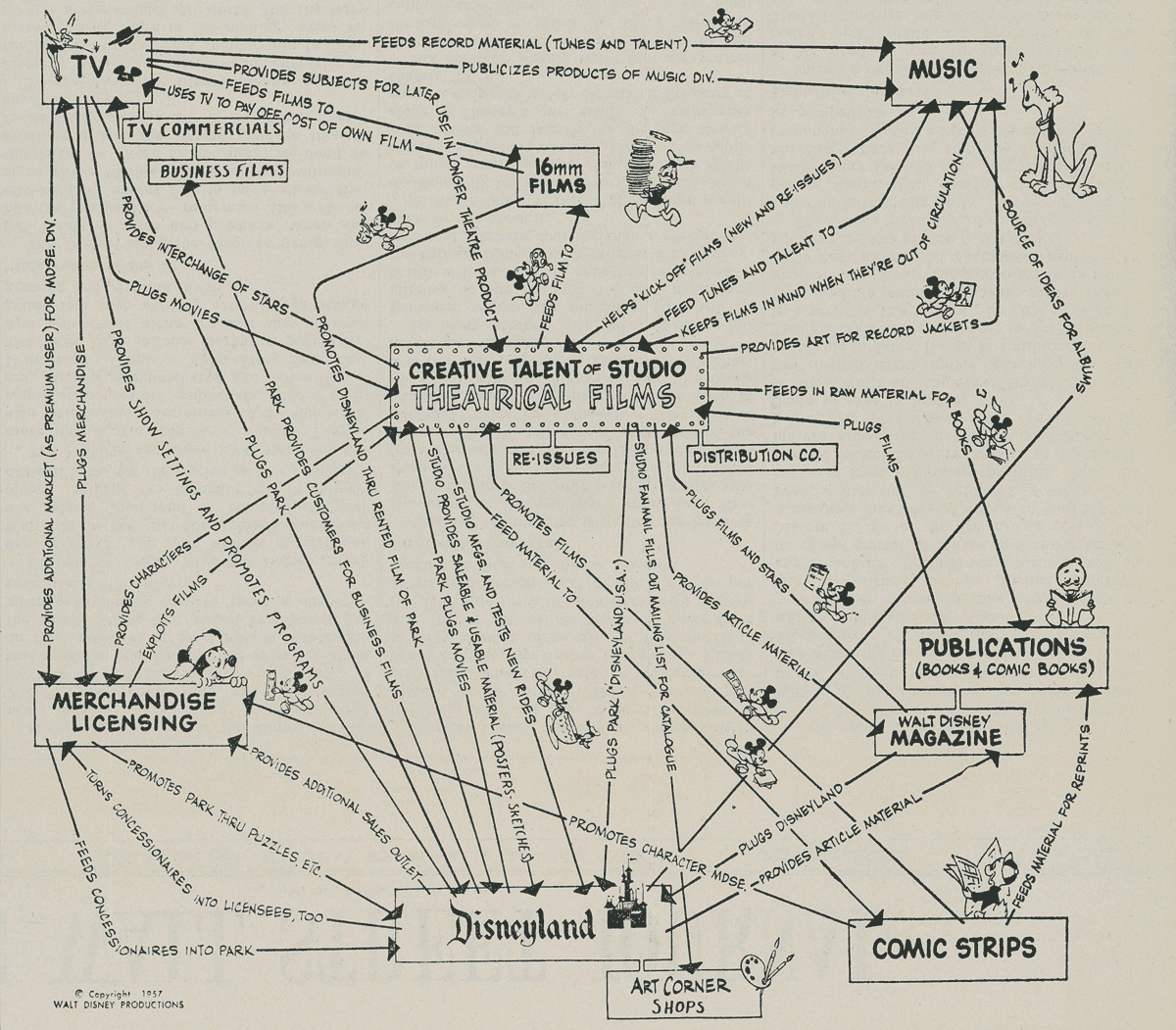
I really love that chart because it tells you so much about the company culture that drew it up. Almost any other company would draw this diagram in some depressingly corporate way, but Disney drew it as a cartoon with little characters running around. It's a corporate strategy, expressed in concrete terms, in a way that demonstrates that the company was still run by artists.
The most common example of being in two businesses is the toy/cartoon pairing, e.g. Transformers or He Man or My Little Pony or Care Bears. These work well because you can keep selling the cartoons on repeat for years, and they act as ads for the toys.
The trick is to get five series. Then they can be repeated as infinitum, if not on the primary channels.
Octonauts is my favourite toy franchise, they have eight characters and many vehicles with other props. Kids do not mind having duplicates of the octonaut characters. This makes no sense to an adult but a three year old thinks differently.
The octonaut characters have large heads and small bodies. Therefore they do not stand up. The vehicles are for under water so there are no wheels. This again is no problem. Scale is also variable. As is quality, some toys come for free on the octonauts magazine.
The strength of the TV show is what matters. Sony bought the rights and there is a movie and two more series in the works. The franchise is global.
Yes, I was a little surprised Hobart doesn't cover Hasbro. The multi-media/modal approach seems to be the natural way out of the churn, letting you own demand, and make it multi-generational (eg the MLP:FiM proposal/bible is very clear that it should be a show that moms can enjoy as much as their daughters).
I thought the trick was to do 6, so you’d have more than 100 episodes and trigger a bunch of stuff about extra royalties and syndication. At least this is what US television authors seem to see as the Holy Grail.
Lego have got this down pat. Rather than being solely reliant on external IP like Star Wars and Harry Potter where they only get one slice of the cake (and share that) they made their own IP. The most successful IP is Ninjago, there's about a dozen TV series, one film, one computer game, a theme park ride, books serialising the TV series, "fact books", clothing and the full range of merchandise.
This is a recent development for LEGO though, likely triggered by a lull in sales that they experienced after their first wave of modern franchised sets (which had literally saved them from bankruptcy) looked depleted. In other words, they learnt a lesson.
The rest of the toy industry has been doing this sort of combo for 30+ years with TV series, but their problem historically has been the high costs of animation. LEGO could leverage digital 3d earlier and easier than anyone else, and they did it very well, so now they can reap big rewards.
I'd disagree. The purchaser is an adult, but the customer is not. Who gets excited about a particular toy? That's the customer. (Note: I'm not talking about the edutainment market here)
Phrase it as you might. The adult is the one making the decisions. The children's excitement and desire is only one of the things the adult takes into consideration when buying a toy. That's a big deal for the parents, but much less so for the grandparents, uncles, aunts, etc. Obviously they want to make the kid happy, but they are distanced enough that they will probably not know what the kid actually considers the hot things. That's why when you were young you had many toys, but not always the ones you really wanted to have.
The adult isn't always the one making the decision. When I was a kid, I'd often be set free in the toy store and given some limit on how much I was allowed to spend. It was usually a low limit, but there was a good variety of toys under it.
The adult set the budget, but as the kid I had control over how that budget was spent, unless it was a toy my parents found objectionable.
Exactly, they had the final say. They were merely making their decision simpler. And that's the best experience you'd get. If you have family and friends, it's likely a good chunk of your toys were bought by them too. Toy makers have to appeal both to kids and adults.
For certain categories, the adult is definitely the customer. For toys aimed at children under three, the ads regularly talk about training hand-eye coordination and other basic skills.
For other categories, you could argue that the toy companies are selling a service: Make the kids stop complaining for a few hours. Naturally, an easy way to do this is to be the reason that the kids are complaining in the first place.
No, because the excited person does not get to make the decision. I do.
Also, good proportions of toys are not exciting to kids at all. Especially during Christmas and birthdays. They are swimming in sea of toys they will never actually play with, because it is simply not possible to play with that many toys.
This is an interesting distinction within any industry. Who's the customer? Ultimately what matters is how the buying decision is made -- who has agency.
Parents and grandparents are the ones who spend the money, sure. But the advertising is directed towards the kids.
> A smarter approach would be what Tim Sweeney is talking about with Fortnite (and Amazon infamously does): you have to do everything you can to pivot any initial success into a durable advantage, by aggressively expanding into adjacent opportunities, even if they're very different businesses (e.g. movie theaters).
Do you have any links to articles related to that? Would love to learn more about their strategy.
Yup. I always say - we are post-scarcity for plastic. I have 3 kids, and we accumulated plastic stuff at such a horrifying rate that I started thinking of it as a liquid.
Great question. We, for example, don’t buy any toys ourselves except legos. But they come in through different channels: gifts, included with something else, birthday parties (am sure you are aware that now at any birthday party all kids get small gift). Most toys last for the few days: it’s a plastic contraption which is not that appealing to repeatedly play with. So after few years of this there is no choice but to throw it away by the bag-full.
For my younger daughter, we started requesting restaurant gift cards to be donated. We gave them to the local Ronald McDonald house because she had a friend who was away from home, undergoing treatment at a special hospital in Minnesota. Her friend's parents had stayed in the Ronald McDonald house local to that hospital.
I'll admit that the circumstances were quite special but it seemed like a relief from the burden of all those toys we would have had instead.
It doesn't really help. I have purchased very few toys for my kids myself, but they have way more than enough, we even have couple of huge garbage bags full of toys hidden away in the attic, and we gave some away, otherwise our house started to look like we are hoarding them.
We have many relatives and friends, everyone wants to gift something at every occasion (x2 kids), and several times friends gave us whole bags of toys their kids outgrew. Over time they pile up more than you may think.
And in the end - it doesn't matter how many toys they got - a measuring tape or an empty box will keep them occupied longer than any toy you can imagine :D
I am a parent and I can confirm. Most of my 4 year old son's toys were purchased for him by grandparents, friends, etc. We've bought almost none of them. We have bought him a lot of books and good second-hand clothes.
No, I'll tell their best friends' parents to tell their kid to only trade toys with my kids but not give them out. I recall my parents and a good childhood friend's parents having a similar conversation when I was 10 or so
Yes, we've told family/friends that instead of buying something that will be garbage in a few weeks they should spend the money on an experience with the kids (books are an exception). Most people have understood (except grandparents, they seem the most resistant to the idea).
Agreed. It's one of the most pressing enviro concerns. The UK ran a massive campaign on it last year. I hope all int GOVS remember the urgency in post-CV19 land.
We have three and have to try to keep people from giving us more toys. It doesn’t work and we get rid of about 1-2 kids worth of toys per year.
You could outfit a kid’s room with toys pretty respectably from scratch with $30-40 at the thrift store or garage sales, plus maybe about that much again at Target to fill in the gaps (bucket o’ LEGO and a base plate or two, or some dolls that still have their accessories, or whatever). Could stretch that second amount further with some good Ebaying, I bet. Drop another $30-40 every couple years (even for bikes—$10-30 at a garage sale) and you’re good until they start wanting electronics (and then you can just say “cool, get a job”)
The only toys my siblings and I ever needed in our childhood was Lego. The incomplete sets my parents bought in a garage sale when I was 3 were still in decent condition when I left home for college. Every additional set we bought (or were given) in the meantime blended flawlessly with existing sets, so none of it ever went to waste. Forward & backward compatibility at their finest!
same here, we pretty much only had lego (a lot was second hand) and stuffed animals as kids. now, for my own children lego and compatible bricks is the only thing that survives here. pretty much every other toy breaks after a few weeks.
Why spend? Just start ordering large and/or strangely shaped stuff online. With free shipping you can always order a single piece and your kids will grow up thinking that cardboard is in free unlimited supply /s
When I was a kid we have to make our own toys. Now my child is drowning with toys. We only bought a couple, most are gifts. We can even pick up toys in the recycle bin section of our apartment.
My two kids have 8 fully employed adults purchasing toys for them, in a competitive manner. We put the kibosh on new toys about 2 years ago. I literally have an entire room of nearly-unused toys that I can't donate because "relative X bought that". It's probably 10,0000$ in toys.
They play with their iPads, watch TV, draw, paint, sculpt with clay, and poke bugs outside -- my childhood + an iPad.
I have two kids and now I have to throw away old toys all the time filling up garbage bags. This would be unimaginable in my childhood, so for the first few years we didn’t manage that, but now we have to just dump them.
It also doesn't help that 80% of toys is cheap plastic tat. There's a lot of stuff but most of it is junk. For those who reach London at some point, I can't recommend enough V&A Museum of Childhood. It's a large museum with a substantial collection of toys,some as old as 300 years or so. It has it all: from PS1 to some wooden doll house an affluent Victorian family would have spent a small fortune on. The older toys are fabulous and nicely made. I think it's probably better to have a few quality ones than some 20 transform er cars that brake after 10 days of playing with them.
Except that kids tend to destroy things (the binoculars obviously, not a trowel), tend to be violent with and throw things (a real gardening trowel is heavy and could injure their sibling for life), and quickly lose interest in things (they forget about the $20 binoculars long before their lack of quality is apparent).
I mean it depends on the ages of your kids... but there are very good reasons most toys are cheap plastic. It didn't just happen accidentally. It's a feature, not a bug. (Except for landfills, of course.)
i don't know if it's a realistic expectation for everyone but i absolutely loathe getting new toys because with the exception of lego and compatibles and a few other constructable toys and plastic animal figures none of toys we ever got survived beyond a few weeks.
i once bet my son that the toy he wanted so badly would not survive two weeks. and if i won, he'd have to promise me to never ask for junk toys again, but focus on lego and compatibles.
and it seems to have worked. we were looking at toys in passing. and when i pointed out the quality of the material of one particular toy that he was looking at, he agreed, and said he didn't want it anyways.
Ironically WRT tiny shovels, kids plastic toys are made to fall apart for about $10, real plastic adult spades that last forever run about $5, and adult metal spades designed to rapidly fall apart cost $15. If you're willing to pay $30 you can get a dewitt that your kids will inherit, but it'll be ugly and heavy...
There's a different problem for binoculars, Thomas the Tank Engine binoculars will cost $20 for licensing, no name but optically superior adult binocs will be $30. Of course the $400 Steiners are worth it if you're actually going to look thru them, or if you spend thousands of dollars to get somewhere to look thru them it would be nice if they actually work.
My preferred alternative is cash. Always cash for gifts. It’s better for the environment, and it’s better for the recipient. Either you’re close to the person you’re giving a gift to and know what kind of utility they will get from a gift so it’s not wasted, or just simple cash.
A reason I basically just don't give gifts is that if I prefer to receive cash, and you prefer to receive cash, then what the hell is the point of it anyway?
I remember when I was little, probably early elementary, my brother gave me $5 for Christmas. I thought that was really swell of him, so I went to my room and got him $5. In the end, what was the point of it? It didn't mean anything.
I give gifts when there is something I'm excited about giving. Otherwise, I just don't bother.
Well, generally, it's adults (who have cash) who give children (who don't have cash) the cash.
I've never heard of siblings giving each other cash, that's really funny. :) I mean in my family, us siblings never exchanged gifts at all until we were adults with our own income. Gifts were always from adults to kids, not kids to kids.
But when I was a kid my aunts and uncles obviously didn't have a clue what I was into or wanted. Cash would be wonderful -- the whole experience of figuring out how much, what my options were, going to the store, picking something out, having it be linked to not just one but multiple family members...
Cash as a gift, for kids, is honestly pretty great. A million times better than the usual itchy sweater and socks from grandma that I could never wear, unfortunately.
> A reason I basically just don't give gifts is that if I prefer to receive cash, and you prefer to receive cash, then what the hell is the point of it anyway?
> I remember when I was little, probably early elementary, my brother gave me $5 for Christmas. I thought that was really swell of him, so I went to my room and got him $5. In the end, what was the point of it? It didn't mean anything.
This is solved by asymmetrical giving. The structure of Christmas, where everyone gives a gift to everyone else, is wrong. Compare Chinese New Year, where adults give money to children, or a Chinese wedding, where everyone else gives money to the bride and groom.
Even from the '80s to now, things have changed. The early transformers involved very heavy plastic and some die-cast metal construction. Later ones were more elaborate and poseable but also involved much thinner material and no die-cast metal parts.
Yep I remember I had a Voltron toy that was die-cast metal. It was heavy and would have probably lasted for decades (it went to goodwill at some point).
As a kid in the 70's and even into the 80's it was the Sears Wishbook. Nothing beats the tactile experience of flipping through those pages of potential. I wish I would have kept some of those from back in the day - they would be amazing time capsules now.
I don't understand this. I'd prefer to give children the same things that I enjoyed as a child. (E.g. meccano, technic Lego). But the problem is that these companies "modernize" their offerings to such extent that I don't like them anymore.
Also most of the good Lego sets are either cars or airplanes. This gets a little boring after giving these sets for a few years in a row. Lots of good sets become retired, which is a pity.
I think I will be moving away from Lego for my next gifts because there is only very limited choice left in the $50 price range.
When I was first looking into buying Lego sets for my kids I felt the same way, but I've completely turned around. Legos are way better than they were when I was a kid. Check out the 3-in-1 line. They're brilliantly designed. A few of my favorites:
I also used to be bummed that Lego retired their standalone fantastical space ships line, in favor of making everything about starwars, but instead they've now based their space line on actually realistic spaceships, and it feels like a much better fit. When my son builds Lego rockets now, it makes him want to learn about all the NASA missions they're based on. He ends up learning about the parts of real rockets that are reflected in the Lego models.
The "Lego sets are worse now" meme seems to be a combination of people having overly rosey memories of how good Lego used to be (80s Lego was not as amazing as people make it out to be) and people checking in during one of Lego's slumps (they've had a few) and never checking again.
I got a slingshot just recently: the simpleshot from scout. It was really just an impulse buy on amazon. You wouldn't believe how much better it is from the old-school wrist rockets. There's simply no comparing them.
I started hitting plastic bottles from about 30 yards away in the first couple days I got it.
If I had this when I was a kid, I would have terrorized the neighborhood fauna and my mom would have definitely taken it away. Instead, I eventually got bored and moved on to other hobbies.
HN is so resistant to change they should just call it LN.
> Also most of the good Lego sets are either cars or airplanes.
Isn't that just expression of your topical preference? The shelves are full of lego sets that are neither cars nor airplanes and I really don't know what is supposed to be wrong with them.
We tend to buy lego when there are discounts which does remove bests sets and there still seem to be enough choice.
I've found that knex is a good alternative to "single purpose legos". Not only does it stay true to the idea of no custom pieces, but they can also take a serious beating and they're also friendly to girls (mine will make things like crowns and a dog leash for her plushie)
I hear they use different plastics for lego nowadays. My legos from back in the day were pretty sturdy, but the ones my kids have seem to crack more easily, just from regular play. The knex connectors do break, but they are abused comparatively more (e.g. bending them into bracelets, dragging and throwing them across the room, etc)
What frustrates me is the price of the Lego electronic motors and gizmos. We have some but they're rarely played with. I just did a project with my son where we took apart an old rc car and hot glued the motors to some Legos and mounted the battery box+ rc receiver on some other legos. He's been building contraptions with that for a while now. Plus we did some soldering when the wires broke. I don't know why Lego doesn't target a lower price point on that stuff.
There’s an interesting angle about which definition you use for constitutes a good business. There is robust demand for good quality toys (e.g. LEGO, Brio, Melissa & Doug) but it’s relatively stable because not everyone wants to buy in the higher price ranges, demand is finite, and making quality toys means you’re competing against yourself because many toys are passed down to siblings and resold or gifted locally.
If you’re a parent that’s good, but if you’re trying to serve market expectations of constant growth you’re always under pressure to cut corners, and thus the long-term future of your brand, since the business can’t grow rapidly without a baby boom. LEGO clearly hit escape velocity but they seem more like an outlier.
Toys are /not/ a bad business. If you're an investor looking for 10x returns on millions in capital, sure. If you're a maker/designer, it's a GREAT business for as long as you embrace the holiday sales cycle and can command a healthy margin.
I designed a game with my brother a few years ago, and we've been growing steadily every year.
This business only required a few thousand dollars to get started. If you're a maker, go make your toy/game!
If you're an investor, go away. You'll probably ruin the business. It's so incredibly cheap to get an idea into the market place, we don't need you anymore.
I'm going to say that the business of selling card games is very different from the business of selling injection-molded plastic toys. A mold can cost thousands of dollars, and is useless once you have to make something different for next year's toy line.
Don't forget that large manufacturers also manufacture trends as well as best as they can. That's the easiest way to sell. Someone I knew that worked in clothing design said that all the big manufacturers decide either by observation, discussion in industry journals, or collaboration that e.g. olive green (not the current example) is going to be the thing this year so customers are essentially forced to buy the newest "trend" due to lack of choice.
It's different strategies for collusion, but it's more illustrative to discuss how they're doing it. Talking about collusion in the abstract makes it sound like a conspiracy theory. Also, the difference between collusion and collaboration is whether you think parties having discussions is bad or good.
> TV ad campaigns, too, tend to be purchased in advance. About half of TV ad spending is allocated to the upfronts—booked March through May to be delivered by the end of the year.
I wonder how that's been in this game-changing year...
I could see kids being cooped up and bouncing off the walls generating additional demand that could offset some of the overall economic slowdown. There's also reduced competition from secondhand toys with parents avoiding garage sales.
My prediction: board game companies will do ok. All-ages board games tend to be cheap, and they give the whole family something to do for a few hours.
It does say "Prime", with same (or next)-day delivery.
I can't imagine how many extra delivery drivers they need to hire to meet this demand from last minute shoppers. Amazon would be clever to incentivize with pre-Christmas discounts (I guess they probably do that, with "Black Friday" and "Cyber Week" offers...).
I would like to call BS on this entire "analysis" and presume that dropping fertility rates (and child births) across all of the developed world with enough discretionary money to spend on toys might be the single biggest reason why toy businesses are stagnating and perhaps reduce over the long run.
No, probably not. If your thesis is: toy companies perform worse than the rest of the market. Then you would need to short toy companies and long the rest of the market. You would want to construct it to be market neutral: the same proportion of stock is held both long and short.
Just shorting toy companies would not work. Or it might work over some short period of time, but it's not the sort of portfolio you would want to construct for the long haul.


Insightful post. This succinctly explains why most toys are movie-related. It's the easiest trend to predict.
EDIT: This article keeps getting better and better. I had no idea Skyrim was almost set in Game of Thrones. https://www.tor.com/2011/09/16/how-skyrim-was-almost-set-in-... It left me wanting more.
The author is apparently Byrne Hobart, and they've written a variety of things: https://diff.substack.com/people/112633-byrne-hobart Looks like I'll be spending too much time reading them.
They also write a post ... double checks ... every day?! For a week straight, sometimes? Wow.
Sadly, most of their work appears to be locked behind a $20/mo paywall. It all looks very interesting though: https://diff.substack.com/p/dropbox-information-asymmetry-an...