1) End all offensive military actions overseas. Finish winding down Iraq and abandon Afghanistan wholesale. These actions have cost several trillion dollars over the last 10 years. We can't get that money back, but we can stop spending more.
2) Defense spending is in the top 3 highest budget expenditures. Cut it by 1 third across the board. Maintain important overseas installations such as Japan and Taiwan. Given China's rise, its wise long-term to keep a presence in the region. Scale back deployments in Europe unless Russia still is still a threat to western Europe.
3) The most amount of money the U.S. spends is Health and Human Services. The U.S. health system is a fucking mess. Somehow we spend the most on healthcare and get some of the worst societal benefits out of any industrialized country. I don't have an answer here, but it likely involves completely tearing down the existing system to its nuts and bolts and building it back up. I'd love to hear ideas on this point from others that know more about it.
4) Social Security is the other one. My mom relies on it, so does a lot of my family. We're from meager backgrounds and traditionally have come from poorer parts of the nation. That being said, cut it.
When I look at my paycheck and see that upwards of 40% of my income is being sucked out by the government and used more for things I oppose than things I support (e.g. war spending versus scientific investment) it pisses me right off.
Yes, I have heard the naive argument "But taxes are there to run the things you use like roads and government services that you use every day". This is true only in part. Yup, we need an army. Yup, we need local police. Yup, we need roads. Yup, we need a justice system. But it doesn't take trillions of dollars a year to run those things.
The government shouldn't interfere with business like propping up failing business models. It should work to make sure that business plays fair, i.e. anti-monopoly or collusion, etc.
I'm more liberal than conservative, and definitely not one of these people that wants business to have free-reign over everything. But there are bottom lines that we have crossed and need to back off.
You're more liberal than conservative. I'm more conservative than liberal. Bless your heart, I agree with all of your points. At the end of the Cold War, other conservatives were making the same noises that you're making now. For their pains, their careers were destroyed by the people who run the current mainstream conservative movement. Let's take a look at those points of yours.
Points 1 & 2. Cut defense spending and all of the cool people will call you an isolationist. Sure, argue rationally all you want; the name will stick. Also, remember that the United States is bound by treaty to defend more than two dozen nations. That includes keeping bases in some of those nations. Those treaties will have to be renegotiated. Those nations will have to increase their own defense spending. Many of those nations have budget problems of their own. Have fun.
Point 3. Touch social spending and the cool people will call you a heartless bastard who cackles at the sight of starving widows in between gulps of baby orphan blood. Sure, argue rationally all you want; the charge will stick. Of course, this doesn't solve the money problem. Iceberg? What iceberg?
Point 4. Social Security is the third rail of American politics: If you touch it, you will die. Sure, argue rationally all you want. It will help as much as it ever has.
Long story short, the bureaucracy rules us. The administration of administrators who administer the other administers who supervise the people in charge of those who actually get real work done cannot make any concessions to reality. It would be like Gorbachev loosening the grip of Communism; one exit through the Iron Curtain and it's all over.
The Cool People will double down. They will continue to double down until it is physically impossible for them to continue doing so.
Thanks. I have no refutations to any of your comments. I know exactly what you mean.
One interesting thing about your first statement, "At the end of the Cold War, other conservatives were making the same noises that you're making now". A few years ago I had the opportunity to hear Francis Fukuyama speak. He was the author of The End of History and a later follow up book. I never knew it before then, but he was one of the founding members of the Neo-conservative movement. It was originally started by him and a group of like-minded sorts around a cafeteria table in some ivy-league college (Princeton maybe?). He went on to talk about how the ideals of what they founded were adopted and warped beyond recognition by the Evangelical Christian community in the U.S. and by other conservatives. What was remarkable about the talk was that at the end, he essentially repudiated everything he had originally written in The End of History.
I remember stories my grandparents told of growing up during the Great Depression. I also remember stories from my mom's family of 7 kids growing up poor in Rochester, NY in the post-war era. Perhaps I've inherited an attitude of bite-down and deal with reality from their history.
When Fukuyama was talking about the Evangelical Christians, I think that he meant their doctrine of "The Rapture" and how it motivates their support for Israel. It's scary just how much of their politics rotate around that. Seriously, Christopher Hitchens (yes, that Christopher Hitchens, the atheist) can get published in National Review because of his support for Israel and for wars to bring democracy to the Middle East. Meanwhile, the paleoconservatives (the guys who opposed these wars) have been airbrushed out of the conservative movement; vaporized, in the Orwellian sense.
It's downright eerie.
And it's gotten to the point where "extreme" right-wingers like Pat Buchanan are saying that the bankers and corporate executives are ruining America. Paul Craig Roberts, assistant secretary at the Treasury under Reagan for crying out loud, the guy who helped implement supply-side economics, sounds more like Noam Chomsky than George W. Bush, these days.
The string-pullers behind the conservative "movement" see the Evangelical Christians for what they are -- a bunch of easily fooled suckers. (Especially the non-denominational types) They are insecure, fearful people who respond to the crazy message that's being sold.
One of the big motivations behind the pushing of non-denominational, stupid christianity as you get these large flocks of people attracted to the personality of the leadership of their church, but there's no doctrinal basis. The Catholics or Lutherans have their issues, but they won't allow the psychotics to retain power within their religion.
Not necessarily. The traditional conservative nutjob string pullers are people who own natural resources. They are getting very rich right now -- and that's about all they care about.
The traditional patrician Republicans are getting owned.
So complaining about extremist theocrats is crass if they call themselves Christian, but civilized if they're Muslim? It doesn't matter what religion it is, it's still a destabilizing influence on what's supposed to be a democracy.
And Fox News had such a clear role in making the Tea Party into a meaningful political force that commenting on the connection isn't necessarily even a political statement - it's a historical statement.
They are insecure, fearful people who respond to the crazy message that's being sold.
I wonder if the powers that be have been purposefully trying to jam media with lots of spurious messages about, "The Truth Behind The Lies," most of which are structurally similar to actual such messages, but otherwise are just junk.
you get these large flocks of people attracted to the personality of the leadership of their church, but there's no doctrinal basis.
Really, this sort of thing isn't that unusual. In places in the US like Cincinnati, with large populations having immigrated generations ago from Ireland, Germany, and Eastern Europe, you have large numbers of people who call themselves "Cultural Catholics." Do they agree with all of the doctrine of the Catholic Church? Heck, a quite a number of them disagree with most of it. Attendance at mass is really just one way they identify their group.
Given that much of the motivation for religious practice is really group affiliation, it's no wonder there's a lot of it organized around personalities.
> I also remember stories from my mom's family of 7 kids growing up poor in Rochester, NY in the post-war era. Perhaps I've inherited an attitude of bite-down and deal with reality from their history.
I have not much to add to your excellent comments, I just wanted to give you a heads-up. I grew up in a former Eastern-European country, and my childhood and teenage years were very much marked by the economic collapse of the post-communist years.
First, regarding the reducing of military spending by the US, I can still remember reading a very beautiful Soviet propaganda magazine in 1989 (with colored pictures and all) about how happy everyone was that the Soviet Army was getting out of Afghanistan and how about everyone will be happy. Then 1991 happened to them and the Soviets disintegrated under their own weight, in many cases leaving military units stranded in foreign territory because the money had just run out. I don't know what the moral of this story should be, maybe that it is never too early to cut military spending. You (the Americans) should do it now.
Second, I have nothing intelligent to say about your health-care system, but regarding Social Security I hope that you, the American people, will find a bunch of decent politicians willing to sacrifice their political careers over this. The reason being that when the money will run out (and at this rate it will definitely run out) no amount of blaming the other party or of accusing the Chinese or the Martians or whatever will make up for the fact that Government-run agencies will have no money to actual do their jobs (and no, inflation, i.e. indefinite printing of money will not help solve this, it will only make it worst). Again, I saw this happening in my country, ~20 years ago, social services going the way of the shitter and basically the entire Government-run infrastructure crumbling on its own weight. It wasn't funny at all.
Those horrible evangelicals and ... some other conservatives. Fukuyama chose a safe target. (Or not. I didn't listen to the speech.)
"Time magazine's Joe Klein has suggested it is legitimate to look at the religion of neoconservatives. He does not say there was a conspiracy but says there is a case to be made for disproportionate influence of Jewish neoconservative figures in US foreign policy, and that several of them supported the Iraq war because of Israel's interests, though sometimes in an unconscious contradiction to American interests:
"I do believe that there is a group of people who got involved and had a disproportionate influence on U.S. foreign policy. There were people out there in the Jewish community who saw this as a way to create a benign domino theory and eliminate all of Israel's enemies....I think it represents a really dangerous anachronistic neocolonial sensibility. And I think it is a very, very dangerous form of extremism. I think it's bad for Israel and it's bad for America. And these guys have been getting a free ride. And now these people are backing the notion of a war with Iran and not all of them, but some of them, are doing it because they believe that Iran is an existential threat to Israel."[75]"
I know I'm invoking Godwin's Law here, but wasn't "The Jews pushed Germany to WW1 and broke the economy" one of Hitler's excuses/propaganda peices? What's the difference between this argument and hitler's?
Why do you - as a conservative - consider it rational to cut social security? The program is popular and self-sustaining. and if you read the trustees' reports you'll see it has been in surplus and perfectly solvent since 1985. In a few years it will stop generating surplus revenue for a few decades as the baby boomers move through the system, but it isn't threatened with insolvency.
There is an ethical problem with using surplus social security revenues to fund tax cuts to non-contributors and then claim there isn't money left to pay back the workers who contributed in good faith. But this isn't a problem with bureaucracy so much as a problem with the Republican Party.
First, both parties have raided Social Security, not just Republicans. In fact, both parties have been complicit in the government's financial misfeasance for a long time.
Second, you mention the money "to pay back the workers who contributed." There was never any money to pay back. Social Security was always a pay-as-you-go system. Current revenue pays for current appropriations. There was never any "trust fund," another fact that smoothed the way for Congresscritters to raid Social Security and replace the surplus with Treasury IOUs.
This system was feasible when there were ten workers being taxed for each retiree receiving benefits. With the graying of the Baby Boomers, that ratio will approach parity. Another commenter on this thread mentioned that the best thing to have done to Social Security would be to build an electric fence around it. A good idea. Too late. Congress has fleeced it.
First, you're right, both parties have diverted Social Security surpluses. But only one party -- the GOP -- is trying to avoid paying it back, using the SS deficit as a tool to dismantle or alter the program.
Second, that doesn't change the social contract we have with people who have spent their entire lives paying out up to $6000 a year in wages to the fund.
Third, yes, while baby boomers retire, it will run a deficit. But if the surpluses over the last SEVENTY YEARS hadn't been diverted to the general fund, they'd have enough in the "lock box" (that Al Gore advocated for in the 2000 election) to pay for 'boomer retirements.
Look at the predictions made by FDR's guys in 193(4?) about social security. They are surprisingly correct. They saw this coming. The only thing they didn't do is force a segregation of funds.
>Second, that doesn't change the social contract we have with people who have spent their entire lives paying out up to $6000 a year in wages to the fund.
A good reason not to trust the government to keep a forced retirement account on your behalf. Someone is going to get the short end of the stick here eventually.
I would prefer that people own up to this and we set up an orderly, phased dismantling of the program, but that doesn't seem very likely. Politicians and head-in-the-sand populace apparently insist on a single disastrous collapse that leaves millions insolvent rather than admitting and accepting that there will be some controlled loss involved in a phaseout.
As opposed to forced retirement accounts you manage yourself? Make no mistake, no sane government would allow for completely voluntary contributions to any sort of pension or superannuation scheme - it'd be setting its country up for a massive economic and social timebomb as the majority of the population put present wants over future needs.
As for investing pensions in the stock market, I'll merely add that in Australia, where we've had superannuation for 20 -odd years, all usually invested in stocks, there were are a large number of people who thought they were going to retire in 2008 (my parents amongst them) who are now still working.
I strongly disagree that retirement accounts should be mandated by the government. If people won't save for retirement, they should understand that the government can't help them. This philosophy that the peon is too stupid and/or undisciplined to manage his own accounts and that the government must protect him from himself is what gets us into huge messes like this in the first place.
I understand this point of view, but at the end of the day, government policy needs to be based on what's going to work out the best for the public. It perhaps goes without saying that there are more than two approaches, but yours is one that I think we can rule out logically.
Psychologically, does it work? In general, if you tell a 22-year-old that in 40-something years he's going to really need some of the money he's making now (even if he feels like he's barely paying his bills), that he absolutely must set aside enough (and invest it wisely, assuming he has the wisdom to do so), will he manage to do it?
From what I understand of human psychology, the answer isn't "yes" nearly enough to make your solution palatable.
It sets up a good learning experience for him when he finally gets to retirement age and finds himself as a greeter in Walmart, but it's way, way too late at that point.
No one wore seatbelts before they were legally required (and still many don't, and many still die because of that dumb decision). People don't, as a rule, have a good grasp of the distant future and/or events that seem unlikely. How many people are still starting smoking, even though it says "cigarettes kill" in big black letters on that first pack they buy?
There are plenty of problems with the US social security system, but removing the safety net entirely to teach a lesson to people who fail to adequately prepare for their old age doesn't feel like a sound approach to me.
And whose idea of "best" do we use? The government is about ensuring a framework of freedom for its citizens to operate within, and if the citizenry refuses to be productive or healthy there's nothing the government can do about it.
Do you support alcohol prohibition? Alcohol leads to much more damage than even smoking from an emotional and psychological perspective.
What if, one day, the government decides that people who buy Japanese cars are a danger to themselves since they are costing the American car companies so much money by refusing to buy home-grown goods? The people just don't have the foresight to understand that buying Honda today means depression throughout Michigan tomorrow. Shouldn't we protect people from that eventuality by ensuring that they only buy domestic vehicles?
How far do we take this? Why do we believe that the politicians have such a heightened sense of foresight and such impeccably unselfish motives? I don't vote for people so they can do my thinking for me, I vote for people who I think will best represent important core principles, like retaining individual free exercise of conscience (like the choice to buy American or foreign cars, even if it will cost Michigan a lot of jobs).
The attitude that we need the government to protect us from our own decisions is in fact extremely dangerous and insidious. Old people survived for thousands of years before the implementation of social security -- if the industrial society doesn't support old people well enough, we have to tweak it so that these things work instead of doing these grotesque hacks of taking > 10% of an average person's salary every year to pay to support your grandpa's RV tour of the US.
We don't use someone's idea of "best" purely based on their opinion. We make changes at a small level, we run studies, we actually find out what works, and stop futzing around with half-baked ideas of what will do what 20 years from now.
This is partly why I hate political discussions as-they-are-played... everyone has such strong opinions based on incredibly tenuous links to actual history, studies, etc.. Just "this is how it is, how it has always been, and if only I were in control I'd have this all tidied up right quick."
Of course I don't support alcohol prohibition. Haven't we tried that? Did it work? Also: we weren't talking about making smoking illegal, just about human psychology, and how people aren't logical. To actually give people better lives requires science, not "more laws" or "fewer laws".
I don't disagree with you on your other examples, generally, but I'll refrain from offering other examples that are obvious in the other direction... it doesn't get us very far.
"I don't vote for people so they can do my thinking for me" -- I half agree with this. I will gladly vote for someone who has thought and researched more deeply on important topics than I have, provided they can explain themselves and advance my own knowledge. In the end we are responsible as citizens for who we elect, so I do agree it's not much use to be snowed by anyone who uses big words or says they have the solutions.
For core principles, though... this is much trickier. Principles, in abstract, are useless. I agree totally with some of my older relatives' politics, when we talk only in terms of principles ("we need better education! critical thinking!"), but when we get into applying the principles we're miles apart.
"Free exercise of conscience", what does that mean in terms of specific issues? We should rely on lynch mobs instead of police? Citizen militias to take out unfair monopolies?
I'm in favor of encouraging responsible citizens who can think critically. I'm not at all convinced that your suggestions (inasmuch as I've seen them) would do that, based on what I know of human psychology.
I also have a suspicion that your idea of what social security payments will cover is a bit overblown. I don't have any living grandparents left, but my father is losing his house and has no medical insurance, in spite of social security.
Somehow, the Federalists have managed to change the conversation from, "should the state provide this service?" to, "should the government provide this service?" I don't quite understand why the state governments should not make their own choices, and people can move to the states that they find have the most acceptable laws to them.
I like the idea of removing power from the federal government in favor of states, but in the case of a service like social security, mobility between states could cause massive issues. State x would not have a safety net, prompting companies and workers to operate there for the tax break. State y, providing a safety net, would be swamped with retirees but not productive workers. Citizens would be hugely incented to game the system. I don't see how it could be sustainable.
If the discrepancies between state policies were large enough, I imagine you'd basically see white flight on a national scale. Essentially, supporting any type of social safety net would be optional for the people with the resources to move out of state. As a result, middle-class and wealthy people would flock to low-tax states without expensive social programs, leaving behind a higher concentration of needy people in the states with the stronger safety nets. What social programs remain would presumably go bankrupt while the nation's wealthiest individuals basked in the glory of their virtually tax-free lifestyles.
That is largely not the case with your neighbors to the north. In Canada only 1/3 of taxes are collected at the federal level, and some of that money is distributed to the provinces to spend (poorer provinces get a larger proportion of payments so they can provide similar services as richer provinces).
While there is some migration to the richest province, that has more to do with jobs related to the oil boom there, and the low taxes there are due to oil revenues.
One possible counterargument to the state-specific approach is that if you have a handful of states that really do well, a majority that do okay, and a few that really screw things up, it's unfair to the residents of the states that chose poorly. They may never be able to move to a better state because the decisions of their current state left them in a financial position too weak to afford life in a different state.
So what do we do with people at the end of their working years, who, through bad luck or bad design, ended up with nothing. Do we stand by and let them suffer and die?
This is not an issue for the government to address. I don't think that people should let them stand by and die, but good governments don't have the powers necessary to give out free money to people they think deserve it. Communities would be expected to handle it in the way most palatable to them. How much more room would Americans have for charity if their paychecks got 50% fatter due to eliminating income and payroll taxation?
There's an interesting argument from Friedrich Hayek (who's usually considered libertarian-leaning) that that approach is actually less pro-individual-liberty than a government safety net is, because it coerces people to stay in collectivist-type communities like ethnic groups, churches, etc., even if they would prefer to leave them, due to the dependence on the safety nets those groups provide. He argues that having a minimal government safety net would give people more freedom to choose their associations within society, since e.g. leaving the Mormon church would no longer mean losing your main safety net.
You could devise a means tested welfare for elderly people. There are a lot of perfectly wealthy, perfectly capable people who retire at 60 whatever for no apparent reason other than ss and tax advantaged accounts make it seem like its time. I am a big fan of retirement, and I think safety nets for the disadvantaged are a good idea. I don't think we need a retirement safety net, however, or to make a retirement an entitlement.
The trouble with means testing is that you drain support for the program from the parts of the population with the most political clout. In other words, how long does SS last when rich people get nothing for what they put into it?
I've always viewed Social Security more like catastrophic insurance than a future income stream. What do you get out of insurance? Hopefully, nothing because if you find yourself needing to exercise it, something has not gone according to plan.
I agree with means testing, but think it would have to be something that slowly phased in over a long period, and proportionally to smooth discontinuities so that people could shift their behavior to match expectations.
Actually retirement accounts are demand leakages. For example quantity theory of money gives us MV=PY money * velocity = prices * quantity of goods/services produced. So if money is squirreled away in retirement accounts it is no longer circulating in the economy and in order to maintain the same level of economic activity we have to 'make up' for the lost M. So retirement accounts are a drag on the economy.
Retirement accounts aren't usually held entirely in cash except very near the end. For younger people the bulk would be invested in equity i.e. funding businesses and thus being fed back into the economy.
Its money taken out of circulation that could have otherwise been spend on consumption. Buying IBM stock in my IRA doesn't do much for the economy compared to taking the same funds and buying an IPAD or 100 happy meals.
A legislative body can't force a segmentation of funds on their own! (I always laughed when my state legislators promised to do this.)
Such a decision is overridable by 50%+1 of the legislative body--that same number that is would take to spend the money.
Okay, yes, a constitutional amendment would work, but I suspect most legislators proposing a "wall" like the one in question would be lukewarm to the idea.
How, exactly, do you propose "paying it back"? Social Security is already a TERRIBLE deal for current workers. The only options are to either limit benefits to retirees, who are already getting more than they paid in (payroll taxes are higher now than they were before 1983), or to make Social Security an even worse deal by taxing current workers even more.
1. Social security reform was a core part of the Democratic platform in 2000. "I will keep Social Security in a lockbox, and that pays down the national debt and the interest savings I would put right back into Social Security." (Al Gore, Oct 4, 2000). Put simply, the Democratic policy aim was to divert the surplus into paying off the debt while preventing lower interest rates from spiking government borrowing/spending by also putting interest savings into the trustee account. You can compare this with the Republican plan at your leisure.
2. Your characterization of the "feasibility" of the social security program is wildly inaccurate. Seriously, instead of turning yourself inside out trying to claim that Republicans didn't setup a system that had workers pay MORE into the system than they were taking out for 30 years, why not just roll back the Bush tax cuts and call it a day?
I think it will take more than rolling back the Bush tax cuts. If no entitlements changes are made, it would take roughly twice the GDP of the entire world:
"Add together the unfunded liabilities from Medicare and Social Security, and it comes to $99.2 trillion over the infinite horizon. Traditional Medicare composes about 69 percent, the new drug benefit roughly 17 percent and Social Security the remaining 14 percent." –Richard W. Fisher, Dallas Federal Reserve President, May 28, 2008 [1]
I agree that Americans pay far more for health care than they should. I agree that Bush's medicare giveaway to industrial pharma was grossly irresponsible and that it has contributed a massive amount to the crater that currently is US fiscal policy. And I do not honestly know how people who consider themselves conservatives could support either that or the tax cuts, especially when the United States was on course to actually pay off its national debt.
Returning to the issue of social security, the statistic Fisher cites comes from Table IV.B6 of the trustees’ report, which is extremely conservative in its assumptions (assuming essentially zero productivity growth over the next 50 years) and thus - even at the worst - would require only a minor tax addition to permanently solve without reducing benefits.
I do not much like your suggestion that since the Republicans instituted tax cuts the surplus is gone and there's nothing we can do about it, but will add only that if Gore's proposal had been adopted (Republicans at the time were championing the terrible idea of dumping social security funds into the stock market while cutting top-end taxes), even the "infinite horizon" figure would be nowhere near where it currently is and it would likely be possible to reduce the payroll tax or increase benefits. And given all this, I don't know how to reconcile your claim that this is not a Republican problem with the fact you claim to be a rational fiscal conservative.
I quite agree with you (and Fisher) that the Social Security system's problems are solvable (you might have confused me with winestock). My point was that SS is a distraction–Medicare dwarfs the other entitlement liabilities–and it will take more than rolling back the Bush tax cuts to bring about budget surpluses.
Social Security has very well defined costs that are manageable if you implement some reforms.
Medicare is a another story altogether. Fact is, a 1960-style PPO for every old person just isn't sustainable when health costs rise like 13% per year.
You do realize that most Treasury IOU's are also called bonds, right? There are also two trust funds that comprise social security: the old-age fund and the disability fund. They each buy special issue securities from the government, but have also bought public bonds in the past. The securities have always been paid back with interest. If the Federal gov't ever didn't pay one of these securities, it would be a default by the gov't.
It would be interesting if these funds could invest (limited amounts) in some other type of security, but for now, they are limited to Federal securities. Imagine the sway on the market a $2.7 trillion fund would have.
The bonds will be paid, but future Congresses can decide at any time to cut benefits to recipients. That's the conflict. Perhaps analogous to lending your boss a large amount of money-- he now has the incentive to cut your wages so that he can more easily pay back the loan.
Also, remember that the United States is bound by treaty to defend more than two dozen nations. That includes keeping bases in some of those nations. Those treaties will have to be renegotiated. Those nations will have to increase their own defense spending.
Not having read the North Atlantic Treaty, I don't know that the US has any special obligation above and beyond the rest of the NATO members. Yes, the US is obligated by treaty to defend Latvia, but by the same token Latvia is obligated by treaty to defend the US. American deployments to Europe are likely above and beyond American treaty obligations.
the US is obligated by treaty to defend Latvia, but by the same token Latvia is obligated by treaty to defend the US
And, in fact, the only time that Article 5 of the NATO treaty -- the mutual self-defence article -- has been invoked was after 9/11, when the US used it to drag the rest of NATO into Afghanistan.
He said, "A good chunk of the post-9/11 air patrols in North America were flown by allied aircraft."
The article says:
" Five NATO planes have arrived at Tinker Air Force Base in Oklahoma City, Oklahoma"
and:
"Most of the United States' 30 AWACS, based at Tinker, have been flying around-the-clock surveillance of U.S. airspace..."
In my opinion, the phrase, "a good chunk of" is dubious. In a few minutes of Googling, I could find no indication of how many missions (if any) those NATO planes flew.
Not true. NATO staff discussed Article 5, decided that it was appropriate, spoke to Colin Powell, who supported it, and by the time the NATO council met to approve the draft statement concerning Article 5 George Bush had also signalled his support for it.
I wasn't denying that NATO passed Article 5 for the first and only time in its history after the 9/11 attacks, and I wasn't denying that the US supported it. I was referring to the arm's length at which the Bush Administration held our NATO allies during the early stages of the Afghan war. The resulting hard feelings made it more difficult for Bush to get cooperation from those same allies during the run up to the Iraq War. This is a fact and was a common talking point at the time among liberals and others critical of Bush's foreign policy.
Fred Kaplan:
"Aside from letting a handful of NATO's AWACS radar planes come help patrol American skies, Bush's response was a shockingly terse: Thanks, but no thanks; we'll handle it by ourselves. Marc Grossman, the undersecretary of state for political affairs, later admitted to the Washington Times that the United States initially 'blew off' the allies. Douglas Feith, the undersecretary of defense for policy, said that the United States, in the Times' words, 'was so busy developing its [Afghanistan] war plans that it did not have time to focus on coordinating Europe's military role.'
"The effect, of course, was to alienate the allies just as they were rediscovering their affections. As London's conservative Financial Times later put it, 'A disdainful refusal even to respond to a genuine offer of support from close allies, at the time of America's most serious crisis in decades, spoke volumes about its attitude to the alliance.'"
(The similarity between the "thanks but no thanks" phrase used by Kaplan and the one used by me is a complete coincidence. I found this article this afternoon when googling for something to support a rebuttal.)
The thing with Social Security is that it's such a huge, tempting cookie jar for Congress to reach into -- remember that this is a program that easily runs a surplus when we just leave it the hell alone. So instead of cutting it, how about we build a big damn electrified fence around it? ;)
Except for the gaping hole in the fence, which dictates that the trust funds have to invest in Treasury bonds. Which means the money goes in and straight back out again, and that threats of default carry an implicit threat of "Social Security won't be able to pay out".
Thus far the risk of investing the SS surpluses into any investments other than US treasuries far out-weighed the risk of the US choosing to make SS forgive the debt incurred by said treasuries.
I've often argued that SSA should be allowed to invest some portion of the surplus (perhaps 10-20%) in AAA-rated municipal bonds. Perhaps the downgrade today will prompt more people to consider this.
Isn't reducing the conflict of interest a small price to pay for slightly higher risk? Currently, Congress can "save" money by cutting benefits to Social Security receipients and use that money to pay off the bonds owed to Social Security.
Congress can't actually divert revenue from SS. The way that cutting benefits affects the budget is that the SSA uses more of the payroll tax to buy more bonds, rather than paying the revenue out as benefits. The government still has to use non-SS revenue to pay off prior SSA-held bonds. Thus, once SSA collects less from the payroll tax than they need to pay out (which will happen soon, and may have already happened due to the Making Work Pay tax cut), cutting benefits will not reduce the budget deficit at all, because the SSA will need all of the revenue from the payroll tax and all of the revenue from its maturing bonds to pay out benefits. In order to use any payroll tax revenue (via SS bonds) for non-SS programs, they would have to make unrealistically large cuts in benefits. So, in short, that well will run dry soon enough, and you won't have to worry about it.
your choice of words suggests that you're a follower of thoroughly-discredited pseudophilosopher ayn rand, and as a consequence i strongly encourage you to read:
and not skim and look to argue. read charitably and see if you can still buy into her ideas, after reading some articulate people dissecting them (and seeing rand's defenders try and fail to defend via the comments sections).
Point 3. I don't know who these cool people are that you're talking about, "liberals" I assume. I find it hard to believe they will call you heartless if you socialize your health care to make it cheaper and available for all. http://en.wikipedia.org/wiki/File:Total_health_expenditure_p...
The argument is much that you can't just socialize the health care, you have to tear it to shreds and then paper-mache it back into a more serviceable shape. This is a process that takes time, and would leave people scrambling all over the place. Trying to do it while reducing damage results in monstrosities like Obamacare, and the current situation.
Sure there's a difference between isolationism and occupying multiple nations across the globe. You know that. I know that. Try telling that to the neocons and watch your reputation get ruined.
The neocons are not nice people. They will call you names for all kinds of silly and/or evil reasons. And they will demand that you think of them as the Righteous Good Guys every step of the way.
I think indirect costs are higher than that. Prisons, for example, cost over 60 billion a year. Legalize cannabis, and I guess you can easily cut that by 25% (I know those costs probably are not federal, but do not think that matters. If your kid overspends, your family suffers)
Also, the 'It is only a small fraction' argument is weak. If you really try, you can cut the entire budget into smaller parts.
And it's a lot harder to differentiate illegal goods from legal ones if the physical item could be either.
I'm not saying whether we should or shouldn't legalize it, but I keep hearing people say "legalize it to remove the criminal element and tax the heck out of it." That doesn't necessarily end the associated crime issues.
If you really try, you can cut the entire budget into smaller parts
Sure. And just because it's a small fraction doesn't mean it shouldn't ever be addressed. But should a 0.5% line item take precedent over three items which combined total to 70%?
When you need drastic improvement fast, it's just a waste of time to dally on pet agendas that don't represent a significant chunk. Get to them later when you have the time and energy to spare.
But should a 0.5% line item take precedent over three items which combined total to 70%?
Is it any less of a waste of time to talk about those three items, each of which is considered a core concern of one of the two parties in control and will likely never be properly gutted?
If you can't afford the shit that you're unwilling to live without, you need to find a way to make more money. To me, America seems to be in this situation, yet the anti-tax sentiment is so strong here that that stark reality is never addressed honestly. People fairly broadly want these things, so we best find a way to pay for them.
Personally, I'd love to see a situation where the tax rates are mandated to be mere functions of spending, rather than being negotiated as if they're completely disconnected entities. Then Congress has only one knob to fiddle with, how much they want to spend. By letting them decide completely independently how much they want to make we expose ourselves to the obvious outcome, that a lot more goes out than comes in, and that's never going to be properly addressed unless we take it on directly.
You can't just tax to cover whatever you spend. Historically, great revenue comes with greater spending. There must be a limit to taxation in order for the economy to function.
You cannot raise enough taxes to balance the budget. Based on income, you'd have to raise approx. 175%. Based on all taxes you'd have to raise by 50%! Such enormous tax increases would destroy business, investment, and people's paychecks. We want more people paying the same rates through economic growth.
It's not a waste of time if you want to balance the budget to focus on medicare and the military, but addressing the war on drugs is. I already provided numbers proving this. The fact that two parties aren't addressing them is why everyone is pissed off and freaked out. Neither party has introduced a budget that is balanced, or even on a path to being balanced.
Poeople don't want taxes raised, but they don't want medicare cut. So they borrow. And borrow. And borrow... and now borrowing is hurting us because we've done it so much. Eventually we won't be able to borrow anymore. Infinite borrowing is consequentially the same as defaulting.
Fareed Zakaria said in February 2010: "But, in one sense, Washington is delivering to the American people exactly what they seem to want. In poll after poll, we find that the public is generally opposed to any new taxes, but we also discover that the public will immediately punish anyone who proposes spending cuts in any middle class program which are the ones where the money is in the federal budget. Now, there is only one way to square this circle short of magic, and that is to borrow money, and that is what we have done for decades now at the local, state and federal level...So, the next time you accuse Washington of being irresponsible, save some of that blame for yourself and your friends."
I do not think it is a matter of precedence. If you make cuts on larger expenditures, the end result will be a discussion of really tiny posts.
As an example, let's say you decide to cut 30% on defense. You cannot realistically do that by deciding to drop, say, the navy. There are lots of dependencies to consider (does it make sense to have marines, but no navy? Should we perhaps keep a small part of the navy for supporting the marines? What part? Can the air force maintain a global presence without carriers? If not, how many carriers do we really need? Can those carriers do without other ships for protection? Etc) People in charge will delegate filling in the details and suggesting a coherent set of cuts to subordinates.
After a few levels of such delegation, people will be talking about such 0.5% items. For that reason, I do not think you should ignore such smallish items.
That has to come in parallel with a bunch of lower-skill job programs centered around prisons with the highest non-violent drug-related offense inmates about to be released. The current system makes the unemployment issue seem a bit less, but it also lets the corporations who contract out prisoners for work make a killing. It's a modern form of slavery. Though as others have noted, while this is an important issue, solving it wouldn't give us the greatest bang-for-buck so to speak. If we can solve it concurrently with other problems, all the better, but there are sadly bigger issues...
The only problem with slashing military spending and ending foreign interventions is that it has been just that spending, and those interventions, that have made the US the economic powerhouse it is today. The US has a history, stretching back well over a century, of launching military campaigns to support corporate interests. Be it South America, the Middle East, or Asia, the US has invaded countries and toppled governments time and again in support of its economic goals. Now, I think this is reprehensible, but I also wouldn't be so naive as to say that the path to economic recovery lies in an end to military adventurism. The US is rich for the same reason Rome, England, and Spain were: they won their riches at the the end of a sword.
The American military budget is clearly unsustainable, but that doesn't mean an end to foreign wars is in their economic interest. It's no coincidence that the US has been both the most prosperous nation on Earth, as well as the most aggressive, for nearly 200 years.
Take a look at the history of US military actions on Wikipedia [1], and see how many times the phrase "protected American interests/property" is mentioned.
Isn't the primary reason the US is rich due to being located far from the battlefields in WW1&2, and after each of these wars an influx of immigration out of Europe into the newly stimulated American industrial economy? We've essentially been riding the demographic wave up the hill since, and yet few in govt/media seem to really take this into account when planning for long-term spending and economic projections. Something has to give eventually, the question is when this long-run day of reckoning will finally come- although to quote Keynes (IMO the only thing he's been proven right about thus far), in the long run, we're all dead.
That's been important, but it's not the only factor. Yes, intactness of American industry after WWI&II was key. It certainly gave the US a big leg up in post-war industry and rebuilding. Imigration was a huge driver of the economy when it came primarily from Europe, and professionals were over-represented. Demographics can't be ignored, but neither can they tell the whole picture.
I'm not trying to insinuate that the US is rich only because it has invaded countries and overthrown governments when doing so suited its economic interests, only that that behaviour has played a large role in its success. As such, the commonly-held libertarian view that an end to military adventurism will be a boon for the US economy strikes me as naive. I still think it's the right thing to do, but I don't argue for it on economic grounds.
As such, the commonly-held libertarian view that an end to military adventurism will be a boon for the US economy strikes me as naive.
Driving economic activity by having the military act as a major consumer is really just running on a treadmill. We need to find an outlet which will lead to increases in economic activity. There is a huge investment hurdle involved, but space exploration and colonization could fit the bill. Once there is a significant human presence in space beyond low earth orbit, there will be tremendous economic growth. The major problem is that hundreds of billions of dollars of investment would be required to jump start it.
>Driving economic activity by having the military act as a major consumer is really just running on a treadmill.
I think you're missing my point. It's not that military spending drives manufacturing, service, and R&D industries (although it does), it's that direct military action has often been, and is often used to promote US economic interests. See the military's actions in Latin America in support of United Fruit, military support of right-wing (pro-US and pro-business) dictators everywhere, or the military-political interventions in the Middle East in support of energy interests.
My contention is not simply that making tanks is an economic activity that many people benefit from, but that those tanks are used to assert and defend economic dominance, which has a massive spillover effect for other industries.
that those tanks are used to assert and defend economic dominance
And the need for the assertion of force to defend economic dominance in turn cements the need for the military machine and perpetuates the military-industrial complex. We are essentially in agreement. I think it would be better for the US to concentrate on economic dominance through sheer commercial and industrial awesomeness combined with forward-thinking research and exploration.
In that, we are in perctect agreement. With leadership and sane economic policy, the US could still be an economic juggernaut without the need for a military that could take out any two nations on earth simultaneously. It can still be by far the most powerful, without needing to cost as much as the next 8 combined.
While I'm an avid supporter of space exploration, it is not the cure for our economic stagnation. Much better are infrastructure improvements: replacing aging bridges, high speed rail, high speed communications, electrical transmission lines. Better to support solar, wind and nuclear energy than to wage wars in the middle east.
A concerted national effort on removing our dependence on foreign energy resources would be a beneficial way to target our resources for the next 30 years or so.
You missed my point. Sure, space exploration won't cure our economic stagnation in the 1 to 30 years time frame. But it will decide if we are a first, second, or third-rate power in the next 100 years.
The US demographic wave hasn't stopped; that's why, from at least a European long-term investor perspective, the US is still a good bet compared to countries that have already peaked: Italy, Japan etc.
There are many paths to wealth. Germany is rich because of - in part - the almost total rebuilding of a ruined nation and the creation of a pretty effective post-war consensus in West Germany. In fact, I'd argue that an important part of the US's success were also an effective post-war consensus (different, but also hugely effective).
"The US is rich for the same reason Rome, England, and Spain were"
Not really, have you been in England, Rome or Spain?
Rome legionaries were used to make roads and bridges and mining 90%of their time. If I show you the extensions of the land they "washed" to get mineral you won't believe it(you can see it using google earth, e.g in the north of spain, look for grooves around mountains).
England made itself rich because of commerce, like Spain(they took the risk to travel the ocean and won the first mover advantage, and when the rest of the world notice, it was late for them). That was what made them rich, not the military.
The US is rich because... IT IS RICH. It is a huge place with huge resources for a small population.
The US became the more powerful country on earth because Japan and Europe totally destroyed itself by the military in the WWII. The US waited for them to auto destroy, and then entered the world and finished it with all their cities untouched, 90% of the world gold reserves and creditor to them all, being able to force the dollar as world currency and english the official language of aviation, and naval commerce. Every body lost their colonies and US got them all(they just wanted the commerce and influence without having to build roads like English or Portuguese did in Africa).
Yes, it was a coincidence(being far away), no, US was not the most prosperous nation on Earth 200 years ago. If you believe in that, please study some real history. US was not the technical leader that is today thanks to all the Europeans that went there thanks to Hitler(militarization and economic totalitarism), the Edisons, the von Brauns and von Newmans.
Thomas Jefferson and other of the US founding fathers thought a permanent military and central banking would ruin the country because military people do nothing while things work at it should they need to create new enemies so they can justify their existence.
I had family members that were in Soviet Russia when something like 95% engineers were used in the war industry, while people needed cars, washing and sewer machines. This was not wealth for Russia, that was a bully inside. Mass media brainwashed them all them about how cool they were being able to destroy anybody else.(This strange pride remains today)
Today 60% of the engineering in US goes to war efforts, 50% of all their money to the military, so they can kill better, while the rest of the world expends significantly less.
They will talk about GPS, but the question is if this money expended in real economy would be able to create as much as the military does?
Thomas Jefferson and other of the US founding fathers thought a permanent military and central banking would ruin the country because military people do nothing while things work at it should they need to create new enemies so they can justify their existence.
The rise of a professional military is often cited in as a major factor in the decline of the Roman Empire. Military Conquest drove economic gain, which provided wealth, which in turn motivated greed and more conquest.
Nowadays, we don't need conquest so much as the economic activity motivated by a military, but the same cycle is there, minus the emphasis on holding territories.
It's curious to think about: The reason a state needs particular access to petroleum, is to support a large mechanized military of the kind first realized on a huge scale in WWII. This petroleum resource now creates a US dependence on other nations, which in turn justifies a large military. While a lot of other things we do need oil, there are alternatives which could offset a lot of those needs. None of those is viable for a mechanized military, however.
Fantastic podcast by history-phile Dan Carlin (also a political journalist, who does a fine job bashing both parties in reference to historical context, "Common Sense, with Dan Carlin" podcast)
You will find so much fantastic similarities to our own downward spiral, re: military, political class of protecting special interests, where near the decline, voting blocks were outright purchased, etc. He brings together several historians, records, etc.
The entire series is wonderful, and you WILL find yourself spending way too much time on them :)
Military spending is still government spending. It's going to contractors, vendors and soldiers. They are, respectively: making jobs and selling to everybody (not just the gov't), and buying cars and houses.
When the government spends a million dollars building a bridge, it creates a bunch of jobs because people need to design the bridge, extract the raw materials for the bridge, and build the bridge.
When the government spends a million dollars building a bomb, it also creates a bunch of jobs for the same reason.
The thing is, a bridge gets you a useful public resource that makes lost of people's lives better and encourages economic growth by making trade easier. A bomb blows up, kills some people, and disappears.
Absolutely, no question. It's the same argument that econonmists make against acceptance of a so-called "service based economy" -- if I pay you $200,000 to build me a house, you've got $200,000 and I've got a house worth $200,000.
If I pay you $100 to clean my house, you've got $100, and all I've got is a clean house. Nice, but there's no market value. There's no multiplier effect.
But there is SOME utility to the gov't injecting capital in the form of military spending. As I mentioned in the comment below yours, the most extreme example of that is WWII, which finally and permanently ended the Great Depression, in a way that the WPA/etc building bridges just did not.
Sounds like something straight out of Orwell's 1984? The economy is based on ridiculous spending my the military, which enables companies to write paychecks to facilitate consumer spending at home. So basically, our way of life depends on finding excuses to go off and kill people, which in turn justifies our military-industrial complex.
No, of course not, and that's the most extreme possible way to take my comments.
But remember that what did more than anything to cure this county of the great depression was the massive Keynesian capital injection that we called WWII.
You're making a spurious correlation. If your assertion was correct, the French, British, Danish, Portuguese, and Spanish, et al.--the great colonial powers--should be stronger economies than the United States.
They were stronger. Much stronger. They collapsed for varied reasons, but suffice to say if the British Empire was as big today as it was in its heyday, it would be a larger economy than the US.
Also, no need to say "in conclusion" when the sum total of your argument is a single sentence.
Yeah. Despite Britain's significant fall from grace over the past 100 years, its wealth per capita is still not significantly below that of the US, even now. The US has nothing on how onerous and profiteering the British empire was.
Social Security is supposed to be a pension program, not an income redistribution program. So you are making "contributions", not paying taxes, in the official lingo.
Of course the program is most regressive for younger workers, who pay the most and will get the least in return.
Social Security is in serious trouble, by the way, although it is not the driver of the current budget crisis. In just a couple of years the program goes into the red, and increasingly so as more boomers retire. The unfunded liability is around $8 trillion. That's serious money.
There's no such thing as an unfunded liability for Social Security. By law, SS is funded solely by payroll taxes. If payroll taxes are insufficient, benefit payments are reduced to match.
Social Security can never go bankrupt, and it can never be in debt.
> There's no such thing as an unfunded liability for Social Security.
This is wishful thinking. Social security benefits have been promised to a lot of people, and the money isn't there. It's all well and good to say they will just reduce benefits, but that's just a nice way of saying that they'll default on the liabilities.
In reality this is no different from Medicare or Medicaid, or the military budget, or anything else. Sure, we can in theory just reduce payout. The reality doesn't work out so neatly.
Social Security and Medicare are different from Medicaid and military budget, because they have different funding.
Social Security and Medicare are funded by payroll taxes.
Medicaid and military budget funded from Federal income tax.
If you cut military budget 100%, you will save ~900 billions (or whatever the right number is) a year.
If, on the other hand, you cut Social Security or Medicare, the savings are 0, because you will have to cut their funding as well.
Surely, no one will pay Medicare taxes, if there is no Medicare exist, right?
This is a strange belief. Why in your mind would payroll tax be necessarily cut just because social security expenses drop? You do realize that social security is actually still running in the black, right? They are, right now, bringing in more money than they spend.
Guess what happens to the rest of the money: It gets spent elsewhere. Social security buys US Government debt with any excess, meaning it goes directly into the budget. In theory the SS trust has assets, but in reality the money is gone. It's one account holding a bunch of IOUs from a second account, and both accounts are owned by the federal government.
"Put another way, the Federal Reserve says that the nation’s net wealth is about $57 trillion. That figure would have to be $18 trillion larger to generate enough additional G.D.P. to pay Social Security benefits without making anyone worse off in the future through higher taxes or lower benefits."
The only reason the healthcare issue seems so complicated is the massive amount of propaganda we're subjected to in the U.S. media about it. You're on the right track to figuring out an answer. Just look at what all the other industrialized countries do. Then do that.
3) Health care: it is screwed up because of the economic model. A single payer system is much more efficient with the government overhead at 5% vs private at 20%. Allow the govt to negotiate drug prices. Currently it's prohibited by law. Streamline the FDA without losing effectiveness.
4) Social Security is in decent shape. Dont cut benefits. If necessary, raise the retirement age. That's a fair trade-off for improved health care.
+ Fix campaign financing to remove the "hidden" corruption that is distorting Congress. Roll back anti-trust a hundred years to the age of the trust-busters. Roll back Republican/Bush deregulation so that banks aren't too big to fail, so that Rupert Murdock doesnt own all news channels. Cone down hard on regulatory capture. (The govt gang that was watching BP should be in jail.)
Edit: Oh yeah taxes. Roll back the Bush tax cuts. My share of the tax cuts was $300 on a 6 figure income. At the time I wished Bush has gone for deficit reduction. The $300 made very little difference to me. Close the loopholes. The oil companies dont need subsidies.
Social security shouldn't be cut, it should be turned into a purely social program (and grandfathered in at that too). Instead of being an entitlement program, it should become like welfare and enabled for the bottom X % of the population. Specifically, the burden for retirement for the middle class should be placed on individuals rather than government.
For too long, babyboomers have relied on social security as a sort of no-interest loan. Why put that extra money in my 401K when I can rely on social security? I'll get a second car, or we'll take a yearly family vacation overseas...
Also, simplify the tax system and close loopholes, but do not directly raises taxes.
You completely underestimate how the average person finds something more important to spend money on now rather than saving for their future. The reason we have social security is because people don't save what they need to. If you don't have this, most of the population will be in poverty when they retire. Social security also has things like survivor's benefits: payments to children and dependents who have lost a wage earner.
I don't think the Social Security program is at all broken; what's broken is that we've used the Social Security surplus over the last 20+ years to help fund a general fund spending deficit.
What you've described is a symptom that can't just be fixed by closing your eyes and throwing money at the government while saying, "Give this back when I need it, OK?"
If the populace doesn't have the discipline to control and organize their extra resources, how can we expect politicians to do so? And why do we even trust them to do it? It's sad that people with the attitude you've described were able to convince the government to enact this as a mandatory thing -- but, the government likes money. We've seen what a faithful steward they have been for us.
People without the self-restraint to save money for a period of time where they expect to live without performing any money-generating work have problems that can't be fixed so simply. Maybe that's the cause of all of this turmoil in the first place.
The idea of "retirement" is also a curious new invention; people didn't save for retirement before the industrial revolution because back then, people would own houses and lands, accumulate real wealth that could be used to sustain life (e.g., agricultural assets) when individuals got too old to perform the work themselves, etc.
The pace of change since the 1860s has been extremely staggering and has introduced many concerns that hadn't existed previously. It is an intriguing matter to be sure. Hopefully we can come out of it all right.
"The reason we have social security is because people don't save what they need to."
Have a law forcing people to put the money into a conservative retirement plan of their choosing.
"I don't think the Social Security program is at all broken; what's broken is that we've used the Social Security surplus over the last 20+ years to help fund a general fund spending deficit."
Absolutely true. But we've also used that surplus to spend much more on current retirees than they ever put in.
If that is true -- people universally don't save what they need to -- than the proposed social security program of taxing everyone to give to the poor will be identical to what we have now.
It isn't entirely true, though. If you look at any net worth by age chart, the values go up with the age categories. People do save, just maybe not enough.
I have an easy solution. Let's make your federal income taxes look less like a bill and more like an order form. So for example some portion of your income taxes are pre-allocated for essential services (say 50%) and everything else is your choice. You get 50 points to spend and a variety of categories to choose from: education, defense, infrastructure, green energy, science research, enhanced Medicare services, NASA, deficit reduction, etc. This data is delivered to congress who must use it as a framework for 50% of the federal budget. After you filed your taxes mid-year you'd receive a detailed receipt that let you know exactly what Americans have decided to spend our money on.
That's part of democracy isn't it? We might be better off if we only let highly educated people vote and only after they passed a series of intelligence and psychological tests but we don't do that. As long as essential spending was covered I do think it would lead to a better allocation of federal dollars simply because it would add an additional check & balance to the system.
You could now (effectively) vote for a candidate or party and through your allocation of tax dollars keep them on a leash. It would allow for a more nuanced political system. For example I might vote for a deficit reducing Republican but I don't trust them to keep their hands off the EPA so I give environmental protection 50 points. Maybe I vote for a Democrat but I still think the deficit is really important so I put 50 points on deficit reduction. This would add a whole new dimension to politics and give some power back to the people. It would in my opinion make the commons relevant again. As it stands today I think many Americans are feeling like their vote is no longer all that important. You get two choices, you vote for one or the other, pat them on the back and cross your fingers. That's just not good enough. By controlling a few hundred billion dollars of the budget we might find ourselves on equal footing with PACS, lobbyists, media tycoons, etc.
Of course there are a lot of practical details I didn't address. It may be this could only cover domestic discretionary spending, or perhaps you could only allocate your tax points every 2 or 4 years to provide for more stability and of course for long-term deficit reduction it would have questionable value since the overall level of spending/revenue would still be playing a central role.
That is not an inherent part of democracy, at least not as it's practiced in any sane nation on the scale we're talking here. And we do put people through rigorous testing before they are allowed to vote on laws and budget issues — it's called an election. You might argue the test is flawed (I would agree), but it's not exactly open season. Opposition to direct democracy was one of the founding principles of the United States — at the time, it was generally accepted that the history of direct democracies had shown it to be an utter failure in actually making people free or happy. That's why we have a representative democracy.
Now, if we could vote on Congressional salaries, that might be interesting.
That sounds like a great experiment to try in another country. I like the way our government is currently structured, it was no accident that the founders made the Senate and the Presidency the way they did (hint, not the way it is today). We don't live in a pure democracy, we live in a representative democracy. The fact that the Senate and the President are a bit more immune from public opinion than the House (and they are far less so today than they were in the founders' time) is a feature not a bug.
I'm not sure if the tragedy of the commons would apply in this case. The "mandatory" aspect of elevating discretionary spending into social spending via taxation seems to fundamentally alter the psychology of spending. "Well, if I absolutely must spend this money on other people, then I guess I'll spend it on ___" (education comes to mind as one area people in America might universally agree should get more dollars). The weakness in this system would be the lack of expertise within the "common wisdom" of the people. That might be solved by, say, providing a "template spending ballot" from respected people... a sort of proxy delegation but simplified so you just copy down the numbers they say. If that latter option were made simple enough that 90% of people could understand and do it, the expertise of a few would hold larger sway than the somewhat uninformed choices of the many.
BTW, a friend and I also thought of this idea independently; we called it "mandatory taxes, voluntary distribution" [1]
In 2000, voters thought they picked "humble foreign policy", "deregulation" and "lower spending" in the primary. It turns out they voted for the exact opposite.
About 2 years ago, voters thought they picked "not forcing people to buy insurance they can't afford". They also voted for the exact opposite.
Many, many people use tax-deductable donations to do just this. Soo...this is already done. To make it done more, there should be non-profits. Non-profit insurance organizations, non-profit post, mail, private schools. Seriously, just encourage more people to donate, rather than be taxed. Of course, this won't solve the government's problem, because the government is intentionally expansionary.
the actual step 1: admit you have a problem. the US still spends with the attitude that it is a rich country. it needs to start spending with the attitude of a country that is rapidly going broke.
of course, this can't happen because any politician who doesn't parrot the "America is the greatest country in the world" message gets ousted.
Not enough people would though. They would flock to the other candidate that would inevitably reassure them that everything was going to be ok. Heaven forbid that people should vote by thinking about the issues rather than just digestion a handful of sound-bites.
This is really a symptom of control and hypnosis by media sources and a lack of capacity to reason independently than a direct "If you don't flatter me I'll kill you!" response. Though obviously, flattery has a long and successful history.
it is human nature to support ideas that make you happy. nobody wants to be told that their country's economic system is failing. people love to be told that everything is peachy and they have nothing to worry about. attempting to educate people about a gloomy topic is just going to make them dislike you as well.
Need an iPhone app linked to local government data with where, when, HOW to vote, appropriate links to the various candidates, etc. Start at a local level, burgeon up. KickStarter or O'Relly Gov20 project. Would love to see this tackled.
One thing to note, I think the strength of our currency is at least partly based on the large amount of military power behind it, and the promise of stability that it brings.
Basically, it went from being backed by gold to being backed by power and promise of restraint in printing more. I guess we've largely given up on the restraint side, though.
Quite a few fallen empires have made that error of judgement. I believe it hails from a time when the military could be used to make occupied peoples pay taxes. Nowadays, a military that is much bigger than what is needed for defense suffers from diminishing returns in terms of backing the currency with a safety net.
The military is not going to force the Fed to stop printing money.
There are lots of things we could do to end the recovery. They won't happen because they are not in the best short term interest of the politicians making the decisions. Natural selection has weeded out the congressmen that make decisions contrary to their ability to raise campaign money.
That is the root cause of the problem. Until that is solved, there's no point in dreaming up efficient solutions, because they won't happen.
The problem is the voters, you get the politicians you deserve.
I don't think the american people are dumb or lazy, I think they are very complacent.
Americans have become so used to their fairly high standard of living that they are ignoring substantive issues and focusing on trivia.
My personal prediction is that the voters will wise up and listen to smart people who understand the issues eventually. At the moment though americans just see high gas prices and demand their government fix "the problem", they aren't interested in the challenging geo political, economic and social complexities.
How far amercia falls on the way to this correction is difficult to tell.
edit: just in case anyone thinks I am america bashing, the above applies to most of western europe as well.
The problem isn't the voters, the problem is the process.
There is no way that basing a representative democracy on geographical cohorts can be optimal. I assume it is based originally on logistical constraints, but today is something we just accept because it is how it has always been done.
Wouldn't it make more sense to divide the political arena based on the scope of the issues allowed to be legislated and not on the origin of the legislator? Or maybe we just need a stronger 10th amendment.
It will never happen. I know. Wishful thinking maybe.
As above, the problem is corruption. We have a structure that is supposed to effectively keep the federal government almost completely incapable of doing anything besides maintaining international borders, treaties, and other boring matters like import taxes. Because the people in power like power, and because the populace is complacent enough to allow it, they ignore any structural inconveniences like the fact that a strict reading of the Constitution forbids almost all federal programs and activities that exist today.
> As above, the problem is corruption. We have a structure that is supposed to effectively keep the federal government almost completely incapable of doing anything besides maintaining international borders, treaties, and other boring matters like import taxes.
This isn't true at all. There was a group of founders led intellectually by Alexander Hamilton who believed in a strong central government and who saw the federal Constitution as giving that government very broad powers.
This is in opposition to the Jeffersonian view of limited government, the primacy of the states, the ideal of the yeoman farmer, etc.
> Because the people in power like power, and because the populace is complacent enough to allow it, they ignore any structural inconveniences like the fact that a strict reading of the Constitution forbids almost all federal programs and activities that exist today.
This also isn't true. Setting aside whether the Constitution forbids, say, the Department of Education or whatever, we have the government we have because that's what people have voted for. FDR was elected president 4 times. The New Deal was popular at the time. He wasn't cramming it down the throats of a credulous population.
It's a good thing that the Constitution is malleable enough to continue to support the wishes of a majority of Americans. If it isn't, we can either amended it so that it does (which we have done when needed), or, in an extreme case, replace it completely.
The Constitution exists to serve the people, not the other way around.
Also, the Senate was once elected by the States, which may have been intended by the founding fathers as an important check on the expansion of Federal power. State-elected senators would serve their state governments, who would probably not want to see the massive appropriation of state power to the federal government.
Is it largely salary payments to current troops? Wouldn't we have to deal with a large unemployment problem in case we laid off a bunch of military employees and told them to go find a job somewhere else?
Or is it payment to defense contractors, such as Valley's own Lockheed Martin? Wouldn't this cause a large number of people to be unemployed, contributing to recession?
Spending money on government employees who provide no value is not sustainable. Those employees go spend their money on goods and services produced in other countries (where the workers are actually providing useful services) and you get a net flow of cash out of the U.S.
Is it the government's job to keep people employed for the sake of employing them? No!
There are times in history where government spending can help, like during the Great Depression. The government spent a lot of money on public works projects to help put some people back to work. But this didn't do much to actually end the depression. It was the onset of WWII and the subsequent ramp-up to a war economy that really ended the Depression.
WWII and the rampup was still a public works project.
What really turned the economy for good imo was not WWII but the result of WWII -- all of our competitors on the international stage having large parts of their population and infrastructure destroyed. A few year grace period while the rest of the world rebuilt turned into 50 years of global corporate hegemony.
> Is it the government's job to keep people employed for the sake of employing them? No!
The most basic task of government is to maintain a stable social order (see, e.g., the preamble to the U.S. Constitution). With sustained, pervasive unemployment comes social unrest (see any number of examples from the past 100 years). So ....
> The government spent a lot of money on public works projects to help put some people back to work. But this didn't do much to actually end the depression. It was the onset of WWII and the subsequent ramp-up to a war economy that really ended the Depression.
According to most economists (from what I've read), the New Deal was doing OK at getting people back to work until 1937, when the government suddenly cut its spending and raised taxes. That threw the economy back into recession.[1] And yes, the massive deficit spending of WWII did indeed pretty much take care of unemployment, and then some.
>The most basic task of government is to maintain a stable social order (see, e.g., the preamble to the U.S. Constitution).
I must say I don't see this language appear in the preamble of the Constitution. The Preamble outlines the purpose of the Constitution to "promote the general welfare" -- not to "provide the general welfare". All a reasonable, healthy government can do is provide a few basic structures for its people to build off of, it can't support the whole country (or really anyone) by itself. Unemployment is a governmental problem only insofar as governmental policy impedes useful production; anything else is pandering politicians attempting to dodge the wrath of an uninformed, slothful populace (because the politician likes prominence, money, and power).
Right, I'm not arguing the philosophical aspect of employing people for the sake of employing people.
However, laid off militants are likely to apply for unemployment benefits + whatever other entitlement programs they have. So in terms of pure numbers there might be some win, but when you cut $100 of military salary, you don't magically save a total of $100, you generate some liabilities on the other end.
All those military salaries also generate income taxes for Federal and state coffers, so now you've got lower revenues to deal with, too.
However, laid off militants are likely to apply for unemployment benefits + whatever other entitlement programs they have.
Perhaps initially. The military population in general is disciplined, educated (or even technically inclined), proud, and self-reliant. I've got to think that demographic is more likely to respond to unemployment by going out and doing stuff than any other.
That is an excellent question. I'm too lazy to search for the answer, but, with our luck, I'd say that the Defense budget is about evenly split betwixt personnel and hardware. Therefore, cuts to defense spending will cause unemployment for both defense contractor engineers as well as veteran grunts.
Taking over your laziness I found the 2010 budget. It doesn't really provide an accurate personnel versus hardware comparison but it looks like this:
Maintenance and operations 41.35%
Military personnel 22.5%
Procurement 20.45%
Research, Development, Testing & Evaluation 11.54%
Military Construction 3.49%
Family Housing 0.145%
Total 99.45% (I'm lazy too and rounded too much. Hey it's just 359.6775 millions that are missing...)
So keeping the lights on and the water running is 42% (there was a link that the Pentagon spends more on air-conditioning in Iraq and Afghanistan per year than NASA's entire annual budget). Much of that cost must be due to maintaining offshore bases.
22.5% pays for the salaries of everyone from grunts to Joint Chiefs. I'll say that getting snazzy new hardware comes under Procurement, R&D, and Test & Eval. So, let's say 32%. That makes 22.5% versus 32% for personnel versus hardware. It's not parity, but it's in the same ballpark.
The biggest bite comes from maintenance & ops, of course. That figure has to include the cost keeping Navy boats afloat. No way to chop that down without also cutting down personnel. After all, if you cut the number of facilities by half, there will a lot less space for the personnel to stay in and fight from. Doing that has to have non-trivial effects on military readiness and the perception of potential enemies.
Theoretically, this problem can easily be solved: keep sending them paychecks. At least, they could be working on something productive like finding jobs or starting businesses.
Well at least if they live in the US the government does not have to feed them all and provide shelter etc... At home they support the economy of the US by buying things whit their salaries here. Soldiers at home are cheaper than soldiers on a battleground. Add to that lower amount of injured soldiers etc... That's also a cost when you factor in the medical costs on the battlefield with the need for quick transport to a hospital etc and future disabilities.
Problem is that, especially during the bush era, there were a lot of no-bid contracts to firms such as Halliburton. And we are obliged to make those payments.
"Given China's rise, its wise long-term to keep a presence in the region."
Why?
China will surpass the United States in soft and hard power eventually. This is demographically and economically inevitable. Even sooner, if not already, China will become an unshakable hegemon over all of Asia. So why fight it in the most expensive and futile ways possible, i.e., by maintaining the fiction that we will be able to exercise any sort of long-term military power in Asia?
It's time we focused on our economic power, and not our military power. The former is a necessary precondition of the latter, and we're acting as though it's not.
"This is demographically and economically inevitable."
Oh, no it's not. First China has to hold together over that time frame. This is feasible... this is not inevitable. There's a lot of tensions over there. Then even if they pass that test, there's other things they're going to have to deal with.
Right now, there isn't a single world power that's looking to be "inevitably powerful" in the next 50 years, it's really "anybody's game".
First China has to hold together over that time frame. This is feasible... this is not inevitable. There's a lot of tensions over there. Then even if they pass that test, there's other things they're going to have to deal with.
Right. It's entirely possible that China can hold together as a sovereign nation, but will develop or hold onto pathologies which will cripple it as a major power. Then again, the same could also be said for other potential powerhouses like Brazil, Russia, and India. The same could even be said for the EU and the US.
China doesn't need to hold together for that to happen. China has a far stronger ability than most other countries to collapse, reform, and remain "China."
> China will surpass the United States in soft and hard power eventually. This is demographically and economically inevitable.
As far as I can tell, this conclusion can only be reached via naive interpolation of current trends. I can't come up with one plausible scenario in which this actually happens. Most of China, population-wise, lives in a state of abject poverty, about which the government has done very little. The Chinese gov't itself indicates that nearly 10% of the population are migrant workers. The migration of peasants from the countryside to the city is already considered the largest migration in human history, and it's expected to grow drastically over the next decade or so.
No country can smoothly handle the kind of stresses that come with having most of the country living in abject poverty, and seeking migration to already-overpopulated cities. At some point, /something/ will snap - the magic bubble that is China's economy will pop, and we'll all realize that being gigantic is an impairment, not an advantage.
Put another way: at some point, China's ridiculously poor standards of education and health care will catch up to its economy - and the western companies that have been moving (partly) there, helping to fuel the growth, will stop doing so.
Your point about economic vs. military power is, of course, valid, and largely irrefutable. I would add that, as China does seem to be a relatively stable country - with a competent and, most importantly, sane government - they stand little to gain by way of aggressive military action. We may do well to let them police their part of the world (read: keep North Korea in line), trusting their own rational self-interest, and save ourselves the effort.
I don't think it is unreasonable to believe that in 40 years China will have per capita GDP half of the US (The Shanghai and Beijing areas are already close on a PPP basis) - indeed some GS research paper argues this. At that point its economy will be about double the size of the US...
This is a plan I could sign on to (for the most part), but as Winestock said, such a plan would never get support.
It is not a coincidence that Presidential elections are as close as they are. Politicians essentially buy votes to get elected, in the form of government programs.
The problem in this country is medical entitlements - not so much Social Security. Social Security in theory funds itself, although Social Security's funds have been raided to fund other programs which now jeopardize its future.
Politicians will not address medical entitlements, because they will lose too many votes in doing so. Ultimately it's these medical entitlements that will bankrupt our country, and in the process, cause the greatest transfer of wealth in the history of the U.S. - not from the rich to the poor, but from the young, to the old.
Most people who support medical entitlements do so for "selfish" reasons, in that they want those entitlements to be available for themselves, their family, and/or their friends. They say things like "health care is a right," although it obviously is not a right. Health care is essentially the result of man's labor, and to say you have a right to health care, is to say you have a right to impose your needs on another man. Which of course is silly and inconsistent with the American constitution.
Still - people will assert their right to medical entitlements, and politicians will oblige, which in the long-run will pull money away from business investment (not all businesses are rich with billions in cash). The added financial burden will either stifle entrepreneurship and innovation, or it will send it oversees.
Of course, anyone who stands up against medical entitlements, like Paul Ryan, will be referred to as a villain who wants to murder old people. To quote the President: "throw grandma off the cliff."
That's my long-term prediction, anyway.
In the short-term we will continue to go through up and down cycles. Each down cycle will bring fear. Each up cycle will bring relief. There will be booms and busts in America's near-future, although the booms will be short-lived, and the busts (like our current bust) will be longer-lived.
To the extent innovators, like many of the people on HackerNews, are able to create great innovations, we can postpone the day of reckoning for our country.
They are proponents of ending all offensive military action overseas, and cutting government spending and red tape.
They have an excellent system that makes it easier for USA people to contact their government -- you put in your name and address, and they give you a simple "contact us" form (just a single text area) where you can write your comments and they automatically get routed to your reps in Congress and Senate -- very efficient use of the voter's time!
I think the problem is manifold, but here are some things that may be problematic (please let me know if you agree or disagree):
# Doctors risk getting sued for maltreatment, and thus they prescribe all possible medications, take too many samples and generally spend too much resources.
# On the same note, they also pay large insurances against lawsuits, increasing the costs further.
# Medicine prices are higher in the US, for reasons I don't fully understand.
In our system you need to have health care insurants. Its alot to pay but as far as I can tell we have one of the best systems and everybody really gets good treatment (my father is a doctor my mother is a nurce and my sister is studying medicin). Witch seams not to be the case in america (I watched Sicko, other then that I have know knowlage).
I can only compaire to some other europen countreys but when you get hurt in italy for example the first rule is to get to switzerland as fast as possible.
This all makes good sense and would make a great political party's campaign.
The problem is, it wouldn't work. The economy, as small as any small country, isn't a piece of programming. You don't audit and refactor, or rewrite parts and plug it all in. It's made of generations of flesh and bones, all of which have worked their guts out to get whatever it is you're trying to take from them.
In a tyranny, maybe. In democracy, you have no chance of getting anywhere which such an overhaul.
This is a completely bullshit way of thinking. Its also just another example of the defeatist attitude so many people in this country have. "Oh, the problem is too big to handle" or "Welp, that's just the way it is".
You ABSOLUTELY audit and refactor a society. Every time the country has gotten a bit more free with a new law or court decision, that's a refactor that improves the system.
Sometimes people have added parts to the system or revised bits that end up for the worse. Examples include Prohibition, Jim Crow laws, Defense of Marriage Act, software patents, etc.
One thing that would help society out a lot would be societal unit tests. Set baselines as to what works and doesn't, and if some new changes breaks the tests you go back and refactor again.
I'm tempted to extend the analogy by pointing out that we already have a unit testing framework: a constitution and judicial review. Test only work if you have an idea of how the system is supposed to run and assertions that respect that idea.
Another analogy that I like to use is one that relates governments to operating systems:
Federalism is a microkernel operating system. The states are user land processes where we can experiment with the code without taking down the entire system. When we discover something that is a universally good principle, we implement it at the kernel/federal level. After all, another name for the states is "Laboratories of Democracy".
Specifically, a federal democratic republic. There's no contradiction between "republic" and "democracy". "Republic" refers to sovereignty (the people hold sovereignty rather than a monarch), while "democracy" refers to power (the people hold power rather than a dictator).
Some democracies are not republics--the UK is a constitutional monarchy. Some republics are not democracies--the Roman Republic was an oligarchy and to some extent the early United States was, too.
On point #3, while I'm sure it can be better, it is worth noting out that historically medicare has done better at cost management than private healthcare (http://krugman.blogs.nytimes.com/2009/07/29/medicare-versus-...). I don't have the answer either, but health is one of those areas we know enough about yet to optimize using the same techniques you would in manufacturing, for instance. It is about investing in preventative measures as it is in reactive treatments. In Canada we face similar issues where more of our tax dollars being spent on healthcare with lesser returns. This is due in part to an ageing population, but can also be attributed to the lack of broader innovation in the delivery of care. A first step would be to encourage a more team-oriented approach where the doctor's lobby group (aka union) doesn't retain so much influence and control over policy decisions. From afar it looks like the private insurance lobby is one of the larger distractions preventing the US from getting down to the real issues of efficient and effective health practices.
On the business front propping up failing business models is a tough one. There is something to be said about preventing a complete and sudden collapse. The number of unemployed would hit the system in so many other ways. What we have seen from the auto industry, as much as I disagreed with the bailouts, is reinvention and retooling. I hope they take their bailouts with a great deal of thankfulness and invest wisely. I look at the next generation of companies like Tesla Motors and hope that more auto industry giants will seek to innovate and evolve rather than focus on just getting bigger (and slower).
The message I believe we all (conservative and liberal) can and should agree on is respect for the tax payer dollar. Money in government isn't free, the debt and deficit isn't free. As they plan out capital and operating expenses they need to do so with an passion towards building a better country while taking calculated measures and risks. Government's role, in my mind, isn't to innovate itself but instead to facilitate innovation by its people. It should focus on facilitating the success of the people through "just enough" regulation which means refactoring how they work on a regular basis to find the most effective means in which to operate. They need to continue to question their own purposes, not get comfortable in the security of a public sector job for life. Most importantly they need to share with their shareholders, we the people, on their progress in an open and transparent manner. I don't need fancy marketing campaigns to tell me about the good work that they do, but I don't want to see them hiding it either. One way to do this is to add a more direct measure of how tax dollars are spent. In Canada we pay a good portion of our taxes into a general revenue pool. I would like to see that eliminated in favour of a clear indication of what portion of my taxes go towards specific ministries or sectors of government. I think that next level of granularity would provide a bit more awareness that public money really belongs to the public.
It's fairly widely understood (though I guess not by Professor Krugman) that Medicare offloads some of its own costs onto the private sector by the below-market rates it pays providers.
He's also neglecting to make a real comparison of the services that private health care provides vs. Medicare. Sure, private insurance premiums may have risen faster than Medicare spending during the '90s, but Medicare wasn't even paying for prescription drugs (a huge cost driver) until Part D was implemented in 2006.
> It's fairly widely understood (though I guess not by Professor Krugman) that Medicare offloads some of its own costs onto the private sector by the below-market rates it pays providers.
This is fairly widely claimed, but it's a pretty weak claim. Doctors are not required to accept Medicare. They choose to do so. They choose to accept the rates Medicare offers. When one party offers an amount for a second party's services, and the second party accepts, they have just established the market rate for that transaction.
This claim also conveniently ignores the fact that insurance companies do the same thing. Check over a medical statement from your insurance company some time. You'll see where the doctor billed $300 for "nasal deconfrabulation", your copay was $25, and the insurance paid $125. Total due: $0.
> He's also neglecting to make a real comparison of the services that private health care provides vs. Medicare. Sure, private insurance premiums may have risen faster than Medicare spending during the '90s, but Medicare wasn't even paying for prescription drugs (a huge cost driver) until Part D was implemented in 2006.
The status of Medicare in 2006 seems to have little relevance to Medicare today. The first question is how much Medicare spends today per client vs how much private insurance spends per client, on average. The second question is how coverage differs in these scenarios. How does Medicare compare to the average insurance policy? I don't know the real answer to these questions, but I know Medicare's coverage or lack of coverage for prescription drugs in 2006 isn't relevant.
They choose to accept the rates Medicare offers. When one party offers an amount for a second party's services, and the second party accepts, they have just established the market rate for that transaction.
Not when second party holds a monopoly on a certain patient population, as does Medicare for the elderly. The healthcare market is so distorted by government intervention that calling anything a true 'market rate' is laughable.
How much of the patient population does Aetna have a "monopoly" on? How about Keiser? Medicare most certainly does not have a monopoly on healthcare. Not for any reasonable definition of "monopoly".
And again, doctors do not have to accept Medicare. It doesn't matter how "monopolistic" Medicare is. There's no force that makes doctors accept it. They can simply decline to accept Medicare just as they can Aetna. If Aetna pays below the rate a doctor is willing to accept, then they simply don't work with Aetna. The same applies to Medicare.
Doctors don't have to serve that patient population... they choose to. (It is a huge % of the market though)
It's not medicare, but there have been instances where hospital systems have dropped (or threatened to drop) medicaid because accepting and dealing with it became too onerous.
End all offensive military actions overseas. Finish winding down Iraq and abandon Afghanistan wholesale. These actions have cost several trillion dollars over the last 10 years. We can't get that money back, but we can stop spending more.
Once you realize that the military is not a collection of armed forces so much as it is the US's largest social welfare program, these policies and figures start to make more sense. Put it this way: We're paying our troops there so we don't have to pay them here.
i see this point made every time the discussion about military spending comes up, and i hate it so so much.
what this argument boils down to, for me, is "we need to keep killing foreigners so that our economy doesn't suffer", and this is a morally reprehensible position.
True, and numerous families across the US depend on the active and guard pay of the armed forces. However, by bringing troops home, there are a number of secondary costs that can be reduced, or eliminated. For example, one of the more famous recently has been the discussion of AC in Afghanistan. Per the NPR article:
We are spending 20 billion a year to truck energy supplies across some of the worst terrain in the world so that we can provide AC to thousands of horridly inefficient tents for our soldiers in the field. For comparison, that's more than the entire yearly budget of NASA. And its only one of numerous logistics and support costs we incur in our active warzones.
The 20 billion a year air conditioning cost is marketing nonsense. Specifically, this number comes from someone selling energy-efficient tents to the Pentagon, and it's pretty clear they made up this number. At the very bottom of the article, the Pentagon states it spends $15 billion on energy for all military operations around the world (i.e. everything, not just air conditioning).
Not taken that way. I expect the real number is somewhere between the 20 billion from this article, and the 1.5 billion the Pentagon responded with in their reply. 1.5 billion is probably the line item in the budget that says "tent AC", while different calculations assuming sundry costs can reach higher, and some of it probably is PR inflation.
The main point not being the specific final total, but rather that the cost, and other logistical costs like it, would be reduced or possibly eliminated if troops weren't in the field.
A lot of your points seem to cover international issues/action.
The US needs to come to the realization that it is part of the world economy and not the ruler/leader.
A large percentage of the US economy was damaged in the events that occurred after September 2001. Trying to to do business, travel or get workers to the US requires so much paperwork that a lot of business has simply gone elsewhere. Even trying to do financial trade in the US these days ends up with so much taxes or the threat of your money being taken as it may be linked to some terrorist organization.
And your health insurance.... well I like collecting dividends. If you like I could go into the oil industry, I will say thank you to the American tax payer for electing to go to war and making me some money.
The US has managed to dig itself into a great big hole and gave people like me money. Congratulations on your sinking economy and thank you.
So keep watching that propaganda you call Fox News :)
Disproportion between givers and takers of money makes democracy weak at this. In democratic country, bigger and poorer group can always take some money out of smaller and richer group.
>85% of the $14 Trillion deficit over the past 3 years was not any items you described but these items: -TARP
TARP was $300B, of which the government will recover all but $25B, according to the CBO. The "bailout" in general (considering all acts that fall under that umbrella term) consisted of about $3.5T in payouts, the vast majority of which is expected to be recouped.
Also, you're confusing debt with deficit. The debt is $14T, the deficit is just over a billion. Your 85% figure appears to have been drawn from your sphincter.
You seem to have forgot one point: the trillions spent in the Middle-East are to protect the supply of cheap Oil — so step 0. is: Sell your car, insulate your house.
Tearing the healthcare system down to it's nuts and bolts would costs a lot more than to continue reforming. I spent some time consulting hospitals an implementing electronic medical record systems for hospitals. It costs a hospital millions of dollars and thousands of hours to install and train people for these systems. Too many hospitals are too deep in these EMR systems to start from scratch again. Their margins are only around 1-2 percent as it is.
I agree, the healthcare system is a complete mess, but think of it like re-writing software. Sometimes continuously refactoring code is a much wiser decision than completely re-writing the code
A hospital's margins are only 1-2%? Do you have a source for that?
Maybe they can pull that off by paying themselves all the profits, but there's no way that I buy that hospitals have thinner margins than grocery stores before that. Hospital administrators are very well off on average. Their fees are way too large to be running so close to the wire, given their expenses.
Interesting. I wonder how much of their operating expense is due to administrator salaries. A breakdown of expenses throughout hospitals and the health system would be really fascinating to see, and could probably shed light on potential solutions.
By "sometimes" you mean, "nearly all the damn time".
As an incrementalist coder, it frustrates me to see how non-incremental the approach to solving social problems often is. Decouple, solve one thing at a time, etc.
For those who aren't sure why this matters there are two things to note.
First, interest will go up. US Bonds are now considered riskier than they were before. This means investors in US Bonds will expect to collect more interest due to the greater risk they are taking. Instead of paying China and Japan 3% (for example) on $1 trilion (each), the US will now have to pay 3.5% (and climbing). Of course, the higher the interest rate, the harder it is to pay back (the quicker a new ceiling is reached), the likelier this happens again.
There could be some pretty massive dumping of US bonds. A number of foreign investors can only carry AAA risk. (It's kinda unclear where they'll run to though, since I think all the other AAA countries combined don't issue as much debt as the US). So, the economy might take a pretty big hit by losing all those investors.
Now, generally you need 2 of the big 3 rating agencies to trigger any of this. So it remains to be seen whether Moody or Fitch will follow. I think they both will.
Also worth mentioning is that Canada recently came back from a downgrade (by S&P) mostly by tightening their spending belt. Took 10 years (1992-2002). Australia did it too, though it took 7 years longer.
Again this is based on the same logic that people will treat the U.S. Government the same way they'd treat any other person and that's just not going to happen.
If the U.S. falls back into recession we'll take everyone with us. Other countries know this. Banks know this. Institutional Investors know this.
Increase the interest rate on the U.S. and you'll trigger an increase on the U.S. consumer while exacerbating the U.S. debt crisis (which is the whole reason for the downgrade). That would guarantee a recession and would bring every investment down.
Finally everyone knows what S&P is up to. You said it yourself. They aren't happy with U.S. policy and they've been able to bully other governments into austerity in the past. So they think they can do it here. But S&P's opinion of U.S. policy isn't going to be enough to convince investors to willingly create another recession
(Please note I'm in favor of austerity and think we're already headed into a recession I'm just realistic about S&P's limited power)
Some institutions are obligated (by charter or contract) to only buy AAA rated bonds. That's why it's a big deal... Now that being said, I have no idea how this would work in practice.
Ratings are a factor in financial-industry regulations and in internal policies at financial institutions. But almost all of these regulations and policies treat a AAA rating the same as a AA rating. So a downgrade from AAA to AA would trigger little or no forced selling, Arora said. An official at Vanguard, the big mutual fund company, told me this week that "a downgrade from AAA would not trigger any events inside our funds."
I'm sorry but that's bull. Anything can be changed. Contracts can be revised and even charters can be updated by a Board of Directors. If you hold a significant amount of U.S. Bonds you aren't going to ditch them on S&P's say so. You're going to call a meeting of the Board of Directors or Trustees or whoever and decide based on your own judgement.
The whole point of a rating agency is to provide you with research that you couldn't get based on your available resources. But every economist in the world is a resource on the U.S. Government's viability. You can turn on CNBC and get 24 hour coverage of it.
So the U.S. is a special case and the ratings agencies don't mean all that much in regards to it.
You are assuming that enough people have an actual interest in letting the U.S. remain in the position it is now or that a recession in the U.S. will affect the rest of the world enough to matter.
While that may have been true a couple of years or may be even months ago, I'd say that this is anything but certain. There are a lot of people and government through out the world who would like to see the U.S. weakened.
There is a lot of hope in your post.
Investors will just move money to another country and there are enough who have much better grow rates. (China / India).
Or entities who will bet on the downfall of the U.S and there will be countries who have a high interest in this.
On Monday you can short every major company the downfall will be significant.
This will be very interesting to watch the next world recession is on our doorsteps.
That's probably because the market thought they hit rock bottom. Markets like uncertainty less than bad news, so they are much happier knowing about the downgrade.
p.s. To your earlier point, the '40 ACT details investment requirements for Money Market Funds [can't think of them now, but you are right, there are numerous statutory requirements related to the grade of security certain bodies may invest in]:
People mention that a lot, but what specific institutions have that requirement? And haven't they developed some more coherent requirements ever since subprime mortgage bonds proved the system could be gamed?
One example that comes to my mind is that Indian IPOs can be subscribed by foreign institutional investors using AAA bonds (they just show this as backing instead of paying the full price in cash before getting any shares allocated). I think now investors can only use the bonds of others countries.
> Again this is based on the same logic that people will treat the U.S. Government the same way they'd treat any other person and that's just not going to happen.
It's not a matter of how "people" treat it. Many funds are prohibited from holding anything other than AAA. Those folks will now be selling bonds.
For those that haven't looked at the math of bonds: When the price of a bond goes down (as it does when there are many sellers), the yield goes up. That yield is what the US Govt will be paying on future issued bonds, more or less.
It's a little more complicated than that. Treasury bonds are actively traded on secondary markets. The 'price goes down, yield goes up' generally refers to secondary markets. The concern for the U.S. govt isn't the secondary market. It is the primary market where they auction off bonds to raise money to fund operations. In the primary market, the U.S. treasury issues a certain number of bonds in order to raise a specified amount of money. Investors bid on the bonds, and the best bid (i.e. lowest interest rate) wins. With a credit rating downgrade, there will be a lot fewer bidders, hence higher interest rates.
> The 'price goes down, yield goes up' generally refers to secondary markets.
No. It also refers to the bidding process when the US Govt goes to initiate the sale of bonds.
Regarding the rest: Yes, that is why I included "more or less" in my original post. The bidding for new bonds and the pricing of old bonds is quite close in most circumstances. (If they are not close, then there is usually trouble.)
> With a credit rating downgrade, there will be a lot fewer bidders, hence higher interest rates.
Regardless of the details above, we both get to the same place.
US government doesnt sell bonds to fund operations, it is never revenue constrained (because the US dollar is a non-commodity backed, floating exchange rate, fiat currency). It sells bonds to remove dollars from the system.
I was under the impression that there were funds that were legally required to not anything lower than a certain value, but those values were much lower than AAA (AA or AA-).
Which funds cannot hold anything lower than AAA, and are they really big enough to dump enough US bonds to make a difference?
The only ones I can find that are strictly AAA are either all-corporate to begin with, or explicitly say that they invest in "AAA-rated U.S. Treasury and agency securities" or similar language. Which is awkward if there is no such thing, but it's not clear it'd require them to sell off, since there's nothing eligible to move to.
Checked on BB. It looks like $80B of invested assets across bond funds with any reported information would be affected (which is paltry, considering the full run of US treasuries far exceeds $10T)
I doubt it will be that significant. Japan has been at AA- from all rating agencies forever (and has vastly higher debt) and pays lower rates than the US. Besides, as you pointed out there are so few large countries with AAA from all agencies.
Besides, there's no new information released today, other than what some analysts at S&P think.
Japan is a nation of savers and has a massive domestic pool of savings. Also, Japan will drop below investment grade within the next ten years as those savers retire.
America, on the other hand, needs to borrow internationally.
Japan's famous savings rate, just like its famous work ethic, is nothing but a myth anymore. It stands now at 2% in 2009. (and its famous work ethic...no more. 30% of its working population is part-time. look up 'freeter')
Beyond that, I'm not sure why any of these agencies has any real credibility anymore, since they were giving AAA ratings to the "toxic" CDOs up until they collapsed.
Don't think it this really matters. The US still has the strongest economy of pretty much anyone (even with recession).
There isn't going to be a massive dumping of US bonds.
The AAA credit rating is helpful, but is only used by certain investors, and those big enough to make a real difference have their own assessors of risk.
I think the cutoff for the smaller guys to be legal to invest in is something like AA-. We aren't in danger of that. We'll probably be like AA+ or something.
Hopefully the US will quit spending so much on military and raise taxes on the ultra-rich to even things out, but who knows.
Even if you tax the hell out of the rich, it still leaves this country TRILLIONS in debt.
It's a fact - you don't tax your way out of a recession and you sure as hell don't tax people to create jobs. It simply doesn't work.
And yeah, great idea. Let's cut military funding while we're fighting a war on terror in three countries. Apparently you don't remember Clinton's military cuts which removed almost 300,000 people from the federal payroll. When you make military cuts, you're not just removing tanks and guns. You're also sending a lot of people to the unemployment line.
>It's a fact - you don't tax your way out of a recession and you sure as hell don't tax people to create jobs. It simply doesn't work.
If it is a fact, where is the data?
Economies are stimulated by people spending money.
A tax cut to someone making 50,000 dollars a year is going to have a greater percentage of it spent than a tax cut to someone making 5,000,000 a year. Conversely, a 5-10% tax increase isn't going to drastically change the spending habits of someone making 5,000,000 a year, where as it might make the person making 50,000 a year cut back on a number of things.
The important part is that money finds its way back into the market. The rich have 90% of the money. It would make sense to either tax the rich and spend it on infrastructure (or stuff like scientific research and education). Or tax the rich and spend it on the poor (who will actually spend the money).
I hope we cut down on military spending because I think war is bad. We should stop having it. I can't imagine justifying fighting 3 wars on the basis of possible unemployment.
In short, the opposite/Hayekian view contends that taxation is seizure of resources from profitable/efficient entities and redistribution towards unprofitable/inefficient entities. We saw this in extremis in the bank bailout, and more controversially in microcosm with individual redistribution.
If you accept this -- that "profitable" correlates with "efficient", and conversely, though the correlation is not perfect -- then taxation is not a Robin Hood sort of thing that increases well being, but rather a move that ties the legs of the efficient sectors of the economy -- those that can post a profit even in tough times -- to those that are already underwater.
The Hayekian view here seems patently false according to Moody's research firm, which determined in 2008 that the most cost effective stimulus was food stamps and the least effective was business incentives such as tax breaks for buying new equipment.
Sure, but you are arguing for short-term spending vs long term capital investment. Basically you are arguing that you don't need to get more sleep, you'll just have a red-bull tonight. So the red-bull is better than getting more sleep in general.
If you take all the money (100%) from people who build and make things and give it to people who don't have jobs to spent, in the short term things will be bought and everything thing will appear stimulated. In the long run your entire economy will collapse as your capital base erodes. The basic Keynesian error is to not distinguish between purely consumptive (why don't create jobs to build ships, fill them full of gold and new technology, and then drive them into the Pacific and sink them?) and productive goods which actually build economic wealth and raise the standard of living.
Oh yeah, reference Moody's, they did such an awesome job rating mortgage securities a few years ago.
My own wholly unfounded reasoning goes as this: give a broke guy some food stamps, he'll spend it on food. So the government is essentially buying this guy food. Food and groceries happen to be some of the the lowest-margin sectors of the economy - Safeway's operating margin hovers a little under 3%. So yeah, the guy will spend it right away, but you're not making much money out of this. The broke guy just wants to feed himself.
Give that same money to someone who's actively trying to make more money out of it (e.g, a business), they have much more incentive to use it efficiently.
I'm a SF liberal, I totally believe feeding the poor should have government support. But it makes a poor economic argument to me.
What does margin have to do with it?
Why is using the money efficiently important?
What is your definition of efficiency?
Lets assume he is dirt poor, rather than broke. Everyone needs food and groceries. If he spends the food-stamps on food, he will likely spend the money that he would have spent on groceries on something else. By giving food stamps, you've given him a surplus of money, so he'll buy something that he needs but can do without, or a luxury good that he wants.
Lets assume now he is rich. We give him a tax break equivalent to the food-stamps (or even the same food stamps). He's already buying everything he wants and putting some in the bank. With the food stamps, he is able to put more in the bank. If the money is in the bank, it can be loaned to the poor guy, but it is actually (eventually) taking money out of the economy when it is loaned... the poor guy has to eventually pay it back to the bank with a few % interest.... it isn't actually getting 'spent' on anything.
If Safeway makes 3% on everything this guy buys, that's 3% additional wealth that wouldn't otherwise be there, right?
Meanwhile if you give it to a more profitable business, they'll make much more out of it. We're not pissing around stimulus dollars to feed poor people or make them richer. We want to increase the total amount of value in the economy.
Your now-he-can-buy-luxuries argument is bullshit. Great, let the government subsidize iPads, that'll get the economy going.
Safeway's doesn't have a huge margin, but so what? They employ people directly and indirectly: cashiers, truckers, stock clerks, people who work in canneries, farmers, chemists who formulate fertilizers, etc. It isn't as if a dollar spent at Safeway's ends up in an incinerator while a dollar spent at Apple mates with another dollar to make change.
Sure, but the study tries to find the most cost-effective way of providing stimulus. If you don't care how efficiently that money is used then we might as well just employ a fuck-ton of people building bridges to Hawaii.
That's just completely divorced from reality. There are so many areas of the economy that could not reasonably be directly profitable on their own, but magnify the profit of the overall economy. Many of these things are funded by taxes.
The problem with the Hayekian view is that it's one-size fits all. People who think Keynesian economics works in certain situations have the great depression to back them up. And they're likely to sympathize with a Hayek type view during good times when there's no need for the government to stimulate demand.
Trillions in debt is perfectly fine for an economy as large as America's. It's tens of trillions where you have a problem long-term.
I agree that you should just run the short-term deficits. That said, if we have to cut short-term deficits (which I don't think is a wise strategy), it is significantly better to tax the rich than cut benefit programs.
Finally on military, I'd feel it'd be a better use of resources to transfer the 300,000 people to infrastructure projects. The ROI on the investment is much better than the wars where we have ground-troops.
>> Trillions in debt is perfectly fine for an economy as large as America's.
No it's not. Wouldn't it be much better to not have to constantly pay billions to simply pay the debt's interest? We aren't even reducing the principal, which is why we have to keep raising the debt ceiling.
That's like saying it's perfectly fine to maintain a large credit card debt because you have a high income.
Just because you can handle it, doesn't make it wise.
>Because of those low rates, the amount the U.S. government pays to service its debt is, relative to the size of the economy, less than it was paying throughout the boom years of the 1980s and 1990s and for most of the last decade. The Congressional Budget Office estimates that net interest on the debt (which is what the government pays to service it) would be $225 billion for fiscal year 2011. The latest figures put that a bit higher, so let’s call it $250 billion. That’s about 1.6% of American output, which is lower than at any point since the 1970s – except for 2003 through 2005, when it was closer to 1.4%.
Yes, we should do what we can as a matter of course to pay down the national debt, but we really weren't any worse off in our ability to pay than we've been in decades.
At the very least, manufacturing a crisis out of the matter -- and this one was completely manufactured by the GOP -- that has resulted in making it harder to pay down the debt we already have was a completely daft move.
The US pays a very low interest rate on its debt. If you made $250k per year had a 3% interest rate mortgage of $200k, would you pay it off any faster than you had to? Of course not. You'd spend the money on things that would give you a much better return.
There is absolutely no need for the US to pay down inflation. GDP growth will naturally reduce the effective value of the principal. The problem is the run-away increase in the debt over GDP ratio that we've been seeing.
I agree with you for the most part, particularly about the run-away increase of debt.
I even agree that I would not payoff 3% debt while I could earn higher elsewhere. However, the government isn't doing that. They aren't delaying payback so they can earn a higher rate somewhere else, they are delaying payback and spending the funds.
First of all I fail to see how taxing people sustains jobs. As a business, if you're having to give more money to the government, and putting less of it back into your business, it would seem you're actually creating an incentive to lay people off as opposed to hiring more. It makes it harder to grow and hire more people if your business is taking in less money. I know it's obvious but. . .
There are a million ways to cut spending. Taking Obama's 2.5 TRILLION dollar "Obama Care" would be a great start. Take out his TRILLION dollar stimulus which was an epic failure and guess what? You just saved 3.5 TRILLION dollars without cutting any jobs.
First of all I fail to see how taxing people sustains jobs.
You said it, "When you make military cuts, you're not just removing tanks and guns. You're also sending a lot of people to the unemployment line." So, to fund the military, you have to either sell bonds or levy taxes. Playing World Police for 60 years has been fun, but it's getting a little expensive.
I know it's obvious but...
It's not obvious. What if those tax dollars were reinvested in universal health care? A small business wouldn't have to incur the cost of insuring its full-time employees. That would help stimulate growth, as it would cost less to hire each employee.
The premise that your argument stems from--lower taxes means more jobs--has been, time and time again, false in practice. Trickle-down economics are theoretically sound, but in 30 years of attempted trickle, nothing statistically significant has come down.
This also triggers the automatic review of the debt rating for various states and hundreds of small towns across America. A lot of cities across the US are going to lose their ability to borrow cheap money because of this, not just the federal government.
But the most important aspect is on the banking industry, where there are huge positions that look like (X-X0). X0 may rise, which is a problem, but the bigger issue is that the overall size of this type of bet can be enormous, because it's overall AAA. Suddenly, a fundamental assumption underlying a lot of these trades has been shattered, and will force people to unwind losing positions... And the banking system wasn't a picture of health before.
It's interesting the Treasury Department Issued this statement after the downgrade news basically saying, for all practical purposes we still consider the debt to be AAA regardless of what S&P thinks.
This illustrates one of the risks of hostage-taking and the mistaken assumption of Republican leadership that the "hostage" (their words, not mine) wouldn't be harmed
But at the Capitol, behind the four doors and the three receptionists and the police guard, McConnell said he could imagine doing this again.
"I think some of our members may have thought the default issue was a hostage you might take a chance at shooting," he said. "Most of us didn’t think that. What we did learn is this - it’s a hostage that’s worth ransoming. And it focuses the Congress on something that must be done."
[edit]: Interesting to see all the downvotes, but my comment had a direct quote from the GOP senate leader. Can anyone explain why they downvoted it.
As for temphn's point below. Has any Nobel laureate defended the "hostage taking" ?
Congress already controls both spending and taxation. So they can start fixing the deficit problem by cutting down on pork, cutting tax loopholes etc. Threatening to force a default is not the answer.
The question is whether you believe the issue would have become an issue even if the Republicans hadn't raised it now. Many people look at this as an intervention; if the US is addicted to oil, we are even more addicted to borrowing. I suppose it really comes down to whether you find multiplier/countercyclical spending arguments persuasive or not; Nobel Laureates come down on both sides.
The Republicans raising the issue was good and healthy for us. The clusterfuck that emerged in the months afterwards because of them refusing to pass any bill that didn't fall neatly into their little new imaginary rules was the problem.
Didn't S&P maintain that Lehman Brothers had a favorable rating up until they collapsed? And in the subsequent congressional hearings the rating agencies simply responded that the rating is their opinion. Why do people put so much faith in these ratings when they have proven to be not very useful in evaluating the risk associated with investing in an institution?
People put faith in them because not everyone can hire an army of experts to evaluate all possible investments. S&P supplies their ratings to life insurance companies, pensions funds and even municipal governments. These entities don't have the resources to employ that expertise in-house, so they rely on companies like S&P and Moody's to give them guidance.
S&P and Moody's don't exactly employ an "army of experts" either. It's a few analysts making a rather subjective judgment and voting. (Literally, a few).
And the investors who are actually buying US debt don't rely on ratings agencies to give them guidance, and do in fact have expertise in-house to evaluate these things.
As has been mentioned elsewhere on this thread, institutional investors don't treat US bonds like any other, subject to triggers and rules like AAA-only. It's an exceptional case that is treated differently than the others, and one rating agency's opinion is not going to make as big an impact as people seem to think.
It comes down to this: where else would they put their money?
The interesting part is who is paying the credit rating companies... usually, it's the emitter of the bonds[1]. The emitter can be a state, a local region or some other organization. The emission of the bound is quite often managed by a financial organization. So the interface between the bond, the credit rating company and the state is "a financial organization". Of course, they don't have any conflicting roles in working in the field...
You have a point, but the downgrading has symbolic value. Don't denigrate that symbolic value, either. Confucius say: "Signs and symbols rule the world, not words or laws."
As another comment on this thread pointed out, if the sole maker of the world reserve currency cannot keep a AAA rating, then who really deserves it? As the recent budget fight showed, the US government cannot make more than token attempts to improve its finances. The current debt is about one-fifth of the annual world GDP. Well-nigh invincible power blocs guard the biggest line-items on the budget. Tax increases are off the table and of doubtful effectiveness in this economy even if they were passed.
You're making the assumption that the dollar remains the world reserve currency. Now there's a huge additional argument for moving to a trade-weighted basket of currencies. Besides, there are EUR issuers that are still AAA.
One thing to keep in mind is that many institutional investors, including those in Europe, are required to invest exclusively into triple-A instruments. This downgrade means a major sell-off of US bonds and whatnots currently held by such investors, and that could have an interesting avalanche effect.
Does it? Many institutional investors don't treat U.S. Treasuries as ratable bonds, but a separate category (they aren't lumped in with AAA corporates in investment strategies, for the good reason that they have quite different characteristics).
Based on the slim case studies we have so far, the S&P downgrade of Japan in 2002 had approximately zero impact on Japanese bond rates. It doesn't even show up as a small blip on the 10-year graph; was just completely ignored.
That's because Japanese debt (up to this point) has been primarily financed by its own citizens, life insurance and pension funds. These are more likely to accept sub-AAA rated bonds and support their own government than external investors are.
Even as we speak the Euro is breaking apart. Europeans are pouring billions of dollars into U.S. currency, bonds and investments even at a loss, even after the S&P downgrade. Yesterday Bank Of New York Mellon told depositors that they would only accept investment if the investor accepted a _negative_ interest rate!
Because things are worse in Europe! The Greece financial crisis is ripping the Euro apart. The U.S. remains the best haven in a lousy neighborhood (the world): better than Europe, better than China, better than Asia.
We should obliterate S&P, Fitch and Moody's for their financial crimes during the financial meltdown. More trustworthy firms will rise to replace them. Meanwhile investors will become appropriately wary of investing in financial instruments about which they know nothing.
I don't think this is correct. Planet Money did a recent podcast on this very subject (Would A Downgrade Matter?)[1], and they concluded that a downgrade from AAA to AA+ doesn't matter very much in the long run. Yes, it's somewhat embarrassing, and interest rates are likely to go up _slightly_, but that's about it.
The big leap is from "investment grade" securities to "junk bonds" ('BB'/'Ba' or less). We're still a long way from there.
Maybe long-term the interest rates don't go up much. But the main impact is a huge rocking-the-boat in the banking system : one of the bedrock ideas has just changed. You wouldn't want to do this if the banking system were strong. Now is really not a good time...
I'm sorry but this seems alarmist to me. Any automated system can make an exception. For your logic to hold these institutional investors would have to not take notice of the U.S. Government having its credit rating dropped. You're arguing they'd treat the United States and "any other investment" and rely on an automated system.
That's not going to happen.
Plus S&P's logic is shaky on this. The whole reason the threat of S&P dropping our rating has had no impact is because their demands were impossible to achieve. Cut $4 trillion from the budget in 10 years when we're expected to add $9 trillion in the next 4? Not possible and everyone knows it.
I think they sending a clear message to the US government to get their financial house in order. The fact this has never happened (to either democratic or republican presidents in the history of the country) is a major issue.
Imagine if we actually passed the balanced budget amendment back in 1997 - things would be a LOT different.
In the most recent Planet Money podcast they claimed that a downgrade from AAA to AA would have no effect on investors. This is way out of my area of expertise but they seemed quite certain on this point.
This is by far the biggest problem. I don't think anybody realizes how huge a sell-off that's going to be if the institutions apply their rules about AAA debt to US bonds (a big if, as others have noted).
A sell-off of bonds would make it more expensive for the government to borrow money, which would further accelerate the expansion of the deficit. The deficit is the primary driver of the downgrade, so an acceleration would trigger further downgrades.
Treasuries act as a money store for large institutions that I think would be hard for them to replace in practice. They use T-bills in particular as more or less a jumbo-sized version of an FDIC-insured bank account. Where would they move that money to? I.e., who else provides a similarly safe account where you can deposit $50 billion? Can't be to a bank account, because all the major banks have even lower ratings. There aren't enough AAA-rated corporates to move all that money. Eurozone bonds aren't looking too hot, and may also have institutional rules on proportion of the investment that can go into foreign bonds. I suppose they could buy large quantities of gold and physically store it in vaults, but many institutional investors also have rules on how much they can put into commodities. Perhaps giant suitcases of dollar bills? You can't pull money out of an instrument without putting it somewhere else!
You could, for example, move your money to Canadian treasuries, which are AAA rated, couldn't you?
I am admittedly learning much of this as I read, but it seems to me that a large concern would be the amount of money that might simply shift out of our economy to economies with better (safer) credit ratings.
Perhaps; it depends on whether investors have rules about percentage of foreign holdings (many do). You'd also need to find countries with AAA ratings that still have big enough outstanding debts that the markets are sufficiently liquid even for large transactions. For example, Canada has $550 billion in total outstanding bonds, so you couldn't easily move $50 billion there, since that'd require buying up 10% of the entire market. Even moving $5 billion there is buying up 1%, which the liquidity may or may not support.
The credit rating agencies (S&P, Moody's and Fitch) don't know what they are doing! They enabled the financial meltdown. Their ratings are not useful. Their numbers are bad. They are either corrupt, inaccurate or both.
It would be nice and easy to believe that, since S&P puts a "AAA" beside a company's name, that the company is solid. We now know that is false.
Pay attention to Nicholas Taleb's writings: the financial models commonly in use don't work - don't trust them. Use more conservative measures. Avoid markets where you cannot quantify risk.
I think at least one of the issues is that other AAA countries/entities simply don't produce enough debt. It' not just that we're AAA, it's that we produce so much AAA paper. The AAA bond market gets so much smaller is the issue. That's my understanding, but I'm no expert.
I think that is largely why this won't have that much of an effect, there isn't a replacement for that much money that is AAA. The "cure" (crowding into what is left) would be more painful to the bond market than the "disease" (us).
Damn you, but the boys at Goldman Sachs are probably on it, right now. Take a pile of T-bills. Siphon off the income from them into a pie. Cut the pie into tranches. The first tranch or two are guaranteed to be AAA. Just look at the math that the quants derived...
Old joke: If you owe the bank a thousand dollars and you can't pay it back, then you have a problem. If you owe the bank a billion dollars and you can't pay it back, then the bank has a problem.
It'd have to get very bad for China to pull out. If China pulls out and damages our economy, our imports will dry up, their exports will dry up and their economy will dry up. I understand that China and the US might not be the best of friends right now, but their interests are generally aligned on US debt.
Its really not. If what you say was true they wouldn't still be actively buying U.S. Debt.
Their hesitation is they wouldn't get all their money back. If China pulled even 25% of its investments out of the U.S. the dollar would free fall. They wouldn't be able to cash out before most of the dollars value was inflated away.
China continues to buy our debt because they don't want the value of their current investment to collapse
I don't think de-invest is an actual word, but I will role with you on this. Investors treat U.S. Treasury bonds like cash. A lot of financial transactions are actually done with Treasury notes, because they are considered extremely safe and reliable, and unlike cash, they generate interest payments. If investors don't like the downgrade, then they will sell off their bonds for cash. Cash is theoretically the safest asset you can hold (some would argue that gold is, but that is a different topic). Cash never decreases in value (relative to itself at least, it can change value when compared to other countries currency, and inflation can take it's toll, but once again, this is a different topic), whereas treasury bonds can.
... and now all the random crap financial code out there that simply hard-codes "AAA" as the US credit rating will have problems. I bet a lot of people will be bug testing this change over the weekend.
"Sorry, boss. Our positions are busted because we hard-coded AAA as the T-bill credit rating. Look on the bright side, everyone's got bigger things to worry about."
These are the same guys who rated subprime mortgage backed bonds AAA. How the rating agencies still have any credibility is completely incomprehensible to me. I hope someone in the press has the wherewithal to make this point.
So are you saying that the US shouldn't have been AAA? Or that S&P should be regulated so that its hands are tied behind its back?
While the {S&P, Moodys, Fitch} sub-prime department obviously got completely ahead of itself modelling-wise, the corporate and sovereign departments have a lot of credibility : partly because they haven't been trying to assign values to 'a whole new way of doing things (this time it's different, etc)'.
"The political brinksmanship of recent months highlights what we see as America's governance and policymaking becoming less stable, less effective, and less predictable than what we previously believed. "
There has been a complete lack of leadership from the Congressional Democrats on this issue. They haven't produced a budget plan in nearly three years, while borrowing 40 cents of every dollar spent during that time.
I'm not a partisan-- George Bush's runaway spending contributed a great deal to the current predicament. But the basic Congressional oversight and operating under a budget hasn't happened the last couple of years.
There has been a complete lack of leadership from the Congressional Democrats on this issue. They haven't produced a budget plan in nearly three years, while borrowing 40 cents of every dollar spent during that time.
Uh, you are merely parroting inaccurate GOP talking points, and I think we can be a little more accurate than that here.
First of all, the House and Senate easily passed Obama’s first budget on the president’s 100th day in office. That budget measure, however, did not include a single GOP vote, a harbinger of the lack of bipartisanship to come. From 2009 to January 2011, Republicans forced more than 90 “cloture” votes, which require 60 senators to agree to limit debate (ie stop a filibuster) on a measure.
Pretending that there was no Democrat "budget plan" for 2010 is disingenuous at best. Ongoing Democrat "plans" were continuously on the docket:
Democrats did not have anything like a filibuster-proof majority in the Senate, and Republican Senators were quite open with their threat to filibuster any legislation until the “Bush-tax cuts” were extended.
"We write to inform you that we will not agree to invoke cloture on the motion to proceed to any legislative item until the Senate has acted to fund the government and we have prevented the tax increase that is currently awaiting all American taxpayers,” said the letter, which was sent to Senate Majority Leader Harry Reid this morning."
“The true effect of this letter is to prevent the Senate from acting on many important issues that have bipartisan support,” Reid said this morning on the Senate floor. He said the letter codifies a GOP strategy of delaying action “on critical matters, then blaming the Democrats for not addressing the needs of the American people. Very cynical, but very obvious, very transparent.”
And imagine that, here we are in 2011....
Of course, filibuster has been used by both parties, but these tactics by Republicans accelerated drastically when Dems took over Congress late in Bush's presidency. As even the conservative American Enterprise Institute noted, Republican filibusters were used increasingly to obstruct legislation:
"It is the most striking in history," American Enterprise Institute resident scholar Norm Ornstein told TPM.
"What happened, Ornstein says, is that during the last two years of President George W. Bush's second term, Republicans offered "no initiatives to speak of."
"The initiatives were coming from the Democrats, and the Republicans wanted to kill 'em, or slow things down.
Republican filibuster threats, Ornstein said, were "like throwing molasses in the road."
"Still, Ornstein largely attributes the stark rise in cloture motions in the 110th Congress to Republican delay and obstruction tactics."
The Democrats controlled the Senate, the House and the White House until a lot were booted out of the House. They still control the Senate and the White House and yet the S&P downgrade in your mind is due to the Republicans?
We can expect this to not impact how the parties work against each in the least. The ratings agencies said up front what they were expecting to see in the debt deal and congress didn't come close.
My favourite thing about that link is how it functions both ways. It describes an example of Republicans trying to shift blame onto Democrats, and it is an example of Democrats trying to shift blame onto Republicans.
The real story is that S&P thinks downgrading the US debt will provide political cover against investigations into their role in the mortgage securities debacle by the SEC and Justice. They were determined to downgrade no matter what. Their original justification is the US didn't make their $4 trillion cut target. When Treasury showed them a $2 trillion dollar error in their arithmetic, they changed the justification to political gridlock. Time for a perp walk.
1) The 'madness of the right' holding the debt-ceiling hostage cost us the confidence of investors (and S&P).
2) The ratings agencies have shown they aren't qualified to rate anything, much less sovereign debt.
3) S&P miscalculated the downgrade by $2T before going ahead with it anyway.
4) S&P's magic number for averting a downgrade was $4T deficit reduction over the next decade. The Congressional deal failed to reach that, but according to Krugman that number is barely relevant to the US debt costs and should not effect the credit rating. The real downgrade risk is with long-term unfunded healthcare liabilities, which S&P seems to have ignored here.
A quote: "The outlook on the new U.S. credit rating is negative, S&P said in a statement, a sign that another downgrade is possible in the next 12 to 18 months."
I.e., things are going to get a lot worse before they get worse.
Time to bring this back to a hacker's perspective. Is there any way to "hack" the system so as to get government finances to within commuting distance of sanity? Or have recent events already answered that question?
Letting the Bush tax cuts expire next year, and winding down operations in Iraq and Afghanistan would go a long way to balancing the Federal budget.
As far as reducing the deficit goes, I have less insight into this. Except that making the Federal government's budget revenue-neutral is a critical first step.
+1 for that. Expiring the tax cuts and reducing foreign military expenditures is our best option. We have an obligation to keep our current military personel employed but I would rather they be spending their salaries in local businesses here. Military cuts can occur by shutting down foreign bases and drastically reducing the recruitment of new military personel.
It would be funny, if it were not so serious: a lot of my conservative friends harp on the need to stay in the middle east, but refuse to pay for it with taxes.
I listened to an NPR segment on this topic and it seems like Congress has several ways around doing the things that journalists think can be forced through. I'm an immigrant to the US so this a learning exercise for me, perhaps someone else can explain in more detail.
I am totally flabbergasted that media and governments would give one-shits-worth of consideration to what the credit ratings agencies have to say. The same agencies that gave high ratings to the sour derivatives market which eventually collapsed our economy. The ratings agencies are Wall Street shills. Lowering US Debt ratings will result in the US having to pay higher interest rates, which go into the pockets of the major financial firms. Government et al playing right into the hands of the banks.
I am not American, and here's what I don't get: America can borrow money right now at 1.5% for five years. Why is there such a clamour to stop? I would hope that the government would be able to get better than 1.5% return with the money - if the CEO of any company chose not to take on debt at this rate they'd get fired. It seems like all of the media coverage is glossing over this.
The real problem is that the republicans are zealots of the church of voodoo economics.
The reality is that demand-side economics has stronger and more intelligent underpinnings (give money to individuals --> they spend --> increase demand --> hiring). Giving more cash to companies doesn't induce hiring; demand for products induces hiring.
You are absolutely correct here. When people have more money they tend to spend more and sales at corporations increase and thus the invest and hire more employees to meet the increased demand. How do we get more money in hand? Full payroll tax holiday + New deal 2.0.
This economic crisis isn't about economics, it's about politics. When the GOP goes off on "cutting spending", they're not being fiscally responsible. Ideally, they would literally like to cut every dollar that isn't going to the Pentagon. "Spending cuts" is a dog whistle for the idea that the Federal government shouldn't exist at all.
It doesn't matter if borrowing and spending (some might call it "investing") money is good fiscal policy— "spending" is just wrong.
"Spending cuts" is a dog whistle for the idea that the Federal government shouldn't exist at all.
Please. The government spent far less during Clinton's administration (the last vaguely fiscally responsible president), and I don't recall having to step over that many starving homeless people to get to work.
Um, yes? We could certainly be spending less and providing more social services. That's not what the tea partiers mean when they say "cut spending", though.
There's a lot that doesn't make any sense. As you say, interest rates are low. Plenty of people are out of work. To me, that says, "perfect time to build and repair infrastructure!"
Whether you believe FDR's New Deal helped or hindered recovery from the Great Depression, the simple, business-oriented financials of it would seem to indicate that right now is the time to be building roads, trains, dams, nuclear plants, etc.
Instead, we cut funding to things which may pay off later in order to funnel money into which have an inevitable negative rate of return, like imprisoning people, security theater, and killing people on the other side of the globe.
That's exactly what I thought the response would have been. Cheap money, low employment - hire lots of people to do stuff. But it seems like the public opinion is that this debt is bad, and I'm don't understand why entirely. I mean, I see a lot of comparisons to credit card debt, so is it just lack of education/understanding?
Interest has not become a huge issue, but in any case - so what? They got the money for cheap, it has (presumably) fueled growth. Beating 1.5% over five years is not difficult - the idea is to borrow money to accelerate growth - increase prosperity of America, which would return more than 1.5%. Not all debt is bad.
This requires allowing the government to consider tax income as a revenue stream, which isn't playing well politically right now. We're supposed to think of taxes as money the government had no right to collect in the first place, and which the only right thing for it to do with is give it back.
Having a free floating fx sovereign currency issuing regime such as the US,UK,Japan. The federal debt is equal to the private sector savings. Paying of the debt eliminates our savings. This would throw us into great depression ii. We should have perpetual deficits.
The SEC should criminally prosecute S&P, Fitch and Moody's for their corrupt participation in the financial meltdown. It should have been done sooner (the case was already made). To do so now would look like vengeance. But if vengeance is required then vengeance should be served.
Put their controlling officers in jail and shut down the companies forever.
Yeah, the US deserves a downgrade. What pisses me off is that my wife and I have savings, live within our means, and if you believe Harvard economist Kenneth Rogoff (which I do), there is going to be 5% to 10% yearly inflation for a good while that takes money from savers and basically gives it to debtors.
I am actually sympathetic to some debt forgiveness - it is not the people in need that I am pissed off at. Anyway, it is a mess, and everyone who is worth less than many millions of dollars is going to feel some pain.
I expected this economic collapse to happen after the 2030s - suddenly, after a few years of W. Bush's presidency I realized that the grand plan was to cause the collapse to happen much sooner.
> What pisses me off is that my wife and I have savings, live within our means, and... inflation ... takes money from savers and basically gives it to debtors.
Well, it takes money from lenders (or cash holders) and gives it to debtors. If you don't like that, stop being a lender or cash holder: move out of cash and bonds into, say, stocks, commodities, or real estate. If you're really confident that that inflation is going to happen, go short cash: build up a huge credit card balance at the current low interest rate, while pouring all of your earnings into non-cash holdings. (Danger: if you go short and you're wrong, you're fucked.)
If you're expecting sustained inflation then don't hold debt. Take your cash and buy rental properties with the crazy-low mortgage rates we have now. If we get sustained inflation then rental rates will go up while your fixed-interest mortgage payments will stay the same. Profit.
You bought gold, which conserves your wealth ... and the government takes 15% to 50% of your "profit" (depending on your circumstances). Debasing by the fed together with the tax systems guarantees there's nothing you can do against it.
Perfect. Obama and Boehner are doing an excellent job of what they are paid to do: transferring the wealth of the USA to Wall Street plutocrats. They've given the sleazeball so-called "rating" agencies the cover they need to demand higher interest rates.
No new taxes. No new jobs. I can't believe that folks who are in their 20s and 30s aren't throwing rocks at people my age (late 50s) for our generational greediness.
By the way, I had a six figure federal tax bill one year, when my cofounders and I sold a startup. Maybe I'm an aberration, but I was proud to be able to chip in that much to the government that paid for ARPA back in the day.
The United States produces so much more in terms of GDP than the next largest nations that it's a stretch to compare them. I think the fact that we produce more than 2X what the next largest single nation produces means that debt may function differently for us. The global economy is complex enough that relative position can mean more than short term profit and loss.
Debt is a bad thing. But the debt ceiling we just fought over extending represents 1 year of USD GDP. In everyday terms, someone expected to make $100k per year being $100k in debt. To me that sounds more like a student loan than a national crisis.
Should we make changes, cut spending and increase revenue? Sure. But we should also keep the bigger picture in mind, and look at our debt as it fits into the context of a global economy.
Debt does function differently for the US; the US up till very recently were paying less interest than Germany, even though all economical indicators say Germany is doing better than the US.
I do not think that is directly because of GDP, though. It is because of the size of the US bond market. If you want to buy or sell US bonds, you can easier find a seller or buyer, the larger the market.
That is why people think Euro bonds (bonds issued by the EU, not by individual EU nations) would benefit even the financially stronger nations. They would create a huge market, and gain interest benefits from it.
You cannot compare GDP between countries, as the US for example changes GDP (via the inflation component) every few years. US GDP in general is calculated too high as inflation is calculated too low compared to other countries - e.g. Germany.
Please note that there are two other credit rating agencies, Moody’s and Fitch, and both of them have stated that they have no current plans to downgrade US debt from AAA, although one of them did place a negative outlook on the US. So, generally as long as one of the three agencies has a AAA rating the debt is usually fine for most investment / trust purposes.
But now S&P has provided the others 'cover' for downgrading.
Since part of the reasoning of S&P was that US politicians were willing to play chicken with events of default, I don't see that this is an easy hole for the US to dig out of. The fact that politicians in the US were openly discussing 'how bad would a default really be' sums up why the AAA rating was no longer deserved.
IMHO, 80% likely that the other agencies will follow within a couple of weeks.
If so it might be an interesting political tactic on S&P's part. Issue a downgrade to show you're serious, but include a 'math error' that justifies an almost-immediate retraction.
If a ratings agency feels that it's necessary to use scare tactics, that's scary enough in itself.
If the government that produces the reserve currency can't hold up a AAA rating, what can? The idea that anything else should have a AAA rating if the US gov't doesn't seems a little ridiculous to me on face value.
The implication is really the other way around. The USD was the reserve currency in part because of the credibility of the US government's financials (and also because of amount of trade, etc). But obviously, the US has taken a huge beating credibility-wise recently.
After all, Sterling used to be the world's reserve currency : things change.
Some other AAA countries: Switzerland, Luxembourg, Norway, Singapore.
To me it seems a little ridiculous that the US and these countries shared the same rating for such a long time. On the other hand, there are AAA countries like UK, France, Germany that do not seem to fit into the same category either.
I have no real opinion if the US deserves the AAA rating, but thinking treasuries are the safest investment in the world seems a bit optimistic.
There are countries who don't use debt payments as political tools. A congressional stalemate that leads to a failure to pay bondholders is entirely possible.
I wonder what would have happened if S&P dropped the rating during the trading day, and not after the markets closed. We probably would have seen another -500 point drop on the DJI.
They wait until late friday to make big changes to give the officaldom/industry a weekend to scramble/grab parachutes. They actually didnt release today until after the SPY stopped trading.
This is a non-issue and further proof of the incompetency and worthlessness of Wall Street. The ratings agencies are out of macro-economic paradigm. The US federal government can meet any and all financial USD obligations because it is an issuer of currency as opposed to a user of currency such as Euro-zone states or US states. Of coarse it is possible that politicians refuse to pass the necessary legislation to meet these obligations ( not raising or eliminating the debut ceiling). Read more at www.moslereconomics.com
Mindboggling. Does the S&P understand that the U.S. debt is all denominated in a currency that the U.S. government can print at will? If the U.S. government doesn't have an AAA rating, what does an AAA rating even mean?
At the moment, the national "debt" is over $10 trillion dollars, while the total supply of currency is about $2 trillion, and total government profits are about negative $1.5 trillion. If we assume that the government will not use it's powers as fiat-currency-creator to back the national debt, than the proper credit rating of the U.S. is F. There is no way it could possibly pay back the debt. The debt is five times greater than the total supply of dollars. It's debt to profits ratio is way worse than many bankrupt companies. On the other hand, if we assume that the government will continue to use its power of fiat to back the debt, then the rating is AAA. It's safer in nominal terms than any other sort of debt. It is the baseline, the reference point. No other dollar-denominated debt can possibly be safer.
So you have two possibilities for the U.S. "debt" - AAA or F. Rating it anything else just demonstrates extraordinary ignorance.
Fractional-reserve banking might be a good topic to review. It is entirely possible for more debt than currency to exist. Suppose you deposit $100 at a bank, which lends $80 of it to Alice. She deposits her $80 in another bank which lends $60 to Bob. So that's a perfectly legit scenario where more debt ($140) exists than currency ($100). And it doesn't mean that the debt can never be paid back.
> So you have two possibilities for the U.S. "debt" - AAA or F. Rating it anything else just demonstrates extraordinary ignorance.
Did you just call the entirety of Standard & Poor's, a leading financial firm for over 150 years, extraordinarily ignorant? What basis can you demonstrate that you understand the world and national economies and credit markets better than a few thousand really smart economists? There certainly does exist a spectrum between being the safest investment in the world and currently actually in default (which is what an F actually means.)
That said, it's true that S&P changing their rating doesn't have much concrete meaning. S&P didn't actually make the government any weaker than yesterday. Nobody knows what's going to happen next. S&P is guessing like the rest of us, although the guess is built on the strength of some very sophisticated financial models and analytical tools.
History shows that fractional reserve banking is incredibly unstable with that degree of leverage. As soon as there is the slightest hint of fear of bankruptcy, everyone hoards cash, no one can repay loans, and thousands of banks go bankrupt. See for reference every single recession and depression before the creation of the FDIC.
The only reason fractional reserve works now is because there is an FDIC and Federal Reserve who will create new money any time there is excessive demand for people to convert deposits into cash. Fractional reserve only works because of the fiat powers of the government. So my point stands - if you assume the U.S. is using its fiat powers, then the debt is AAA. If you assume the U.S. is not using its fiat powers, then the U.S. should have the debt rating of an over-leveraged, 1929 private bank - ie, extremely low.
Did you just call the entirety of Standard & Poor's, a leading financial firm for over 150 years, extraordinarily ignorant?
Yes I did. And why shouldn't I? Maybe the S&P was glorious a hundred years ago. But the last few years their track record has been dismal. See for reference the entire subprime fiasco.
What basis can you demonstrate that you understand the world and national economies and credit markets better than a few thousand really smart economists?
All I have his my own brain, and my use of reason, logic and evidence. You either buy my arguments or you don't. If you're not willing to use your own reason, and base your views entirely on appeals to authority, then there really is not any point in further discussion.
If you wish to see my arguments laid out in further detail, I do have a blog. Here are some general thoughts on the economy:
http://intellectual-detox.com/assorted-thoughts-on-the-econo...
It's only been nine months since I posted that article, but so far my predictions have been spot on.
>What basis can you demonstrate that you understand the world and national economies and credit markets better than a few thousand really smart economists?
OK, let's take the financial crisis, where S&P, Moody's, and Fitch rated thousands of CDOs as AAA. In return for the fabricated ratings, S&P et al received billions of dollars. Years later, the credit rating firms downgraded all those CDOs and they went belly up.
The credit rating firms have been under investigation for years now and the Senate has called for criminal investigations by DOJ. Its time your "smart economists" took a perp walk.
These firms should be smashed by the SEC and their officers branded on their foreheads with a giant letter "E". There are other more reliable companies in the industry that will rise to replace them. They have caused the loss of so much money, they have misled so many, they would not be missed.
Paying back creditors in severely devalued dollars isn't exactly meeting obligations. Presumably the ratings would take this into account.
That said, I agree these ratings don't have much basis in reality. As others have commented, look at how S&P and similar organizations rated subprime debt. They're part of the Wall Street club. They might nibble a bit on the hand that feeds them for political reasons, but they certainly aren't going to bite it off.
It's pretty clear that a AA+ rating for US debt is as much of a joke as AAA. The token 'downgrade' gesture just adds to the absurdity.
Issuing currency to back the "debt" is not a devaluation. Imagine you hold $100k in treasury bonds. The Federal reserve then prints a bunch of money, buys those bonds from you, and gives you cash. Are you then going to be willing to pay twice as much for a car, twice as much for a loaf of bread, etc? No. Your financial position has not changed. No change in your financial page, no inflation, no devaluation. All buying back debt with currency does is replace one piece of paper backed by the US Gov with another piece of paper backed by the government.
"The Federal reserve then prints a bunch of money, buys those bonds from you, and gives you cash. Are you then going to be willing to pay twice as much for a car, twice as much for a loaf of bread, etc?"
It doesn't matter if you're "willing" to pay more for things or not. If the Fed monetizes debt, more money enters the system, there are more dollars bidding for the same amount of goods, prices rise, and creditors will get less for their money. Simple supply and demand.
If you were right, the Fed could just write checks for the whole $14.5 trillion debt in one go and we'd have a balanced budget overnight. Do you think that would be a good idea? Hell, why not create a quadrillion or two more on top of that and make us all millionaires??
Just because the government has the printing press doesn't mean it won't default. When China downgraded US ratings last week they said it's because "neither the Democratic Party nor Republican Party has shown any consideration for the general interest in order to argue for their own partisan interest; they had a hard time making the correct choice in a timely manner"
Right, the only risk of default is political risk. But the S&P's rating is still absurd. The peak of political risk was one week ago. Now the risk of a politically-caused default is much lower than it was one week or one month ago. So they should have cut the rating a few months ago, and raised it after the debt ceiling deal was passed.
S&P is the same agency that rated AAA mortgage backed securities. not exactly a brain trust over there. my guess is they took this route for publicity.
again the same group that rated a bunch of debt AAA when it was junk. what is their motivation?
Some great non-hair-on-fire conversation here. Whenever I read and note that most folks are not that far apart on things, I keep wondering why the system is so broken. Here's the systemic problem, which has nothing to do with Treasury Bills, tax structures, or political parties.
Phases of political maturity:
1) Apathy. Political parties are like football teams. You pick one and they're your guys. You root for them no matter what. If anything, there might be something wrong about folks who take these things too seriously.
2) Emotion. The other political party is the devil. They are out to destroy America.
3) Enlightenment. The other party is just full of people like me. There are some smart folks, but the problem is that they have all the wrong incentives and conclusions.
4) Understanding. Gee, there are those same bad conclusions and wrong incentives in my favorite party too. Ergo, parties don't matter. There are smart people everywhere. When the system fails, it's a problem of the system, not of the people or parties.
The problem in the U.S. is that the majority of folks are in stage 1 or 2 when we need them to be in 4. So when deep structural conversations come along, they're still either rooting for their team or blaming the other guys, when they should be talking about principles that need to be changed for the entire system to work better, no matter what the actual goals of any party.
There is another problem that helps create deadlock -- an understanding of where the money comes from. I think many folks view the economy as something the government grows so that it can harvest money in the form of taxes. (This is not a Keynesian discussion, simply a discussion about taxes in general.) Other folks view the government as something the economy grows in order to keep it functioning. These are two deeply conflicting world-views. I'm not sure you'll ever reconcile them. Some put trading first and sharing second. Many put sharing first and trading second. These two camps have come to demonize the others, sadly. (Which takes us back to the observation above)
For this problem to be solved, we need to give up on arguing specific issues or philosophical positions and instead talk about fixing structures so that the budget stays balanced long-term no matter who is in power or what their priorities are. This is a meta conversation, the kind the framers had. I am very doubtful there is anyone around today in power that can handle it. Not a happy outlook. All of the people in political power got that way by playing ideological and rhetorical games and by being fiercely loyal to their party. It's the exact opposite qualifications for folks that would have a chance at actually solving anything.
I think we could talk forever and reach general agreement informally on all number of things, but if the system remains broken, it's all going to be for nothing, sadly. Without an honest look at meta systemic issues, a free-for-all discussion around U.S. policy is all so much activity without results.
Actually, I think there's a stage before all this:
0) Withdrawal. No political party represents me, and the ones in existence represent other groups. There's nothing I can do to change the system, and it's not even worthwhile voting. I'm going to watch Jersey Shore.
In most Western countries, there's a lot of people in stage 0. It's a problem for any putative democracy.
Actually, withdraw may be the last stage (or at least the most logical one). Public choice theory looks at this in depth. Essentially, if your vote doesn't really matter (and statistically it almost never does), then understanding may be too much work with too little payoff. I would say that is why the founders thought limited government was best (although that seems to no longer actually be the case)
It's not just US the whole world economy system is screwed. Look what happens in Europe.
People should really make some radical improvements to the way economy and finance system work. The main things: it should be simplified and transparent.
If only a few experts understand what happens how could the system be reliable and secure? Everyone also knows that the more complicated is the system the higher is the failure rate.
The true shame is not loosing some arbitrary rating from some arbitrary organization, but that this action still matters even after said organization was shown, conclusively, to behave in a completely arbitrary and ultimately self-serving way.
I wonder if the downgrade is because the US might be unwilling to pay its debts or because they feel the people may be unwilling to bailout the banks again?
The downgrade is because the US Gov is spending far more than it's taking in. In other words, it's for the same reason that every other person / business / government gets downgraded. It's important to realize that there's no magic here.
You cannot compare 'person' and 'business' with government. The government has the ability to print money, whereas the other two do not. The only reason they don't print money to pay off all their debts is because it will result in massive inflation.
The reason the European debt crises is so serious is because the adoption of the euro means that no individual contry can print their own money to avoid default.
I agree that is bad for debt holders, but from a political stand point, it is easier to gradually print money to devalue your debt than it is to default.
you can't assume that printing money here will incur inflation, as money is being just sucked up by the system right now - a lot of it in the form of housing prices falling (and thus falling off the assets sheets of banks)
"The reason the European debt crises is so serious is because the adoption of the euro means that no individual contry can print their own money to avoid default."
It's more because each individual country issues bonds. The ECB can't issue debt.
I am not sure I agree. The primary difference between pre and post EURO Europe is that, individual EURO countries no longer control their own currency. In times of economic crisis, countries can manipulate their currencies to make their economies more competitive internationally, and/or inflate their way out of a debt crisis. Despite what the media is saying, the U.S. is not in a debt crisis, we have many tools at our disposal to prevent default, including currency manipulation. The EU on the other hand has a handful of countries that are in serious jeopardy of defaulting.
This is the beginning of the end of the dollar as the worlds reserve currency, its bad for the rest of the world and only good for the US, its imbalanced.
I am not so sure most Americans are ready for what the world will be like when it happens, because unless the need for a regular deficit is reduced and reliance for imported oil curbed, it will be very painful indeed.
This downgrade may just be the first sign of real problems to come. For detailed coverage of the coming US financial storm see the documentary I.O.U.S.A. from former U.S. Comptroller General David Walker (I've seen it on Netflix streaming).
It seems that for the last 40 years we've been in one huge bubble - the 'American bubble.' Overconfidence in the continual growth, recovery and viability of US economics is finally coming to an end, and most of the globe is exposed.
So keep an eye on treasury bonds on monday morning. Rate goes up, people still believe the US is safe, regardless of S&P. Rate goes down, market sentiment mirrors S&P's rating, and that's very very bad.
from the S&P rationale section of their press release:
"Compared with previous projections, our revised base case scenario now assumes that the 2001 and 2003 tax cuts, due to expire by the end of 2012, remain in place. We have changed our assumption on this because the majority of Republicans in Congress continue to resist any measure that would raise revenues, a position we believe Congress reinforced by passing the act."
WOW....talk about CAJONES! I must tip my hat to S&P. This one...just WOW.
I mean, I am not a conspiracy theorist by any stretch of the imagination, but I just never imagined that they would be able to pull the trigger.
All it takes is some 'investigation' by the US Treasury into S&P and that's it....game over. Not that I think the US Treasury will retaliate....but WOW. I never thought they would take this step.
THere is a simple solution to the Social Security "crisis". Right now only income up to 100,000 is subject to social security taxes. Anything over 100,000 is not taxed for social security. If we raised taxable income to 150,000 or 200,000 even we'd have plenty of money.
TL;DR - "I'm not sure it will have any impact. When you look at the bond market — 10-year U.S. Treasuries, for example — where is it today? In the light of all this hype about debt ceilings and possible defaults, it's at 2.93 today, so this is an extremely low interest rate in both nominal and real terms. It means that everyone in the world is willing to hold these bonds and is not the least bit worried about the possibility of a default. So, investors haven't changed their view of the creditworthiness of the United States at all, and I don't think they're likely to in the foreseeable future."
-Mark Weisbrot, co-director of the Center for Economic and Policy Research
The reason yields have been so low is because a) there is no other 'safe haven' for investors to flock to, and b) the markets generally didn't anticipate a downgrade.
A downgrade, even if the markets don't raise Yields, can be catastrophic because many financial institutions (mutual funds, insurance companies, unit trusts, etc.) can only hold AAA rated securities in their portfolios - and some central banks can only hold AAA rated securities as collateral in some situations.
So, legally, they will not be able to hold on to American gov't debt, even if they wanted to. The mere fact that a ton of people will be flooding the market with debt, will push up yields and that will lead to other catastrophic consequences.
I expect that the Fed will buy a ton of bonds to push down yields and keep the Treasuries Interest costs low - but they will have to print a ton of money to do that....which will lead to inflation, which leads to higher yields which leads to higher interest costs, and creates a crazy cycle.
You get the idea.
However, that's just theory - in a perfectly balanced global economy that's not fragile. In this global economy, I suspect that there might be a concerted effort to loosen standards to prevent a mass exodus out of US Treasuries, but at least this sends a strong signal that the ratings agencies are serious.
Good question...I think the actual legal rules are probably something like you have to maintain AAA from 2 out of the 3 rating agencies or something of that nature.
They do account for multiple ratings agencies having different opinions.
In particular, their statement seems to claim that it's almost entirely due to their view that the U.S. might choose not to pay back its bonds, not that it couldn't; when explaining what's changed since previous assessments, their statement mainly focuses on the political will to service debt.
One minor elephant in the room that only a few seem to be mentioning is the 500+ point selloff on Thursday.
On Thursday evening, the economist talking-heads expressed some confusion about what was driving that sell-off on that particular day. There was vague talk of problems in Europe, although there has been worse news out of the Eurozone for months without that kind of drop.
On Friday, we get the S & P announcement of a decision that may impact markets. One can only imagine when this particular decision was actually made.
Unlikely, there's a reasonable chance you could face jail time if you were caught doing such a thing and probably wouldn't be able to work in the financial industry ever again.
So your upside would essentially have to be a huge amount of money, but of course you're much more likely to get caught if you're moving around such a large sum.
Yep. I'm more than a bit suspicious that it's your option 2, given that it's been "Greece"..."Italy"..."Ireland"..."Greece"...Euro-disaster talk for months now without the kind of precipitous one-day decline that just happened to precede this announcement.
Well, just before the precipitous fall on the markets there were letters between various parties in Europe (European Commission President, European Central Bank President and the German Chancellor) which showed that they had some fundamental disagreements about what to do - vastly scale up or not - with the European sovereign bailout fund. That seems to have spooked the markets somewhat.


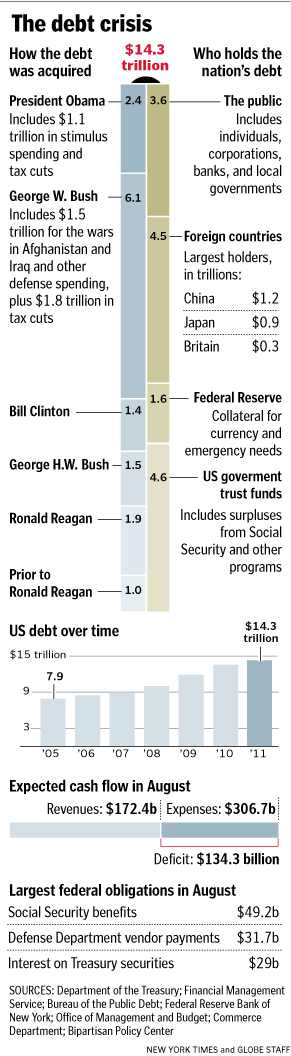
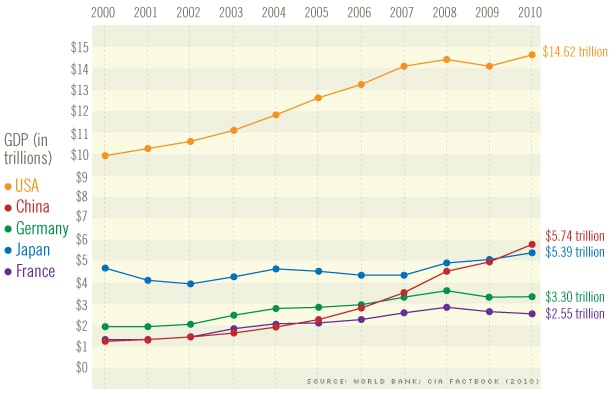
Steps to recovery:
1) End all offensive military actions overseas. Finish winding down Iraq and abandon Afghanistan wholesale. These actions have cost several trillion dollars over the last 10 years. We can't get that money back, but we can stop spending more.
2) Defense spending is in the top 3 highest budget expenditures. Cut it by 1 third across the board. Maintain important overseas installations such as Japan and Taiwan. Given China's rise, its wise long-term to keep a presence in the region. Scale back deployments in Europe unless Russia still is still a threat to western Europe.
3) The most amount of money the U.S. spends is Health and Human Services. The U.S. health system is a fucking mess. Somehow we spend the most on healthcare and get some of the worst societal benefits out of any industrialized country. I don't have an answer here, but it likely involves completely tearing down the existing system to its nuts and bolts and building it back up. I'd love to hear ideas on this point from others that know more about it.
4) Social Security is the other one. My mom relies on it, so does a lot of my family. We're from meager backgrounds and traditionally have come from poorer parts of the nation. That being said, cut it.
When I look at my paycheck and see that upwards of 40% of my income is being sucked out by the government and used more for things I oppose than things I support (e.g. war spending versus scientific investment) it pisses me right off.
Yes, I have heard the naive argument "But taxes are there to run the things you use like roads and government services that you use every day". This is true only in part. Yup, we need an army. Yup, we need local police. Yup, we need roads. Yup, we need a justice system. But it doesn't take trillions of dollars a year to run those things.
The government shouldn't interfere with business like propping up failing business models. It should work to make sure that business plays fair, i.e. anti-monopoly or collusion, etc.
I'm more liberal than conservative, and definitely not one of these people that wants business to have free-reign over everything. But there are bottom lines that we have crossed and need to back off.