When I started doing telecom related projects in Australia I needed to learn about the protocols and terms. It took ages to figure out that when the US referred to the "central office" what they meant was what we would call an "exchange" (formally "telephone exchange"). Why would a building that is primarily serving to interconnect and switch telecommunication circuits, and providing desks and rooms for workers would seemingly be a secondary function, if at all going by those windowless rural sheds, be called an "office"?
The "office" is the building, the "wire center" is the collection of circuits that terminate in a given location, the "frame" is physical hardware that holds those circuits and a group of staff who service them, the "exchange" is a legal and software concept for lines with a particular billing (local vs toll-call) relationship to each other, and the "switch" is hardware that implements the exchange among other things.
These all refer to subtly different things. One office can have several exchanges in it. One exchange can be served by multiple switches, or one switch can serve several exchanges. Office consolidation can mean multiple wire centers in one office. And larger offices often have multiple frames which have multiple frame techs working them because they're a long walk from each other.
Also within the office is transport equipment, historically called "toll" equipment since calls leaving the office were expensive, but that's very much a legacy term at this point. Transport equipment is transparent both to call routing and data traffic, so you don't see it on a billing statement or traceroute or whatever, but in any given office, the transport (and associated cross-conneect) equipment probably outweighs the switch by an order of magnitude.
Within a CLLI code, the first eight characters are the office, then the next three are the exchange. For instance, DTRTMIVTDS0, is the DTRT MI area, VT office, DS0 switch. Historically there was another switch in the building called DTRTMICG0, but it's been decommissioned and the lines moved to DS0. Transport equipment has CLLI codes too but outsiders seldom see them.
The buildings are called Central Offices. The switches inside are the actual pieces of equipment handling the calls. Yes, "telephone exchange" is also used, but not so much in the United States.
This is just my uninformed guess, but in the old days this function did indeed require rows of desks with people manually plugging in wires to connect calls.
I was hoping for interior pictures so I could enjoy the filthy rat's nests.
Instead I see someone has driven around and cataloged a target wishlist for someone who wants to take down communication infras- I mean cataloged very interesting sheds as a hobby.
Seriously though, why was this made? The site claims a combination of historical preservation and eccentricity. That's believable. I just worry about its use.
The same reason people collect stamps, or watch birds, or watch trains, or whatever. They like to learn, and they just find it interesting, and they like to share with others who do the same. No one will claim that this behavior has great utility beyond that, though certainly good hobbies are valuable ends in themselves.
Also, I immediately noticed the site does not have a map and does not give addresses for these buildings.
I appreciate the care taken "back in the day" to make COs fit in to their surroundings.
A friend and I drove around Cincinnati looking at some of the old COs. The COs in Cincinnati, by and large, fit with the architecture of their neighborhoods. Many of them are architecturally interesting.
The "Telephone Company" in its day took its job seriously. Nothing was slap-dash, not even the spaces where its equipment resided, and its telephone operators worked.
And the sad thing about that central office is that it used to house a ton of equipment. And toll operators. Now it's a packet switch. Probably taking up the back corner of the first floor.
Ditto. My $WORK had a 5ESS and a machine room and I've been in many a giga-POP. I wanted pictures from inside of the mix of just nice and rats-nest of cables.
I dislike the way this site is organised. I just want to see some pics, not drill down several layers trying to guess with path will bring me something interesting
Maybe some others did this too, but the first thing I did was go looking for 33 Thomas Street[0], mainly because of it's "infamy", and I think it's a fascinating looking building. I was surprised to find it missing, but it turns out it's not actually classed as a "Central Office".
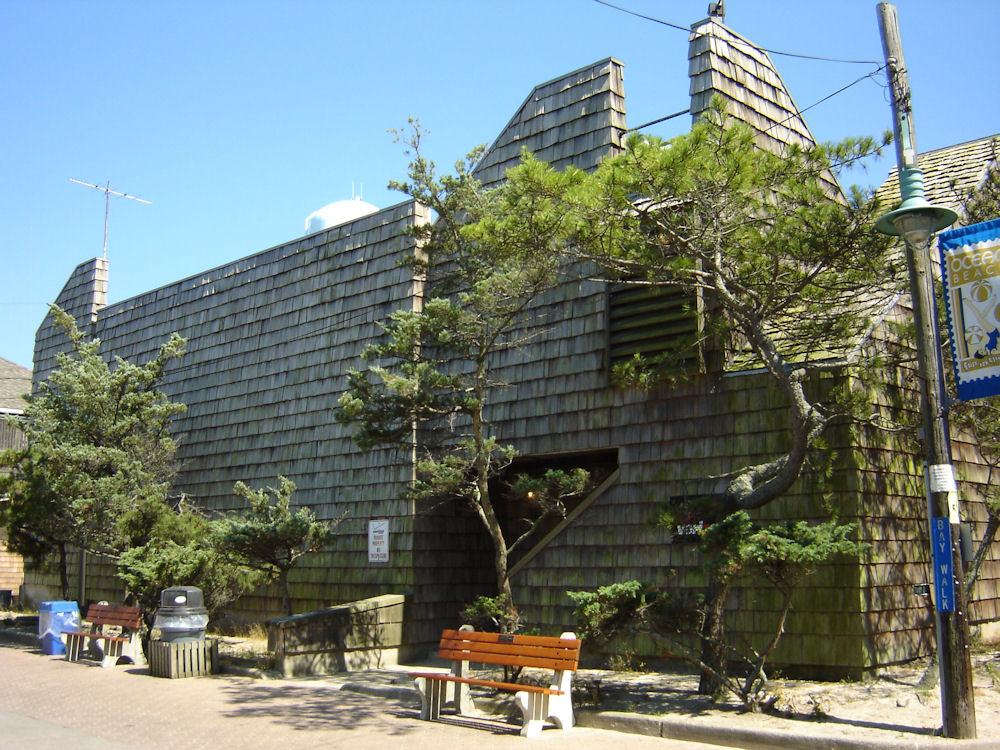
That said there's some neat designs such as this one with its all shingle camouflage:
Why do websites disable right clicking? If you right click on the page it just shows a browser alert. Very annoying for not much, if any gain. Now that I've reloaded the page, right click seems to be working as normal.
Geez. Do FAQ doesn’t mention what a Central Office is (thanks to other comments for an explanation). And how are you supposed to identify one from the outside?
> And how are you supposed to identify one from the outside?
I think many of these were purposefully designed to not be easily identifiable, as they hold critical infrastructure. Many of the internet exchange points near where I live are like this too - they just look like fairly generic office buildings.
Oh, my sweet summer child. How do you terminate 60,000 pairs of copper on a single rack? If they were all bundled together, the bundle itself would be larger than you. This still takes a large frame and lots of line-equipment racks.
Newer switches are smaller than older ones, but line-equipment can only get so dense and still have room to work on it. Some multi-floor offices have entire floors sitting empty because a new switch was installed elsewhere in the building and then the old one decommissioned and removed. But there's still tons (literally, probably dozens of tons) of transport equipment, cross-connect, power and cooling, etc.
I assumed that we had switched to some sort of switching infrastructure a long time ago, where you wouldn’t pull every single copper wire all the way to the exchange
Outdoor infrastructure is built and maintained on the timescale of decades and centuries. It's not like software that you just apt-get upgrade. If we were building from scratch today, that might be how we'd do that, but for it to be done that way now, the technology would've had to be proven, reliable, affordable, environmentally rugged, and better than every alternative back in the 60s or 70s.
Only in a small percentage of cases, typically exurbs where the subdivisions have been wired with such cabinets as pairgain equipment. Usually those cabinets are just cross-connects, basically patch panels, to assign individual subscriber drops to lines within the distribution plant. All the lines go back to the CO for termination, at least for the majority of subscribers that're fairly close to the CO and thus it doesn't make sense to deploy pairgain less than a mile away.
More likely to be sold or leased out, and the server is somewhere far away. Basically all telephony nowadays is VOIP, even if you have an old fashioned landline it'll be analog only at the last mile.
But I thought a lot of these massive exchanges were built for the physical switching devices, which must have been completely miniaturised when they switched to digital.