It's not unprecedented. It's been a steady state that they have pretended was not a steady state. They are not "in a drought". They say drought in a way that implies that it is a temporary state that may return to a different, normal state. But it will not. They have reached a new normal of a lower water level.
Meanwhile, they continue to push nonsense to help. The amount of water used by residences doing "outdoor watering" is miniscule. Agriculture is over 80% of the water use in california. If they were going to completely run out of water in a week, and all outdoor watering by residences would stop, it would buy you less than a day.
It is politically untenable to fix this, as it requires not trying to grow water-hungry crops in what is literally a desert. They are trying to slow-walk things - farmers won't even be required to all have water meters to measure their water usage for years yet. It won't help enough. There is likely no way to fix this without completely destroying the livelihoods of a lot of farmers, and nobody wants to deal with that for real. It will happen either way, mind you, the only question is whether it destroys the ability of everyone else to live there at all.
Unfortunately, nature is not going to wait for politics.
> Meanwhile, they continue to push nonsense to help. The amount of water used by residences doing "outdoor watering" is miniscule. Agriculture is over 80% of the water use in california. If they were going to completely run out of water in a week, and all outdoor watering by residences would stop, it would buy you less than a day.
This is definitely true and something I try to point out to people all the time. The California Water Plan limits residential usage to 10% and it has never utilized more than its allocation (usually closer to 1/4-1/3 of that). So, if every person in every residence and every municipal service were to turn their water usage off for the entire year, it would lower the entire load by about 3-5%.
Meanwhile Ag, industrial and commercial services (water bottling and its ilk) continue to surpass their allocation and continually diminish aquifers and reservoirs, year over year. The whole "Save water, we're in a drought" rhetoric is (generally) a political move from those industries to deflect blame, guilt and responsibility on the populace.
This may not be true for every state, but it most assuredly is the case for California.
That's not really the whole story though, because water supplies are not a centrally stored resource shared amongst all consumers. It's a fairly distributed system with lots of different reserves feeding different consumers.
For example, small towns may pull their drinking water from a dam or other reserve that is of limited supply, where the agriculture in the area is not affecting the same water, being pulled from rivers or bores or a separate reserve.
That is to say, drought measures should really be applied town by town.
Not true in California due to the state water project. Water is captured in NorCal and shipped to SoCal for agriculture. Central Valley farmers directly reduce the water for SV suburbs. The only river they haven't tapped is the Klamath.
> Not true in California due to the state water project.
Very much true in California, your info is incorrect.
There is no central water source. There are tons of independent unrelated water systems.
Source: My small town in California has its own and every nearby small town have their own.
Every one struggles with drought conditions but each one is different. Some feed off mountain runoff and rivers, some are from groundwater only, some are threathened by seawater incursion some are not, and so on. In some of these drought years some of them have nearly run out of water completely, others have more spare capacity.
They're not all interconnected though. For example, where I live most water comes from Hetch Hetchy, which is not connected to the central CA agricultural water delivery projects.
In case anyone is curious, the Tuolumne "river was dammed at Don Pedro and Hetch Hetchy to provide water for Central Valley farmers and the city of San Francisco, respectively". https://en.wikipedia.org/wiki/Tuolumne_River
It appears that one ~half of the Tuolumne is diverted for Central Valley agriculture and one ~sixth is diverted to San Francisco.
To be explicit, water from the Hetch Hetchy reservoir/valley flows to central California agriculture by not being diverted to San Francisco (via the Hetch Hetchy Aqueduct), instead continuing to flow as the Tuolumne river until being dammed by the New Don Pedro Dam, then eventually released by that dam until again hitting the La Grange Dam, from there possibly being diverted into the Turlock Irrigation District main canal.
> The whole "Save water, we're in a drought" rhetoric is (generally) a political move from those industries to deflect blame, guilt and responsibility on the populace.
Just like convincing people that if only they recycle plastic bottles, the environment will be saved, and if it isn't, obviously it was people who just didn't recycle enough shampoo bottles.
Water bottling is a red herring, that one arrowhead bottling facility in california that everyone likes to blame for water shortages uses the same amount of water in one year as a similar sized alfafa farm.
Except there’s not one water bottling plant. There’s multiple Arrowhead bottling plants, Crystal Lake’s plant, a few Nestle Pure Life, Dasani, Aquafina, etc.
In fact, a simple Google search would have told you that there are over 110 of them:
And while the amount they bottle is a drop compared to Ag, their total bottling amount equals the total residential (which includes municipal) water usage in the state. Yet they pay a fraction per gallon, lobby to keep water restriction measures in place on residents and spread misinformation on the topic.
> their total bottling amount equals the total residential (which includes municipal) water usage in the state
From the article you linked
"The International Bottled Water Association says that about 3.1 billion gallons of water are bottled in California annually. Nestle, for example, uses 725 million gallons of water annually at its California bottling plants.
But that volume is dwarfed by the 4 trillion, (with a "t,") gallons used by residents every year."
So those 110 companies combined use 0.00077 of the water residents use each year, and likely pays the same per gallon as other ag and industrial consumers, and this is considered a problem worthy of attention?
Yep. You can look at this from an economics standpoint as well.
We have run out of FREE water.
If all water use in CA cost anywhere close to residential water rates ($8 / 100 cubic feet) there would be no shortage.
Even a small tax of $0.01 per gallon would be a start in this space.
We have exploded population and if you look at water projects (that actually deal with supply) have not done the same over 50 years or whatever. Think grey water use and recycle / desal / dams etc etc.
It's the perfect trifecta+.
Ridiculous water use (afalfa for china) in a desert, free water (water "rights"), limited projects to increase supply for enviro and other reasons (inability of govt to do things).
The residents see it differently. They have been farming there for several generations and it's been mostly fine, the land is very productive when irrigated.
The fact that it all depends on a massive public subsidy (both cash and water) from the rest of the state is ignored by then. They focus on arguments like "stop dumping water in the ocean" - eg make all the river run dry before reaching the coast, and "this is where food comes from" - as if it's the only place in the country you could grow food, or that other nations/regions manage to grow plenty of food in a similar climate with a fraction of the water.
The problem is California is such a young land, people there think "several generations" is a long time that gives them insight into the typical climate of California. They look back one or two hundred years and remember lots of wet weather, and extrapolate out from that to conclude things will be dandy.
Paleoclimatologists look further back than that, and what they say about the history of California is a lot more grim. The present droughts are mild when you look back even just a thousand years.
Those "Stop dumping water in the ocean" signs are a direct result of the Resnick's marketing efforts to grow nuts in the California desert. You may not be familiar with the Resnick name, but you are probably familiar with some of their brands.[0]
Do we even grow a sizeable proportion of staple crops in the western US? Isn't the majority of water going to crops like almonds (as opposed to grains)?
Why do so many people choose to live in a desert? It makes very little economic sense. Feels like it will be destined for failure no matter what silicon valley tries to pay its grunts.
Any expectation of having enough water for such a low price is laughably absurd. The population of this state is literally asking for these conditions - they are choosing to live there.
The vast majority of the population in California doesn't live in a desert. They live in chaparral, temperate coniferous forest and mountainous biomes/climates.
It's a moot point regardless as the California Water Plan is probably one of the most extensive in the world, beaten likely only by Israel. There is plenty of water for the populace and supporting services; and most of the populated desert regions (the IE particularly) are self-sufficient in water sources (Big Bear and Mt San Antonio supplying the aforementioned region).
The problem is water heavy industries (specific types of: ag, water bottling, manufacturing, etc) that benefit from the mild-temperate year round climate and strong soil, despite lack of sufficient natural water supply.
>The vast majority of the population in California doesn't live in a desert. They live in chaparral, temperate coniferous forest and mountainous biomes/climates.
The San Francisco watershed covers 40% of California including much of the region you are speaking of. The paleoclimate research, measuring historical salinity of the Bay using carbon dated sediment cores, shows that during the Medieval warm period the San Francisco watershed averaged only 60% of the rainfall it does today.
Why aren't there MPG-like standards for farming, and if we had such standards, how much water would be saved? Maybe there are irrigation standards and I just don't know.
The aforementioned industries have pushed heavily for "water rights" under the guise of residential accessibility, artificially deflating their cost and forcing the population to subsidize their usage.
That's like asking why does the government take federal tax dollars to subsidize corn fields in Nebraska despite massive surpluses? Because those businesses then use those profits to continue to lobby for those under the guise of "jobs" and commercial welfare.
Right, but then you're also living without plentiful growth - without lots of pollination. That's part of what not having water is. That's the current plight of California, Arizona, and New Mexico.
Florida has plenty of humidity, and when I lived there I got on just fine.
I live in rural TN today - same deal. It rains all the damn time, mosquitoes everywhere. We have a service come once a quarter that takes care of them. I don't have cancer as a result. I capture so much rain water and filter it down and use it for productive purposes, I live on 15 acres and pay $25 for my water.
I saw some other people make reference to subsidizing folks in rural areas, but that's simply not the case. We use our water and conserve it unlike any suburban areas do, we don't spare a drop. And we pay the same rates as everyone else in the state.
People lived in deserts all across the US for tens of thousands of years and got by just fine and never had to pay a dime for water.
This isn't a desert climate problem, it's a "capitalism charging money for something that should be free" and "modern civilization having no concept of ecological balance" problem.
> it's a "capitalism charging money for something that should be free"…problem
It’s mostly the opposite. If we put a price on water, with the first 50,000 gallons per residence being free or subsidised [1], the problem would self correct. Water-heavy industries would be priced out. A budget would emerge for conservation.
We don’t get this, however, because the state’s heaviest water users, certain agriculture and industry, have convinced enough of the urban population that water pricing is some capitalist scam. (Analogous to how landowners convinced renters that the enemy was the employers.)
The story of modern California’s woes is one of special interests co-opting a gullible anti-capitalist slice of the populace.
Likewise, cf. The Catastrophe, when every coastal city around the Mediterranean was sacked c. BCE 1190, beginning a 300-year dark age, which appears to have started with a multi-year region-wide drought; although it is hard to be sure at this remove, especially when record-keeping evaporated along with civilization itself. Archaeology has had to fill in the blanks.
Israel also uses a lot of desalination: “ Israel now gets 55 percent of its domestic water from desalination, and that has helped to turn one of the world’s driest countries into the unlikeliest of water giants.” [1]
While CA is busy stonewalling desalination project that could cover 1/3 of Orange County needs and would reuse old power station infra. And not much else is planned.
Recycled water isn’t readily available in most of the state for irrigation either. Instead we dump it.
I'm not familiar with the reasons given for stonewalling desalination plants. It seems to me (a layman) that this would be one of the first real avenues for actual progress on the shortage. Why is this being fought so hard?
Opponents of desalination in California most often cite the cost of desalination, and the environmental toll of the energy required to run desalination plants. They also don't like the idea of putting salt back into the ocean.
Generally speaking, California is full of NIMBYs who will reflexively oppose virtually anything new, then work backwards to then find disingenuous justifications for their opposition.
Regarding the Poseidon desalination plant proposal for Huntington Beach:
It's an expensive, risky, corporate handout that ranks nearly dead last across the board in terms of water reliability, value, and financial risk relative to any other proposed water projects(including some other desalination projects) per MWDOC's own report.
One problem, at least for Southern California, is that the wastewater is located far away from agricultural areas. Doing this would require another water project on the scale of the project that brings water down here in the first place. Wouldn't be a bad idea tho.
California and Arizona wiped most of the US produce business off the map.
Between the destruction of Ukraine, the western us droughts and the impending exhaustion of much of the Ogallala Aquifer, looks like many chickens are coming home to roost in the coming years.
The worst culprits (in terms of volume + heavy water usage) are almonds, pistachios, and walnuts. No one is going to starve because nuts become rare and expensive, so let's start there.
There are people working on this in California already. Grown more foods that are native to the area is an easy beginning. The answers are not forward, they are backward.
Some nuts are carbon neutral... To grow them you have to grow a forest first. Just don't do it in the desert. Start with eliminating animal products. Feed people instead of livestock. That shouldn't even be controversial but tradition is holding us back. Trust me life is good as a vegan glutton.
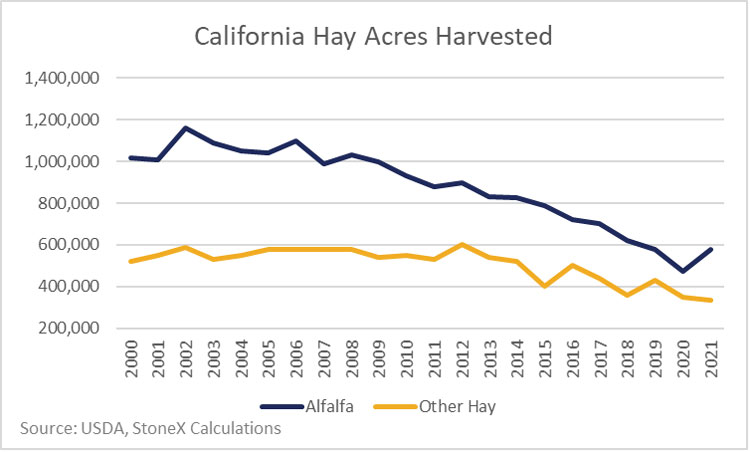
This source is out of date-- alfalfa acreage has substantially declined over the past decade while nut acreage has boomed. Both are bad though, obviously.
Funny you speak of chickens, there's also a chicken pandemic that's spreading everywhere. So, looks like those chickens will be going to the big henhouse in the sky to roost.
I believe this statement is applicable to the climate crisis in general. Recent reviews of 2015 Paris agreement progress indicate abysmal performance. We've been using resources in such a way that we don't have to consider their true costs, and we've been doing so for generations. I don't think we'll see very significant change until it is forced upon us. We'll then make reactive changes, rather than proactive changes. And it will be too late for a lot of regions / people.
Personally, what i find aggravating is the insistence of many that consumption is the answer. Electric vehicles and their associated manufacturing inputs combined with power grid upgrades will be the solution.
No.
The solution is to work together as a tribe, not as individuals. Instead of personal electric vehicles, we should be electrifying logistics and improving public transit.
Sadly, those who will pay the price are those least able to do anything to fix the situation.
> The solution is to work together as a tribe, not as individuals.
Agreed. It's not about continuing our way of life and maintaining the same mentality, but with alternative tech. The fix for this requires leadership and cooperation and significant culture shift. At a global level. Unfortunately we're not even close to where we need to be socially or diplomatically. And yes, those who are least able to affect change, and who are least culpable, are already paying the price.
Surely most here have seen and read enough dystopian sci-fi to understand how bad it can get before the wealthy & powerful feel the pain or are encouraged to do anything about it.
I don’t expect this situation to change until it’s more profitable to do the right thing. Capitalism + game theory all the way down. Unfortunately, the governments that can make a dent in this are heavily lobbied by the same industries they’d be changing the economics of, so what we get is misinformation campaigns (“cOnGReSs cReAtED DuSt bOwL” signs all down I5) and large-scale inaction + pleading with the public to just install lower-flow shower heads and only water plants 1x/week.
I grow food in my own backyard in pots and I’m going to keep those alive. Trying to turn the desert green in Central Valley CA just because some people moved there a few generations ago and took advantage of the infrastructure situation isn’t a tenable solution. There’s so much green open space out east that I really don’t buy the “but then where would food come from?” arguments either. People built up in the wrong place. Now it’s a crisis. It’ll take years / decades to build up supply chains and infra in other places; I get that, but if we just keep kicking the can down the road we’re just screwing our selves more and more each year. Time to rip the bandaid off and pass realistic prices down to industrial users and force a mass exodus of that industry to places where it makes a lot more sense to farm.
"There is likely no way to fix this without completely destroying the livelihoods of a lot of farmers, and nobody wants to deal with that for real."
I disagree. I hate to be the hand-wavy "desalinization" guy but ...
We have completely green solar energy and desal (I assume) wouldn't even necessarily require a base load. We could have all the water we need and everyone in California could have a nice green lawn. Or wash their cars. Or grow almonds.
Correct me if I'm wrong, but I don't think there are even any technical problems to solve - it's just implementation of existing technologies. And is climate-neutral at worst. And we have a staggering budget surplus in California.
We need all of the solar panels we can array to displace fossil fuel and stave off imminent environmental collapse.
Only after we have built out enough solar and wind generating capacity, and (eventually) storage to entirely displace fossil burning will we have excess power that can justifiably be used for desalination. Even then, synthesizing hydrogen and ammonia for industry will absorb all the excess we can muster.
Anyway, direct solar desalination is a much more efficient method (i.e., 100%) than relying on electric power (typically, in practice, <20%).
The best part is all the bleating and political signage in Central Valley. They don’t even realize how much their lives depend on government subsidies, but they’ll loudly complain about welfare and immigration while employing day laborers and paying them cash, cheating on their own taxes, and receiving tons of benefits from the government.
The saltwater is in the ocean, and the agricultural areas lacking water (south central valley) are on the other side of the coastal mountain range. So it will be a huge energy expenditure to 1) desalinate and 2) pump the water over the mountain range.
I suspect it would be too expensive for agriculture, which relies on artificially cheap water.
"The saltwater is in the ocean, and the agricultural areas lacking water (south central valley) are on the other side of the coastal mountain range. So it will be a huge energy expenditure to 1) desalinate and 2) pump the water over the mountain range."
I'm not so sure ...
A large amount of municipal/consumer water, from reservoirs, comes down those mountains - and if the coastal users reduced that demand (as they received water, locally, from desal) then that water could either stay in the mountains or be redirected elsewhere - with gravity.
I'm sure there are many different scenarios but I know for certain that there are big reservoirs away from the coast and at (relatively) high elevations ... those could be used differently.
> A large amount of municipal/consumer water, from reservoirs, comes down those mountains - and if the coastal users reduced that demand (as they received water, locally, from desal) then that water could either stay in the mountains or be redirected elsewhere - with gravity.
Given how small of piece of the water pie municipal/household consumption is, that would have little impact on the overall water crisis, but result in a massive increase in energy consumption, which will not primarily come from renewables. Who should pay for that desalination infrastructure and the energy to run them (to say nothing of the externalities of all that extra fossil fuel consumed)?
This just makes me picture big pipelines following (in reverse) the course of the natural watershed... some desal plants off the coast of S.F. or Marin peninsulas with pipes in through the Golden Gate and up the river delta and fanning out towards Sacramento and south to Fresno etc.
If California agriculture is already untenable at 1c a gallon (as per this comment: https://news.ycombinator.com/item?id=31235312) then its probably not going to be very viable to support agriculture with desalination plants.
I ran the numbers once and you'd have to basically turn the entire coast into desal plants to make enough water for ag. I don't think it's viable, either environmentally or economically.
> It is politically untenable to fix this, as it requires not trying to grow water-hungry crops in what is literally a desert
It doesn't even requiring changing the crops you grow! Instead of watering pecan trees by spraying water all around them, you can use more precise aiming and distribution to get the water right to the roots. You can save a huge percentage of water just by being more careful instead of "if I flood this plain with water, eventually some will get where I want it to go."
Driving through the Central Valley and seeing the signs saying “Build more dams” and “Stop letting our water be wasted to the ocean” really highlights the disconnect.
You do see a lot of almond tree groves ripped up along the San Joaquin valley. Perhaps some farmers are already finding it too expensive to grow water-thirsty crops.
CA water use is 50% environment, 40% agriculture, 10% residential.
Maybe we should focus on reducing that 50%? It was nice and all when we had plenty of water to waste but it’s time to revisit those policies.
That link says that the environmental water use happens largely in areas that are not competing with agriculture. E.g. protecting rivers, streams, and wetlands in the redwoods.
The answer to "we're being wasteful with water during a drought" is not "let's irreversibly destroy habitat and threaten species so we can continue to be wasteful."
Yeah, your numbers are not different, just framed differently.
If you scroll down, you'll see the "More than nine million acres of farmland in California are irrigated, representing roughly 80% of all water used for businesses and homes." number i cited.
Not sure you can necessarily do a lot about the 50%, but maybe worth trying - my (ignorant) understanding is that a lot of it is in areas where it would not help.
You can also see that urban water use has fallen like a rock already..
In the past 2 decades, per-capita use went from 230 gallons per day to 146 gallons per day - people have already cut their water use by 30%.
Which species and ecosystems are you proposing eliminating?
("environmental use" really means "leave it in the river"; reducing environmental use to zero means making rivers never reach the sea because you've extracted 100% of the water.)
Floating solar farms on the reservoirs will radically reduce evaporation, besides providing power. The power generated can be used, in many cases, to pump water back up to the next higher reservoir.
Which species are you claiming would go extinct and does your list cover 100% of those on the environmental list? Perhaps there's room somewhere between the two extremes?
Unclear if anything would go extinct but most of that water drains into Humboldt Bay. There are several robust salmon and trout fisheries which would almost certainly take a beating. These steams support river otters whose numbers have never really recovered from Russian and American fur trappers and those streams support an enormous number of migratory and local bird, fish and amphibian species. Unclear what might go extinct and what would merely take a beating but it is pretty clear from similar projects in the PNW that the ecological consequences would be significant.
A visit to Humboldt might change your thoughts on the topic. It is one of the most beautiful places on Earth. Not only does it boast the tallest trees on the planet but it is one of the few places in America that I would describe as wild and free. The scars of clear cutting from the 60s are still visible but the land is still alive in a way that it just isn’t in a lot of the State.
Characterizing the issue as one between two extremes is a straw man. The rivers of Northern California are already heavily engineered. The current levels were established after the environmental consequences of that engineering was deemed unsuitable for the communities in the region. The Central Valley has effectively engineered its rivers out of existence and it is still not enough. It will never be enough. There is only one extreme in question here.
Hahaha..
Room between the 2 "extremes" of "use every drop of water in the river so it never makes it to the ocean" and "Let plants and animals have a little water". This is exactly what's wrong with discourse in America.
exactly my point. It's like the cartoon where one side says, "kill them" and one side says "don't kill us" and the guy in the middle is asking for a compromise.
This is less of a solution than people in Kern county would like to hope for. That environmental water use is almost entirely in Humboldt and the surrounding counties (Trinity, Del Norte, Mendocino). Those people will be just as unhappy about killing off the Trout and Salmon fisheries that have been there for 10000 years as people in Kern will be about ending the Cotton Harvest that has been going for the last 100 years. And this is to say nothing of the difficulties associated with capturing all of that water.
It is a purely selfish policy that wants LA to pay for Fresno to get water from Trinity instead of Central Valley farms simply living within their means and cutting back on water usage (which will have to be done eventually).
It is really odd to include a metric for “environmental” water “use” and would seem to be a strategy to confuse. As if a river is “using” water and reducing that would be a good thing.
California is past its capacity for people and agriculture and both need to be reduced or supplemented with generated fresh water. There are plenty of other places with adequate resources.
Even within the already small residential slice, regulations are weird. When my parents lived in the LA area, they had a large swimming pool and an irrigated lawn but were required to have ultra low flush toilets. The amount of water saved by those toilets (which often required multiple flushes to empty the bowl of waste) paled in comparison with the government approved swimming pool and sprinkler systems.
A modern low flush toilet is excellent. They flush considerably better than the old 5 gpf toilets. I’ve seen plumbers advise replacing old 5 gpf toilets with 1.28 gpf toilets to reduce the frequency of clogs.
For amusement, you can look up MAPS testing. People flush varying amounts of standardized pretend poop to make sure that toilets work well.
(But yes, there was a generation of low flush toilets that were essentially 5 gpf toilets modified to use less water per flush. They worked poorly.)
Also, a covered pool uses surprisingly little water.
> Even within the already small residential slice, regulations are weird. When my parents lived in the LA area, they had a large swimming pool and an irrigated lawn but were required to have ultra low flush toilets. The amount of water saved by those toilets (which often required multiple flushes to empty the bowl of waste) paled in comparison with the government approved swimming pool and sprinkler systems.
How so? Pretty much everyone there has a flush toilet that they use all the time, while I'd imagine pools are much rarer (and also not drained/filled with each use). Toilets also essential items that last decades, so it takes a long time to phase in any updates to their standards (especially compared to lawn-watering regulations). It wouldn't surprise me that going to low flush toilets would save more water (across the whole population, over the long run) than banning pools would.
As bad as that sounds, all that water (plus all the water used on residential lawns) is included in the 3-5% of California's water that goes to residential use. You could drain every pool in the state and barely touch the total water consumption. And as DannyBee mentioned above, per-capita water use has already been cut 30% over the last 20 years. You could shut off all residential water supplies entirely, to cut residential use by 100%, and still only reduce total water consumption by 5% at most.
Pools aren't the problem. Lawns aren't the problem. Residential use isn't the problem.
Farmers also grow rice in California, and alfalfa, which are two top water-hungry crops. It's so remarkable to which extent business and profits take precedence over the public good of tens of millions, in the United States.
"We'll deal with it when it's a catastrophe - ka-ching!"
The reason that we have those numbers is because we have carefully accounted for practically all of the recoverable freshwater in California. The unintended long-term consequences of damming nearly all of the streams and rivers in the state should not be underestimated. Similar proposals have been raised before and shot down:
Don't bother with HN comments for anything other than tech and startups, and even then you should be suspicious. It's full of privileged tech bros pushing shitty solutions to the wrong problems.
You are correct that nature will not wait for politics. I hope I am wrong, but the following seem absolutely certain:
-climate change will happen as Hemingway described going broke: gradually and then all at once.
-The Central Valley will fail and there is no plan B. Food prices will be exorbitant and unobtainable for many during the transition.
-Over the next 10-20 years direct sunlight will become unbearable. This will make laboring outdoors difficult, dangerous, and costly work.
-One side effect of the warming upper atmosphere is the alteration of cloud formation conditions.
-Over the next 30 years we will lose cloud cover, in some places almost entirely. This will accelerate the moisture loss in soils and create permanent dust bowl conditions across most of the American West.
-Wildfires will begin to propagate in places that traditionally have had few.
-Access to abundant fresh water and cloud cover will be the largest determinant of land value in 10 years.
Thirsty folks from California and the Southwest wanting more water to be piped in to feed their water intensive crops and lawns in the desert. I'm sure that'll go down well in outlying regions. Maybe change in meteorological patterns and population levels hitting critical mass without the attendant infrastructure are bad for water levels. Aquifers are depleted. Rainfall is reduced. There's no more snowmelt to bank on as that savings account has been drained. Wildfires, drought, and rising sea levels will displace significant numbers of people. Agriculture will shift north and east. I think California peaked a few years ago.
“folks from California and the Southwest wanting more water”
People don’t complain about Floridians or iowaians. It’s always the brown bodies from California “driving up prices” and “drinking all the water.” California is a dog whistle for anti-immigrant viewpoints. “Folks from California.” We know who you mean when you say that. Immigrants and other “water drinkers.”
Water is very heavy. The energy expenditure (AKA fossil fuel burned) to lift water over the mountains between the PNW and Southern CA would be massive and defeat any climate change progress.
A fraction of that energy/investment put toward using water more efficiently in agriculture (in both the physical and economic sense) would make a bigger difference.
I just finished a trip to the Buttermilks, a climbing area on the eastern slopes of the Sierras. I was surprised to discover that the land is owned by the city of Los Angeles, so they can protect their freshwater source that is pumped and piped over the mountains to LA.
The mountains they are piped over are not the High Sierra, but the narrow coastal ranges near Santa Clarita. That itself requires a massive amount of energy.
Pumping over the Cascades would require much more energy since there are no natural valleys connecting the water rich parts of the PNW with CA. It's a very thick wall of mountains that you would have to pump water up and down repeatedly.
Like others mentioned the current drought/dry period is how the west has always been. What is an abnormality is the last 150 years and how wet it was. Multiple scientists are saying the same thing but nobody in politics/media are listening. Given no desalinization plants are being built or efforts made to trap more water runoff expect things to get alot worse. Also expect current CA politicans to blame everything on residents "wasting water".
I always wondered if there'd be a way to basically create a deeply sloped man-made river system that essentially brings salt water deep inland - say as far as Colorado, and perhaps it can be desalinated naturally setting up some filtration systems along the way to catch some of the salt.
Imagine if we had a river as big and wide as the colorado river coming from the pacific ocean and back into the colorado river. It might even change weather systems to bring more rain in the area because there's more water vapor.
I'm not a scientist and don't know the specifics on how/if that'd work but it'd be a pretty interesting experiment.
Hasn't drought in the American west been a constant for at least the past 1500 years? Like, that's the origin story of most of the native groups - "everything died so we traveled through the hellish lands of death until we reached a place with water". Those that lived in the area throughout that time (like my own ancestors) left almost no history for obvious reasons, but it's pretty sure that they lived without most of the trappings of what present-day humans think of as civilization, like fire, clothing, or agriculture.
> Those that lived in the area throughout that time (like my own ancestors) left almost no history for obvious reasons,
Humans have lived in the basin where I live for at least 4000 years, and many parts of it are filled with thousands of bits of their pottery as evidence of their presence. I suspect that the Tewa/Pueblo people in general would be a little troubled by the idea that they "left almost no history" behind. I'm not sure what you think the "obvious reasons" would be for this, were it to be true?
> but it's pretty sure that they lived without most of the trappings of what present-day humans think of as civilization, like fire, clothing, or agriculture.
Your assumption is incorrect. The US southwest, like other parts of north America, has been home to human civilizations for thousands of years. The meant civilizations with technologies, art, trade, travel and certainly "fire, clothing and agriculture". Chaco Canyon in NW New Mexico was at one time a basically urban center that functioned as the area hub of a trading route that stretched from south of what is now Mexico City up into Utah, and was likely home to thousands of people living in permanent dwellings.
What is true is that the populations were generally small compared to modern American cities in the region, and would have tended to concentrate in areas with year-round surface water flow. Because of the lack of access to groundwater (as we have today, perhaps at a our long term peril), when the decades-long droughts hit (e.g. in the late 1400s) many of these populations had no choice but to move.
Artifacts are not history, they are items. The names, languages, and cultures of many native groups are completely unknown due to genocide and forced integration.
I said that they lacked the trappings of what present-day humans think of as civilization, not that they didn't exist or have civilization, which I know they did - but they died out due to drought. Much of the time, they lacked resources for widespread access to fire, clothing materials, or sedentary farming, because there was so little water and so little arable land, and they learned to live without those things.
> The names, languages, and cultures of many native groups are completely unknown due to genocide and forced integration.
Now that I understand what you're referring to, sure, absolutely. A apologize for not getting your point there immediately, since it now seems so obvious.
The Chihuahan and Sonoran deserts are certainly unforgiving landscapes for human settlement, even more so without access to groundwater. But they don't represent the full range of landscapes and ecosystems of the "desert southwest" - the northern half of both what is now AZ and NM is still relatively dry compared to areas east of the 100th meridian, but has lots more opportunities for water-requiring civilization-al stuff (especially along valleys like the Rio Grande).
Places like Bandelier and Gila show evidence of sedentary farming that lasted for (at least) hundreds of years. Yes, this is a different ecosystem and climate from the desert areas described in the article you linked to, but just as much a part of the human history of this part of the world.
>The names, languages, and cultures of many native groups are completely unknown due to genocide and forced integration.
This is post hoc ergo propter hoc. The history was lost because the Spaniards burned all the books, with the exception of stuff that was never written down in the first place. The Romans did plenty of genocide and forced integration but we didn't lose the history of their predecessors because they didn't intentionally destroy it all.
>Much of the time, they lacked resources for widespread access to fire, clothing materials, or sedentary farming
This bears little resemblance to the actual history of the Southwest, which was absolutely agricultural:
They also made clothing not only from animal hides but from furs and yucca fibres. Native trade networks extended nearly across the continent, although mostly by local connections. Durable goods such as fiber could easily have made it to the desert. However, they did often wear little clothing, because it's damned hot in the Southwest.
I'd be careful with language like this. My impression is that "they were wiped out by smallpox" is the sort of thing that infuriates native Americans, because it is implies that their cultures were destroyed, a claim they very much dispute. Yes, populations were massively reduced by european diseases, but in most cases (all? I don't know) it did not wipe out the cultures. It have a dramatic impact on them, and did set the stage, of course, for the subsequently arriving colonialists to attempt to continue the process in person (with varying degrees of success).
Certainly all the cultures that were wiped out are not here to object; and those that weren't weren't. But many even of them might have been, after. We have no record of them, so cannot count them. Those still around to object are subject, necessarily, to survivorship bias, and rather more starkly than is usual.
While you're correct about the native people often living as nomads and lacking clothing or permanent structures, it's worth clarifying the "genocide" claim which is a source of mass misunderstanding about American history.
To be clear- many indigenous groups lived as distinct tribes for decades or centuries which then disappeared, but essentially none of them were due to direct contact with immigrants from Europe. Disease, drought, inter-tribal warfare wiped out the vast majority.
The introduction of guns and horses to tribes that had lived in a state of intergenerational conflict led to much higher death rates when groups clashed. Even relatively minor diseases can lead to deaths when the entire tribe needs to keep moving daily to follow a herd of animals.
The narrative of European immigrants wiping out the tribal groups is mostly a modern fiction, heavily signal-boosted by Chinese & Russian propaganda to undermine Western human rights demands by turning contemporary abuses into a "whataboutism" of an imagined past.
> Disease, drought, inter-tribal warfare wiped out the vast majority.
To be clear, disease was by far the biggest factor.
To be even more clear, diseases introduced via Europeans. Wikipedia's list includes "smallpox, bubonic plague, chickenpox, cholera, the common cold, diphtheria, influenza, malaria, measles, scarlet fever, sexually transmitted diseases (with the possible exception of syphilis), typhoid, typhus, tuberculosis (although a form of this infection existed in South America prior to contact),[4] and pertussis" - https://en.wikipedia.org/wiki/Native_American_disease_and_ep...
European colonization was significantly easier because something like 50-90% of the population was gone, 1) causing Europeans to think the land was 'virgin wilderness', with no strong indigenous land claim 2) making it easier for Europeans to conquer the local population, and 3) leaving improved lands that were easier to settle.
> led to much higher death rates when groups clashed
Do you have any numbers putting those rates into perspective? What I've found says it's a relatively small factor.
> The narrative of European immigrants wiping out the tribal groups is mostly a modern fiction
I have no idea of what are you talking about.
The California genocide isn't a modern fiction. The forced relocations and ethnic cleansings of the "Five Civilized Tribes" isn't a modern fiction. The "Battle" at Wounded Knee was a US fiction about a massacre.
I don't even see how this "whataboutism" is supposed to work. US government policy was directly based on white supremacy. It ended up with horrific consequences. We teach those as bad things. So that makes similar contemporary abuses good? Somehow? How?
Your confusion is because you fully believe the myths you've been told. I recognize a message board comment isn't going to change your mind any more than if I tell a devoutly religious person "God isn't real" or an extreme Qanon anti-vaxer that "vaccines don't cause autism". But I'll say it anyway- almost everything the average American was taught in school about native Americans and early settlers is somewhere between completely false and deeply misleading. We teach history as if the natives were peaceful victims and the settlers were violent attackers, but the truth is often entirely the opposite, where refugees from European wars settled as peaceful farmers only to have a Comanche war party find and attack them years later. Unfortunately the Overton window is so far away from reality, that stating basic factual truths like this gets you attacked with the vigor of an atheistic heretic under a Sharia system.
As for the "whataboutism" it's a simple attack against America to silence human rights activists as having essentially "no moral ground to stand upon". If an American says China shouldn't genocide the Uyghurs, they deflect the criticism by refocusing on the (imagined) treatment of various tribes by American policies in the 1800s.
I don't know what you are talking about. To the point where it sound like you are part of the kooks who believe kids these days are being taught to hate their country.
> you fully believe the myths you've been told
Which myths are you referring to?
> is somewhere between completely false and deeply misleading
I'm totally on board with that. The history I learned in school appear to have whitewashed the history.
> We teach history as if the natives were peaceful victims and the settlers were violent attackers
This is completely untrue. I even pulled out my high school American history book, and it doesn't say that. And my high school teacher is still teaching American history.
> where refugees from European wars settled as peaceful farmers only to have a Comanche war party find and attack them years later.
Is this a specific incident you have in mind? The Comanche surrendered in 1875 so you're talking about settlements in 1870 or earlier, and in modern-day Texas or Oklahoma. I'm hard pressed to think of which European refugees you refer to.
] In May 1847, Texas allowed the German settlers near Fredericksburg and New Braunfels to make their own treaty with the Texas Comanches. In exchange for land, the Germans promised a trading post and gifts. Unfortunately, the Germans not only encroached beyond the agreed boundary, but were slow to pay, and in response the Comanches made raids.
This is some time after the Council House Fight, "in which Republic of Texas officials attempted to capture and take prisoner 33 Comanche chiefs who had come to negotiate a peace treaty, killing them together with two dozen of their family and followers" - https://en.wikipedia.org/wiki/Great_Raid_of_1840
] In Texas, “the facts of history arc plain: Most Texas Indians were exterminated or brought to the brink of oblivion by Spaniards, Mexicans, Texans, and Americans who often had no more regard for the life of an Indian than they had for that of a dog, sometimes less” (Newcomb, 1961: 334; see also chapters on individual Texas tribes in Ortiz, 1983)
I'm curious - how much regard did this European refugee farmer have for the Comanche? And how did the refugee come to be settled in contested land? Who did he think would protect him, and why?
I ask, because we can directly compare the roughly century of peace between the Comanche and New Mexico, after NM killed Cuerno Verde and made - and upheld - a peace agreement with the Comanche, to know that long-term peace was possible. ... by a non-expansionist power.
> basic factual truths like
There really weren't that many European war refugees settling the plains, so even given that it's a basic factual truth, I don't understand how one small example is at all meaningful over the entire history of English-speaking American expansionism.
> they deflect the criticism by refocusing on the (imagined) treatment of various tribes by American policies in the 1800s
Again, the California Genocide was not imagined. Or do you think it was?
What imagined example are being given? Why make up examples when the real ones are so plentiful?
I mean, Soviet propaganda used real examples of Black oppression in the US to counter American "Free World" propaganda.
] The change came as a result of Roosevelt’s fear that racial inequalities would be used as anti-United States propaganda by the Japanese during World War II. After Pearl Harbor Roosevelt asked the cabinet what were the U.S soft spots, propaganda wise. The reply he received was that the Japanese may claim America is stating that it fights for freedom while oppressing its own citizens. This led him to finally order some enforcement actions against slavery by the federal government.
Own up to our negative history, explain why it was wrong, and use that to prevent further genocides.
So if I understand you right, Namibia lacks the "trappings of what present-day humans think of as civilization" because many San live as hunter-gatherers?
The link you gave describes people who live on the margin; "peripheral members of the Puebloan culture". Not "most of the native groups", which is the phrase yous used earlier.
Yes, many modern people don't have a sense of the pre-Spanish history of the Southwest. How is their ignorance relevant?
> Artifacts are not history
PaulDavisThe1st wrote "I suspect that the Tewa/Pueblo people in general would be a little troubled by the idea that they "left almost no history" behind."
The current buildings of Taos Pueblo, as an example, started about 1,000 years ago. And they have a detailed oral history.
] Consultation and collaboration with Pueblo people and scholars has changed the way that archaeologists think about migration away from Mesa Verde. Now, based on Tewa oral history, researchers understand that Mesa Verde people simply moved farther east, towards the Rio Grande region of northern New Mexico, where many of their descendants still live today. Using oral history, archaeology, and soil science, archaeologists have been able to come up with new ideas about the end of Mesa Verde. Even though there was a drought at the end of the time that people lived at the site, we can see that the environment was only one of the things that led people to move. The conditions when people moved weren’t much worse than they had been before.
(Emphasis mine.)
> everything died so we traveled through the hellish lands of death until we reached a place with water
Or, "The oldest tradition of the people of Acoma and Laguna indicates that they lived on some island; that their homes were destroyed by tidal waves, earthquakes, and red-hot stones from the sky. They fled and landed on a low, swampy coast. From here they migrated to the northwest, and wherever they made a long stay they built a "White City" (Kush-kut-ret)" - http://www.legendsofnativeamerica.com/region_southwest/legen... .
In that story, things died because it was too cold, until Summer and Winter came to an agreement.
And as I quoted earlier, "The conditions when people moved weren’t much worse than they had been before."
to be fair to t-3, they seem to have some real focus on the Chihuahan and Sonoran deserts, and I suspect that things may indeed have been a little different there than the areas occupied by the Tewa/Pueblo peoples and even the Hopi.
The idea that the people there 'lacked resources for widespread access to fire' is preposterous. And t-3's own example shows the Jumanos 'developed a high skill in tanning buffalo and deer hides from which they made clothing and moccasins', the and the Mansos women 'cover themselves from the waist down with two deerskins', so definitely with access to resources from which to make clothing.
The only recent human population that lacked fire was the Tasmanians. They of course had fire when Tasmania was still connected to Australia, but lost the secret, probably in some catastrophe that wiped out hereditary fire-keepers.
Tasmanians were almost exterminated by British occupiers conducting safaris.
It sounds like your saying that there have been droughts in the past that repeatedly uprooted and changed entire cultures lives and history.
Right now we're going to be facing even more severly droughts due to climate change that will very likely impact far more people far more severely.
So you're correct: when this happened in the past simply do to natural variation in the region in caused incredible hardship on the residents of the region.
Now we're experience this from factors changing the environment on a much larger and more aggressive scale, so it will likely be even more devastating the the past.
> hey lived without most of the trappings of what present-day humans think of as civilization, like fire, clothing, or agriculture.
While some of the native populations of the region where nomadic groups and likely didn't have agriculture, they all had fire and clothing. In addition there were plenty of agricultural civilizations in the region.
> Now we're experience this from factors changing the environment on a much larger and more aggressive scale, so it will likely be even more devastating the the past.
The peoples impacted by the decades long droughts in the past did not have access to groundwater and in general terms did not have the capacity to build significant dams. This changes the impact story quite significantly.
However, they also didn't practice agriculture on the scale or with the irrigation practices that have become common in the US southwest now, and since it is this that uses 75% of all the water, the more likely change if intense drought continues is the abandonement of the "reclamation" dreams hatched in the 1920s and 1930s after 20-30 of the wettest years in the history of the United States as a nation.
> Right now we're going to be facing even more severly droughts due to climate change that will very likely impact far more people far more severely.
There isn't evidence that global warming is causing more droughts in California. Just because the globe overall is warmer and experiences more droughts, doesn't mean every part of it is warmer and experiences more droughts.
Global warming could actually be causing the opposite, and there would be even more severe droughts if less CO2 had been emitted by humans.
Drought has always been part of the American west. The distinction here is the frequency & intensity of # of drought days. Those are increasing due to us pumping GHG into our atmosphere.
The ecosystem in the west has adapted to drought, but they never adapted for a sudden increase in drought in only a few decades (not long enough for evolution to create useful adaptations on a large scale to speciate) + a competing species reducing total avail land and taking up water supply.
> The SPI is the number of standard deviations that observed cumulative precipitation deviates from the climatological average
Is "the climatological average" the same as https://en.wikipedia.org/wiki/Climatological_normal? if so then it's a pretty misleading metic. You can deviate from "normal" in both directions roughly at the same frequency, all the while dragging normal below a "you can survive this" threshold.
The West was unusually wet when white settlement really got going. That's why the idea of 'rain following the plow' was able to exist for so long without being obviously discredited.
Here's a novel idea: Don't live in the desert. Don't grow baby spinach in the desert. Let water prices rise to the extremes they need to discourage people from doing stupid stuff with essentially free water.
Most Californians don't. They live in chaparral, temperate coniferous forest and mountainous biomes.
The idea that "California is one big desert" is pretty big misunderstanding, unless you think people should evacuate places like a significant portion of the Mediterranean (Sicily and Southern Italy, particularly), the pacific northwest and huge segments of the Rocky Mountain states as well.
Living in synch with nature, what a radical idea! /S
They wont, it will fail and then those who get it and are ahead of the curb will innovate. You already see it with rising fertilizer costs, farmers are looking into more traditional methods not reliant ok chemical companies.
Regulators will surely screw it up, as they have been in cohoots with $insiders.
Who is going to tell middle California that they need to pay a lot higher to grow crops? The politicians sure won’t. The government is already an enemy in those parts.
When one drives on I-5 or 99 through central California, there are billboards every 10-20 miles telling people that big government is trying to stop farming by restricting water rights. There is a constant messaging campaign (for the 20+ years I have lived in California) and the signs all look the same, and it's the opposite of what you are writing.
Huh? Those signs all are arguing for more free water for agriculture.
That’s not the opposite of “The politicians won’t tell farmers to pay for their inefficient water use”.
Or maybe you’re arguing “yeah, politicians, won’t try to charge market rate for water, because the farmers are already up at arms at not having more subsidies thrown their way”?
Most of the fights over water in the central valley is over water coming from the American and Sacramento rivers, not the Colorado river.
Bonds were raised and contracts were made with farmers for X gallons at Y price. The state water project doesn't want to uphold the contracts and this is what the farmers are demanding.
There is a separate fight also going on about new laws preventing farmers pumping their own water with private wells. The state holds that the new laws supersede the water rights of the farmers, but that restricting their use does not constitute eminent domain and the farmers do not need to be compensated. There are a number of heated cases making their way through the courts regarding this now.
Last, the waters imported from the Colorado River are used for drinking and domestic use, not for agriculture.
If even Amazon rainforest can now start losing its ability to retain/produce rain due to deforestation (animal agriculture, hello again), how can our scattered and battered patches of trees we call forests have any meaningful ability to save/enhance the water cycle?
We need more forests, more continuous forests, large forests, new rainforests ... that's the only way.
> "We knew climate change would stress our water supplies and we've been preparing for it but we did not know it would happen this fast," said Gloria Gray, chairwoman of the Metropolitan Water District Board of Directors.
Semi-related, but last night I watched City Beautiful's video on YT [1] that explains the troubled relationship between poor fire management practices in the western USA and poor development practices - meaning intermingling of houses and forest so controlled burns become impossible.
I think forestry management is only a part of the story.
New England has houses intermingled with forest, and we make very limited use of controlled burns. Yet, we don't have forest fires like the west coast. There are two big reasons for this:
1) It rains here. The forest floor is perpetually damp, which makes the risk of a fire starting and spreading much lower.
2) We have mature, native forests. The invasive Eucalyptus tree in CA makes their forest fire problem much worse than it otherwise would be.
Wait, seirously? People are growing Eucalyptus in a desert?
That is one of the most mind boggling stupidity thing I ever heard of! It is just insane and suicidal to do that!
Eucalyptus trees have 60 meter long roots, and use water at absurd amounts! In my country people only have those in places that rain a lot and have a ton of groundwater!
Eucalyptus is invasive, but it's not like they're a significant percentage of water usage in CA. Also, they have't played even a minor role in any of the massive forest fires in CA/OR/WA/CO in the last few years.
The problem is that it is now too hot and dry for native forests in all those states, so they dry out and burn.
(Also, we've been doing fire suppression for 150+ years, and don't rake the forest, so there's a massive fuel build up.)
Meanwhile in Chile, we are losing in a year what we used to lose a decade of water drought in Santiago. The government has a plan to ration water consumption if it gets worse.
It amazes me that this isn't considered a full blown emergency. This feels as bad as a nuke slowly descending onto a city of millions. Yet everyone continues to consume water like nothing is happening. The time for extreme water rationing and banning of certain industries in the desert is years ago.
If I lived anywhere near there I would have been desperately trying to sell my property before it became worthless.
A market based solution (not rationing) would work well, you just need to do it. I would not be worried about drinking water access if I lived in CA, but I would worry about dumb politicians imposing additional draconian restrictions on residential water use while continuing to do nothing to agricultural use.
This causes two problems for California residents:
1) Forest fires. This is not solvable without addressing climate change, which Washington DC keeps blocking.
2) Dire food shortages, and price hikes. California is expensive, and raw food ingredients are a smaller fraction of household budgets than in othet places. This is going to hit poorer countries and poorer states much harder.
There's almost nowhere to move to avoid either of these problems. Here's a map for of which parts of the US are likely to be uninhabitable soon. California is less screwed than most of the US. In fact the California coasts are some of the more heavily populated areas that'll be OK moving forward.
> The essential message is that weather and climate data do not support the claims of extreme or severe drought in eastern Washington this year.
> There is no expectation of water problems over or near the Columbia Basin. The Drought Monitor graphics, which are created subjectively, are sufficiently problematic and deficient that they should not be considered or applied to any serious decision making.
While this is not great at all, it will mainly impact agriculture. Coastal cities, where a majority of the population lives and where most economic value is created will always have the option to desalinize seawater, which currently costs ~ $4/(1000 gal) in the town where I’m living [1].
It also doesn’t mean that people won’t have anything to eat because agriculture fails completely. It will mostly mean that extremely water hungry produce like almonds, dates etc will have to be replaced by crops that only use a fraction of water. It’s disappointing that there isn’t more regulation to force this transition (and more general common sense practices like forcing farmers to install water meters).
People being told to not water their lawns and installing low flow shower heads is really irrelevant in the grand scheme of things (but might be necessary in a local water shortage).
Meanwhile the US NRC is denying permits to nuclear startups like OKLO which would solve this problem in a way which is clean, and both safe and effective.
Water is a solved problem. Nuclear desilnation plants exist, and are both safe and effective. The only thing standing in the way is regulators.
Historically the 20th Century was more wet than average. We got falsely comfortable with that level of precipitation. Worse that level of self-deception led to development (i.e., people and structures) that was struggling with water issues in the best of times.
It's unfortunate. But to call it unprecedented is painting a false narrative.
Fortunately not for us here in the Eastside of Seattle. It rains almost every morning here, which is much needed considering last year we didn't get rain for 3 months straight in the summer.
A pipeline like this is so naive I can't figure out if the op is serious or not. The cost alone would bankrupt multiple states. For example the Central Arizona Pipeline goes from lake Mead to Tucson. That's it. It cost on the order of $10 billion and provides barely enough water to cover the needs of the cities and farmers along it. Doing a pipeline from Iowa over the continental divide and into the Colorado River basin that was big enough to matter would cost hundreds of billions to a trillion dollars.
Forcing water intensive ag to move by actually charging a reasonable rate for water is a far more sensible answer. Just requires political capital.
I don't forsee a transcontinental water pipe going over well. I, for one, refuse to subsidize people who want to live in a dessert with my own water table.
People should live in areas that can support human life.
While I think there should absolutely be limits of some kind, if the water need in places like California could be spread out over the water table of, say, everything else west of the Mississippi, I imagine it could make a big difference to the water-poor places without running the risk of depleting the water-rich places enough for anyone to even notice.
Of course, that's assuming that such a pipeline network would be practical to build and maintain. Personally, I suspect that local desalination will end up being better for coastal or near-coastal areas like California.
The nuclear power + desalination plant combo seems like a no-brainer to me in particular. Even if it meant sticking them in Oregon or Washington (for reduced seismic risk) and piping the fresh water down to Cali.
Nope. Washington/Oregon has the same or greater seismic risk to California due to the offshore Juan de Fuca Subduction zone. Less common, but much bigger earthquakes, and generally we're overdue for one. (return period, low hundreds of years. Last one, Jan 26, 1700, magnitude 8.7-9.2.
https://en.wikipedia.org/wiki/1700_Cascadia_earthquake)
Does anyone know how the capital depreciation versus electricity cost of desalinization works out? As in, would desalinization make for a good capacity smoother (for solar/wind and the like), where the plant could produce more fresh water while electricity was abundant and then idle when it was not? Or if desalinization is done by something like reverse osmosis then perhaps storing energy as accumulated pressure, while the filter membranes worked full time. It would seem to make more sense than using lithium for grid scale batteries.
The Pacific Northwest does not have reduced seismic risk. It is prone to regular strong earthquakes, both from the subduction zone and from systems of major thrust faults that run through populated areas. Also major tsunami risk since many of the thrust faults run through large bodies of water.
Well, first of all, most of North America already has an interconnected grid. So if CA has surplus solar generation, we already get it today.
If we wanted to build a dedicated line so that only the places pumping water to CA were getting the electricity, I am skeptical that the economics work out. I'm sure CA is sunnier than the average east coast state, but enough to cancel out all transmission losses and the higher cost of operating a plant in CA?
This is a good point - Californias could start buying fruits and foods from states without water problems, and everyone could boycott California produce.
This would effectively be the same as shipping water to California.
This concept is commonly called "river". Except they go downhill from the rockies, not up. It would be just a tad ambitious to somehow build a second Mississippi but in reverse.
This makes sense to me. Water is the most abundant substance on Earth. Build aqueducts and move the water around. If the Romans could do it we can handle it too.
Running a water pipeline across the continental divide and through the Rocky Mountains? Did the Romans do anything comparable to that (move water UP)? I was under the belief that aqueducts relied on gravity to move the water.
As a California resident I’m slowly mentally preparing myself to gtfo this state. Not only are the politics stupid af here, so are the people. Ultimately, they elect the politicians into power.
It’s sad and pathetic watching the populace make poor decisions. As soon as it becomes untenable to live here I’m out.
The politicians have take advantage of people who are stretched to the max as it is to swoon them with words while making underhand deals. Imo.
No it's not. California and some large cities are. Most of the US isn't pants on head retarded like that. Try to leave the stupidity behind when you leave though.
and yet people still waste the perfectly fine drinkable water on their lawns, most of them frontyard which don’t have even any actual use beyond “looks nice”. Unbelievable!
Blowing up the Cascade Range would probably solve this problem. The resulting rubble would also prove as extremely potent fertilizer. Thinking about it some more the idea seems so good that you almost have to do it. Not from the US but it would also seems like a US thing to do.
It's the next big crisis like the incoming ice age, global warming, climate change, covid, etc. etc.
It'll never be solved.
Especially when you think California has a ton of water up north but yet needs to drain the Colorado River.
And nobody wants to take water from the ocean.
Or run a pipeline from the east to the west.
Or pass laws requiring low-flow showerheads. Lots of states in the west have full on shower heads in hotels.
What a big scam.
Downvote me now, you all in on the jig.




https://www.latimes.com/opinion/story/2021-05-06/editorial-t... was a great editorial on this from last year.
Meanwhile, they continue to push nonsense to help. The amount of water used by residences doing "outdoor watering" is miniscule. Agriculture is over 80% of the water use in california. If they were going to completely run out of water in a week, and all outdoor watering by residences would stop, it would buy you less than a day.
It is politically untenable to fix this, as it requires not trying to grow water-hungry crops in what is literally a desert. They are trying to slow-walk things - farmers won't even be required to all have water meters to measure their water usage for years yet. It won't help enough. There is likely no way to fix this without completely destroying the livelihoods of a lot of farmers, and nobody wants to deal with that for real. It will happen either way, mind you, the only question is whether it destroys the ability of everyone else to live there at all.
Unfortunately, nature is not going to wait for politics.