Hacker Newsnew | past | comments | ask | show | jobs | submitlogin

I recently learned this from BBC's Life in Colour documentary. It explained it, similar to the article (although the paper really dances around this hypothesis), that the flies had a hard time landing due to some visual weirdness from the stripes when the flies are close up. They had a lot of close-up footage of flies hovering above a zebra's skin but seemingly confused on how to land.


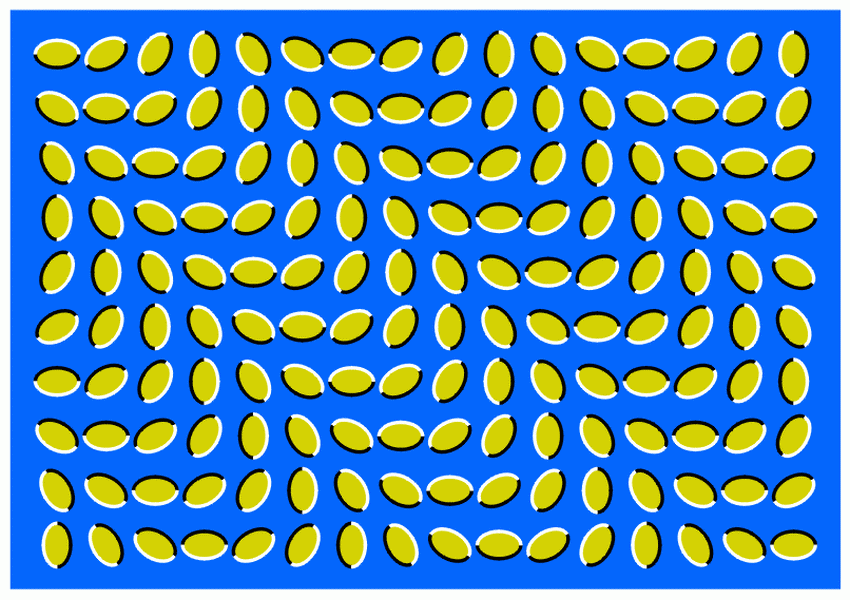
Our eyes can also be confused by relatively simple patterns: http://brainden.com/images/ricewave-big.gif

Intuitively, it does seem like stripes would make it more difficult to achieve focus for a compound eye, similar to how when looking through a chain-link fence or window screen it's easy to focus the wrong plane due to the spaced repetition.


Vision is weird. It's things like this that, in my opinion, showcase the idea that our perception of reality is sculpted by our physiobiology.


It's deeper than that, not sculpted by - entirely defined by.

You're a lump of electrical fat wrapped in a fortress of bone, running an internal approximation of the localised world outside.

And from within this fortress, with its little holes for light, you control a robot made of meat.


I’ll never forgive Animal Collective for using this as an album cover!


I wonder why, over the long term, the flies did not adapt to this.


Or the short term -- flies have much shorter generations. That doesn't guarantee faster evolution, but it helps.


Maybe the adaptation would require significantly more advanced visual processing with attendant increase in weight, size, and energy consumption, making it not worth it?


Maybe compound eyes have some inherit flaw that makes it harder to process visual signal of stripes.


Guidelines | FAQ | Lists | API | Security | Legal | Apply to YC | Contact

Search: