The people using matlab are typically experts in things other than programming. Matlab is for people designing antennas or control systems, where the math is more important than the code.
Most definitely, but my point was to my programmer-brain, nearly any text-based modeling language would be better than some sort of awkward graphical diagram. And since the same company makes MATLAB, why not?
It turns out non-programmers actually like graphical tools. Go figure.
I once wrote a linear programming optimal solver for a business problem.
But because it was all equations and logical reasoning, it was hard to understand, and boring to non-enthusiasts.
So my manager had me make a visual simulation instead, which we could then present to his managers.
This isn't as stupid as it sounds - we humans have huge visual processing networks. It makes sense to tap into that when interfacing with other humans.
I think to learn programming or math, you actually end up learning to use this visual wiring to think about written symbols. But this process of rewiring - while valuable - is very hard and slow, and only a tiny fraction of humans have gone through it.
partly as a "this is what we were doing in 1962, you are now as far removed from that demo as that demo was removed from the year 1900 -- do you really feel like you've made the analogous/concomitant progress in programming?" ... and one of his points there was that a lot of programming acts as a "pop music" where you are trying to replicate the latest new sounds and marginally iterate on those, rather than study the classics and the greats and the legacy of awesome things that had been done in the past.
I'm just putting this Alan Kay question (from Stack Overflow) here because of relevance.
In that question, he's considered not with implementation or how good the execution of an idea is (which is certainly one type of progress), but in genuinely new ideas.
I don't think I personally am qualified to say yes or no. There are new data structures since then for example, but those tend to be improvements over existing ideas rather than "fundamental new ideas" which I understand him (perhaps wrongly) to be asking for.
this is awfully manual, does autocad have parametric topology tools ?
programs like houdini are more reactive and mathematical (no need to create width/volume by hand and trim intersections by hand), i think mech engineering tools (memory fail here) have options like this
One thing that I think diagrams are better at than common text-base PLs is that with diagrams (when the blocks are placed nicely) you can _very quickly_ tell what is going into something (both directly and indirectly).
Of course you can abstract away a bit with functions or intermediate values in programming, but at one point if you do that too much you now have a bunch of indirection that harms overall readability.
All a balance of course, but "what takes part in this calculation" often feels more valuable than "what is the calculation itself".
> It turns out non-programmers actually like graphical tools. Go figure.
I'd rather say that visual tools are better abstractions than what text based tools can provide for those specific scenarios. Some problems are easier solved with diagrams.
Programmers just don't like switching between representations - it's the same reason that "printf debugging" will still be widespread after all of us are gone.
Another thing is the ability to actually have a breakpoint in the program. There is a lot of distributed systems (especially embedded ones) where just stoping the program and inspecting the state will cause the rest of the system to enter some kind of failure state.
I use printf debugging locally as well. Interactive debuggers and I just don't get on, and my test cases are built to start fast enough that it works out for me. Usually I have a 'debug_stderr' function of some sort that serialises + writes its argument and then returns it so I can stick it in the middle of expressions.
(I do make sure that anybody learning from me understands that debuggers are not evil, they're just not my thing, and that shouldn't stop everybody else at least trying to learn to use them)
Sure, that's just one use case. And logs can be useful for history as well as current state. But I think it's the mode shift to "do I set a breakpoint here, and then inspect the program state" as opposed to just continuing to sling code to print the state out.
What's funny is that I learned to debug with breakpoints, stepping, and inspectors. I use printf debugging now because the more experience you get, the easier and faster it becomes. There's a point where it's just a faster tool to validate your mental model than watching values churn in memory.
Printf debugging is actually a very primitive case of predicate reasoning. Hopefully in the not too distant future instead of using prints to check our assumptions about the code we will instead statically check them as SMT solvable assertions.
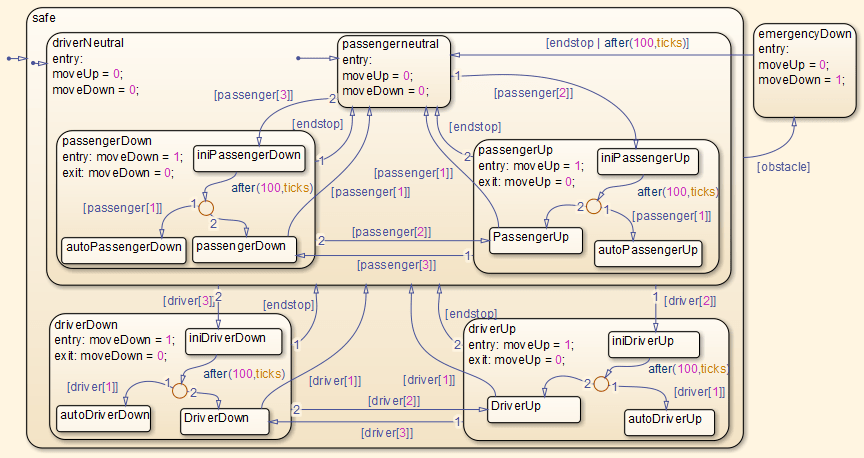
Well, software developers in the embedded field of automotive use Matlab and Simulink quite extensively. I haven't worked with it myself but the "excuse" for using it was that "we have complicated state machines that would be difficult to write directly in C".
You would think about a lot of the things that they do, "how hard can it be?". Take a look at the simplified example statechart here (scroll down) for a power window control and ponder all the ways an embedded programmer could struggle to get the behavior right in plain procedural C code as well as how difficult it would be to get a typical team to document their design intent.
Those do strike me as elucidating the power in suitable contexts very nicely.
For those following along at home, click https://uk.mathworks.com/help/simulink/ug/powerwindow_02.png first and then realise that's a top level chart with per-case sub charts (and then follow buescher's link if you want to see those) ... and that at the very least this is probably the Correct approach to developing and documenting a design for something like that.
You're welcome, and yeah, that is the statechart. It's actually at the low zoomed-in level. That's the controller at the heart of the example. A lot of the diagrams in the article are higher-level, not sub-charts. I am not a 100% advocate for the BDUF-flavored model-driven-design approach in the whole document at that link, though I can understand why some industries would take it.
Remember, too, this is undoubtedly a simplified example. Just off the cuff I'd expect a real-world window motor controller in 2024 to have at least open-loop ramp-up and ramp-down in speed, if not closed-loop speed control. I also would expect there'd be more to their safety requirements.
> A lot of the diagrams in the article are higher-level, not sub-charts.
I must have failed to understand even more things than I thought I did. I'll have to read through again when more awake if I want to fix that, I suspect.
I think if faced with that class of problem (am not automative developer, just spitballing) I would probably try using some sort of (no, not YAML) config format to express the various things.
But that's a 'how my brain works' and I am aware of that - for database designs, I've both ensured there was a reasonable diagram generated when the point of truth was a .sql file, and happily accepted an ERD as the point of truth once I figured out how to get a .sql file out of it to review myself.
I haven't worked in automotive. And I'm not a strong advocate of exhaustive model-driven design like what's shown at that link. But it's worth looking at.
Generally if you have a state machine or state chart with more than a few states, it's worth implementing as a table. The "config format" is then an array in a source file. There is a standard interchange format, scxml, for statechart tooling and libraries, but if you're implementing your state machine directly from a whiteboard drawing, you might not bother with it.
What they didn't tell you is that these state-machines are differential equations as well. Again, the math is more important than the code. If you want to look more into it, just search for state variable control.
Matlab also solves a ton of common engineering problems with efficient BLAS wrappers. And it is (or at least used to be) pretty trivial to drop in a CUDA kernel for hotter code paths.