It tells you that prime numbers and periodic curves might be related more than you might have thought at first blush. I.e., if you can mathematically describe and analyze this set of periodic curves, then you have also described and can analyze the prime numbers.
As I mentioned, I don't know much about number theory, but I do know that it uses a lot of math that is counterintuitive at first blush. Perhaps this visualization gives us a clue as to why that is the case.
>if you can mathematically describe and analyze this set of periodic curves, then you have also described and can analyze the prime numbers.
Dude, no offense, you are really making stuff up. The periodicity has to to with the divisors of the composites. Every prime p has exactly 2 curves - the wave of period 1, and the wave of period p. There's nothing interesting or useful to take way from that observation. otoh, you look at a composite c - it has several divisors & each divisor d generates a curve of period d, and those curves intersect in interesting ways...though I don't see how you could mathematically analyze them to tell you anything about the primes nearby. They are mostly pretty patterns, not mathematically useful...here are 2 quite famous & useful diagrams on periodicity in primes if you are interested in that sort of thing -
I take it, then, that you find nothing inspirational in the videos made by Vi Hart either. To each, their own.
As to the diagrams you pointed me at, they mean nothing to me, and do not inspire me. If I knew more about number theory, perhaps they would. Some things are not about information, they are about inspiration.
The visualization in the OP provides inspiration that number theory is connected to other fields of math. You can see structure in the way that the periodic curves intersect and the primes are the gaps. If you could understand that structure, then maybe you could understand the gaps. Then again maybe not. That doesn't mean that the question and the visualization doesn't cause you to think and wonder.
Sure, this is old hat to mathematicians, and for all I know, this approach is a complete dead end. Sometimes dead ends are interesting too.
> Dude, no offense, you are really making stuff up.
No. Parent has it essentially correct. Many new results in number theory are obtained by studying automorphic forms, which are the stable waveforms, on various spaces.
Things like the Riemann zeta function arise out of spectral transforms of automorphic forms.
Thank you. I don't know what's up with the increasing trend around here for people to imply you are an idiot over some nitpick that seems to reveal only that the nitpicker spent no effort to try understanding what you had to say, and would rather berate you for a detail rather than engaging in the gist.
One of the things that can seem almost mystical at times about math to someone who has not studied math heavily, is even just simple things, like how pi and e seem to get into everything, even where you might not naively expect it.
The visualization in the OP shows how to use sine waves to build a sieve of Sieve of Eratosthenes. Now that I've seen the visualization, this revelation seems so utterly obvious that it goes without saying. But somehow, I never drew this connection until seeing the visualization.
And once I see how "obvious" this is, it's suddenly obvious how e and pi might get into everything, because everything that repeats with a specific frequency can be modeled as a wheel rolling along and leaving a mark on every revolution. And what is multiplication, but repeated addition? I.e., a wheel of a certain size rolling down the number line, leaving its mark once per turn. Above a certain age, we tend to stop thinking about multiplication as repeated addition, and so we don't think about how all multiplication is implicitly bringing pi into everything we are doing.
Maybe everything I said above is wrong in some way, since, as I have mentioned, I haven't studied any math past calculus and college algebra, and even that was so long ago, most of it I don't remember. Or maybe what I've said is so obvious to someone who has studied math seriously that they just want to shout, "Duh!" But there must be some way to interpret what I just wrote that doesn't deserve being summarily shot down.
> One of the things that can seem almost mystical at times about math to someone who has not studied math heavily, is even just simple things, like how pi and e seem to get into everything, even where you might not naively expect it.
Yep. Sure blew my mind when I saw a proof of quadratic reciprocity (a very neat result about square numbers in modular arithmetic) which used complex analysis (how on earth can complex numbers prove stuff about modular arithmetic!?)
> Maybe everything I said above is wrong in some way...
Not really. Your intuition upon seeing this visualization was pretty much right on: studying periodic functions is a way of understanding numbers.
> Or maybe what I've said is so obvious to someone who has studied math seriously that they just want to shout, "Duh!"
Not so much. It took some mighty smart folks to develop some ideas which are perhaps suggested, in hindsight, by this picture. The big one is Fourier series and transforms, which allow you to decompose periodic functions into their constituent sine waves. You can use Fourier analysis to get information about number theory, which was essentially your suggestion. However, that's not at all obvious without seeing this picture. Certainly, my first exposures to Fourier analysis were in the context of signal processing and solving PDEs. I had absolutely no inkling that it may be useful for number theory until actually seeing it. Even if I had seen this picture 7 years ago (when I knew signal processing and PDEs, but not number-theoretic applications), I probably would not have made the connection that you made.
So, I think your intuition was a rather non-obvious idea, and so your comment did not deserve the quick shoot-down. (And even if it were obvious to folks who have studied math, it would still be non-obvious to someone, probably).
Thanks again! You restore my faith that it is possible to have a reasonable conversation around here.
This leads me to a question: Do mathematicians actually try to analyze primes by looking at a function that is created by combining a set of sine waves where there is one sine wave for each integer, on order to form a sieve out of the sine waves? E.g., creating a function that crosses zero only at each composite, or some such? Or is this visualization only suggestive of a broad approach?
The paper cited by the visualization is clearly attempting to do what I just described, but it appears to be the work of an amateur, and I don't read Spanish, so I can't really tell if this approach is on sound footing. I tried to Google around looking for this approach referenced in something more authoritative, but couldn't find any. I did find plenty of references to trying to analyze the function that you get from subtracting x/ln(x) from the prime staircase, using Fourier transforms and the like. But I can't see a direct connection between these approaches, other than the general inspiration of trying to break the problem down into a combination of sine waves. On the other hand, I'm well aware that a lot of identities in math are not readily obvious!
Oooh... you're getting into some serious math now.
The stable waves on a circle are precisely those waves which oscillate an integer number of times as they traverse. In other words, one for each integer. Further, every function on the circle can be expressed as a sum of the sine waves. That sum is called the spectral decomposition. (This is Fourier series.)
With clever choices of functions, you can get some profound results. For example, picking a saw-tooth wave and doing the spectral decomposition gives the identity
1 + 1/4 + 1/9 + 1/16 + ... = pi^2/6
And, by the way, the left hand side is the zeta function evaluated at 2.
And about functions that are zero at each composite... You may want to check out Dirichlet characters. They are periodic functions which behave nicely under multiplication. Whenever an integer and the period have a common factor, the character will be zero at that integer.
It's not going to be zero at all composites, but it's on the right track.
Are you claiming that I've gleaned no insight at all as to why Fourier transforms are used in number theory? Or are you claiming that I just didn't acquire this insight from the visualization?
If you claim the latter, then just where did I get it from?
Dude, I think that you are less intellectually rigorous than you strive to appear, and rude to boot.
Did you look at the paper that the visualization cites? It provides both the semicircular version and a sine-wave version. The paper does some mathematical analysis on the sine wave version, and putatively comes up with a way to transform the series of sine waves for a Sieve of Eratosthenes of a finite size into a single function that is close to zero for composites and significantly non-zero for primes.
I assumed on first sight of the visualization that the semicircles were standing in for sine waves, and I was right. I assumed that semicircles were used because they are easier to draw, or because it's easier to see the Sieve of Eratosthenes in it, or that it was necessary to make this adjustment in order to perform well. Or maybe just that it was prettier. But it was clearly alluding to sine waves. Looking at the paper demonstrates that I was correct on this assumption.
By the way, you do know that any periodic function can be expressed as a sum of sine waves, don't you? Even a wave form made out of repeating semicircles. What I didn't know before this is that Fourier transforms are used in number theory, and now I know, thanks to this visualization. And best of all, this visualization let me intuit that fact on my own. I can't imagine a visualization that could provide anything better than that!
The number between them have a high number of small factors including 2 and 3.
  2 * 3 = 6: 5 and 7 are prime.
  2 * 3 * 2 = 12: 11 and 13 are prime
  2 * 3 * 3 = 18: 17 and 19 are prime
  2 * 3 * 5 = 30: 11 and 13 are prime
  2 * 3 * 7 = 42: 41 and 43 are prime.
  However, 2 * 3 * 101 = 606 but 605 is not prime.
  But,
  2 * 3 * 5 * 5 = 150 and 149 and 151 are prime.
  2 * 3 * 2 * 3 * 5 = 180 and  179 and 181 are prime.
The point is twin primes (6k-1, 6k+1) are more likely for a large k when k is a composite number than a prime AND the more factors of k the higher chance for twin primes.


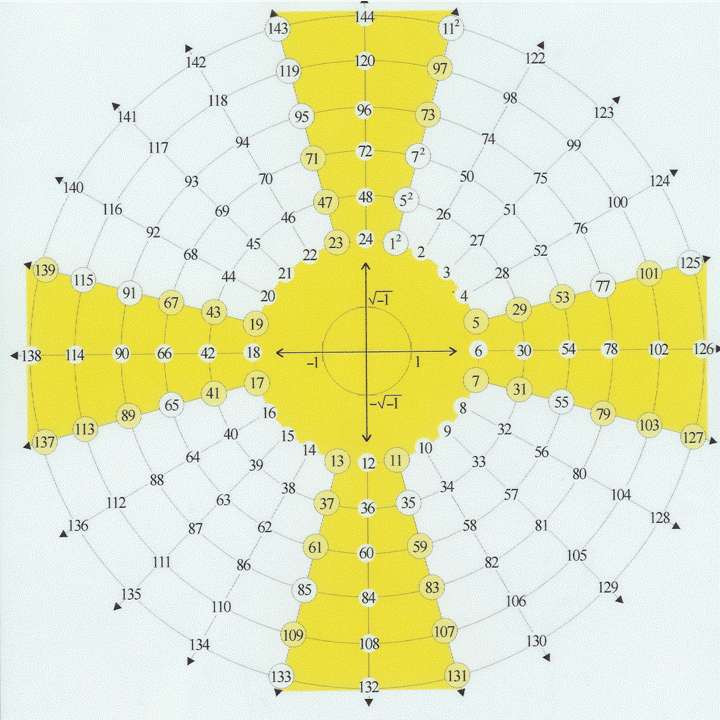
As I mentioned, I don't know much about number theory, but I do know that it uses a lot of math that is counterintuitive at first blush. Perhaps this visualization gives us a clue as to why that is the case.