Is "clown GCP Host" a technical term I am unaware of, or is the author just voicing their discontent?
Seems to me that the problem is the NAS's web interface using sentry for logging/monitoring, and part of what was logged were internal hostnames (which might be named in a way that has sensitive info, e.g, the corp-and-other-corp-merger example they gave. So it wouldn't matter that it's inaccessible in a private network, the name itself is sensitive information.).
In that case, I would personally replace the operating system of the NAS with one that is free/open source that I trust and does not phone home. I suppose some form of adblocking ala PiHole or some other DNS configuration that blocks sentry calls would work too, but I would just go with using an operating system I trust.
No it's because lots of stuff is duct taped together and then you have tons of scripts or tooling that was someone's weekend project (to make their oncall burden easier) that they shared around. Usually there'll be a flag like --clowntown or --clowny-xyz when it's obvious to all parties involved that it's destined to destroy everything one day but YOLO (also a common one).
Could you please stop posting unsubstantive comments and flamebait? You've unfortunately been doing it repeatedly. It's not what this site is for, and destroys what it is for.
You may not owe clown-resemblers better, but you owe this community better if you're participating in it.
We ban accounts that keep posting in this sort of pattern, as yours has, so if you'd please review https://news.ycombinator.com/newsguidelines.html and stick to the rules when posting here, we'd appreciate it.
As long as you and I both agree on the truth, I am willing to go along with your moderation. I can cut down on some of the editorial remarks, but everyone on this site engages in some level of unsubstantiated commentary and I really would appreciate knowing what % of posts can be unsubstantiated opinion before it becomes a significant pattern.
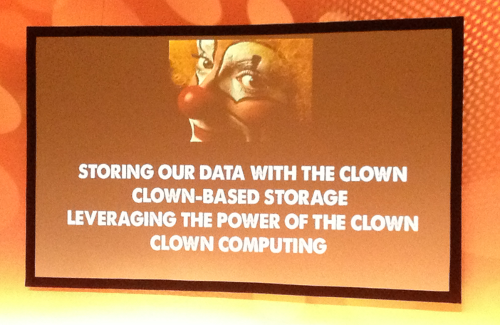
I remember the term "clown computing" to describe "cloud computing" from IRC earlier than 2016
I use a localhost TLS forward proxy for all TCP and HTTP over the LAN
There is no access to remote DNS, only local DNS. I use stored DNS data periodically gathered in bulk from various sources. As such, HTTP and other traffic over TCP that use hostnames cannot reach hosts on the internet unless I allow it in local DNS or the proxy config
For me, "WebPKI" has proven useful for blocking attempts to phone home. Attempts to phone home that try to use TLS will fail
I also like adding CSP response header that effectively blocks certain Javascript
It sounds like the blog author gave the NAS direct access to the internet
Every user is different, not everyone has the same preferences
Another habit I follow is to set the gateway of (a) computers I cannot trust, i.e., ones running corporate OS I cannot control, to (b) a computer that I believe I can control running UNIX-like OS that I compiled from source
I run tcpdump on (b)
(b) is the only computer with direct access to the internet
The only time I have seen a sentry.io DNS request is from (a)
> It sounds like the blog author gave the NAS direct access to the internet
FTFA:
  Every time you load up the NAS [in your browser], you get some clown GCP host knocking on your door, presenting a SNI hostname of that thing you buried deep inside your infrastructure. Hope you didn't name it anything sensitive, like "mycorp-and-othercorp-planned-merger-storage", or something.

  Around this time, you realize that the web interface for this thing has some stuff that phones home, and part of what it does is to send stack traces back to sentry.io. Yep, your browser is calling back to them, and it's telling them the hostname you use for your internal storage box. Then for some reason, they're making a TLS connection back to it, but they don't ever request anything. Curious, right?

  This is when you fire up Little Snitch, block the whole domain for any app on the machine, and go on with life.
I disagree with your conclusion. The post speaks specifically about interactions with the NAS through a browser being the source of the problem and the use of an OSX application firewall program called Little Snitch to resolve the problem. [0] The author's ~fifteen years of posts demonstrate that she is a significantly accomplished and knowledgeable system administrator who has configured and debugged much trickier things than what's described in the article.
It's not impossible that the source of the problem has been misidentified... but it's extremely unlikely. Having said that, one thing I do find likely is that the NAS in question is isolated from the Internet; that's just a smart thing that a savvy sysadmin would do.
[0] I find it... unlikely that the NAS in question is running OSX, so Little Snitch is almost certainly running on a client PC, rather than the NAS.
> Is "clown GCP Host" a technical term I am unaware of, or is the author just voicing their discontent?
The term has been in use for quite some time; It is voicing sarcastic discontent with the hyperscaler platforms _and_ their users (the idea being that the platform is "someone else's computer" or - more up to date - "a landlord for your data"). I'm not sure if she coined it, but if she did then good on her!
Not everyone believes using "the cloud" is a good idea, and for those of us who have run their own infrastructure "on-premises" or co-located, the clown is considered suitably patronising. Just saying ;)
> the idea being that the platform is "someone else's computer"
I have a vague memory of once having a userscript or browser extension that replaced every instance of the word "cloud" with "other peoples' computers". (iirc while funny, it was not practical, and I removed it).
fwiw I agree and I do not believe using "the cloud" for everything is a good idea either, I've just never heard of the word "clown" being used in this way before now.
I remember ridiculing "cloud computing" by calling it "clown computing" decades ago. It's pretty old and well established snark-jargon, like spelling Micro$oft with a dollar sign.


Seems to me that the problem is the NAS's web interface using sentry for logging/monitoring, and part of what was logged were internal hostnames (which might be named in a way that has sensitive info, e.g, the corp-and-other-corp-merger example they gave. So it wouldn't matter that it's inaccessible in a private network, the name itself is sensitive information.).
In that case, I would personally replace the operating system of the NAS with one that is free/open source that I trust and does not phone home. I suppose some form of adblocking ala PiHole or some other DNS configuration that blocks sentry calls would work too, but I would just go with using an operating system I trust.