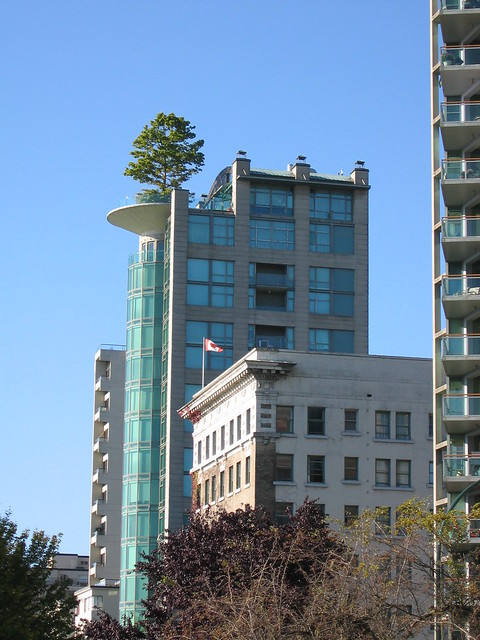
We have an incredible 4000sq ft olive grove at the top of the 48 storey Beetham Tower in rainy Manchester. The architect turned the top two floors into his own penthouse, complete with enclosed olive trees.
Well that certainly skewers the claim in the article that it will "never" happen :-). I note that these trees are effectively indoors as opposed to many of the architectural conceptions of being out doors (and the primary objection of the author).
That said my biologist friend says that trees are a lot hardier than the author gives them credit for, in particular many evergreens are adapted to living in pretty harsh climates and their needles are better able to deal with high winds and temperature extremes. His question was "where are the roots" since a 25' tall tree might have a 10' root 'ball' holding it in place. So if you don't mind having a floor of 'dirt' and then the tree on the next floor up, and you don't mind your tree being an evergreen, you can probably do something sustainable.
There are several other buildings with trees inside, in Buenos Aires (Argentina), one of the tallest towers (the YPF tower, by architect César Pelli), has an Eucalyptus grove inside.
In Mexico City, you have "La Torre del Árbol" (Tree Tower), with a baobab tree that goes outside a window on the 9th floor, it has now grown up to the 13th floor
Toronto requires green roofs for new building projects. Grasses and shrubs are typically grown, and they survive just fine with minimal care. I suspect the only reason that large trees are not typically used is that there's fear that tree roots will damage the roof of the building. Oh, and the weight of the soil required for larger plants is an issue.
Yep, looking at the bylaw, the growing medium - soil - is only required to be four inches deep. Weight of soil and drainage starts to be a problem - you have to figure that the soil may be 100% soaked...
It's going to be tough to grow trees in four inches of soil.
So, nutshell, tree survivability not a problem, but engineering a roof to hold enough soil (and therefore water) to grow a large tree is expensive, and root damage is a problem, and therefore - no large trees on skyscrapers. Still, there's nothing magic about it, just engineering problems. I could easily imagine a high-end residential tower with a forest on the roof.
Just to add some more information to your comment, I'm an Architect and I worked on a building with trees growing on top of a structure, but not at high level. I just happen to know that, according to the tree specialist, a 5-8m tall magnolia tree can probably survive in a cube of soil 1.5m x 1.5m x 1.5m encased in a concrete pit lined with a geotextile to prevent root damage to the structure. It needs to be hooked up to a fairly sophisticated hydroponic system to keep it alive and their growth will be stunted by the restrictions placed on the root ball. Another issue with some of the trees shown is that, because they are under the structure, they will need to be turned every couple of years and/or illuminated with special lights to keep them from being distorted by growing towards the sun and to ensure they receive enough light to photosynthesise.
More generally, the computer renderings you see in the article are often generated by students or outside design agencies based on sketches and other early information from the architects. They are done in a few weeks often to very tight deadlines and are definitely not based on technical drawings so you can get all kinds of weird stuff in there depending on how imaginative the computer graphics person is and how late they had to stay up to beat the deadline. A real skyscraper takes years to design, the details of how tree pits work wont be fully bottomed out until a few years after the fancy renderings are done. Ultimately, trees often disappear from the finished product once it has permission from the city as the developer will be looking for ways to cut costs; things like this often get the chop unless there are specific conditions to keep them in the design that have been placed on the permission granted by the local authority.
My first development job was at an Architecture studio funded by the LA Community College District. The Architecture interns there were allowed a lot of artistic license as they used the renderings in their portfolios.
Usually the renderings mimic "magic hour"[1] lighting conditions and are taken from the best vantage point. Being a talented bunch, sometimes their embellishments ended up in the final work and looked great... and somethings not. Sometimes their renderings ignored the actual position of the sun in order to make it look better at the vantage point the picture was "taken", since the CAD software would add lens flare and glare. Sometimes a rendering has one time of plant or another simply due to the whims of the intern or because of what was available in the asset library (i.e. Coconut or Palm Trees instead of Magnolia tress).
Can you provide any reference/elaboration for your claim that tree survivability is not a problem? It's directly counter to the arguments made in the article. Grasses and shrubs are a lot more hardy than trees, as anybody who's even been on a mountain can attest to.
Your other points are well taken and they are sort of addressed in the article in the form of the infrastructure issues. I think the author also would agree that it's sort of feasible in theory, but extremely expensive and impractical.
But you need a meter of soil, two meters would be better. This is 10-20x as much soil as is currently available on most green roofs (or mountainsides).
There are already pictures in this thread of buildings with trees on top, so... the idea that somehow trees are subject to instant death when lifted off the ground is silly. The conditions are not any harsher than trees living in an asphalt jungle in the city are subjected to every day.
It called my attention that in South Finland there are pine trees which apparently are able to grow with their roots barely covered with soil. Some sit directly on hard rock with all their roots visible. I took two photos of this on 2006:
http://pix.hamoid.com/finland2006/nature_is_a_huge_canvas.jp...http://pix.hamoid.com/finland2006/going_back_to_my_roots.jpg
Those trees survive winter winds at -22F (-30C) with very little sunlight, although sometimes winds knock them down making a vertical wall out of the exposed roots.
You are right, if one sees roots it doesn't mean there aren't other roots.
I think the difference is, South Finland was compressed by 1 km of ice during the last ice age, and the ground is pure granite that is blown up using explosives whenever a new building or road is built.
In those places I talk about, the dirt layer is extremely thin or often nonexistent. The photos I linked don't show that, but many trees are clearly sitting on pure red granite rock with just a little bit of dirt and moss surrounding the roots, in the middle of pale rock.
Yes, and the article directly addresses this: Still, plants in these environments aren’t usually tall and graceful. In other words, not the tall trees we see in architectural drawings.
Though I'm personally very partial to the gnarly mountain trees, too.
> Can you provide any reference/elaboration for your claim that tree survivability is not a problem?
Mountane ecology start a 1500ft at the very lowest (e.g. in Scotland), and a characteristic of them is that they're generally forested. Elevation is not an issue. Wind and exposure mostly mean that no all species will handle it (duh) and you will have the usual loss as not all saplings will survive, but trees do grow, even in windy environments with no groves to buffer them.
Conifers are extremely hardy trees and will grow without issue. Hell, a mere 500ft might be too low and warm for them.
I would go out on a limb here and say that the weight of the soil and drainage issues are not relevant. We're talking 100 pcf or so for saturated organic soil and drainage is pretty easily taken care of with geotextiles. 300 psf isn't overly large for a dead load when you note that live loads should not be applied over the same area as it isn't a space that should have traffic during a significant load combination.
Your second point about root damage has more merit but still doesn't seem like a hard problem.
Even if the dead load isn't a problem, the space taken up by a one- to two-meter-deep soil level is going to be significant. (Oh, you were planning on occupying the floor under the tree? Tough.) Also, even if draining the water isn't a problem, pumping all that water up there in the first place doesn't sound cheap.
The comment you link doesn't even remotely state it's impossible though. Mostly, that you won't have the same tree up there than you natively have on the ground. Which is kind-of obvious really, especially if "on the ground" is flat lowlands.
It goes further than that: air near the surface of the earth is doing a lot more interacting with the earth than the other air, and is getting and keeping a lot more heat and dissolved gases. That includes air at sea-level or air at a mountaintop. Thus, there is no natural analogy to a tree growing atop a 500 foot building. Even bristlecones at 10000 feet still benefit from air that has been in prolonged proximity to a surface.
You can grow trees on skyscrapers. But the author captured why it is unlikely to happen: trees need care & maintenance. Care & maintenance == $.
For the types of people who build and run skyscrapers, facility operations is a cost center, and regulating authorities don't really care about greenscape. Nobody wants to pay for a staff of gardeners.
That's why when plans get mocked up, the public spaces around commercial buildings are usually lush, but when the building are actually constructed, you see a few shrubs or maybe a few arbor vitae at ground level.
When the local people and regulating bodies care, things are different. The Wal-Mart parking lot in Hilton Head Island, SC is wooded and shaded. The town refuses to issue construction permits that require old growth trees to be cut down -- so there's 60" wide tree in the lot, with a buffer between it and the pavement. Instead of curbs directing water to storm drains, there are mulched beds that absorb alot of storm water. About 15 miles away near I-95, there is another Wal-Mart with the typical construction methods -- bulldoze, flatten and pave everything.
I feel like most of the replies are focusing on the feasibility of putting trees in or on skyscrapers when I think the criticism levied in the article was more towards "designers" or architects who are using them as decorations knowing they will never get to see actual production.
I don't think it actually matters to the author if trees can live and thrive in this environment but more so if they are actually implemented.
Including something in your design to make it special (or to win a project) knowing it will never be implemented is a design problem and one that could be translated to what we (hackers) do with technology projects.
> There are plenty of scientific reasons why skyscrapers don’t—and probably won’t—have trees, at least not to the heights which many architects propose.
implies strongly and clearly enough that the author doesn't think it's feasible.
That said, he's also clearly annoyed that designers/architects are being unrealistic in their proposals.
Maybe it's more me wishing he had taken that tact than him actually doing so. I felt like he should be more mad at the architects and those who award projects to said architects with these "never to be implemented" features.
There is a history of putting large plants inside glass buildings at ground level. Because in a building with amazing views and glass walls you should make people look at something that is trite and artificial! Skyscrapers are already in a sometimes beautiful dynamic natural environment (the sky). Putting trees in the sky is absurd.
* They hold tons and tons of water and are generally massive (if you've never given a hardwood tree a good pruning, the volume and mass are surprising). A large, growing tree and its root system would add very significant load to the structure.
* They blow over sometimes. Probably frequently, on an exposed, elevated rooftop with limited soil depth (shallow roots, fairly easy to saturate). 20 tons of tree flying off a tower during a storm doesn't sound like fun.
> Life sucks up there. For you, for me, for trees, and just about everything else except peregrine falcons. It’s hot, cold, windy, the rain lashes at you, and the snow and sleet pelt you at high velocity. Life for city trees is hard enough on the ground. I can’t imagine what it’s like at 500 feet, where nearly every climate variable is more extreme than at street level.
How is being located on top of a tall building much different from being located on top of a tall hill or mountain? Wouldn't the only factors involved be the type of soil and species chosen?
The short answer is that a tall hill or mountain represents a broad elevation change that's contiguous with the surrounding landscape. Difference in air quality from sea level is not a simple function of elevation, but of air flow and direction. You actually have to treat the air near the surface as a flow.
Check out this extremely kickass old film:
http://youtu.be/7SkWxEUXIoM?t=29s
The drag near the solid surface greatly slows down, and introduces turbulence to, an otherwise laminar flow. This means that the air near the surface of the earth is doing a lot more interacting with the earth than the other air, and is getting and keeping a lot more heat and dissolved gases. Above that turbulent layer, you just have cold dry air. It loses heat, water condenses, gases fall out.
What can you use as an indicator for the height of the wet air layer? The height of the local trees! Their tops are about at the top of the survivable boundary layer in the air. Desert plants are short, rainforest plants are tall. Interestingly, this might lead you to wonder where the tallest trees in the world are.
Probably in some place where there's an ocean wind that blows into a blind valley, right? Because that thick boundary layer would just pile up and up, right?
So being on top of a tall building is like being on a spike up above the livable atmosphere for trees. Unless your city is built in a place that already had giant trees, it won't have much success growing them at heights above their native height.
Attrition rate for saplings is pretty high. So in nature when you see a bunch of trees on a hill there are many more trees that didn't survive. But in a building you don't get to have any attrition; you want all trees to survive.
And city buildings can generate surprisingly strong winds. "The wind loading on a skyscraper is also considerable. In fact, the lateral wind load imposed on super-tall structures is generally the governing factor in the structural design. Wind pressure increases with height, so for very tall buildings, the loads associated with wind are larger than dead or live loads."
I guess he addressed this point. There are plants well adapted to life on top of a tall mountain... though it's not the beautiful tall trees depicted on the mockups. I'm guessing those plants probably are short shrubs with dark green leafs and contorted trunks.
Friction with the ground slows air down near ground level, so air 500 feet above the ground will, on average, be faster-moving than ground-level air, regardless of elevation. See http://en.wikipedia.org/wiki/Wind_gradient
My guess is that the raw exposure is a big deal. Trees on hillsides or mountainsides only have one side fully exposed, so there's a dominant direction they could brace against. They would also benefit from having other trees (and a mountain) next to them to help dissipate the energy from the wind and rain.
I think this shows the problem that people like me have with design.
I don't notice good design. Things just work and everything is where it should be. It's taken hundreds of years of collected wisdom and research and skill to get it like that, and someone has worked very hard to make it so I don't notice their work.
I do notice when someone draws a willowy slender tree on the side of a towerblock. It'd be great to have more shrubbery and trees up high, but at least they could do it realistically. And I get the impression that they forget about all the root system and maintenance and etc.
England has a problem with terribly dull architecture.
That is the musee de quai branly. It's a vertical garden on one of the sides of the main building. If you look really close there is a lot of infrastructure to water and feed those plants. Also, at this altitude and orientation the plants are shielded from weather extremes fairly well. The architect was complaining that these high-rises don't have any of this plant nutrient infrastructure nor the shielding. If you've been to the top of the Eiffel tower you'll know the wind can get pretty intense up there. Now imagine trying to exist as a tree up there.
The problem is that architects are trying to make their buildings look more ecofriendly, green by putting more trees on it.
Yes, but couldn't we put all that infrastructure in skyscrapers?
Also trees are quite sturdy, in the desert they grow as high up as 1500m according to wikipedia. Here in Europe we have lone trees in the alps as high up as ~1800m if I remember my primary school geography correctly. Have you ever been so high? It gets pretty crazy as far as weather is concerned and situation can change from lovely sun to heavy storm with insane cold in a matter of minutes.
you could but most of these architect renderings don't look like they have any of that. Some of them are communal terraces with deep infrastructure for trees to grow down into. But a few of these renderings are smaller terraces and judging from the rendering just 30-50cm of structure above the apartment below. Except grass not much can grow there. I've seen some pullt it off fairly well. Like the Sands Marina Bay Hotel in Singapore. In real life it looks like it does in the renderings before groundbreaking.
True, I'm just saying it seems possible to construct facades with plants where all the water and nutrients are supplied from within the building's walls through pipes and stuff.
I wonder what the technical limitations would be to building that on a skyscraper ... we can have running water on top floor, so why not running water in the facade?
The article indicates that the temperature fluctuations and wind speed are much more extreme as you go higher. Maybe it would still work by selected well-suited plants? But those well-suited plants are probably not going to be the kind of plants the articles author was complaining about using in their renderings.
> This is not about good design, this is about whether it's possible.
...but a good designer would have some appreciation of whether it's possible or not and thus not bother drawing trees on tops top of skyscrapers. Or at least they'd draw realistic stumpy trees.
> but you do reap the benefits of good design
Absolutely, yes. I need to be clearer. I am very grateful for good design. It has made my life better. Through HN I have developed a better appreciation for the hard, hidden, work of good design. In the past I automatically thought of of things I'd find on Yanko as 'designery stuff' - but I've learnt that many designers hate that kind of design just as much as I do.
Maybe there is a certain height where this comes into play, but I've seen trees growing naturally (not by design) in abandoned buildings. The first I could think of is the 13-story Highland building here in Pittsburgh you can kind of make out the quite large tree in this photo http://photos.mycapture.com/PITT/1314621/37517652E.jpg
East St. Louis as well has a bunch of abandoned 10+ story buildings with trees growing on top. They're not the biggest but they're actually quite beautiful. Like nature taking back what belongs to it.
There's another reason to not have trees on top of skyscrapers: It's dangerous.
Even the best-pruned tree will occasionally have the occasional branch break off in a severe storm. Normally that's not a problem -- but if the tree is 300' in the air, that branch can go flying a long way and hit someone with a lot of force when it reaches ground level. The sorts of companies which build big skyscrapers don't like to take risks like that; nor do most city zoning boards.
> Even the best-pruned tree will occasionally have the occasional branch break off in a severe storm.
I would imagine it's not that easy for a tree to truly root itself in whatever shallow sandbox they plant it in. You're more likely to have the entire tree fly straight at you.
That's also a potential problem, but the weight:surface area ratio suggests that whole trees are more likely to get knocked over and stay in place, while individual branches are more likely to become long-range projectiles.
That's nice but that is hardly a skyscraper. By the look of it the building is around 15 floors high... let's say around 40m high. The author was talking about putting trees at 500feet in the air, that's 152m... considerably more.
I don't see height as being the issue, I beleive this building is around 50m-60m high.
This building is in front of the ocean and gets a fair share of both wind, salt and the occasional snow storm (it's in Vancouver).
It was lifted in place using a crane and since it's a large oak tree a system must have been been put into place to deal with the extensive amount of roots ( I'm not sure how long it's been there but at least 15+ years).
What is relevant here is height above the ground, as the various forces that he describes are a facet of the ground effect (or lack of ground effect).
e.g. You would find the top of the CN tower an endlessly windy, environmentally unfriendly place. Yet standing on the street in Madrid you are just as high and suffer none of the same effects.
500 feet up is really not that much considering trees are just fine over two miles (10,560ft) above sea level. Mountains generally do have a tree line, but most buildings are well below what the local tree line would be as most city's are fairly close to sea level.
I get what he's saying. I think he's more upset that architects are using a "tree" to add some level of trendiness to their buildings. When in fact they should be adding altitude hardened plants that are typically not the most aesthetic plant.
But it is after all just a model and hopefully someone will sit down and scratch their head and say, wait what happens if a branch falls off that tree? Lets just put some bushes up there that don't grow past the railing...
"Trees won't survive in this conditions", but in Nature they are not watered, they are not pruned, and they have lived for millions of years
What harsh conditions are there in the side of a building that don't exist in nature? (Off the top of my head there are several, but it would be nice for him to specify)
It could be: temperature, winds, lack of cover (either soil cover or taller trees) and their corresponding soil dynamic.
But it shouldn't be too complicated to find a plant that works there.
My issue is that it's pure speculation. Trees won't grow there because he says they won't. Except trees do grow under some of the most extreme conditions possible. This is after all just a blog.
No, they don't "grow under some of the most extreme conditions possible"; consider the meaning of the phrase "tree line". It is routine for conditions to be too extreme for trees to be feasible.
Life is very adaptable, but it's a category error to then conclude that any given life form is very adaptable. Trees have limits. Ones based in physics.
> No, they don't "grow under some of the most extreme conditions possible"; consider the meaning of the phrase "tree line". It is routine for conditions to be too extreme for trees to be feasible.
'Routine' is a strong word. You'll note that tree lines exist at significant altitudes commonly on mountains. Typically places that trees cannot grow are also places that humans find difficult.
Demonstrating that trees are incapable of growing on buildings would of course shut me up, but the author didn't do that. What they did was to say 'trees wont grow on buildings'. A bare assertion. One counteracted by pictures in this very thread.
> The windows on tall buildings don't open, which is not a coincidence. Humans can't survive for very long 50+ stories in the air either.
50+ stories is significantly less than the difference between my altitude and the altitude of many perfectly happy civilisations.
The reason windows don't open is that there are significant issues with cooling and regulating air pressure in a building that large. It has little to do with anything like oxygen concentration or even temperature.
If I understand Wikipedia’s article on tree lines[0] correctly, the variant usually referred to is due to coldness and snowpack[1]. I have trouble imagining considerable snowpack on a building that would not also occur on the ground and cities (where you would most likely find skyscrapers) tend to be a little warmer than the surrounding countryside anyways.
He lists several. Actually, most of the article is listing these conditions.
> It’s hot, cold, windy, the rain lashes at you, and the snow and sleet pelt you at high velocity.
> Wind is perhaps the most formidable force trees face at that elevation. Ever seen trees on the top of a mountain? Their trunks bow away from the prevailing winds.
> Next let’s add extreme heat and cold to the mix. [Long paragraph of explanation]. The surface of a leaf—especially in direct sunlight, as on the unshaded side of a skyscraper—can be many degrees hotter than the air, up to 14 degrees C in some species (nearly 26 degrees F).
That's what made the article rather provincial and a fail, even though the basic point that "gardening is somewhat complicated" was OK. If you've never been out of your urban area, ever, perhaps a native New Yorker or something like that, you may not realize that trees can be found all over the world in some pretty crazy conditions. Not just trees, but even human beings, have been known to live in places that are 26 degrees warmer (or colder), although someone extremely unsophisticated may not be aware of it. Which made me interpret the article as a humor piece.
What could be a problem is placing a skyscraper in an area already only borderline habitable, but why would you want to live there anyway? The treeline in colorado is around eleven or twelve thousand feet so given that Denver is about five thousand feet up, I would not put a tree covered skyscraper more than 5000 or so feet higher than Denver. Or if you're building in Denver and insist on putting a tree on top, don't make the building more than 6000 feet tall. Or if you're building a little hut at Mt Everest base camp, putting a tree on top of it might not work out so well. Another issue is the absolute tree line for all conifers might be 11000 feet but for say, palm trees, it might be lower.
I was replying specifically to the question in the comment asking: "What harsh conditions are there in the side of a building that don't exist in nature? ([...] it would be nice for him to specify)". Whether those specified conditions are actually too harsh or not is not for me to say, I don't grow trees and I don't analyse weather patterns on skyscrapers.
Also, assuming you meant "you" as in me rather than "you" as in "one": I am quite far away from being a native New Yorker, and I don't appreciate the implication that I am "extremely unsophisticated".
That's what made the article rather provincial and a fail
You argue that you were unsure if the article was a humor piece, yet I find your comically haughty reply to be just as questionable, as are many other of the comments in here clearly by people who have never tried to grow anything in their lives. The armchair expert is as loud as ever.
I live near an escarpment, along which you can find countless trees surviving (sometimes barely) along the rocky edge, desperately clinging to life in the most unsustaining of conditions. Yet in perfect soil / perfect sun / perfect hydration I've barely been able to grow two trees in my back yard (I'll find out shortly whether they survived the winter).
You see in nature it gets countless tries with countless specimens to give it a go. For every one tree in harsh conditions you see surviving, uncountable others perished. The one that survived had the luck of being the perfect variation for the environment, lucking into the right conditions at the right times of its life, etc.
Is that how you garden a skyscraper? Just give it several million years to work it out?
I don't seen how your experience with growing trees is any different than the original author's experience. Both of you may be professional arborists, yet you fail at growing trees. Therefore your conclusion is trees are hard to grow. Maybe you both are bad at growing trees.
Trees are pretty easy to grow, and the posters might be good at growing trees. The problem is there are so many kinds of tree. More likely growing the wrong tree for the local climate and microclimate. Being able to buy a sapling from someone who profits from people having to buy saplings doesn't necessarily prove anything about either the sapling or the environment other than you can definitely make money selling saplings.
If you go into the design process with a selected species before you design its environment, and then ignore its biological requirements in the environment design, its going to fail. Ignoring the environment while planting a tree anyway, is the opposite of being truly ecological or truly green. Looking a couple levels up at the guy with the two dead trees... just grow a different species, it'll take off like a weed unless you're in a desert or worse (grow a cactus?)
The existence of professional arborists proves nothing. There's nothing wrong with trying to stretch both your own abilities and your local/micro climate abilities. An arborist is an expensive way to get someone who knows what they're doing to have your back when you get a little too ambitious. Growing two oak trees in front of my childhood home was a little overambitious once they got up to 100 feet or so, and an arborist (for quite a fee) trimmed the dead branches every couple years for my parents. If you insist and have way too much money, an arborist can probably find a way to grow a palm tree in Alaska or a conifer in Dubai. But you won't like the bill...
Analogy: I want to grow and eat some edible plants. I like bananas (whats not to love?). I plant some bananas outside in Wisconsin. They die in January when it never goes above freezing for three weeks. Therefore no edible plants can or should be grown in Wisconsin, and no one else should even try, and growing edible plants in Wisconsin is just a wasteful fad that should go away. Or maybe not, since I know personally you can eat pretty well off fresh farmers market produce... however, no bananas.
Ignoring the environment while planting a tree anyway, is the opposite of being truly ecological or truly green.
He is doing exactly the opposite of ignoring the environment. Again, your haughtiness is transparent and doesn't make you sound like an expert, but more an armchair expert (which is not an admirable thing).
How many trees in nature grow on spires that are 100s of times higher than their base (hint: trees that grow on mountains do not apply. Mountains are wide enough with a shallow enough grade that they carry their own ground effect. A skyscraper does not), raising hundreds of meters above ground level?
Zero. None. Nada.
This discussion has nothing to do with enclosing tropical plants in polar areas. It has to do with trees environmentally exposed 100s of feet in air. Completely exposed to an incredibly hostile environment. It is enormously impractical.
The simple fact that "professional arborist" exists as a profession might be hint enough to you that saying "trees exist in nature, therefore you can have them anywhere you'd like" might be a poor bit of logic.
I'm a bit surprised that the article never mentioned the potential affects of the tree's roots on the structures supporting them. My driveway can tell you that the roots of a decent sized tree will not play nice with man made things that get in their way.
Yeah, I wouldn't want my unit under or around whatever space was reserved for the roots. Nor would I want my unit next to or under any of those units. After enough years a root will break through just about anything, or at least stress it. Then comes the water. And the critters.
So long as you aren't somewhere at a rather high elevation to begin with, the temperature, elevation and wind chill factors seem like they'd be quite easy to work around. Even something as simple as buffering vegetation from the prevailing wind direction ought to go a long way.
Perhaps a more relevant point might be that the architects aren't fully designing their vegetation's support systems, but that seems like it would require a higher burden of proof. I wouldn't be surprised if issues such as 'what if a large branch fell off 500 feet above street level?' aren't fully thought out, either.
But I don't think there's any reason that someone using careful engineering and design couldn't put healthy plants on a tall building.
If he was merely intending to point out that many architects are placing vegetation without proper design and engineering, he may be right, but I don't think he really succeeded in making the point.
He mentions "500 ft" as a height that the trees would be at (and wouldn't deal well with). That's roughly 50 stories. I don't think that shopping malls reach those heights. ;-)
I live @ 9200 ft in the rocky mountains in colorado. Plenty of tree growing right out of the granite. It amazes me how easily plants and trees can make their homes here. At these altitudes, a wide, horizontal root system works better than a deep vertical root system. It is definately within our ability to plant trees on top of buildings.
I'm wondering if the author has ever seen a tree on the side of a mountain or cliff - it's hard to stop a tree from growing if they are left alone. He makes trees sound like whiny children who require constant pampering. Not the things that have been on earth longer than any invertebrates and will most likely out survive our species.
Are those trees the stereotypical tall strong oak type trees used in most examples? I agree its possible but you don't usually see what most people think of as a "majestic" tree standing alone in those sorts of conditions. Normally they seem to be oddly shaped and have grown away from the predominate direction of wind.
Looking at those pictures, I wonder "Where are the roots?" It's like the artists think the tree stops where the trunk meets the surface. I see rooms where peoples would be walking just under the trunk of the tree.
I could see using Bonsai style root trimming and enclosed spaces for the trees, but yeah, other than that it looks like pure fantasy.
Agreed. I think a blanket "Don't even try" is silly, and antithetical to the ethos of HN. I'm surprised there isn't more backlash against this.
"Don't just draw them on the skyscraper, make it work." would be a better sentiment. If wind is a problem, find a way to break the wind. If roots are a problem, find a way to stop the roots, or trim the roots, and build that into the design.
But there's a pile of evidence for the benefits of adding greenery to cities, so please just don't say to stop trying.
Still, at least consider if climbing vines on trellises might serve better before putting a ton of effort into trees per se. They provide most of the same greenery benefits, can be made to fit the space, don't have dangerous roots, and are in many ways more robust. Plus they can have flowers or fruits near floor level.
Also, if we're to pick a definition of "natural" that means something more specific than "exists", cities seem like a good candidate for the "unnatural" end of the spectrum.
Who says these have to be real trees? Fake trees look damn impressive these days. All you have to do is dust them off. And hey -- the wind at these altitudes will do that for you. Now we just need to hire someone to clean up the bird poop.
As a fan of urban exploration (photographing old left-behind structures in cities), I had a positive gut reaction to images of buildings overrun by plants.
To me putting trees on the exterior of a tall building makes the building look abandoned. When you find your way in and explore such a building, the artifacts, grittiness and worn-down aesthetic make you think about all the people who have ever lived and worked there.
For this personal reason, I think the trees might be an improvement. Much better than the typical sterile corporate look of skyscrapers. But I can understand why someone who has more architecture experience might think of it as a cliche.
In San Francisco there at least one building with trees and other greenery about 500 ft up at 1 Front Street. It has them on the 35th through 38th floor with a rather high glass wind shield that keeps parts from blowing off the roof.
I know that's short compared to some of these massive skyscrapers they show, but as long as the building radiates heat back up at the trees, I don't really see why you couldn't go considerably higher.
This house: http://www.geograph.org.uk/photo/2994951 is a few miles from where I live. Last time I saw it the green stripe over it was a sea of dead yellow grass.
In my neighbourhood there is an apartment block with two pine trees on the roof terrace. The trees are about 2m high. I still do not understand how they are not causing any trouble. Its not a skyscraper but still..
So far, I hadn't seen written what's most obvious problem to me. A dead branch or something from the tree that falls from a building will kill or cause serious injury to someone. Now if a few trees were dead center on the roof, they likely wouldn't, but anything close to overhanging in high winds will shake loose objects very dangerous to humans.
sure you could protect people by adding nets. Well then you have a skyscraper that looks trashier than it did without plants at all.
Yes, trees bow on windy mountains (or even next to the ocean), but since when was this a bad thing and/or a sign that the trees were not healthy? This article is like saying "don't put plants on your balcony". True, it's more windy but many plants, especially trees, are created to be more durable.
I do agree that it's a more challenging environment than a forest, but if the building is willing to cover the costs of maintenance, I don't see why not have them!
this is a really, really interesting critique of why the current idea of trees on buildings is wrong, but it's a bit short-sighted in that it just says "stop". The next logical step in this is to contemplate how a rooftop environment would affect the evolution of trees moving forward; how human architecture will interact with the genetic lineage of trees in the future, and how we can encourage an evolutionary process so that we get to a point where trees on buildings are possible. Either way, upvote; there's a lot of interesting content in this article.
Yep, but trees are big, so the enclosure will have to be similarly massive.
One thing not mentioned in the article: roots. Tree roots get everywhere and have no respect for the clean lines of your skyscraper. They are also capable of going anywhere it damn well pleases - anyone who's seen tree roots break concrete sidewalks and barriers can attest to that.
Whatever trees we put on skyscrapers won't last very long. You'd have to destroy them/replace them every few years.
The expense makes tree'd buildings a show of conspicuous consumption not "green". This IS marketing genius in that it appeals to both the "ha ha I'm richer than you" crowd and also at least superficially to the wanna be greenies.
There is a certain "startup wisdom" to it in that one way to save marketing dollars is to appeal to two groups at the same time. Maybe a very crude tech example would be facebook being a workforce automation system for teen girls social interactions AND also for their mothers, sorta. There are cars like that, the Prius was cool enough from a technological standpoint that I got one quite a few years ago although I don't care about the mileage, yet it also appeals to the greenies as being lower eco impact or something. You can be a success only appealing to one group, but if you can appeal to two for free, why not?
There are probably solutions to the root problems.
Bonsai growers prune roots, so you just need a big double walled structure. The inner liner has many holes which is good for drainage and allows roots to grow, and you prune roots growing out of the holes.
I say 'Just' - having read this it feels very wrong and anyone who knows anything about how tree roots actually grow will be able to point out the flaws. But it can't be that hard. In West Drayton there's a garden with everything grown in pots. (http://goo.gl/maps/G2oXN)
Putting trees on skyscrapers is lame when its only purpose is to gussy-up an image, but honest to goodness metropolitan reforestation where condos and apartment buildings are self-sustaining and eco-friendly is something we should move forward with.





Picture: http://www.bbc.co.uk/manchester/content/articles/2009/04/27/...
Trees at the top of a skyscraper convey both extravagance and eco credentials. Helipads are no longer credit-crunch-friendly.
Video (Skip to 1:16 for the trees)
http://karmacrew.tv/our-work/architect-profile-ian-simpson-b...