As someone who has personal interaction with the disorder (I'm not officially diagnosed, but probably have it, my son has it, several siblings, nieces and nephews as well), I hate this phrase. Because people use it to mean the exact opposite of what the actual disorder is.
People with ADD or ADHD (different names for pretty much the same thing) do not lack focus. To the contrary, a primary characteristic is extreme focus. Instead we lack the ability to focus on what we are told to focus on.
Society labels this "distractibility" because the person does not focus on what those around would want them to focus on (following instructions, getting dressed, doing homework, etc) but instead goes back to what interests them (bugs, dinosaurs, math, etc). But in terms of ability to get fascinated by something, then follow through on complex tasks, people with ADD or ADHD are significantly more capable than the general public.
It sounds different, but I am simply giving more detail about what happens inside of the disorder. Any decent book written in the last decade will confirm my description.
People with ADHD or ADD don't have executive control of what they will focus on. Inability to focus on what you're told to focus on is noticed in most environments as not listening to instructions, inability to stay on assigned task, poor attention to detail if you do stay on assigned task, etc. Everything in that link you posted is covered. In most environments your excellent focus on things you're NOT "supposed" to be doing is not likely to be noticed. Or if it is noticed, it likely increases frustration over the inability to pay attention to assigned tasks.
Speaking personally, I was very confused when screening for ADHD was recommended for my son. He seemed to have excellent focus - at 3 he would often get involved in a detailed task for half an hour or more, at 5 he would sit quietly through a full length documentary, then demonstrate how much he had learned for days afterwards. It was not until my sister explained from her experience that this was, in fact, characteristic that I became less resistant to having him screened.
I was also resistant to medicating him because I'd absorbed all of the usual biases about how overmedicating leads to drug abuse. However after being pointed to the statistics for ADHD, medication became a no-brainer. Children with ADHD do not become addicted to their medication, and have the same risks of drug abuse as the general population. By contrast ADHD people who are not treated are at massively increased risk for all kinds of drug abuse, including both prescription drug abuse and cocaine. (Cocaine is an interesting one since it actually is an effective ADHD medication! Though inconvenient, illegal, and subject to abuse.)
Therefore popular wisdom is exactly backwards - appropriate medication for ADHD reduces the odds of drug abuse later in life.
I have a child with a diagnosis that significantly increases the risk of his failing to graduate, using drugs, becoming a convicted felon, suffering accidental death, and being unable to hold down a regular job. There is a safe medication that addresses all of those risks, with reasonably moderate side effects.
If some day you have a child in the same situation, you'll be free to try whatever unproven experimental course of action you want. But I see no point in taking such risks with my child's future.
The one problem I have with an ADHD diagnosis is the power of choosing a useful narrative for oneself. I see an ADHD diagnoses as a stepping stone to letting go of the ADHD diagnosis. Use the tools but don't let your son get stuck there.
Here are various narratives I've had for myself:
1) Child prodigy
2) Failed child prodigy
3) Something's not right about work / study. I know what to do, but in the moment I do the wrong thing or procrastinate egregiously.
4) ADHD (medicated)
5) ADHD (stopped medication due to side-effects and depression)
6) Square peg / round hole. Make (startup) or find square hole.
7) Found square hole. First non-founder programmer at regional success story mobile games company. Crucial to the company, recognized / compensated as such. In demand.
Guess what hasn't changed all that much through all of these narratives? Me. I've just become ... optimized. I'm still terrible at time-sheets and coming in before 11. I would be a failure in a place that expected that.
P.S. Check for sleep issues (e.g. sleep apnea). As a society, I think we encourage and tolerate sleep deprivation to an absurd degree. From what I've seen, chronic sleep deprivation is indistinguishable from ADHD.
I have been diagnosed with ADD, and I know I can't trigger that focus, even for things I want to do. I sometimes fall into extreme focus mode, but it's usually on "accident".


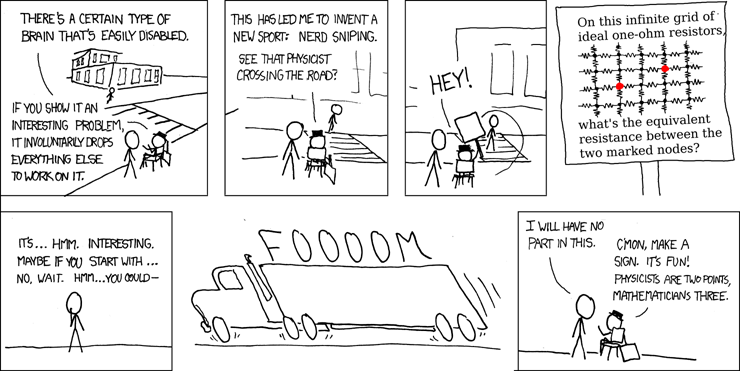
As someone who has personal interaction with the disorder (I'm not officially diagnosed, but probably have it, my son has it, several siblings, nieces and nephews as well), I hate this phrase. Because people use it to mean the exact opposite of what the actual disorder is.
People with ADD or ADHD (different names for pretty much the same thing) do not lack focus. To the contrary, a primary characteristic is extreme focus. Instead we lack the ability to focus on what we are told to focus on.
Society labels this "distractibility" because the person does not focus on what those around would want them to focus on (following instructions, getting dressed, doing homework, etc) but instead goes back to what interests them (bugs, dinosaurs, math, etc). But in terms of ability to get fascinated by something, then follow through on complex tasks, people with ADD or ADHD are significantly more capable than the general public.