"The problem is that the value of a currency is supposed to also be somehow related to its utility in acquiring goods and services. When it is rarely used to that effect, people may reconsider their investment in the currency."
Gold and silver stand in opposition to this statement.
You can't buy groceries with gold or silver coins, but they're a fantastic store of value and time-tested investment.
Furthermore, according to Gresham's Law, people keep "good money" (i.e. money that holds its value) out of the marketplace and spend their "bad money" (i.e. fiat) acquiring goods and services.
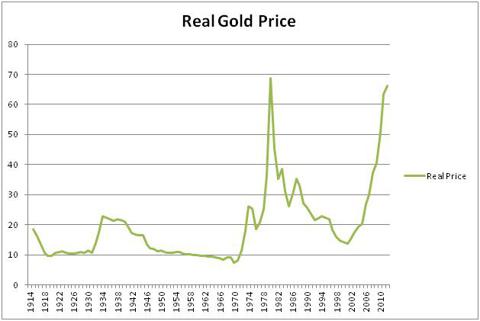
That is very much not my idea of a "fantastic store of value." Not unlike bitcoin, its value appears to vacillate wildly. The S&P 500 looks tame by comparison, and also has the added benefit of a much higher long-run rate of return.
I don't know how you can look at your chart and say gold has not maintained its value. Your chart shows gold holding steady with two upward spikes during 1980 and now as hedges against fiat.
Also, I don't know what "real gold price" means. Some details of the measurement would help.
> also has the added benefit of a much higher long-run rate of return
When measured in dollars, which have lost 98% of their value since 1913.
"Real" prices are almost always measured in CPI terms, although sometimes the GDP deflator is used (it was CPI in that chart).
The real value of gold was (relatively) flat until gold convertibility ended in 1971 because the price was being fixed by the western powers under Bretton-Woods. Ever after it's been on a non-stop roller-coaster ride. If you bought gold in 1980, far from its value being "stored" it would have lost half its value in 10 years even if you bought after the spike.
It sounds like you don't value low CPI volatility very much (perhaps CPI goods and services are of little interest to you), which is fine, but many would use CPI volatility as the definition of a "store of value" as opposed to a speculative investment.
> When measured in dollars
No, when measured in real terms.
> which have lost 98% of their value since 1913.
Nobody would suggest that dollars are a useful store of value. They are a useful medium of exchange and in the short term, a useful unit of account.
But still, gold has never dipped below its 1918 low on that chart. Twice it shot up as a hedge against paper inflation, but it never went below where it started.
Isn't that a terrific store of value? I'm talking about a time frame of centuries here. Not just a few years during a bubble.
And before you counter that we're currently in a low inflation period - we're not. If the CPI was measured using the same metrics that the government used itself in the early 80's, inflation would be running at 9% annually.
Gold and silver are not money either, except in a tiny minority of countries. Wages are not being paid in gold or silver, debts cannot be settled with gold or silver, and neither gold nor silver is commonly traded for other goods. Nobody uses gold or silver as units of account. The only resemblance either metal has to money in this day and age is as a store of value, but if that is your only requirement to consider something to be money then you would need to include land, buildings, and various collectible items too.
Gold and silver are commodities, traded like any other metal, and the historically-motivated obsession people have with using gold as a store of value makes it more difficult to acquire gold for industrial uses (which would be a real, productive use of the metal).


Gold and silver stand in opposition to this statement.
You can't buy groceries with gold or silver coins, but they're a fantastic store of value and time-tested investment.
Furthermore, according to Gresham's Law, people keep "good money" (i.e. money that holds its value) out of the marketplace and spend their "bad money" (i.e. fiat) acquiring goods and services.