Crime is at an all-time low yet spending on police is near an all-time high. (Those factors could have a causal relationship, but I doubt it's the primary cause based on reading "The Better Angels of Our Nature".) http://www.usgovernmentspending.com/spending_chart_1950_2010...
Having big budgets but less crime means these swollen budgets end up being wasted on a lot of "fun" things like military gear. (Did you know that Wisconsin has two anti-terrorism centers? One in Madison and one in Milwaukee.)
I think this has something to do with politicians being unable to touch the budgets of first responders.
Today in the US, if you call 911 about an emergency medical condition, they will often send a fire engine along with an ambulance and a cop. It makes me wonder if firemen and firewomen are so underutilized they've ended up with mostly make-work.
"Today in the US, if you call 911 about an emergency medical condition, they will often send a fire engine along with an ambulance [...]"
This is SOP (Standard Operating Procedure).
1. Imagine a scenario where an ambulance arrives as a first responder, and the EMTs [1] find that they cannot gain access to the emergency scene, because the home or other structure is locked or otherwise blocked. In this case, a firetruck would need to be dispatched, because it deploys with the correct equipment (e.g., Halligan bar [2], Denver tool [3], etc.) and personnel trained to handle such a situation. Also, ambulances are typically deployed with only two personnel, and that may not be enough in situations where items need to be moved or cleared to gain clear access to the emergency scene.
2. Most firefighters are cross-trained as EMTs. If they are local to the emergency scene, then they may be the first responders, while an ambulance is en-route.
3. Incoming 911 calls can often be confusing, with callers under extreme stress, experiencing situations that they have never faced in their lives. Imagine a situation where a caller is so distraught, overwhelmed, or focused on a life-saving effort, that they cannot articulate that they need firefighting support, in addition to an ambulance.
The bottom line: in an emergency situation, it is better to have more help on-hand than too little.
There may even be a happy middle-ground with regards to firefighters. In eastern King County, they don't send out a firetruck and three firefighters for non-lethal medical emergencies anymore -- they just send a single firefighter in an SUV.
SUV? Over here (Netherlands) they send them in tiny cars (http://www.mijnalbum.nl/GroteFoto-SMYHWONA.jpg for example, but I've seen even smaller, two-person city cars with a flashlight bolted on). If it's just to carry a person with some essential first responder tools (fire extinguisher, medkit, axe / tools), you don't need anything big. Of course, in the US, distances are much larger than over here.
Interesting anecdotal data: here in Italy you have to call the fire department to get a fire truck out, whereas they're part of the standard package described above in the US. Fires aren't that common here because of construction materials, so while you see plenty of ambulances and police cars whizzing around, fire trucks are a far rarer sight than in the US.
In France, well Paris, it is quite common to see fire trucks. Like the US they are the first responders to most medical emergencies. And since the city is very old the buildings are mix of material, my previous apartment had plaster walls with mud and hay as fill material. And the wiring looked like it existed during WWII.
Since being here, I've observed fires are quite common amongst the disaffected youth who enjoy burning cars and motos when they are bored.
And yet I can imagine this is something that could be optimized; why not cross-train the three emergency respondent department members into jack-of-all-trades that can deal with 80% of cases? Or put members of the three departments into a single vehicle equipped to deal with most cases? They could travel swifly to the site and deal with most cases, and call in back-up (like a fully equipped ambulance, fire-truck, or paramilitary SWAT-team in an armored hum-vee) if the situation needs it. I'm not an expert, but that would reduce overhead and cross-department communication needs.
Of course, the risk is that if the one vehicle has an accident in itself, there's no others that can fall in right then.
Firemen and EMTS DON'T WANT to be cops! That's why "public safety" movements fail. They don't want to be forced to issue citations for petty drug laws while trying to save people from health or fire emergencies. It's not an uncommon situation for somebody with petty illegal activity to start shooting at firemen trying to stop their house being on fire because they think firemen might arrest them. Regular fireman just want to take care of safety.. They don't want to put on jackboots and arrest people.
Of course the Feds want as many police as possible because of the laws militarizing them and actually disincentive separete rate fire protection with rigged grant processes.
> And yet I can imagine this is something that could be optimized; why not cross-train the three emergency respondent department members into jack-of-all-trades that can deal with 80% of cases?
Because we need firefighters anyway, and EMT's in ambulances are often volunteers or paid substantially lower than a fireman in most areas of the country. Bear in mind, you're also talking about putting additional equipment in what is already a jam-packed ambulance, if you end up needing to dispatch another vehicle it might as well be a fire-truck (you never know when someone forgot to say "my house is on fire" when they called in because their wife isn't breathing after dragging her out of the house).
> And yet I can imagine this is something that could be optimized; why not cross-train the three emergency respondent department members into jack-of-all-trades that can deal with 80% of cases?
Because that's very expensive (increasing initial and ongoing costs for training and equipping every first-response unit), and in the many cases where more than the minimal response is known to be necessary from the first call, and in cases where those departments aren't acting as first responders, it doesn't save anything.
> I'm not an expert, but that would reduce overhead and cross-department communication needs.
No, training and equipping EMTs to be adequate-for-most-cases firefighters and cops, firefighters to be adequate-for-most-cases cops and EMTs, and cops to be adequate-for-most-cases EMTs and firefighters would not reduce overhead. Quite the opposite.
I needed an ambulance in a state park and they sent a fire truck too. When I asked the EMT from the ambulance why the firetruck, she responded "they're our toolbox."
I thought the reason the red fire ambulance needed to be around was because regular EMTs aren't allowed to administer oxygen do to its high flammability, which important in many emergencies. This according to one EMT that I know.
In general, the EMTs you see carrying out an elderly woman are people with a few months of training. When people are getting stabbed, shot, or on the brink of life, you sort of need people with better training.
How about a HazMat team? Imagine a scenario where the EMTs cannot gain access to the emergency scene because there are toxic substances in their way. You can't rely on the incoming 911 calls to decide on a case by case basis so you might as well send a HazMat team alongside the ambulance and firetruck for each and every call.
And what about an anti-terrorist unit? Imagine a scenario where...
If those were as common as fires and doors being deadbolted closed with child 911 callers, we might do it. You act as if the scenarios outlined by the parent are as rare as biohazard emergencies.
a fire truck costs $250000. for the truck. If you don't need a 150 foot ladder and 1000 gallons of water, then a tool-truck like many contractors have would probably do for much less cost.
In San Francisco, people have been trying to get stats on how many times the fire trucks are sent on medical emergencies ("unresponsive man on the sidewalk"). The SFFD has resisted all attempts at such inquiry.
I often see big fire trucks responding for homeless people, and it seems like such a waste. But their union is too powerful.
The original argument is in the book. The idea is that children from disadvantaged families are more likely to be aborted, while at the same time, children from disadvantaged families are also more likely to be crime prone. So, logically, abortion reduces crime with a twenty year delay. Personally, I like the lead theory[1] better, but it doesn't matter. It's not about eugenics or genes.
I attempted to address that in my comment. Check out, Steven Pinker's "The Better Angels of Our Nature" which shows that violent crime is down globally, not just in the US.
Pinker's thesis is not without serious detractors. Edward Herman and David Peterson's critique[1] in ZNet is worth considering before taking it as fact.
Among other things, it argues against the concept of normalizing death tolls of war by population (when the primary variable under consideration is the likelihood of one person to die violently across different times), it tries to cram as much contemporary political rhetoric as it can, and it uses highly pathetic analysis such as "the phenomenon of structural violence, or the kind of violence that is “built into the structure” of social relations" (yes, because past societies based aristocracy that brutally extracts what it can from the majority of the population is so much less structurally violent) and "the increasingly savage global class war of the 1 Percent against the other 99, and the “endemic undernutrition and deprivation”" (conveniently ignoring the fact that endemic undernutrition was the normal state of the world prior to recent times).
It staggers me that someone can actually read that and take it at face value. His entire thesis seems to be "ignore statistics, look at these pretty individual cases" and "look at how bad the world is", completely missing the point that Pinker didn't actually say the world is peaceful, only that it is more peaceful than it has ever been before, and completely failing to make any case against this.
But if spending AND crime were at an all time high wed be saying that its cause and affect in the other direction and probably be making the argument that we need even more spending! So no matter what high budgets are always justified.
If you're not adjusting for inflation, spending on nearly everything is at an all-time high. (And when you're arguing that budgets are too high, it's rarely in your interest to adjust for inflation).
About now I usually are the below story quoted. It's such a fascinating read that I'll stick it in as someone may not have seen it. Leaded petrol and crime.
Indeed; the view I have of unions in Europe are worker organizations that protect and enforce the rights of employees, things like minimum wage, working conditions, fair treatment, and retaining of jobs; afaik, they don't do much to create jobs, let alone in an immoral way by paying lots of money to governments and organizations to, for example, increase the incarceration rate and duration.
This is why tech workers need unions. When Facebook does something nasty, they can blame the unions; the billionaires and millionaires were merely cowering behind their desks.
We shouldn't contort ourselves to avoid the simplest answer: the state is getting what it paid for. The US incarcerates its population more than any known state on earth. That isn't unions' fault — other countries with more powerful unions don't jail themselves like this.
If any enemy nation did this, we wouldn't have any illusions. But we refuse to apply the same logic to ourselves, nor conclude as Chomsky did, "Remember, any state has a primary enemy: its own population."
Otherwise, it might be obvious why police are fighting a war, and who their enemy is.
It is, in fact, the unions' fault. The prison unions and police unions are huge proponents of the drug war, longer sentences, etc. It isn't just there fault, of course, America's general Puritan streak helps, but the public unions have really capitalized on that.
> other countries with more powerful unions don't jail themselves like this.
What happens in other countries isn't a good model for the U.S. Sub-segments of the population don't viscerally hate each other in Frankfurt or London the way they do in L.A. or Detroit. It will be interesting to see what happens to the internal social cohesion European countries have enjoyed post-WWII as middle eastern immigration continues to rise. A few more muslim youths rioting in Paris and I think you'd be surprised by what kind of police escalation Parisians will be willing to put up with...
> "It will be interesting to see what happens to the internal social cohesion European countries have enjoyed post-WWII as middle eastern immigration continues to rise."
It's already here. Every time there is some discussion of Muslim extremism or immigration we have a few HN members saying things that, in even conservative parts of the US, would leave your jaw hanging.
In the US it's common for the more liberal folks to perceive Europe has some kind of bastion of social enlightenment. This view seems to fall apart once you actually inject some different skin colors into the population.
Social enlightenment is easy when your major cities aren't majority-minority and almost perfectly geographically segregated by race/ethnicity. From someone who lived in Chicago for several years: it's hard to empathize with people who look different than you, have dramatically different family backgrounds, etc. It's harder still to empathize with them when they're separated by a river.
I'm sure they're protecting their turf, but they didn't start the drug war, and they're not at the forefront of promoting it.
Nixon declared the "War on Drugs". He also pioneered the "Southern Strategy", and many elements of his campaign are now well accepted to have been used as code words.
It wasn't a personal appeal to the puritan morality of drug users to stop, it was an appeal to the fears of scared whites.
The "War on Drugs" almost exclusively effects poor, minority communities and individuals.
In three decades, the California Correctional Peace Officers Association has become one of the most powerful political forces in California. The union has contributed millions of dollars to support "three strikes" and other laws that lengthen sentences and increase parole sanctions. It donated $1 million to Wilson after he backed the three strikes law.
It's not precisely what 'rayiner was saying, but the prison guard union is definitely pushing for more people in prison.
Give me a break. Unions have a lot of problems but if they were so damned influential, maybe every public sector union except for federal security wouldn't have been losing jobs and hours for the last 10 years.
The only reason public sector unions exist is because they are so influential, despite FDR's warning against them and the conflict of interest that falls on the taxpayers representatives who often have their campaigns partially financed by unions. And I don't think you can look at the past 10 years of "belt tightening" at the state and local level (let's be real, that's where the cuts are), and say they aren't that influential. They still have tons of power.
The states are teetering on the verge of bankruptcy, and it's extremely telling that the public unions are the last things to feel the pain after states have been gutting things like higher education for decades. Many of the recent municipal bankruptcies have been driven by pension obligations for public employees: http://www.foxbusiness.com/government/2013/06/11/california-....
I agree with all of that. What I'm saying is that blaming the current security state on 'unions' is like saying NYC exists because of, I dunno, greenpoint. Not necessary and not even sufficient.
Of course certain unions see an interest in the security state. Other, bigger unions are generally opposed but don't have skin in the game. Whatever. The security state is much bigger than the police and prison guard unions.
Fundamentally, the issue here is political game theory where there's no upside to fixing things and a lot of upside to painting your opponent as 'soft on terror' or 'soft on crime'. So policy only moves in one direction, and that direction is often stupid. Unions' wishes are just drops in the bucket compared to that.
Yeah, that's an extremely exceptional case and related to a centuries-old political conflict between nations. I'm Irish, you can't generalize from Belfast to anywhere else except maybe Israel/Palestine.
There are actually quite a few, and though I'm surely missing 10+, here goes. Serbia/Montenegro/Kosovo, Kashmir (though someone made civil war simpler by dividing those into countries) Sri Lanka, Syria, Iraq, The Sudan, Somalia, Congo, Timor, Cyprus, Afghanistan, Pakistan. None are the same, most are significantly more violent and have rather less western involvement in stabilizing rather than just supporting one side or totally ignoring it.
This isn't minimizing the Irish situation, its just saying that the Irish one is generally appreciated as a complex mess, while the other myriad array of violent, messy historical problems are equally sad.
No. I am no lover of the police or prison officers' unions (which are very powerful here in CA), but they are only one part of the problem. The other part is that we have private corporations that operate prisons for profit, such as Correctional Corporation of America, who are well-documented as promoting the building of more prisons through forums such as ALEC. The incentives are a) huge and b) perverse.
I fully agree with your point, but there is a union that contributes significantly to the prison-industrial complex: the various prison guard unions. (Also culpable are privatized prisons, which are often little more than slave labor camps.)
> (Also culpable are privatized prisons, which are often little more than slave labor camps.)
As opposed to regular prisons which are just slave camps? What exactly is the moral difference between the state of living between public and private prisons? (I take it that you were implying a difference exists, but I could be mistaken.)
Don't get me wrong, they're both awful. Prisons as we know them are a travesty of both efficacy and human decency no matter who runs the show.
But whatever perverse incentives and moral hazards already exist for state prisons, they are double when there is a profit motive for maximizing headcount. Moreover, the taxpayer still ends up footing most of the bill for private prisons; in state-run institutions, they at least have a budgetary incentive to moderate sentences, rehabilitate, and reduce recidivism. In a private prison, an inmate who finds Jesus/Buddha/etc and becomes an honest citizen is a blow to the bottom line.
OK. I thought you were referring to the morality of working while in person as opposed to idling. Given your comment, it seems like you weren't---and yet your previous comment seems to imply it. So why refer to private prisons as "nothing more slave labor camps" while public prisons could just as easily be "nothing more than slave camps"?
I now understand that you were criticizing the incentive structure of prisons, but it didn't seem that way.
> Moreover, the taxpayer still ends up footing most of the bill for private prisons
I would therefore not call them private prisons. Perhaps, crony prisons or quasi-public prisons?
> In a private prison, an inmate who finds Jesus/Buddha/etc and becomes an honest citizen is a blow to the bottom line.
How can this be true while tax payers are simultaneously footing the bill? Moreover, isn't a large part of the comments in this thread about how there is an incentive structure in public prisons to keep more prisoners? (The correctional officer unions.)
> in state-run institutions, they at least have a budgetary incentive to moderate sentences, rehabilitate, and reduce recidivism.
That kind of makes sense. But when there are unions, and the jobs of union members depends on the number of prisoners, it becomes much less clear.
Very true, and equally applicable to many other "private" companies (Lockheed-Martin comes to mind).
> How can this be true while tax payers are simultaneously footing the bill?
Private prisons (that include inmate labor) charge from both ends: per-head to the taxpayer (ostensibly at a lower rate than if the state handled it in-house), and per-hour to businesses seeking cheap labor. State prisons have only the first incentive, with the countervailing force of finite tax revenue.
Also, the prison guard unions have the same incentive to lobby (and/or support the lobbying of their parent corporation) regardless of who signs their checks. I would claim that union influence and lobbying is a constant in either case.
> But when there are unions, and the jobs of union members depends on the number of prisoners, it becomes much less clear.
Agreed. It is bad policy and a waste of taxes in either case.
>That isn't unions' fault — other countries with more powerful unions don't jail themselves like this.
Well, actually, prison guard unions did lobby for things like three-strikes laws to increase incarceration rates. [1] And yes, unions in general are weaker in the US, but public employees' unions haven't waned in power anything like their private sector counterparts.
(I know, I know, "it's a left-wing California site!" But it's well-sourced and one of many articles saying the same thing when you google for who is lobbying for three-strikes laws and whatnot.)
I'm not opposed to unions in general, but there are definitely some specific ones our labor relations dept. could point out that would correlate very well with your point.
I think that's true, but I also think it's true that it would be possible for police forces to demobilize a bit, instead of continuing their ramp-up. It's like invading Iraq. The police went in and broke the criminal gangs and organized crime. What's needed now is nation building, so to speak. The crime that's left is leaderless gangs of youths shooting each other up in turf wars, and SWAT teams aren't the answer to that.
"Today in the US, if you call 911 about an emergency medical condition, they will often send a fire engine along with an ambulance and a cop. It makes me wonder if firemen and firewomen are so underutilized they've ended up with mostly make-work."
One of the reasons for this is also that fire stations are often far closer to the scene of a call (fire suppression being something that benefits from being distributed vs. centralized hospitals) so the fire truck will often arrive there first, and can render aid until the ambulance arrives.
Depending on where you live, and what the incident is, yes. Since fire fighters usually serve paramedic roles, a fire truck will often be dispatched to a serious car accident. If you're lucky your car insurance will cover some or all of the bill.
What you don't want is the $10,000 bill if they send a helicopter out.
> What you don't want is the $10,000 bill if they send a helicopter out.
If you frequently find yourself in locations where a heli may be needed you may want to invest in a membership with your hospital or regional network (in the northwest US (ID, OR, WA) there is the life flight network, $60 a year covers any costs that your insurance don't pay).
I used to be a volunteer junior firefighter as a teen (many of Long Island's fire departments are volunteer based). Fire engines were sent out on emergency calls because many times the situation calls for tools and equipment that ambulances don't carry. I doubt it was budget-related, considering nobody was on payroll.
"Today in the US, if you call 911 about an emergency medical condition, they will often send a fire engine along with an ambulance and a cop. It makes me wonder if firemen and firewomen are so underutilized they've ended up with mostly make-work."
In response to a similar observation that I once made, a friend suggested that police at a non-law enforcement emergency act as ad hoc project managers. "You need what, Mr. EMT? I'll have it for you directly, and I'll have those cars blocking access towed too. ... You lot! Back away!"
Taking off on a tangent, the comment about firefighters and police reminded of Dennis Smith's 'Report from Engine Co. 82'. It described his life as a firefighter in New York City/South Bronx during the 1960s and early 1970s. What I recall most vividly from it was that locals would use the callbox to ring the fire department, in case of problem, because they didn't trust the police.
They glamorize and hero worship mega violent law breaking cops, while at the same time portraying criminals as super beings with government like resources, who always lose due to the violent law breaking cops.
The people in the end believe this to be a vaguely true, even though in their lives they rarely see it, most cops are in fact fairly decent professionals, and criminals are average to dumb folk with bugger all resources, while the cops think they look crap compared to the Hollywood versions, and want more powers and toys.
No? Well, I'm yet to see a credible argument as to why adverts influence us, but movies don't. One of those special people who claim ads dont work on you? Simply, I don't believe you. Every one reckons that, yet ads work.
I think it's not just that Hollywood movies are influencing the Police, although that is part of it. Art both reflects and influences culture. It's hard to separate out causes and effects, although it's clear there is a problem here.
American culture as a whole places a ridiculous emphasis on empowerment through violence. It's everywhere; films, tv, books, music, punditry, news reporting, people's attitudes and idle conversation. A huge proportion of narratives resolve themselves through heroic violence. Often a heroic character will find inner strength through physical violence (and often inner strength means becoming murderously callous).
If you take a step back and look at it critically, it is rather absurd. In the real world true empowerment comes from intelligence and leadership skills. In the real world, having to kill lots of people would be very traumatic (at least for a well adjusted person).
I don't think it's as simple as violent movies causing violence. I think the real dangers come from the unspoken assumptions, the things that movies take for granted, which then become part of everyday thinking.
Yes, they do dress up news like an action movie. That most obvious and grating feature of this is the emotional music they now play over news and documentaries. Also, they way enemies are completely demonized and dehumanized, and the good guys worshiped. And when a lead character goes off script, they really freak out.
During the 2011 protests in Russia, some people suggested that the government benefits from bad relations between the public and the police, because the government is afraid that the police will side with the public during mass protests. Though I guess that problem is much less severe in the US.
David Simon and Ed Burns wrote the following passage for the TV show, "The Wire" spoken by Bunny Colvin:
<<<<
I mean, you call something a war and pretty soon everybody gonna be running around acting like warriors. They gonna be running around on a damn crusade, storming corners, slapping on cuffs, racking up body counts. And when you at war, you need a fucking enemy. And pretty soon, damn near everybody on every corner is your fucking enemy. And soon the neighborhood that you're supposed to be policing, that's just occupied territory.
>>>>
This was written in 2004. With the passage of time, it seems more and more prescient.
It's not prescient because that is how it's been in predominantly black neighbourhoods. Black people have been saying this for the last 2-3 decades through protests, riots, and community organisers. It's only now that everyone has a cameraphone and a Youtube account do you get to see what's been going on.
His famous role was in Roots as the slave that kept getting lashed for not taking a proper English name from his owner over and over if he would just say his English name...
So its more than a little ironic that THIS actor makes a video about how to be properly submissive to his mas'ers!
It just sad that he would have to make a video like that because most of his TV time has been spent reading books to children. He's about as threatening as Mr. Rogers and still gets the jackboot.
> Police in North Dakota borrowed a $154 million MQ-9 Predator B drone from the Department of Homeland Security to arrest a family of anti-government separatists who refused to return six cows that wandered onto their farm.
There is a base in Grand Forks, ND that houses several CBP (Customs and Border Patrol) Predator Drones, and they work with local law enforcement when asked to.
So, more than likely, the drone is going to be flying home here anyway, and made a pass over some property.
The facility where these things are flown from isn't some top secret bunker or anything, it's an office building on the air force base, and they give tours to local schools[1]. A local cop probably just stood behind one of the pilots while they flew over the property and spotted the cows.
Also: to somebody who didn't grow up in this area, that probably sounds really silly...but keep in mind that cows are worth a couple of thousand dollars each. So you're talking, low end, about $12,000 worth of property that they won't return. That's like having a stolen car.
--
I think something like this (flying a UAV, since CBP doesn't actually fly drones) should require a search warrant, but this is a totally reasonable use of resources IMHO.
Don't throw the baby out with the bathwater, I guess.
[1]: They'd probably give a tour to anybody that asked, actually. Grand Forks is home to one of the biggest and best Aviation and Aerospace engineering schools in the world[2], and it would surprise me if there wasn't a relationship between the air force base there, and the school. If any HNers are ever up there, I'd suggest asking for a tour.
Well, it's quoting from the ACLU feature. The headline does take a certain stance, but 10 years ago it would sound like some joke headline from Robocop.
I'm not a US citizen but if I was I'd love to take that tour.
Thanks for the counterpoint. I'm completely of the mindset that police should take the mindset of community-servants first (perhaps the fighting mentality is appropriate in certain situations at specific times.) But so many of these kinds of articles (not this one specifically) take anecdotal incidents, tell them from one specific viewpoint that makes the cops look like trash, and expect you to be all outraged with them. I'm personally not going to get outraged until things are prevented in a fair light and I can decide if things are over-militarized.
> I think something like this (flying a UAV, since CBP doesn't actually fly drones) should require a search warrant, but this is a totally reasonable use of resources IMHO.
The Supreme Court decided in 1986 that aerial surveillance of a person's backyard did not require a warrant. Then again, the search was conducted by a human only using his "naked eye". See California v. Ciraolo.
Cattle prices are listed in $/cwt ($ per 100 pounds), and most prices you find like this are the price when you want to slaughter the animal. If you're looking for something for breeding, the prices can be substantially higher.
I'm looking around the internet, and seeing prices all over the place actually. $60 is the lowest I've seen, NASDAQ.com says $120, some farming websites are saying $1000-$2000, etc.
> North Dakota [...] a family of anti-government separatists
Were these the kind of anti-government separatists who are harmless quirky people who confine their anti-government activity to blogs and leaflets, or the kind of anti-government separatists who amass a ton of weapons and declare themselves independent and vow to shoot any government agents who "invade" their sovereign territory?
The SWAT issue is a different issue IMO, more related to politicians wanting to "do something" at the Federal and State levels. "Doing something" translates to "allocate funding". That money can pay for more cops/overtime, or stuff. Or it may be earmarked by a congressman whose donor makes light tanks to only buy tanks.
The us vs. them stuff is related to the state of affairs in high-crime communities. Cops can't relate to the people they interact with (and vice versa) because they essentially live in different societies -- they might as well be different planets.
If a policeman has access to body armor and machine guns to serve a warrant on some guy in a house, he will take them along. The cop has no idea who may be behind a door when they knock -- they may be intoxicated/high, have a vicious pit bull, or just be a scared kid with a gun and nothing to lose. The policeman wants to go home to see his kids at the end of his shift.
If a policeman has access to body armor and machine guns to serve a warrant on some guy in a house, he will take them along. The cop has no idea who may be behind a door when they knock -- they may be intoxicated/high, have a vicious pit bull, or just be a scared kid with a gun and nothing to lose. The policeman wants to go home to see his kids at the end of his shift.
Uh, shouldn't this information be available based on some kind of investigation that the warrant is based on? This argument leads to the "shoot first, ask questions later" ethos. It is exactly what leads to innocent people and animals being murdered by police. The police should not shift the risks of their job on to the public.
Easy for a guy sitting in a chair in front of a computer to say.
I'm not justifying the behavior, I'm trying to illuminate why it's happening. You're attributing responsibility for a situation to people who don't make decisions. Society has made choices (let's move to the burbs to get away from those poor folk) and your representatives have enacted laws that have created all sorts of absurd situations. And we drop policemen into the middle of the chaos to exert some control over it.
Regardless of where the responsibility lies, it is unacceptable. I agree that the actual police officer does not control policies but they do control their own actions and it is part of the job description to put their lives on the line for the benefit of the general public. If they are not happy with that then they can leave the job that they voluntarily entered.
As soon as they draw a gun on someone without clear evidence that that person poses and immediate risk to themselves (police) or others, they are putting their safety above that of the general public. If they do not wish to put public safety above their own, then they need to find a new job.
Emergency services have to put their own safety above the public safety. It's how they're trained, and it's necessary. If you sacrifice an officer of the emergency service for a member of the public, you now have one more member of the public... well, actually you don't because the officer is also a member of the public... and you have also lost a trained officer, who can't respond to future requests for help, so the future service to the public suffers. And not all areas find it easy to recruit for the emergency services.
Police actively lobby for many of the tactics and policies being decried in these articles.
They routinely oppose state level drug decriminalization (with sheriffs and other local police actively coordinating with DEA / Federal officials to undermine local / state policies).
They also oppose and actively hinder investigations into police malfeasance, firing of corrupt / incompetent officers, and many other forms of limited civilian oversight.
The idea that police officers and their ilk (correctional officers, district attorneys, etc) don't have an active hand in the types of laws and policies being practice in America is not at all true.
If a cop has to choose between his own safety and the safety of innocent citizens, he should either choose the latter or find a new profession. He chose to become a policeman, knowing the risks; innocent people terrorized and murdered by the police never had that luxury.
Yes, it is easy for a guy sitting in a chair in front of a computer to say, and since those guys are the ones paying for the small chance to one day be murdered by a police officer, it should be easy to say, and should be said confidently.
> Easy for a guy sitting in a chair in front of a computer to say.
I'm sorry but last time I checked there was no police draft, these officers chose this line of work and were made aware or the risks and responsibilities (and pay) involved. I agree that the sureounding circumstances are partially at fault, but you make it seem as if these guys are bystanders thrown into thee situations with no culpability of their own.
> If a policeman has access to body armor and machine guns to serve a warrant on some guy in a house, he will take them along.
Interestingly, in the UK, where regular policemen don't carry guns, most policemen apparently don't want to have firearms.
Obviously this is a rather different culture, and there's a difference between a collective matter (should we all be armed?) and an individual matter (should I be armed today for this particular call?). But I mention this to point out that human nature isn't as simple as everyone wielding the biggest stick available to them.
I think part of the reason for UK police not wanting guns is primarily what the UK police see as their mission: It is community policing, where UK police try to work within and with the permission of the community because they feel they're most effective that way (also called "policing by consent"). http://www.civitas.org.uk/pubs/policeNine.php
Police carrying guns makes them "scary" to the general public, and as such damages their primary mission (see above). It is also hugely damaging to the police's reputation when someone gets shot (even righteously) and would be catastrophic if someone was illegitimately killed (http://en.wikipedia.org/wiki/Death_of_Jean_Charles_de_Meneze...).
The US police is VERY militarized in Urban areas. They also seem to have an "us Vs. them" attitude about the general public, and are less interested in earning respect but rather taking it by force or coercion ("thin blue line," "respect my authority," "quit resisting," etc).
> The US police is VERY militarized in Urban areas.
U.S. urban areas are very militarized. London, a city of 8 million people, had 100 murders last year. Over the last 20 years, the number broke 200 only once, in 2003. Chicago, a city of only 2.7 million people, had 532 last year. And this is way down from the peak. Murders in U.S. cities peaked in the early 1990's. L.A. county had 2,589 murders at its peak in 1993. New York peaked at 2,245 murders in 1990.
Gang-related murders are the result of gang activity, and gang-activity is very scary for a community. First, lots of teenagers and young people are gang members, and gangs have major presences in inner-city schools, so even a "gang-related murder" isn't like some mobster getting killed, but something that hits really close to home in the community. Second, this activity is very geographically segregated, which makes particular neighborhoods seem more like war zones. Third, even a few innocent bystanders getting caught in the cross-fire can have a chilling effect on the community. In Chicago this year, a kid who sang at Obama's inauguration was gunned down in gang-related cross-fire. Just one kid in a city of 2.7 million people, but it still had a tremendous effect on the community.
The trend in America is definitely downward--murder counts in LA county and NYC are about a fifth of what they were in the early 1990's, but they are still 4x higher than London's (greater London is roughly similar in population to LA county and NYC). And the militarization of the U.S. police didn't happen overnight. It happened in the 1970's-1990's when crime rates in U.S. cities skyrocketed. That apparatus hasn't demobilized in response to decreased crime rates.
> Gang-related murders are the result of gang activity, and gang-activity is very scary for a community. First, lots of teenagers and young people are gang members, and gangs have major presences in inner-city schools, so even a "gang-related murder" isn't like some mobster getting killed, but something that hits really close to home in the community. Second, this activity is very geographically segregated, which makes particular neighborhoods seem more like war zones. Third, even a few innocent bystanders getting caught in the cross-fire can have a chilling effect on the community. In Chicago this year, a kid who sang at Obama's inauguration was gunned down in gang-related cross-fire. Just one kid in a city of 2.7 million people, but it still had a tremendous effect on the community.
Of course, the solution for this is not policing but rather to address the fundamental social inequalities that make gangs thrive.
> And the militarization of the U.S. police didn't happen overnight. It happened in the 1970's-1990's when crime rates in U.S. cities skyrocketed.
Violent crime rates in cities have been on a declining trend since the late 70s/early 80s. The militarization isn't caused by violent crime, because we would expect as rates fall that there would be no call to increase police power at any given time. You are definitely right, the policing issue is really institutional in nature, but as a systemic kind of effect it isn't necessarily tied to any factual reality about crime.
>Of course, the solution for this is not policing but rather to address the fundamental social inequalities that make gangs thrive.
I disagree that the fundamental reason for gangs is social inequality. The feature that general makes gangs distinct from clubs is their use of force. They use force for the same reason society at large uses force, to protect property /enforce contracts/ensure fair play. Society at large has conceeded this force to the government (specifically the police department), however when the police fail to protect a certain group of people, then those people may be forced to take enforcement into their own hands, which is exactly what gangs do.
This problem stems largly from the war on drugs. There is a huge economic force pushing for drug sales, so capitalism tells us that drugs will be sold. However, the people engaging in the drug trade cannot rely on the legal system for the protections any other business has, so they have to do it themselves.
> The militarization isn't caused by violent crime, because we would expect as rates fall that there would be no call to increase police power at any given time.
The militarization can have been caused by violent crime without being perpetuated by it.
Also remember the war on drugs rocketed the number of incarcerations. Under Reagan small-time offenders went into prison for 5-10 years and emerged hardened, smarter criminals. In the mean time the removal of so many males from communities allowed an entire generation of kids and teenagers to be preyed on by gangs.
And that wasn't my point at all. My point being gang on gang violence perpetuated by societal issues (say for Chicago black gang members) isn't a great comparison of 2.7 million people in Chicago and N deaths/murders versus N million people in $western_country with N/4 murders isn't really describing the issues. It alludes the issues as being related to things which are fundamentally different and not directly or easily statistically comparable.
I used to live in Chicago. The fact that almost all murders in Chicago happen to blacks and Hispanics, many of them in gangs, doesn't reduce people's incentive to support stronger police presence. Indeed, it makes it easier. You fear the gangs taking the red line up to the north side, but don't care so much about more aggressive policing because those cops aren't kicking down doors in your neighborhood.
A common argument from police officers I know in the UK is that they don't want to carry things like firearms and heavy protection gear routinely precisely because it promotes escalation, as well as the kind of them-and-us culture mentioned elsewhere in this thread because most of us here aren't legally allowed to carry firearms.
As a counterpoint, for all the early mockery that Police Community Support Officers took, the idea seems to have worked out pretty well. If you call to report a relatively minor problem today, it's a good bet that you'll get one or two PCSOs and maybe a PC turning up. I think the fact that "real people" come to deal with the situation and maybe have a quiet word with someone who's a little out of line probably goes a long way to avoiding unnecessary confrontation. I'm pretty sure I would be far less comfortable if a small paramilitary team knocked on my door and asked to come in, even if they just wanted to ask if I'd seen anything relevant to a break-in at a neighbour's house or something.
The notion that the UK police force "doesn't have or wants fire arms" gives a somewhat wrong impression. They have special fire arms squads and in major cities they either patrol amongst the regular units or are on standby.
I believe there is a much more pragmatic side to it. One could see fire arms as a specialisation which needs to be handled by a specially trained squad, much like riding a police horse or doing mountain rescue.
In a country with relatively very little gun violence that makes perfect sense. You train but a little group, which also gains in experience from the incidents that occur, instead of (under) training every single police officer for a shooting incident that will most likely never take place in their whole career.
Here was an article a while ago about making safer beer mugs so barfights didn't turn into dangerous weapons. The UK police were backing rolling them out.
American police just shoot fuckers instead of getting in a minor tussle.
In a sick and twisted way, this whole US militarization of the police reminds me of Judge Dredd.
And due to the laws in which police are not subject to, they many time ARE the judge, jury, and executioner.
I would much prefer the UK style police, where they work with the citizens (cause, who wants a rundown shack of a drughouse next door). But I believe that is untenable, due to the prevalent amount of guns in our country.
It sounds like a lose-lose, where We the People lose.
I don't think the guns make it untenable. If the police approached people in a professional, friendly manner (even with a gun around their waste), then most people even if they own a gun, or even are carring one, would not think to use it. The problem comes when the police start a situation as a confrontation, their is no good way out of it.
The bigger barrier to solving this issue isn't the guns, but the fact that the police have a big reputation that they would need to overcome.
'A 2006 survey of 47,328 Police Federation members found 82% did not want officers to be routinely armed on duty, despite almost half saying their lives had been "in serious jeopardy" during the previous three years.'
"Arming the force would, say opponents, undermine the principle of policing by consent - the notion that the force owes its primary duty to the public, rather than to the state, as in other countries."
> The cop has no idea who may be behind a door when they knock -- they may be intoxicated/high, have a vicious pit bull, or just be a scared kid with a gun and nothing to lose. The policeman wants to go home to see his kids at the end of his shift.
One way to reduce the risk of encountering these dangers is to not be serving warrants on non-violent drug offenders in the first place. Not that this a police decision, but it should be obvious to policy makers.
The more drug dealers they stamp out, the more rewarding an endeavor selling drugs becomes. Increasingly aggressive police tactics will be met with increasingly drastic measure to secure drug operations, until you've literally got cartels riding around in military hardware.
I wish that was a hypothetical doomsday scenario, but just look to the south of the border.
If you dress up a guy in like a soldier and tell him he's going to war, he's going to go fight one, even if his enemy turns out to be a 12 year old with a baseball bat.
Context leads action. Our police are deeply out of context. Bulls in china shops break china. If you don't want broken dishes, don't send in a bull.
"The policeman wants to go home to see his kids at the end of his shift."
...and I do not want to have a gang of soldiers invade my home at 5:00am and shoot my dog. When soldiers are doing police work, police work puts the public in danger.
> "The cop has no idea who may be behind a door when they knock"
The cop also has no idea what's waiting for them in a vehicle they've just pulled over on the highway. Some of them have been murdered in exactly that situation.
But should they all suit up before writing traffic tickets?
The policeman wants to go home to see his kids at the end of his shift.
All kids are different. Personally, I think I would have preferred my father not come home, than come home a murderer. Maybe I was a fluke, but just to be sure the police officers should ask their kids about this, before operating on potentially false assumptions.
It's more likely that SWAT teams are being used to hide the fact that violent crime is at the lowest levels in decades. Police use terrorism to justify keeping officers on the force when they should be getting laid off. It's makework.
The job of the US' domestic police force is to serve and protect; the job of the military is to defend the nation against foreign enemies. When police forces become militaristic, the citizens become the foreign enemy.
The job of the US domestic police force is to serve and protect the status quo (NOT individuals). Be against that, and you're against the police. Police aren't paid to care what the status quo is, but the status quo pay the police. And who is the status quo (ask yourself)
The methods they use to protect and serve that ideal just need to be one step less that what the masses will absolutely tolerate. If they cross that line, you get a riot.
Police violate individual citizen rights all the time and usually it's just ignored. It's a sorry state of affairs. That's why I'm afraid of police and police actions.
Google the story about 7 cops in VA that went after a 17yr old girl because she was carrying non alcoholic fruit soda the cops thought were wine coolers. They handled this by breaking through her car windows guns drawn like they were seals going after bin laden lol.
Actually, it was a 20-year-old college student with a 12-pack of water, and they failed to break her windows because she drove away when the crowd of large men ran up and started beating on her car, and then they charged her with assault.
"She and her roommates say they panicked, dialed 911 and tried to drive to a police station."
Christ, if that is somebodies genuine reaction after having an encounter with the police, then it is plainly the police involved that should be charged and arrested.
b) The police should have been suspended and/or fired. Even if the girl did buy a 12 pack of beer, the level of force used was beyond excessive for the crime they thought occurred.
After she spent a night in jail. More relevantly, she called 911 and fled because she was scared of people who (unknown to her) were active law enforcement agents. This aggression as a first resort is precisely what is being discussed here.
"There's a reason you separate military and the police. One fights the enemies of the state, the other serves and protects the people. When the military becomes both, then the enemies of the state tend to become the people" -Commander William Adama, Battlestar Galactica
Do you think it matter if veterans were disallowed from joining law enforcement? Without getting into constitutionality arguments, would it really make the country safer for all its citizens (and not just those lucky enough to never be confronted by cops)?
It's interesting to contrast the approach taken in different countries. I spent the majority of my life in New Zealand but the last 9 years in the UK so I've witnessed it first hand.
Within the first couple of months of arriving here (London) I had attended several large gatherings, for example festivals in and out of London, and there was a marked difference in the police handling. I was genuinely surprised when I realised that the police controlling the events were interested in the safety and enjoyment of the public. They weren't looking to stir up trouble, they weren't searching for the "bad eggs" to antagonise - they were just trying to do their best to control the situation by working with those involved.
In my time in NZ I saw the police carry out all sorts of actions that were completely unnecessary.
I saw someone arrested for overloading a car with people leaving a party - prior to that I watched the police insist that the driver allow the car to be overloaded in the first place.
I was once tripped from behind by the police (on the pavement) for walking alongside a protest on my way home from University.
Might not seem like big issues but I've seen countless similar examples where the police were actually responsible for instigating the problem.
There's very much an Us vs Them attitude in NZ that, thankfully, isn't the norm in the UK (for the moment).
This is an awful generalization, there are many veterans that see this as excessive and abhorrent. They left the Middle East to trade the military environment for quiet(er) civilian life.
Real MILITARY soldiers are subject to the Uniform Code of Military Justice... Which is somewhat stricter and includes a lot of rules that are unconstitutional for crvilians. They also don't get to form unions, they get a chin of command and that's it. They break ORDERS and they get Courtmartialed.
Our militarized police like to call the rest of us "civilians" but they run straight to their Union when any superior calls them out, and they hide behind the same lawyers as the rest of us and ask for favors from the prosecutor and court.
We need to keep the teacher unions and break the police unions up, then subject them to higher standards of conduct, and LOWER standards of defense and evidence... We have allowed them to become a wild pack of dogs and they need caged up, put back on the leash, or put down.
Yet they presumably chose to join the military, right? Is it really excessive and abhorrent to suggest that those who decide to join the military would tend towards militarized philosophies? They're not saints.
It would be interesting to get a lot of data (HN specialty!) looking at the breakdown of all the different approaches. It seems like there are 2 extremes, and a wide variety from place to place.
Certain parts of NYC has seen amazingly drops in violent crime due to more "community-oriented" policing that requires officers to integrate themselves into the fabric of the neighborhoods in their precincts (I think it's NYC...). On the other end, you have that Salon article about SWAT teams gone willy nilly.
Some basic correlations, and visualizations showing comparative effectiveness of the different techniques could go a long way....
As with everything else it seems to be a case of misplaced incentives, both good and bad.
Imagine in 2 out of every 100 raids (numbers completely made up of course) that these style raids are called for - the people inside are incredibly dangerous and bargin in unannounced is the safest thing to do. Based on what I've read these police forces seem to treat every situation like this. Whether a hardened criminal or some dude playing poker with his friends they assume the worst and barge in guns a blazing.
And what happens? 2 times out of 100 they nail the bad guys and are probably congratulated on the local news and within the department. And the other 98 times? Nothing. They hand out some minor violations and leave, none the worse for it. Or again that's what it seems the case is based on these articles. So why wouldn't they just barge in and do whatever the hell they want. They are either heroes or the people they are terrorizing have no way to fight back. There needs to be some way to either punish them for this or positively incentivize more civil raids/raiding at all.
As the financial crisis showed us, bankers would bet the country if it meant they get a bigger bonus. It seems we are a point where the police will essentially do the same.
One of my best friends is NYPD working in the projects in Brownsville NY, one of the most dangerous cities in NYC. From the stories he tells me, he is fighting a war.
Of course, that's not applicable to most other areas, but it's worth noting that when your day-to-day job is dealing with the criminals and scum of the earth, it changes your perspective on life.
But are they criminals just because drugs are illegal, and they got sent to prison where crime is all they learned? Has the adversarial relationship been heightened by both sides?
When you send the police to war, the people become the enemy. The goal should be deterring the behavior not taking these people down and stomping them hard in retribution.
Here in Hawai'i, we're lucky to have small communities, from which many of our police officers are enlisted, thus maintaining more of sense that we are all part of the same class, as well as the fact that many officers are related to people in the communities, so there is less disconnection and stratification than one would see in larger metropolitan areas.
I've been on both sides of the law here, and have always been treated with the utmost respect and humanity, even when I didn't deserve such. (a couple of drunken incidents, which will shame me for the rest of my days)
Sure our local police force has an armored, Lenco Bearcat, which they rarely use, but such measures are necessary in today's world - where criminals possess military-grade weapons.
This is not to say that I disagree with the article, as it's plain to see that the points made in the article are valid for a large portion of the USA.
I guess all I can say is...
Lucky we live Hawai'i!
I find that hard to believe. I grew up in Hawaii, and I have come across lots of dick head cops engaging in some heinous activities. I have several friends from Oahu who would also agree with my statement.
Somewhat tangential: There has long been a tie-in between the military and the police. Former military members make an easier transition to the police, and a lot of policemen have a strong weekend-warrior, macho mentality and like big guns and things that go boom. Plus the rank system is similar, there's use of deadly force, and so on.
The U.S. has also seen major mission creep in the military. Instead of going in and bringing a devastating kinetic assault to an enemy in order to get them to surrender, now we're in the mission of Counter-Insurgency (COIN), nation-building, handing out candy to kids, and air-lifting supplies in to earthquake victims.
Because of all of that, I think we need a new branch of the armed forces specifically set aside for nation-building, humanitarian relief, and so forth. It's a completely different mission from the other branches, and deserves its own budget, training, and voice. Then, civilian police forces should only pull military members from that branch.
We need to separate the warrior mentality from the protect and serve, community-friendly mentality. Some organizational re-alignment may help.
I wouldn't say the military has seen mission creep. Their job was always to stay until the fighting was over and the mission was accomplished. The difference is that we've found ourselves in conflicts where the fighting doesn't stop, and the mission might be "accomplished" now and then but it never stays that way. Judging by our recent conflicts, it's wishful thinking to try to separate the duties of fighting and interacting with civilians, and I think the new branch of the armed forces you're talking about is basically what the current U.S. Army is trying to be. Any nation-building and humanitarian relief force we create will have to deal with ambushes, mortar attacks, RPGs, and assaults on their bases, so it's not like they won't be fighters (and inevitably killers.)
Honestly, I think the army, along with a handful of progressive city police departments, will solve the problem of community policing long before most local U.S. law enforcement agencies. The army has greater ability to control and change its culture. It won't happen overnight, but we can hope that eventually U.S. cops will learn to respect their neighbors across town by the example of how U.S. soldiers treat people from the other side of the world. The army will also learn how to assess soldiers' fitness for interaction with civilians, which will have interesting implications for law enforcement.
>Because of all of that, I think we need a new branch of the armed forces specifically set aside for nation-building, humanitarian relief, and so forth.
Maybe we could call it something like The Peace Corps?
The US military did do extensive nation-building in Europe and Japan after WWII. (I have it from my father, a 4-year-old German at war's end, that candy was most definitely involved.) I would argue that the difference is that, then, the military was expected and allowed to win the war first.
In the interest of playing devil's advocate, couldn't the fact that we have 94 guns per 100 Americans have something to do with it? To be honest, the cops that work in Oakland, Compton, Detroit, Chicago, and many other cities effectively are fighting wars with heavily armed gangs, etc.
I don't know that I buy the notion that police are the way they are today because of the Civil Rights Movement and Vietnam protests. Seems to me like the rise of inner city violence is a far bigger mover.
Not trying to justify militarized police, just trying to understand the reasons why in order to logically approach alternatives.
It's been dropping since the 90s, but so far as I can tell there has been a large increase in violent crime rates since the 60s. If we're at a 50 year low in rates, what does that mean for the total number of violent crimes?
Which raises other questions. Has our militarized police force contributed to declining crime in the past 20 years? If so, to what extent?
America has always had that many guns, but the police weren't always militarized. In addition, the amount of crime and number of police killed in the line of duty has steadily decreased over the years.
The devil's advocate in me wonders if the number of police killed is reduced because of the heavy use of SWAT whenever they think there might be any threat to an officer in a raid.
In regards to the first point, yes, there are more guns. I don't think the percentage of the population that owns 1 or more firearms has increased significantly.
Murders are WAY down from their peaks in the 90's. And that's across the board. So what violence are they encountering now, that they didn't encounter in... say ... '93 when they had no APC?
In continuing the devil's advocate angle here, there is a lot of scary stuff going on in Mexico right now. Some of that spilling over the border(or more realistically, the people and equipment are already here just unnoticed) is a possibility.
But that's supposition. Have there been any border skirmishes, or skirmishes in cities with large Hispanic populations, (I assume you are talking about Mexican Cartels), where the police faced these well equipped Mexican Cartels?
I don't know if there have or haven't... that was not snark, but a serious question. My suspicion is that there have not been any such engagements.
Again, devil's advocate. The Hollywood Shootout was in 97. Murders might be down, but I don't think it's murder rates alone that drive policy in the area.
I don't know how we got here, but you must admit that SWAT teams in mine-resistant personnel carriers sure look spiffy. If your police force isn't ready for battle, the terrorists win
From the article: "–You are 8 times more likely to be killed by a police officer than by a terrorist"... Wow, so we need a war against... The police? If we follow todays logic?
Enough babying them--it is time to stop letting their infantile behavior and juvenile antics hurt our civilization. We can't continue to let minor offenses slide.
I was wondering how toddlers kill people, so I went to the original source, which describes 5 fatal shootings. All but one were by preschoolers, not toddlers, which ruins the alliteration. And the article cherry-picks data from 2013; terrorism deaths are considerably higher if you include other years (even excluding 2001). I'd classify this as a catchy link title, not an accurate statement.
What terrorists? Did you read the article? "Today, the use of this sort of force is in too many jurisdictions the first option for serving search warrants instead of the last. SWAT teams today are used to break up poker games and massage parlors, for immigration enforcement, even to perform regulatory inspections."
Anything that keeps us scared and submissive works well for the plutocracy. Citizens should never think that they live in a neighborhood, oh no, they live in a terrorist infested war zone.
"But whether it's with the ubiquity of these SWAT raids, stop-and-frisk, or the default geared-up, Robocop response to political protest, the relationship between police and the public on the whole is growing increasingly antagonistic -- and oddly, this comes during a period when both crime and on-duty police deaths are at historic lows."
Author seems to completely miss the possibility that this is causal.
Edit: Just see gizmo686's comment below. Pretty much sums up my line of thinking.
If you want to say its causal, you are going to have to show some kind of evidence that it is. The author is correct not to make that leap since they don't have any such evidence or info to provide on that point.
I suspect that what you're intending to assert is the possibility that lower crime and higher police survival rates are due to the access the police have to better, "military-style" weapons, and you're accusing the author of missing that possibility.
But that's not what the thesis of the sentence you quoted above is. The thesis is "it is odd that the relationship between police and the public on the whole is growing increasingly antagonistic." For that relationship to be casual, that would mean that lower crime and higher police survival rates are due to the practice of responding to illegal poker games among retirees at the Elks Lodge with the same degree of force as they'd use to take down an international drug cartel.
Or maybe the author doesn't want to pull something completely out his ass? Isn't this what we criticize journalists for? Especially in social sciences reporting?
There has been a lot of spilled ink regarding why big city crime has been going down with lots of decent theories (abortion access, gentrification, easier access to higher education, smarter policing, larger prison population, etc) and I've never really heard that heavy handed SWAT tactics account for this.
But the author is making a claim that this is a contradiction. There is an obvious explanation that disagrees with the author that was ommited. That is exactly what we complain about in journalism.
You shouldn't have a gun except for things you care about more than your and others' lives. Having one makes it far more likely for a violent encounter to escalate into a lethal one.
Actually the militarization of the police force comes from a coordinated effort to repurpose military hardware for domestic police use. [1]
Kind of funny that the gear used to fight one terrible war overseas is sent back to our own country and used to fight another terrible war domestically, huh?
The existence of drug organizations is a capitalist response to government intervention in the market. Prohibition is the source of the black drugs market as well as the reason the police militarized themselves.
Then why did the practice only catch on and spread like wild-fire after crime had already begun its plunge?
And why, after crime has continued to drop dramatically, has SWAT-ification continued to increase (if not accelerated) rather than plateau or even drop in response?
When EPA and Department of Agriculture have their own SWAT teams, you know that SWAT teams are more for status display between high level bureaucrats than for any real need to fight off the nefarious activities of Dr Evil.
Blaming unions would probably have worked better, back before the banking crisis forced many communities to do exactly what you suggest can't be done.
That said, you do raise a good point that it's career-suicide to advocate reducing police budgets in the US unless absolutely necessary -- and even then it isn't ever well-received.
(Which makes the (in)ability to actually reduce staffing a secondary problem, at best.)
But none of that excuses continued growth in the face of plunging crime, let alone the acceleration in use of such tactics.
If you think limited freedom cultures are good for our work go on ahead ignoring this stuff. Or realize that we generally need a good free society to work in and flourish in and these are all precursor warnings to more political crack downs that could drastically curb the hacker scene in the US. There are already increased cases of security researchers getting the SWAT treatment followed by jail. Who thinks thats good. These articles are digging deeper into the why this is happening trying to look for ways to prevent it before it tanks the US tech scene.
I'd say that's relevant but if you disagree put your fingers in your ears, close your eyes and wait another decade and we'll see
Between this and the PRISM stories, some hackers seem to think the interesting new phenomenon of a US surveillance state run by warlords is just as important to talk about as the Nth new javascript framework or blog post about MVPs.
I, personally, like that HN is talking more about politics. We have to build our technology with politics in mind. Accompany technology with good politics(in the meaning of ethics and society and communities) and use(where's possible) technology to route around bad politics.
From [1], "McKenzie Wark talks about the new class of hackers, a direct social manifestation of the intellectual property laws. According to Wark hackers are the people capable of forcing the sign/information system to creatively transform."
Since hackers transform the sign/information system, they inherently infringe upon AND establish authority. This puts us incidentally in the same position as other authority, such as police.
Simple, do you see the limits to preventive actions they can take in most cities? Have you read how "rights" activist are going to strip NYC cops from doing just that which has resulted in an incredible drop in murders and similar crimes?
We got there because we stopped police from policing and instead forced them to respond to situations left to build until they explode.
We got there by telling them, no you can't look at that guy because of where he lives, where he doesn't live, his skin color, the type of clothing he wears, or such.
> Have you read how "rights" activist are going to strip NYC cops from doing just that which has resulted in an incredible drop in murders and similar crimes?
You are no doubt referring to stop and frisk. I'm so tired of having to say this to folks, but the violent crime rate in NYC has been dropping since before stop and frisk was a policy. In fact, there is no conclusive evidence or study that gives a direct causation for the fall in violent crime rates in NYC, even though Bloomberg and Ray Kelly will continue to claim otherwise.
> We got there by telling them, no you can't look at that guy because of where he lives, where he doesn't live, his skin color, the type of clothing he wears, or such.
If you think the race and poverty oriented profiling that the police employ make you safer, you are totally mistaken. They encourage harm to communities of predominantly black and hispanic people, they encourage imprisonment of those people, they encourage the destruction of those communities, and they encourage the increased power of the police force over all aspects of a city.
There is very good evidence that the reduction in crime is related to the levels of lead in blood. The correlation between crime and lead levels is found on the international, national, state, city and even block by block level.
Stop and frisk can be legally done, but the way the NYPD implements it is clearly discriminatory. There is no better way to create a criminal than to treat someone like one from adolescence.
I'm not sure of what you're trying to say here. Is it OK for the police to harass people because they're black, or sport a beard, or wear the wrong T-shirt? That's what you call "preventive policing"?
Crime still happens in jail. If you put everyone (presumably, except for the jail guards) in jail, you don't reduce the crime rate, you increase it and change the location.
> Simple, do you see the limits to preventive actions they can take in most cities?
No, what limits?
> Have you read how "rights" activist are going to strip NYC cops from doing just that which has resulted in an incredible drop in murders and similar crimes?
NYC cops were never allowed to give abortions, so I'm not sure how any changes are going to affect the crime rate.


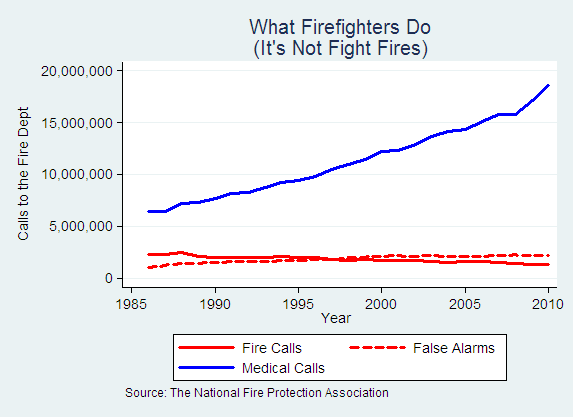


Having big budgets but less crime means these swollen budgets end up being wasted on a lot of "fun" things like military gear. (Did you know that Wisconsin has two anti-terrorism centers? One in Madison and one in Milwaukee.)
I think this has something to do with politicians being unable to touch the budgets of first responders.
Tangentially, due to stringent building codes, the number and severity of fires has been dropping dramatically over time. Yet spending on fire protection only goes one way: up. http://www.usgovernmentspending.com/spending_chart_1950_2010...
Today in the US, if you call 911 about an emergency medical condition, they will often send a fire engine along with an ambulance and a cop. It makes me wonder if firemen and firewomen are so underutilized they've ended up with mostly make-work.