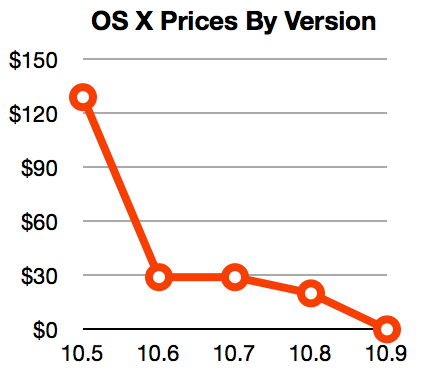
Some would say that Mavericks was launched for free because Windows 8.1 did the same. Those same people might also say that Apple did one better by offering the update for computers running older than the most recent version of their software.
This has been coming a long time. The updates were already very cheap (20something Euros) compared to the old days (> 100 Euro if I remember correctly) and it fits in with the iOS strategy of having the latest version on every device.
OS X upgrade revenue is now such a minuscule piece of the pie that it probably doesn't matter anymore.
> the old days (> 100 Euro if I remember correctly)
Yes, 129 for single-user and 169 for family (5-user).
And these are not so old days, Leopard was 129 and that was in 2007. Snow Leopard and Lion were 30, and ML was 20 (in USD, IIRC $129 translated to 129€ but ML is "only" 18€)
Apple's policy until System 7 was that you paid for the hardware and you should be able to expect software updates free for the life of the product. Nice to see them coming home, on this point anyway.
The reason they offer it for free is pretty simple to me. They have an app store which is making them more money than the Operating System itself. The more people who have access to the app store the more money they make, so why put a price barrier between the user and the store?
This is why Windows 8.1 is free and I will assume the next iterations of Windows will be. Windows now has an app store and they are banking on getting as many people into that ecosystem as possible. While they may lose money in the OS purchase, that isn't where the bulk of the money is made anymore.
I think the bigger hit to Microsoft, or just as big, is the free and much improved iWorks. Now there are 2 office suites from 2 big companies being offered for free (Docs and iWorks), which are becoming increasingly more popular not just with consumers, but a lot of enterprise customers, too.
Microsoft should be terrified. Both of their cash cows are getting rapidly commoditized.
I would think iWorks is targeting the same market ClarisWorks did from 1984 until the 90s. [1]
It's the same reason iOS is coming into corporate environments: people want to use it.
iWorks is never going to be a threat to Microsoft in corporate environments, really. But the fact that Apple's customers don't need Microsoft at all just as Microsoft is taking a big step into consumer devices is probably an issue.
Apple still makes money selling the computers that are running free OS X Mavericks. Microsoft makes no money by giving away Windows 8.1 for free to consumers.
When you need to finally replace that 2007 machine, Apple obviously wants you to buy another Mac. Screwing over people with perfectly good hardware wouldn't do a whole lot for customer goodwill.
It very much is for the average home consumer. Normal users upgrade their version of windows when they buy a new computer, because the new version is what comes installed.
It's not as much effort as it sounds. My home laptop has had Ubuntu, Mint, Mageia, Suse, Fedora, Arch, Windows 7, 8, OS X 10.7, 10.8, and just today, 10.9 on it in about a month (it's a mac).
I have an external hard drive with all my documents, projects, music, movies, etc. on it. What's absolutely essential is recopied to my hard drive each time. It's kind of addictive to dive into a new operating system and learn it every so often. That's why there's a term for it - distro hopping.
It's good for some things. It gets you very good at doing rote computer tasks because you do them over and over in slightly different environments each time - install homebrew, update ruby, install rvm, configure common programs, tweak preferences and small aspects of the OS, etc.
As a result, I can wipe my entire hard drive and bring it back up to my workflow speed in less than 3 hours on a linux distro I roll myself via Arch.
All that said, I like OS X, so I'll be sticking with Mavericks for a while now.
I'd be interested to see your thoughts on each distro, even if it's just a sentence or two. Switching quickly, while obviously making some types of perspective difficult to develop in such a short timeframe, probably makes it easier for you to notice some things most people wouldn't through more typical usage habits.
I think it just pays Apple more in customer satisfaction to have everyone on the same boat. Simple economics. They make the money on the hardware after all. Same thing for free iLife and iWork, customers pay for the complete experience in the price of the device.
It also helps developers. It would be a reasonable position to take to only support the latest MacOS release and features. (People who don't want to upgrade their MacOS version for free are also less likely to want to try your software or upgrade to new versions of it.)
They went out of their way to point out that this is a "going forward" thing, too — system software on Apple devices is free. I assume Windows 9 isn't gonna be.