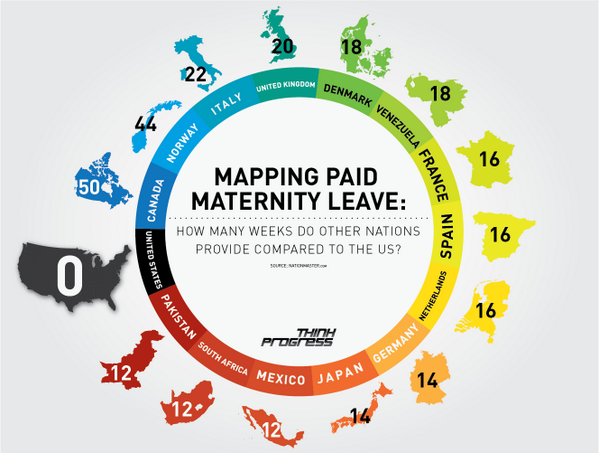
Pretty much every country in the world, both 'first-world' and poor countries, has it better than USA in this regard.
Let this serve as a warning for young (age-with-a-potential-to-have-a-family) people who might be tempted to relocate to California - you have to ask for a significant premium in salary, since even in good companies (the OP lists multiple items where her job is considered 'above average') you're simply not getting as good conditions as the absolute minimum mandated elsewhere even for the cheapest entry level jobs.
Locally, a shelf-stacker in the most cost-cutting-oriented local supermarket gets far better maternity leave conditions than those described here.
I am self employed and buy my own insurance in CA and it is about $1000/month for two adults and one child for a silver plan through covered CA. This is for medical only, so not too far off the estimate.
Important to note that these are government leave programs. A big problem in the USA is that it is expected that your employer handle this stuff.
Here in Canada, the employment insurance system - a payroll-tax-funded program that handles short-term unemployment benefits - also handles parental leave. They offer 4 months for birth mothers and a an additional 8 months for any parent. The money is tiny - something like half your salary capped to a poverty-level wage, but it's better than nothing and good employers will subsidize it somewhat.
My wife and I split the leave with our 3rd kid. 5 months for her, 7 for me. It's easily some of the happiest days of my life.
There is no reason that private companies should be expected to shoulder this burden. It's practically punishing them for hiring women who want a family. This is the exact kind of case that government exists for.
That policy punishes the company of hiring any fertile woman.
My dad used to hire for a large engineering department. One of the things he had to keep in mind is that if a woman is hired, they can leave pretty much at any time due to FMLA, and hiring someone else is not feasible (due to law). The simple result is if he were given a choice between a man and woman of equal capacity, he would pick the man every time. Women have too much legal baggage.
My answer is that you extend the same rights to the man, and that calculus would equalize itself... but that is wishful thinking here in the US.
Even when you extend the rights to the man, there's still the traditional cultural expectations will end up with the leave on the mother. I mean, I'm a liberal stereotype and we didn't split the parental leave until our third kid - we went the traditional way for the first 2. So even in the optimal "extend rights to both" we still have the problem that the female employee took leave and the male one didn't.
We can remove the financial burden from the company by shifting it to the Employee Insurance system, but I don't know how to remove the HR problem of "you have an employee who has gone for a year of unpaid leave and you must give them back their job when they finish their leave". There's no easy answer for that one.
But, shouldn't that choice be within the family, rather than government applying uneven pressure for the female to "mother"?
It may be the case with my wife and I as well. We've discussed it, and whoever makes more per 2 weeks will be the one to continue work. But we'd both want that choice to be our own.
And also to be more specific, my dad was Wilbur Crawley. Worked at Faurecia, and was over 50+ engineers in an automotive setting. After being burnt by 2 engineers he brought on, whom were women, both within 2 years were pregnant. Cool, none of his concern, until they FMLA'd and were out for about a year each.
Both projects they were put in charge of were scrapped as the projects themselves had one less person (leaving 2 engineers). They were beaten to market on one of them and the other one fizzled as the engineers were reassigned.
And this also goes back to male vs. female salary issues too. Do women get paid as well as men, given the appropriate experience level? The main source I know of has bad controls. But, the more I think regarding this, what is the cost of FMLA with regard to women?
Is Salary_man == Salary_woman + FMLA_cost ? Ugly indeed.
How were they out on the FMLA for a year? The federal FMLA caps out at 12 weeks, and I'm not aware of any state that has a FMLA that would extend to a year's leave.
> they can leave pretty much at any time due to FMLA, and hiring someone else is not feasible (due to law).
Why? Around here you see plenty of job offers that go "must start on X and will be terminated on Y (1 year later) -- to replace an employee on maternity leave". I would imagine you would publish that offer plenty of months in advance to X, so you'll have a replacement person hired on time.
> "Punishing them for hiring women who want a family" is a curious way to put it.
The reason that private companies should be expected to perhaps shoulder SOME of this "burden" (I disagree with your choice of wording there) is that we all live together in a goddamn society and there should be a part of everyone's effort (private individuals, businesses and the government) that goes towards the overall betterment of that society as a whole, and that includes supporting those that choose to procreate and keep our society going.
Right, but if private companies had to pay for parental leave directly rather than through taxes, they would have a huge incentive to avoid hiring people who wanted to start families.
Taxes are the right way to pay for this, just like most things that are for the overall betterment of society.
But the burden is unequal based on the percentage of women at one company compared to another company. When hiring a woman, the company would have to understand that it would cost more to hire her (at equal pay) than it would to hire a man.
In my opinion that's what taxes are supposed to be, not just for carrying the "burden" of children but ALL the "burdens" and "advantages" of being together in a society.
No because it concentrates the burden onto the employer and creates very real economic incentives to avoid hiring women from certain age ranges depending on the industry.
It's like telling corporations they can't buy insurance for a semi-common event since they should 'shoulder SOME of this "burden"' and just self insure. The entire point of their taxes/insurance should be distributing the cost of something like this. They shoulder the burden through their taxes, and it keeps it fair.
Congrats you just argued for a social welfare system. This is what modern societies do. Yet, for some reason in the US it's branded as socialism which is viewed as equal to communism which is evil and therefore never enters the debate.
You just listed how the Canadian policy lets the husband take time also (more time, if they want, such as in your case). That suggests that companies would be equally "punished" by hiring men who want families. Why would that policy only harm women's employment options?
Because realistically I'm unusual for using it, and I used it for only one of my three kids.
In my progressive, bleeding-heart-liberal family? The man still represented only 7 months of leave time, while the woman represented 29. The "leave cost" whatever it may be was 4X higher for my wife.
From a policy perspective, it's roughly egalitarian... but you can't ignore the cultural difference that means 100% maternal leave is the default assumption.
In the entire EU you can take unlimited sick leave(which does not take away anything from your mandatory 25 days of paid holidays), and the employer has to pay only for the first 30 days - after that, the government continues paying your salary(it might be 75% of the full salary in some countries). If you are sick for long periods of time(>2-3 months) they might require you visit an approved doctor, otherwise they stop paying. The same rules apply to maternity/paternity leave.
Quite a few years ago, I had six months off work sick, followed by a gradual build-up to full-time work again over another six months. I got full pay throughout and a wonderful occupational health department complete with doctors looking after me. That's what you get with a good employer in the UK.
Canada's 50 weeks come after a 2-week waiting period, and pay 55% of weekly salary up to $500. Not exactly the land of milk and honey.
Also a little unfair to compare the whole of the US as one nation -- family leave is handled at the state level. CA, HI, and a few others have somewhat sane family leave laws.
In Norway you get 49 weeks with 100% pay covered by the state (up to $80k), or 59 weeks with 80%. For those who earn more than $80k, most employers pay the rest.
The upward limit on the payment OTOH is quite low (<US$2k/month) but most employers choose to supplement the State payment with the balance of your paycheck.
> Let this serve as a warning for young (age-with-a-potential-to-have-a-family) people who might be tempted to relocate to California
It's interesting. This is a difficult conversation to have. I have good personal reasons for wanting to relocate to California (I'm British/not American so this is difficult), though logistically it doesn't seem like that will/can happen. What I don't understand though is why so many people want to move to the USA just because. From a purely outside perspective, it seems like it's fairly low down in terms of standard of living/worker's rights/healthcare/etc. For the lucky few (of which those reading here might be over-represented) it's great, but otherwise... I just don't understand. Even for salary I don't see it–I'm entering a short postdoctoral programme at the moment and my salary in the UK is about 1.7 times what I would expect in the states, and it's not like my salary in the UK is even that good(!) and I know full well I'd be worked to death over there too.
I just don't understand. But it's such a can of worms (personal politics, patriotism etc.) that it's difficult to talk about. I will say this though, it really is a beautiful country/continent, and all the people I've met seem pretty happy.
> I'm entering a short postdoctoral programme at the moment and my salary in the UK is about 1.7 times what I would expect in the states
It sounds like you're working in academia, a sector which is under pressure from way too many people who would like to enter it. It's pretty likely you don't want to and won't get to work in the United States in this sector: the market is very saturated.
For other positions in the United States, it's more plausible to find comparable or better salaries. In many areas you can also expect lower tax burdens and lower costs of living, especially if you're interested in owning a small home of your own or if you expect to operate a motor vehicle (your petrol prices are twice as high as ours because taxes). Rising medical costs are an ongoing concern, and recent reform attempts have done an excellent job at not fixing this, while possibly also undermining the economic recovery in general. :(
"Workers' rights" are in fact more limited, but the labor market is typically much more dynamic and as such when there is hiring going on in the economy at large, it's much easier to actually get hired to begin with and change jobs to a better employer. It's especially much easier to break into new fields as a young person -- youth unemployment has long been a chronic problem throughout much of the EU, including the UK, and it's only at the bottom of this last recession that the US has reached similar levels, despite many EU nations having more favorable demographics which should mitigate against it. (The US has more illegal immigrants than some EU member nations have citizens.) So this is sort of a risk / reward tradeoff.
Now myself, I'm pondering a job offer which would put me in London in a year, so I'll get a glimpse at things over there in practice before too long. :)
Thanks for the insight. I'm seriously considering leaving academia at the end of my current contract, but visa-wise it seems even more difficult to get a H1-B than an academic visa. But we shall see. Good luck with London if you make it! :)
H1-B visas are easy for academics to get (there isn't a cap on the number issued, unlike industry). While these H1-B visas cannot be transferred between academia and industry, they do allow you to start applying for residency.
The advantage of going to CA, and then leaving academia, would be better access to local employers, who often don't recruit abroad. You still face the visa problem, though.
In addition to the financial considerations mentioned above, most US employers don't make very large contributions to funding pensions (~5% "matching 401K" is considered generous), whereas the total contribution at UK universities is about 16% of salary.
If you do go abroad, don't forget to continue paying minimal national insurance contributions in the UK. This will help if you suddenly need expensive medical care, become unemployed, etc.
UK to US is not as straightforward as say Russia to US (my path). Yes, Russia offers a lot better protection on paper, but what most people don't think about is that in most of the world what is written is very often not what is in practice.
The US state of post-doc employment is well documented to be abysmal. I never had to go through it, but had the privilege to work with people that had and gave up, going tech route instead.
Because of taxation and general consumerism, you get great standard of living as long as nothing bad happens. On average luxury goods are cheaper in US. You even have the option of Oregon to avoid sales tax on big purchases all together (doesn't work on cars easily).
The weather/nature in Bay Area is amazing too. Los Angeles is a bit more desert-like, but still great.
>it seems like it's fairly low down in terms of standard of living/worker's rights/healthcare/etc.
While this is certainly true when you discuss the bare minimum legal requirements, many employers here go above and beyond the requirements and offer benefits that are equal to what you find in other countries.
The problem is those problem employers are in the majority. The many employers you're thinking of are typically in the STEM fields or highly unionized gov't, manufacturing, transportation industries.
> I work for an independent school and my benefits are fantastic.
Thank you. This is the perfect example of an anecdote. Walmart, the largest employer in the US at 2.2mm employees. Guess who FMLA benefits don't apply to? Small businesses (<50 employees) and part-time employees. Guess who is the biggest part-time employer?
And know I don't have numbers. Other countries have created a uniform referable benefits baseline that companies are required to provide. For me to answer your question I would need to interrogate every US company. There are research companies that do exactly that, I would need to pay for their answers.


Let this serve as a warning for young (age-with-a-potential-to-have-a-family) people who might be tempted to relocate to California - you have to ask for a significant premium in salary, since even in good companies (the OP lists multiple items where her job is considered 'above average') you're simply not getting as good conditions as the absolute minimum mandated elsewhere even for the cheapest entry level jobs.
Locally, a shelf-stacker in the most cost-cutting-oriented local supermarket gets far better maternity leave conditions than those described here.