Poitras says "the reporting we’ve done has all been filtering what’s in the public interest versus what’s operational" yet in the same interview reveals "the communication flow for the drone system all goes through Rammstein, so it’s part of the nerve center. The controls are elsewhere, but it all runs through fiber optic cables that go in and out of Rammstein" How is it in the public interest to know that all drone communication flows through a specific base especially considering how valuable that fact might be to someone who would want to ground our drone fleet?
That is my only problem with Snowden and how these things are being reported. It started out with valid whistle blowing but there are plenty of real operational national secrets that are being revealed in the process. If Snowden simply stuck to the NSA's overreach in domestic spying, it would be much harder for politicians and the like to call him a traitor and marginalize these issues.
* Ramstein is a large city unto itself with the proper security perimeters and provisions. Even if you get on the base itself, you're not going to walk into the fenced off drone ops area. Revealing it as the location/hub is not a major security issue.
* If the military cared enough, they would camouflage the tell-tale cookie cutter design of rows of trailers + satcom equipment from Google Maps, but they don't. Even the CIA doesn't seem to for its less-than-public UAV ops facilities in VA and the Middle East.
* Ramstein is already well-known as the hub of virtually everything US military going on in the other side of the world, from medical, to logistics, materiels, intelligence, etc.
Source: former military with knowledge/experiences.
Not under the US Constitution which is what governs the NSA. That has been one of the main features of government throughout history. They put their own people's rights above the rights of foreigners. EDIT: And doing the opposite will generally be viewed as treason.
I am honestly not aware of anything that was revealed that would violate any international treaty the US agreed to, but will definitely listen if you have examples. I also have a hard time believing that any other country with the capability to do the type of international spying the US does wouldn't do the exact same thing (or isn't already).
I am honestly not aware of anything that was revealed that would violate any international treaty the US agreed to, but will definitely listen if you have examples.
If something is not restricted by international treaties, it does not mean it's ethically ok to do so. I can understand that the US would push the boundaries when it comes to enemies. But it is utterly painful what it has done to so-called allies.
Europe has a lot of historical debt to Canada and the US. However, 'betrayal' is the word that comes up describing what many Europeans feel.
>If something is not restricted by international treaties, it does not mean it's ethically ok to do so
This is where I think we get into problems. You seem to be suggesting that people should be allowed to reveal classified national secrets that are legal both nationally and internationally if they find them unethical. I think this is a dangerous precedent to set. Different people will have wildly different views on what is ethical when it comes to war and espionage. That is why it is important to codify these things into laws and international treaties.
You seem to be suggesting that people should be allowed to reveal classified national secrets that are legal both nationally and internationally if they find them unethical. [...] Different people will have wildly different views on what is ethical when it comes to war and espionage.
Definitely.
That is why it is important to codify these things into laws and international treaties.
But treaties (as we have seen in this case) often lag significantly.
In the end it is the judgement and the responsibility of the leaker. In this case, I think Snowden made a good call. For many reasons: e.g. the world had the right to know that virtually all internet traffic is tapped or tappable and that cryptography was intentionally weakened. Even if the US is your friend, that makes you vulnerable to criminal organizations and states that are not allies.
>The Helsinki Accords, however, were not binding as they did not have treaty status.
That is at the end of the first paragraph, so I am not sure what you are getting at with your post. Even ignoring that, I didn't find anything that jumped out in that short Wikipedia article. Can you expand on how you believe the US violated the Helsinki Accords?
>Can you expand on how you believe the US violated the Helsinki Accords?
1. a cornerstone of Helsinki is "fundamental freedoms, including the freedom of thought, conscience, religion or belief"
2. it is well established legal principle, incl. in US legal system, that mass surveillance violates such fundamental freedoms (by means of chilling effect in particular)
>>The Helsinki Accords, however, were not binding as they did not have treaty status.
> The enumerated powers clause does not authorize the NSA,
The NSA is a foreign signals intelligence service principally, though not exclusively, supporting the military. I don't really see any argument that the existence of the NSA -- however much the case may be made of particular activities of the NSA violating various provisions of the Constitution -- is any less within the purview of Art. I Sec. 8 enumerated powers (particularly, the power to "raise and support armies") than any other non-uniformed part of the military support structure in the US government.
So you feel that your rights include knowing which military bases intelligence information flows through?
I can understand people being outraged at the idea of NSA spying and wanting specific programs to end immediately. Whether certain intelligence operations violate your Constitutional or philosophical rights to privacy is an issue that's important to democracy and should be debated vociferously. But there is no legal or moral right that entitles you to know what air force base controls our drone fleet, what the nuclear launch codes are or where our achilles heels are located.
Dumping troves of sensitive data is a bad idea, even if you want the NSA to be completely abolished. Snowden could have just as easily made a speech, instead of handing millions of unread classified documents over to private individuals.
The bigger issue here for me is Snowden and his small team of people are doing the same thing the government does.
They regulate the flow of what documents they want the public to see, while still holding a large trove of other documents, deciding unilaterally when they will get released. For someone who had a lot issues with the government, Snowden seems to be emulating quite well with this draconian process of releasing the remaining documents at such a slow pace.
Snowden has said many times that he is not the one deciding which documents to publish and when. He gave them all to the reporters, who make all of those decisions on their own. Replace "Snowden and his small team" with "The reporters who have the documents."
... which is a cop-out. He decided which documents to give to the reporters. If they decided to release something that isn't in the public interest or is harmful to national security, nobody can say "well, Snowden wasn't the one who released it." He shouldn't have given them those documents to begin with.
> He shouldn't have given them those documents to begin with.
Why do you propose Snowdon should have chosen the suicide mission? It it essential to disconnect the leaker from the documents to bring life threatening action down to a minimum.
I'm not saying he should have released the documents himself, I'm saying he shouldn't have given anything to the reporters which weren't in the public interest.
Whistleblowing is when you see something illegal and you reveal those specific instances of illegal activity. You can debate whether or not what has been revealed has been beneficial or not, but that doesn't change the definition of whistleblowing - it's not taking a job specifically to gain access to classified information you've never seen before with intention to leak it[1], downloading hundreds of thousands of documents, then handing them over to a few reporters and saying "I'm not sure what's appropriate to reveal to the public, so I'll let you decide." If those reporters reveal something that isn't in the public interest or is damaging to national security, it's a cop-out to say that he wasn't the one who revealed it - he gave it to the reporters and he's responsible for anything they choose to report.
I see people saying all of the time that there's a huge difference between what Manning and Snowden did. The way I see it, the difference is that Manning gave thousands of documents to Julian Assange hoping that he'd act responsibly with them, whereas Snowden gave hundreds of thousands of documents to Greenwald, Poitras and Gellman hoping that they'd act responsibly with them.
> I'm not saying he should have released the documents himself, I'm saying he shouldn't have given anything to the reporters which weren't in the public interest.
That's very much a contradiction in this case. Snowdon found a whole corpus of evidence of illegal action. Since you agree he was capable to evaluate what's illegal or not, the next logic step is to reach out for experts in public interests. Who do you think is more qualified than journalists for this job?
That's the thing - you can call it controversial, but he hasn't shown anything illegal. He'd have a lot more support if he stopped with the cell phone metadata revelation. Section 215 was controversial to begin with (remember the Section 215 library records fiasco from a few years ago? [1]). It's been debated in Congress at length since the revelation.
Everything after that has been showing actual foreign intelligence collection or technical information on the NSA's capabilities, often times shown to the public with a warning that they could be used against ordinary citizens, but no evidence to show that they have. In fact, multiple independent reviews of the NSA's program all mentioned in their reports that they found no evidence of abuse[2][3][4].
If he's going to go up and make the claim that the NSA is spying on all of us, I what to see actual evidence of spying on regular people, not descriptions of how they spy with a warning that it could be used against us. That's like saying "the police have guns - they could use them to kill your children!" Instead of showing small number of revelations limited to actual abuse, he's instead given us this: [5][6].
He doesn't get to say that he has no responsibility for it or try to shift the blame over to the reporters. He dumped a huge trove of documents on them unrelated to abuse.
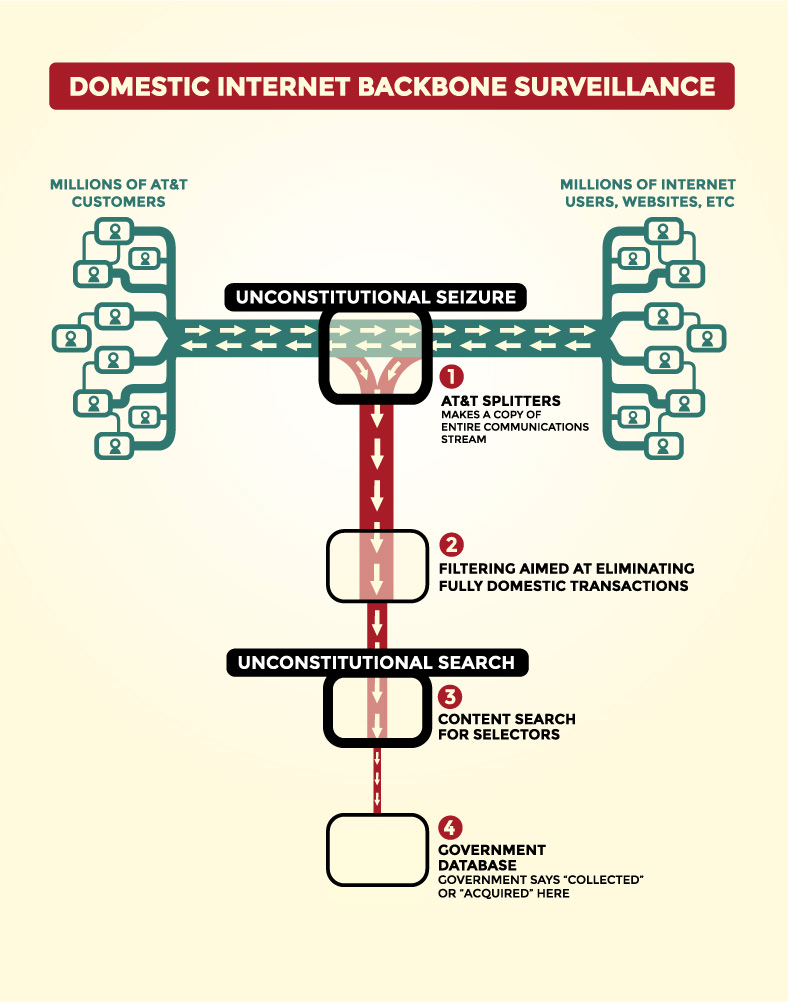
Well, except for all the stuff detailing mass search and seizure[1] of domestic communication. While some people proclaim that the writs of assistance[2] issued by the FISA court make these searches legal, the constitution is still the highest law of the land.
> independent reviews
> [2]...whitehouse.gov
> [3],[4]...pclob.gov
You consider two parts of the executive-branch[3] to be "independent"? Even when one is a "five-member Board is appointed by the President"[4] and the other is "The President’s Review Group"[5]? That's about as far from "independent" as you can get.
With regards to your first link, I think the EFF has a losing argument with their recent addition to the Jewel v. NSA case. Their argument, by analogy:
$ seq 1 3 | grep -v 1 | grep 2 > collected.txt
The government argues that only "2" is collected, and furthermore there's an extra step to ensure that "1" is never collected. Even though they are never seen by a human/entered into a database/saved to disk/transmitted elsewhere, the EFF argues that 1 and 3 are also collected because they exist in memory for a millisecond before grep discards them. Without coming out and saying it explicitly, they're essentially arguing that it's illegal for the NSA to collect targeted information from any network connection unless they can show that the connection is only used by the target. I don't think the court will ultimately agree with them. If you're interested, you can read the EFF's argument[1] and the corresponding opposition argument[2].
With regards to the independence of the President's Review Group and the PCLOB: all of the members of the PCLOB are confirmed by Congress, so the President can't just staff them with people favorable to his policies; and if you read the PRG report you'll see that it called for quite a few things that directly contradicted the President's statements beforehand (e.g.: moving the phone records to a 3rd party, splitting up NSA and US Cyber Command, limiting NSLs, etc.)
I am very familiar with the EFF's case and the various arguments against it, the methods used to eavesdrop on the network, and the excuses used to pretend the actions.
> NSA to collect targeted information
> show that the connection is only used by the target
This is off topic. Targeted searches are not relevant, and assuming they have a proper warrant, is perfectly legal. I'm sure some unavoidable collection happens while executing targeted searches, and the filtering necessary is is just the mechanics of wiretapping. Obviously, this is not the illegal part.
Bulk, non-targeted collection is very different. The NSA admits they do not meet the 4th Amendment's warrant requirement, while claiming to have a general warrant from the FISA court, often while waving around Sections 215 and 702 of the Patriot Act, or Executive Order 12333. IN the end, the NSA is still claiming to have a general warrant ("writ of assistance"). As we have not had a constitutional amendment that repeals the 4th Amendment, the specific warrant requirement is still the highest law of the land.
Running your "grep" filter to find the communications of a specific target will probably run across other people's communications. The important part is that - as a targeted action - it only applies to specific locations (or routers/etc) at some some specific time. If you getting a traditional search warrant to search someone's house does not allow you to come back at some future data for another search, nor does it extend to other locations.
On the other hand, if you had a warrant to search Alice's apartment, it is likely that some of her roommate Carol's stuff will be search as well. This is unfortunate, but probably unavoidable and generally legal. The fact that there is a valid reason for the search of Carol's stuff doesn't suddenly extend to allowing a search of anybody else.
It's entirely on topic - the diagram and summary you linked to, along with the EFF's motion all describe 702 Upstream collection[1]. As described in the PCLOB report and reiterated in the government opinion that I linked to, 702 is for targeted collection of non-US persons. From the PCLOB report:
As noted above, however, all upstream collection — of which “about” collection is a subset — is “selector-based, i.e., based on . . . things like phone numbers or emails.” Just as in PRISM collection, a selector used as a basis for upstream collection “is not a ‘keyword’ or particular term (e.g., ‘nuclear’ or ‘bomb’) but must be a specific communications identifier (e.g., email address).” In other words, the government’s collection devices are not searching for references to particular topics or ideas, but only for references to specific communications selectors used by people who have been targeted under Section 702.
The EFF says in their motion that they have no problem with the final results of the filtering - they instead consider the act of putting a packet filter on the line to begin with to be illegal[2]. They argue that the packet filter itself constitutes bulk collection, even if it is only pulling out communications that match specific, targeted identifiers.
If the court were to side with the EFF's definition of collection, the NSA would be legally prohibited from collecting on any network connection unless it could show that the only communications that would pass over it were ones that match those specific identifiers because (getting back to my analogy) you can't implement a variant of grep that only reads in the lines that match.
The EFF poster was just an example, I'm not sure why you're focusing on it, and totally ignoring the main issue I discussed about the use of general warrants.
You asserted that "[Snowden] hasn't shown anything illegal". I have attempted to point out that he has shown illegal activity: their improper search-and-seizure and the writs of assistance they are using to pretend those searches are legal.
What you (and many other people) seem to be missing is that yes, the constitution says that the NSA is "legally prohibited from collecting on any [domestic] network connection [unless they get warrant]". It doesn't matter if this is inconvenient, it's still law. If modern technology has made the law unworkable or obsolete, the law can be amended. Until then, yes, they don't get to run grep against without a specific warrant.
I was focusing on it because that was the example you provided. I asked for examples of illegality and you gave me Jewel v. NSA, where the EFF is claiming unconstitutional bulk search and seizure based on a technicality in their definition of collection (ironic given the number of people who mock the NSA for the same, citing the EFF as their source). There is no general warrant issue with the 702 program as it targets specific non-US persons. If you want to argue about general warrants and bulk collection, you'd be better off discussing the Section 215 cell phone metadata program, which is entirely different legal mess.
You claim that the NSA is legally prohibited from collecting on any domestic network connection, but the 4th Amendment protects people, not network connections. There was never any 4th Amendment issue with spying on foreigners before because, being outside US jurisdiction, they don't have 4th Amendment rights - thus no warrant requirement. A warrant is absolutely required to gather the communications of an American citizen.
You say that the law can be amended, and I would counter that by saying that it already was amended - FISA Section 702 is specifically written to target non-US persons using US telecommunications infrastructure to communicate.
> He dumped a huge trove of documents on them unrelated to abuse.
Yes, you already said that. But logic tells me before any conclusion the documents must be analyzed in the first place. To put it simple: Dumping then judging.
There are only two ways around this timeline, a time machine or you already knew the documents before they were published. Since the former can be safely assumed unrealistic, do you see who do you support with your reasoning?


That is my only problem with Snowden and how these things are being reported. It started out with valid whistle blowing but there are plenty of real operational national secrets that are being revealed in the process. If Snowden simply stuck to the NSA's overreach in domestic spying, it would be much harder for politicians and the like to call him a traitor and marginalize these issues.