While it is easy to criticize any animal model study, especially when targeting cancer, we should be HIGHLY skeptical of any mouse study that uses vitamin C. Why?
Mice synthesize their own vitamin C; humans do not (hence, it should properly be called ascorbic acid in mice, not vitamin c). The biological pathways involving this compound are very different between species, and deserve special consideration.
The dose makes the poison (or the cure). According to the article they gave daily injections containing 300 oranges worth of vitamin C (which google tells me is over 15 grams of vitamin C, an order of magnitude larger than the daily recommended dose for adult humans).
Certainly being skeptical is still warranted, as OP is correct, there are significant differences in how this particular compound is handled species to species. However, simply that mice produce ascorbic acid does not imply that they produce it in quantity great enough to impact this kind of tumor.
No of course not. It does mean that this particular pathway is very different in the mouse model, and studies of vitamin C and mice should be taken with an extra grain of salt.
In this regard, I think we agree very much! I simply wanted to point out that the specific example that they endogenously synthesize ascorbic acid wasn't a great reason for why this particular trial wouldn't be valid.
Be skeptical of any scientific claim made, especially around possible links between animal models and human clinical environment, and even more especially when the systems involved are not highly conserved cross species.
Mega-dosing vitamin C is fairly common among alternative medicine practitioners. The medical community recommends an upper limit of 2g per day for adults due to mild laxative effects around that dosage. There's a paucity of trials that experiment with dosages above that level, so long term effects are mostly unknown.
I experimented 5+ years with it and took on several occasions 100+g per day with regular input between 10-15g per day.
The only problem I had after 5 years is slight pain in esophagus immediately after taking C, but it passed after I switched to taking C on full stomach.
Note: you MUST use pure AA powder, nothing else. Timing of C is essential - you must do it right, or the effects are minimal (you basically have to simulate the liver ancestral production now disabled in humans).
Vitamin C is a miracle thing IMO, especially 4 kids. My daughter was taking 1g since age 1 (now has 5) and she has remarkable health (she is sick once or twice per year for 2-4 days without any complications with being in kindergarten with 30+ kids since age 1, although the non-vitamin-c factors are contributing to this picture quite a bit).
Vitamin C is the most effective virus killer in large doses if you time it right. It is poor antibiotic but you have many options in plant world for that.
These are fairly typical anecdotal comments made by people pushing Vitamin C cures / treatment, often in conjunction with mention of 'miracles'. Oblig xkcd:
https://xkcd.com/1217/
What can I say, it works for me and few more people I know.
But the argument you are giving is quite pointless - vitamin C has no side effects and it is dead cheap so there is no harm in trying it out for several months and deciding on your own if its good or not for you.
I didnt want to elaborate here, i did so on several other places. It basically stops common cold and probably other common viral diseases in a day if used right.
I'm not aware of evidence that this is true for megadoses (e.g. 10g per day, as you mentioned).
Given that you are making a claim not supported by mainstream medical consensus (that megadoses of vitamin C have positive health effects), you are essentially arguing that megadoses of Vitamin C have a different effect than regular doses. Given that you admit that megadoses have a different effect to regular doses, what is your evidence that megadoses have no side effects?
Toxicity of vit-c is very low. Death by vit-c overdose is un-heard of. Intaking enough vit-c to cause death, could be due to sheer weight of substance intaken rather than bio-chemical function of vit-c.
https://en.wikipedia.org/wiki/Vitamin_C#Overdose
Also studies conducted on animals (especially primates) that cannot synthesize vit-c on their own, show that they intake about upto 80x the RDA value of vitamin-c. So, humans intake as low as 1.25% of vit-c levels that monkeys eat.
https://en.wikipedia.org/wiki/Vitamin_C#Daily_requirements
Most often than not, RDA values are a joke and should be treated as bare minimum levels to prevent diseases such as scurvy and not as the optimum level. Sub-clinical deficiency in essential vitamins and minerals always happen.
> Do you have any comprehensive resource on timing Vit-C supplements?
There isn't any that I am aware of except bowel tolerance method. IMO, timing during healthy state is relaxed - twice per day is probably enough for most people; during stress however individual dose shouldn't be higher but should be taken more frequently (until bowel starts to complain, which means C is not absorbed any more and passes to colon where it causes diarrhea trough osmosis). What is remarkable here is the difference between bowel tolerance in healthy (low) and disease (high) state which suggests that vitamin C absorption increases.
> Also what form of supplement & which brand did you intake? Liposomal vit-c?
I take pure synthetic AA with sodium bicarbonate half of the time (3-5g x2). I don't have experience with liposomal vit-c but I am sure it is way better then regular C, altho far more expensive.
> Do you also have any comprehensive resources that explains if vit-c supplements can affect recovery from lifting weights or general exercise?
I don't have one at hand now. Some people think it prevents adaptation during exercise and don't take it. I personaly think it reduces stress so it simply gives you an option to work more. Since exercise can actually reduce your immune system if you overdo it or have concurrent stressor, AA intake will certainly be more beneficial on the long run then any supposed adaptation shortcomings.
You have not established causation. That is, you and others you know do it; you have a health outcome you are comfortable with; yet you have not established causation between the two.
Ironically, you're talking about the very thing this article leads with: that Linus Pauling touted vitamin C as a miracle cure with over-dosing, despite no evidence, and none has been found.
(I also think that article lead is irresponsible, because if it turns out this study holds up, and vitamin C is a viable treatment for this kind of cancer, we have soundly shown it does not work in the many areas we have tested it.)
What do you deem "insignificant"? The required daily dose is about 90 mg. There are experiments which include several grams [1, 2, 3], which is a large enough dose that those writing the papers call it a "megadose". If you consider a megadose to be 1,000g and 10,000g, then I think that's just moving the goal posts. Is there a dosage level at which you would say, "Yes, with no clear signal at that level, it's probable it makes no difference"?
[3] http://www.ncbi.nlm.nih.gov/pubmed/8191227, shows some positive evidence, which may be noise, and concludes "needs more research" - despite there already being a lot, with no clear positive signal.
Why is this brought out in such a dismissing and ironic way? He claimed that there may be some treatments with Vitamin C, not that if you take a little a day you'll be immortal. Hell, there are so many different types of cancer, that even if megadosing C helped with one it probably wouldn't help with all.
He lived to his 90s. At that point it was either cancer or heart disease that kills people. That fact that he lived to 93 is pretty impressive in itself.
As someone who recently went on Vitamin D supplements due to low D in my bloodstream, I find it incredibly interesting how medicine is always changing. This knee-jerk skeptic idea about how everything but the current accepted status quo is "quackery" and mocking guys like Pauling is reprehensible. Just a few years ago, no one was checking Vitamin D levels. Now my depression and lethargy have been turned way down as my Vitamin D increases.
Hell, I remember being a teen with ulcers and being told to lay off the spicy foods. I tried to explain to the doctor that I never eat that and he shrugged and wrote me a script for Zantac, it being prescription-only at the time. A few years later H. pylori's role in ulcer creation was revealed and now the standard treatment isn't large doses of zantac, but two weeks of amoxicillin. My ulcers magically went away after that treatment.
Medicine is one of things that moves fast and the jury is still out on a lot of marginalized treatments, concepts, and research. I wouldn't be surprised if Pauling's research eventually fleshed out into some kind of cancer treatment, or at least as a supplemental treatment.
I never understood the mocking, either, especially since he’s been proven extremely right about the ill-effects of consuming processed sugars. I suspect it’s rooted in his anti-nuclear and anti-war views and it just grew from there. His views on Vitamin C were just a convenient target.
It’s uncomfortable to those with analytical minds to accept the fact that we know so little about the human body and how it works. Studies are always contradicting each other because the scientific method dictates that studies must be reduced to the minimum of variables. But the body is far too complex for that. Most of what I was taught nutritionally in school as a kid was wrong. Most of the health advice was wrong. We were told butter is evil and we should eat margerine. We were told fat was evil and that cholesterol causes heart disease despite no evidence other than correlation. We don’t know how or even if consumed cholesterol gets turned into cholesterol in the bloodstream. It’s virtually universally believed that salt is bad despite it being an essential nutrient. It’s universally believed that sun is bad and we must slather ourselves with sunscreen and now we all have Vitamin D deficiencies. Read the literature that comes with any prescription drug and there will be a paragraph explaining that they have no idea how the drug works. Many are no more effective than a placebo. There’s a perception that has persisted most of my life that we are always at a point where we have these things figured out, but ten years later they are proven wrong, but we don’t seem to notice that.
There is an almost religious fervor surrounding science when it comes to our health and nutrition. Lots of research in the past few years surrounds gut bacteria, something that wasn’t even on the charts even 10 years ago. Now we are realizing that we not only know nothing, we know less than nothing.
I don’t think Pauling will be vindicated on Vitamin C because this came from a time when it was universally thought that there was a pill or an injecton for anything and we just had to discover it. If you read Pauling’s books, you’ll realize that he never advocated it as a panacea, but part of a complete dietary and mental regimen. His research is compelling and it’s not hard to see how he came to the conclusions that he did.
It’s good to hear I’m not the only one learning from history and realizing the uncomfortable fact that we know so little and this treatment of ulcers is the exception rather than the rule. How did we not discover this was bacterial for so long? It’s not like this is the 19th century after all.
Nutrition has changed far less over the last 50 years than you might think. The real issue is condensing it into sound bytes.
In a sound bite X More! vs. X Less! has a lot to do with peoples eating habits and overall health not just how good or bad X is.
Especially when it often breaks down as Benefits A, B, C vs. problems X, Y, Z. Yes, sometimes we add a benefit or risk to the list and or change the risk weights slightly, but rarely do things change all that much from one decade to the next.
I'm not very knowledgeable in this topic, but I think it's changed a lot. The way food is processed changes the way we're absorbing it.
Today's bread, milk, cheese, veggies, fruits are a bit different than 50 years ago - they last longer, taste different, probably because of how they're processed.
That lack of bacteria that makes things go bad faster should have a different effect on our bodies, no?
I've just been cured from another sickness caused by the same bacteria. Only one or two years of suffering, not so much, but enough to make my life miserable in so many ways.
The explanation I've read at Wikipedia is that it's an extremophile (digestive acids), so it could never be cultured until very recently.
I completely agree with you about lack of perspective in medical knowledge. Pros get all defensive instead of doing a bit of self-criticism. Fortunately the scientific method seems to be stronger that individuals' biases.
Right, but almost all cancers depend on this pathway. GLUT receptor mega overexpression is a milestone in cancer evolution and vitamin C in its oxidized form competes with glucose which is in cancer cells almost exclusive energy source.
When you hear something about a field you know very little about, your default reaction should be skepticism. People say bullshit stuff all the time and pass it off as fact.
I don't know much about cancer biology, but what you heard sounds wrong. I don't see why, as you live longer, your body gets better at fighting cancer. If anything, the opposite sounds more likely.
One possibility is that someone is citing data with survivorship bias. That is, the people who make it past 65 have good genes that generally lower their chances of getting cancer. Even if this were the case, obviously it doesn't imply a causal relationship where passing 65 years reduces your chance of getting cancer.
Flip 5 coins and stop when each turns up tails, record the number of trials until the last coin is tails (just use # trials for the last coin...). Repeat this 100 times. Does the probability of ending on a given trial keep increasing with trial#? No, it will peak depending on the number of coins and probability of tails for each coin (here always close to 0.5).
This is the same as accumulating n number of modifications in a cell until it grows into and gets detected as a tumor. Instead of accumulating "tails" you are accumulating mutations or whatever it turns out to be.
That's the nasty thing about cancerous cells, they can adapt to "feed" (via blood) on a wide range of macro- (glucose, protein, fatty acids, even ketones for some rare types) and micro-nutrients (vitamins, "antioxidants") just like "healthy" cells.
What baffles me is that even autophagy either doesn't seem to always work (easy to induce by water-fasting for a couple of weeks) --else every sufferer would do so until in remission-- or that we still don't seem to have pharmaceutical ways of jumpstarting/forcing "99% effective" autophagy..
It would actually contradict it if this article mentioned melanoma like the post you found. I highly suspect we'll find individual ways of treating most individual cancer types before finding one that targets them all.
Vitamin C has been proven to not have an effect on viral colds either way.[1] Vitamin D on the other hand has been proven to be an immune system modulator.[2] Unlike Vitamin C, most people develop Vitamin D deficiency.[3] I strongly advice you and everybody based on these studies to get yearly blood work and talk to a doctor about taking 4000IU daily supplement of Vitamin D. Also massive doses of Vitamin D can have negative effects.
As for Vitimin C, just because someone is a Noble Prize winner or brain surgeon doesn't mean they are an authority on all things. Ben Carson makes my point.
While human and animal studies have shown that vitamin C does significantly improve immune function,[1] over 40 years of research suggests that routine vitamin C supplementation does not prevent the common cold but modestly reduces its duration and severity in the general population, and halves the risk of catching a cold in people exposed to extreme physical stress, while the few therapeutic trials of vitamin C treatment of the common cold have been inconsistent.[2][3]
Vitamin C doesn't cure common cold, but it sure as hell a) shortens it b) prevents complications (which may rise to be chronic).
What vitamin C does is prevent common cold, if taken the right way.
Pauling cure for common cold was never really tested. All papers on common cold used very small doses, almost all bellow 1g. Paulling advocated 1-2g every hour. I tried it and it works for me, but timing is crucial - it must be taken on first signs of disease, it wont do much if you delay that.
Did you try taking zinc right after an onset of symptoms? I experimented with that one and had like 50% probability of getting over some common viroses within one day.
Everything I have read either concludes "no measurable benefit" or "statistically significant, but not clinically significant benefit; need more research". That latter is hard to distinguish from noise. What have you found that concludes otherwise?
Irrespective of the common cold, vitamin C is uniquely beneficial in many different scenarios. Negative paper on vitamin C is almost non existent.
Speaking about the vitamin C and common cold, since you don't have any good papers in mainstream medicine that tested Pauling protocol you must turn to those groups that did so and use it in every day practice - orthomolecular practitioners. I am sure you will recognize this is considered frindge science by mainstream medicine but that is irrelevant since they didn't do the job. The situation is similar to that of vitamin C and cancer. Original claims by Pauling were not tested and instead we got Moertel studies on Mayo clinic that concluded that Pauling protocol does not good, except that they didn't test it at all. Check out the history here, highly informative paper:
Most of the experiments were done by Dr. Cathcart who treated over 20000 patients using vitamin C and extensively documented it. Book "Ascorbate, the science of vitamin C" by Hickey is also very informative.
But don't limit yourself to common cold, just look everything that vitamin C does in the body, and I am sure you will change your opinion.
The fact is, AA is the main anti-stress molecule for the animal body (thats why they didn't delegate production to plants and still produce high quantity of AA from glucose on daily basis), just as GSH is primary endogenous antioxidant and detoxication agent.
Humans did have some adaptation to GULO loss for sure, but modern lifestyle sure as hell topped that in other direction.
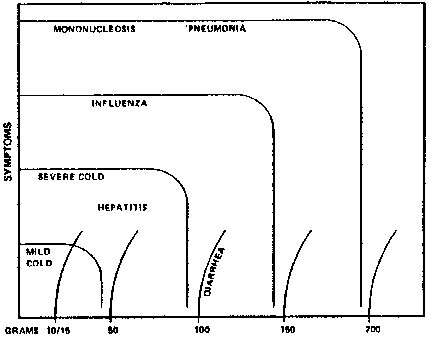
The major problem is dosing as half life of vitamin C is very low and you have to make the dose right in order to neutralize it or effects are not impressive. See this graph by Cathart:
which says that symptoms start to disappear only when you are very close to bowel tolerance. Notice the dose also - 1g per day is non existent compared to ~100g per day that Cathart used. I tried that many times, and it works for me. It is especially true for alcohol intoxication where the same protocol will bring you back from nonoperational to fully normal person in few hours.
If you consider the evolution of homo sapiens and it's predecessor, homo erectus, you have about 1.98 Million years where their diet would have been rich in Vitamin C; berries, fruit, vegetables etc.; their primary food sources, supplemented occasionally by meat when available.
Farming only began to develop around 20,000 years ago, causing grains take a bigger role in home sapiens diet and reducing the relative Vitamin C consumption. Meanwhile we didn't physically evolve during that time.
So one might expect that our bodies are evolved to thrive when Vitamin C intake is high...
Nope. Doing that is, from what I've read at least, 100% useless. But it's a pervasive enough belief that snake-oil salesmen have made a killing off it.
Lots of mice studies don't translate well into humans. This one is highly specific -- a specific mutation. It's unlikely to have much bearing on real world cancer.
Why is this comment down-voted? It's true. Mouse-models, especially for colon and breast cancers, have proven to be less-than-dependable (Cf. Voskoglou-Nomikos)
Very true. To be charitable, the future is in personalized medicine, so if a vitamin C population subset can be well-defined then maybe there's something here. That said, cancer cells are notorious for expressing efflux pumps and in so doing frustrating treatment, and there's every reason to think that would happen here given the high doses and long time needed for therapeutic effect.
I have to say, the very first thing that came to mind when I read the article was Xkcd: http://www.xkcd.com/1217/
"To test the effect of vitamin C, two million HCT116 or VACO432 cells were injected subcutaneously into the flank of 6 to 8-week-old female athymic nude mice (Harlan, Indianapolis, IN). After 7-10 days, mice with tumors of 40-60 mm3 were randomly divided into two groups. One group was treated with freshly prepared vitamin C (sodium ascorbate in 400 ul PBS, 4 g per kilogram of body weight) by intraperitoneal (IP) injection twice a day (HCT116: n=6, VACO432: n=6). Control group mice were treated with PBS instead of vitamin C with the same dosing schedule (HCT116: n=4, VACO432: n=7)."
[...]
[Caption Fig 2:]
"Tumor sizes were measured 2-3 times per week in an unblinded manner."
Not only are they mice, but they have no immune system[1]. Also, the dose of vitamin C is like consuming an entire bottle twice a day (~240 g)[2]. They are honest about the lack of blinding, which is good, but obviously that should make us wary of these findings. Also, they do not report tumor size before splitting into treatment vs control groups (only saying mice with 40-60 mm^3 tumors were used). Put the larger ones in the control group and you can easily appear to be slowing tumor growth for totally artefactual reasons.
For example, start with low initial (40) and high initial (60) cells in two different mice. If the cells all divide every day how many do you expect after 1:3 days. Low: 40,80,160; High: 60,120,240; Difference: 20,40,80. The difference seems to grow just due to the starting conditions, growth rates were the same. So these results are uninterpretable without knowing the starting tumor sizes.
>"Vitamin C treatment significantly reduced tumor growth compared to vehicle control treatment (Fig. 2B)."
This is a perfect example of what is wrong with biomed research. Just because the null hypothesis of no difference is rejected does not mean it is for your favorite reason. There are other reasons for this difference. For example, as mentioned above, perhaps the initial tumor size was different (which we cannot see since the size of the points in figure 2 correspond to ~50 mm^3 on the y axis).
Well, it won't get funded by a company unless there's a profit incentive, however there's other funding avenues for clinical trials like this. Besides applying for grants (which is extremely slow and extremely time consuming), research institutions often have small amounts of funds for running a trial in house, especially for something like this which only involves a few gene tests and an inexpensive treatment.
This. Article ends with:
> But Cantley says it may be possible to make an oral formulation that reaches high doses in the blood—which may be one way to get companies interested in sponsoring trials.


Mice synthesize their own vitamin C; humans do not (hence, it should properly be called ascorbic acid in mice, not vitamin c). The biological pathways involving this compound are very different between species, and deserve special consideration.