Vitamin C has been proven to not have an effect on viral colds either way.[1] Vitamin D on the other hand has been proven to be an immune system modulator.[2] Unlike Vitamin C, most people develop Vitamin D deficiency.[3] I strongly advice you and everybody based on these studies to get yearly blood work and talk to a doctor about taking 4000IU daily supplement of Vitamin D. Also massive doses of Vitamin D can have negative effects.
As for Vitimin C, just because someone is a Noble Prize winner or brain surgeon doesn't mean they are an authority on all things. Ben Carson makes my point.
While human and animal studies have shown that vitamin C does significantly improve immune function,[1] over 40 years of research suggests that routine vitamin C supplementation does not prevent the common cold but modestly reduces its duration and severity in the general population, and halves the risk of catching a cold in people exposed to extreme physical stress, while the few therapeutic trials of vitamin C treatment of the common cold have been inconsistent.[2][3]
Vitamin C doesn't cure common cold, but it sure as hell a) shortens it b) prevents complications (which may rise to be chronic).
What vitamin C does is prevent common cold, if taken the right way.
Pauling cure for common cold was never really tested. All papers on common cold used very small doses, almost all bellow 1g. Paulling advocated 1-2g every hour. I tried it and it works for me, but timing is crucial - it must be taken on first signs of disease, it wont do much if you delay that.
Did you try taking zinc right after an onset of symptoms? I experimented with that one and had like 50% probability of getting over some common viroses within one day.
Everything I have read either concludes "no measurable benefit" or "statistically significant, but not clinically significant benefit; need more research". That latter is hard to distinguish from noise. What have you found that concludes otherwise?
Irrespective of the common cold, vitamin C is uniquely beneficial in many different scenarios. Negative paper on vitamin C is almost non existent.
Speaking about the vitamin C and common cold, since you don't have any good papers in mainstream medicine that tested Pauling protocol you must turn to those groups that did so and use it in every day practice - orthomolecular practitioners. I am sure you will recognize this is considered frindge science by mainstream medicine but that is irrelevant since they didn't do the job. The situation is similar to that of vitamin C and cancer. Original claims by Pauling were not tested and instead we got Moertel studies on Mayo clinic that concluded that Pauling protocol does not good, except that they didn't test it at all. Check out the history here, highly informative paper:
Most of the experiments were done by Dr. Cathcart who treated over 20000 patients using vitamin C and extensively documented it. Book "Ascorbate, the science of vitamin C" by Hickey is also very informative.
But don't limit yourself to common cold, just look everything that vitamin C does in the body, and I am sure you will change your opinion.
The fact is, AA is the main anti-stress molecule for the animal body (thats why they didn't delegate production to plants and still produce high quantity of AA from glucose on daily basis), just as GSH is primary endogenous antioxidant and detoxication agent.
Humans did have some adaptation to GULO loss for sure, but modern lifestyle sure as hell topped that in other direction.
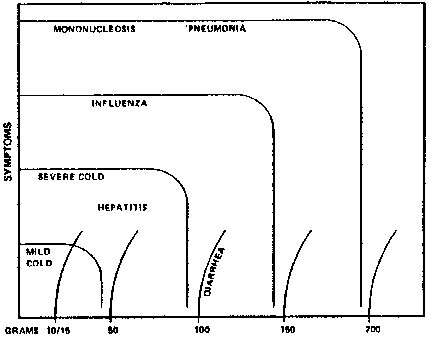
The major problem is dosing as half life of vitamin C is very low and you have to make the dose right in order to neutralize it or effects are not impressive. See this graph by Cathart:
which says that symptoms start to disappear only when you are very close to bowel tolerance. Notice the dose also - 1g per day is non existent compared to ~100g per day that Cathart used. I tried that many times, and it works for me. It is especially true for alcohol intoxication where the same protocol will bring you back from nonoperational to fully normal person in few hours.


As for Vitimin C, just because someone is a Noble Prize winner or brain surgeon doesn't mean they are an authority on all things. Ben Carson makes my point.
[1] http://www.ncbi.nlm.nih.gov/pubmed/23440782
[2]https://www.ncbi.nlm.nih.gov/pmc/articles/PMC2870528/
[3]http://www.scientificamerican.com/article/vitamin-d-deficien...