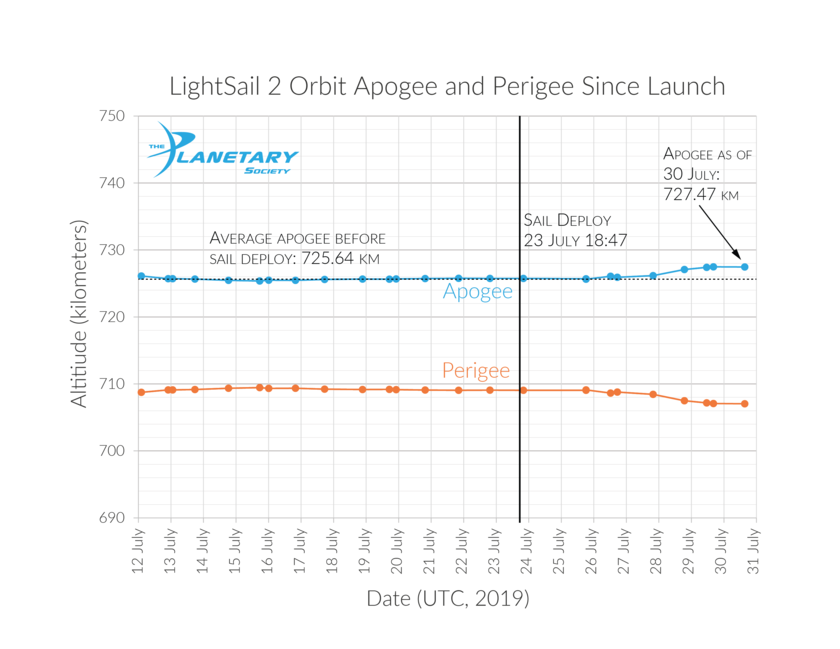
Can someone more familiar with orbital mechanics help me understand why it looks like the perigree is coming down in opposite to the apogee?
I'm but a mere KSP player, but I've always thought the perigee comes down in a fairly linear fashion based on drag, which is mostly a function of altitude - I would assume they'd be using the sail to just "burn prograde" whenever the solar angle is possible, raising both the apogee and the perigee, but the apogee coming up way faster?
I'd guess the sail orientation is not changing relative to the sun, so at perigee this provides an acceleration (because it's mostly in the velocity direction), which raises apogee. At apogee it provides deceleration (because it's in the anti-velocity direction), which lowers perigee. There are also probably other effects depending on the sail orientation that muck with the inclination and other elements. It's a little different than drag which is always anti-velocity.
I have limited KSP experience and an aerospace degree, so I'd defer to someone with more KSP experience.
According to the article though they're already adjusting orientation to adjust thrust, but possibly they saturate too fast and they can't control it enough to truly null the deceleration?
> One such refinement involves LightSail 2's single momentum wheel, which rotates the spacecraft broadside and then edge-on to the Sun each orbit to turn the thrust from solar sailing on and off.
Since the relative position to the sun changes pretty slowly, I imagine they would need to wait half a year to raise the current periapsis. I doubt this is a sail that allows to beat to "wind"-ward.
My "mere KSP player" guess (without having access to my desktop on which I'd check that, in KSP) is that the angle at which they're reflecting the Sun amounts to burning prograde and radial-in (i.e. forward and down), which when done near perigee should both rise the apogee (the prograde component) and lower the perigee (the radial-in component).
(another ksp'er here...)
I think the problem is atmospheric drag, which increases when the sail is open. If you're looking to increase apogee, the most efficient place to do so is at the perigee, which also happens to be where the atmospheric drag is the worst.
So setting the mission, you get to choose the orientation of the sun relative to your orbital ellipse. If the sun direction to the sun is perpendicular to the long axis, then you (presumably) want your sail wide at the perigee, where drag will also be greatest, but will also provide the most efficient raising of the apogee.
OTOH, if the sun's direction is parallel to the long axis, you can try to avoid drag at the perigee, and then rotate into position to get more thrust during the journey from perigee to apogee. But this is a less efficient way to raise the orbit, and will deform (circularize?) the orbit. I might have to fire up KSP with 'cubesat' with an ion thruster to simulate this...
"In the past 4 days, the spacecraft has raised its orbital high point, or apogee, by about 2 kilometers. The perigee, or low point of its orbit, has dropped by a similar amount, which is consistent with pre-flight expectations for the effects of atmospheric drag on the spacecraft."
They also say this on the mission page:
"LightSail 2's attitude control system does not have the precision to maintain a circular orbit and continuously fly the spacecraft higher. Therefore, as one side of LightSail 2’s orbit rises, the other side will dip lower, until atmospheric drag overcomes the forces of solar sailing, ending the primary mission. The spacecraft will remain in orbit roughly a year before entering the atmosphere and burning up."
Based on my previous reading, I was under the impression that the atmosphere would be negligible until the perigee dipped much lower than the initial orbit. (Obviously, if you keep lowering the perigee then eventually it becomes important.) That's consistent with your second quote, but your first quote suggests I was wrong and the atmospheric effects are detectable even now. Thanks for the correction.
It's not quite negligible at 700km. The effects of the atmosphere are also proportional to the craft's B* value (atmospheric drag coefficient), which is partially based on the surface area/mass ratio.
Id imagine that a sail's effectiveness probably increases as its area increases and mass decreases so it should have have a relatively high B* compared to similar objects. Looking at the published TLE's seems to back this up— Lightsail 2's B* is larger than any current cubesat's value (https://celestrak.com/NORAD/elements/cubesat.txt)
I don't think it's atmospheric drag unless deployment took several days. On the graph the change in perigee doesn't start until several about 2-3 days after the sail was deployed.
"The perigee, or low point of its orbit, has dropped by a similar amount, which is consistent with pre-flight expectations for the effects of atmospheric drag on the spacecraft."
Basically, they're using the sail to boost their apogee while at the same time drag is bringing the orbit as a whole down.
Another armchair dweller here, but you can use low thrust to make an orbit more elliptical or more circular. With the earth in the way part of the day, making it more circular is probably not in the cards.
I wonder if there is more solar wind at apogee, too...


I'm but a mere KSP player, but I've always thought the perigee comes down in a fairly linear fashion based on drag, which is mostly a function of altitude - I would assume they'd be using the sail to just "burn prograde" whenever the solar angle is possible, raising both the apogee and the perigee, but the apogee coming up way faster?