My understanding of what's going on here is that the light sail isn't aiming or changing at all. It's just a big sail, in orbit.
When it's moving away from the sun, the sail is being pushed "forward", which adds to it's velocity- this increases the apogee on the opposite side of the orbit. When it's moving towards the sun, the sail is being pushed "backwards", lowering it's current velocity and reducing the perigee. As the perigee comes lower, it spends less time in that end of the orbit, where it's gaining velocity, and when it's apogee is high it spends more time in that end of the orbit, where it's losing velocity. It's not a winning strategy I'm afraid.
But imagine! Imagine if we had a slightly different solar sail. One that could retract and expand at will, via solar powered electric motors. Then we could have it open it's sails when the "wind" is favorable, then close them when it's not. It could slowly but surely escape earth's gravity well, and gracefully travel around the solar system. A big enough one might even be able to accelerate right out of the solar system.
I didn’t work on Lightsail, but the article implies that it does aim the sail. It isn’t expanding/contracting, but it does change orientation using the reaction wheels. Basically, they turn the sail broadside to catch the sunlight to raise the orbit, and turn it on edge when they don’t want the extra drag.
This particular satellite won’t ever leave orbit because the sail can’t overcome even the tiny amount of atmospheric drag. If you want to achieve escape velocity with a sail you’ll need a bigger sail and a higher orbit to start out. Right now it’s only feasible for small satellites and we’ve been able to achieve escape velocity using rockets for decades.
Eventually, I do envision a competition to see who can get a payload to Mars with the least amount of fuel. Kind of like the fuel efficiency challenges that college engineering departments participate in today.
I have to admit, I got the idea from the beginning of the book Abaddon’s Gate. Solar sails might not be required but I think there’s a future in people plotting slingshot trajectories and sending packages around the solar system as fast and as cheap as possible. One day it will be manned missions, the space equivalent of people that fly hot air balloons around the world.
But the higher orbit would reduce the drag. You could probably get away with the same size sail, but you’ve got to start high enough that the sail’s tiny thrust over its 50% (ish) duty cycle can overcome the drag present in 100% of the orbit. Once you’re high enough a bigger sail would mean lifting the orbit faster.
A minor note: the LightSail team says the perigee is lowering due to atmospheric drag not due to the sun slowing it down:
> The perigee, or low point of its orbit, has dropped by a similar amount, which is consistent with pre-flight expectations for the effects of atmospheric drag on the spacecraft.
That's not to say the solar pressure isn't potentially slowing it down too, but it sounds like the main driver is drag in this case.
There are no known materials that act as a one way mirror. We don't expect to find any such material. With a one way mirror it would be easy to lower global entropy.
However, one side reflective/white one absorbing black is possible.
I guess the weight of extra paint is not attractive, compared to attitude control which you need anyway.
EDIT: this matters because full 180° reflection is like "bouncing" the photon to opposite velocity, can up to double exchanged momentum vs absorption. (This is why reflective mylar is nice)
Solar sails are intended for interplanetary travel in heliocentric orbit. Providing a continuous radial low thrust, resulting in an expanding spiral trajectory. In this application, the wind is always favorable.
This is a proof of concept test vehicle in low earth orbit, it isn't going anywhere.
You can try tilting a sail in 2-d simulation: http://wry.me/t/gravity/gravity.html (I don't promise I got the light-pressure math right, but it least this shows maneuvering without needing to extend and retract it.)
I think LightSail 2 already does just that, though, but possibly not very efficiently.
From the article:
> LightSail 2's single momentum wheel, which rotates the spacecraft broadside and then edge-on to the Sun each orbit to turn the thrust from solar sailing on and off.
I'm not too sure about how easy it would be to use a non-planar sail to redirect photons in the direction required to constantly build forward momentum - but a photonic "wind" turbine used to power a quantum dot emitter array might be able to do something.
Gravity is exponential, which makes lifting fuel off of Earth a losing strategy for long-distance travel. Anything that is fueled by something already in space seems incredibly promising.
They have 3 perpendicular coils that can orient the spacecraft relative to Earth's magnetic field. The reaction wheels are for fine tuning the attitude.
Can someone more familiar with orbital mechanics help me understand why it looks like the perigree is coming down in opposite to the apogee?
I'm but a mere KSP player, but I've always thought the perigee comes down in a fairly linear fashion based on drag, which is mostly a function of altitude - I would assume they'd be using the sail to just "burn prograde" whenever the solar angle is possible, raising both the apogee and the perigee, but the apogee coming up way faster?
I'd guess the sail orientation is not changing relative to the sun, so at perigee this provides an acceleration (because it's mostly in the velocity direction), which raises apogee. At apogee it provides deceleration (because it's in the anti-velocity direction), which lowers perigee. There are also probably other effects depending on the sail orientation that muck with the inclination and other elements. It's a little different than drag which is always anti-velocity.
I have limited KSP experience and an aerospace degree, so I'd defer to someone with more KSP experience.
According to the article though they're already adjusting orientation to adjust thrust, but possibly they saturate too fast and they can't control it enough to truly null the deceleration?
> One such refinement involves LightSail 2's single momentum wheel, which rotates the spacecraft broadside and then edge-on to the Sun each orbit to turn the thrust from solar sailing on and off.
Since the relative position to the sun changes pretty slowly, I imagine they would need to wait half a year to raise the current periapsis. I doubt this is a sail that allows to beat to "wind"-ward.
My "mere KSP player" guess (without having access to my desktop on which I'd check that, in KSP) is that the angle at which they're reflecting the Sun amounts to burning prograde and radial-in (i.e. forward and down), which when done near perigee should both rise the apogee (the prograde component) and lower the perigee (the radial-in component).
(another ksp'er here...)
I think the problem is atmospheric drag, which increases when the sail is open. If you're looking to increase apogee, the most efficient place to do so is at the perigee, which also happens to be where the atmospheric drag is the worst.
So setting the mission, you get to choose the orientation of the sun relative to your orbital ellipse. If the sun direction to the sun is perpendicular to the long axis, then you (presumably) want your sail wide at the perigee, where drag will also be greatest, but will also provide the most efficient raising of the apogee.
OTOH, if the sun's direction is parallel to the long axis, you can try to avoid drag at the perigee, and then rotate into position to get more thrust during the journey from perigee to apogee. But this is a less efficient way to raise the orbit, and will deform (circularize?) the orbit. I might have to fire up KSP with 'cubesat' with an ion thruster to simulate this...
"In the past 4 days, the spacecraft has raised its orbital high point, or apogee, by about 2 kilometers. The perigee, or low point of its orbit, has dropped by a similar amount, which is consistent with pre-flight expectations for the effects of atmospheric drag on the spacecraft."
They also say this on the mission page:
"LightSail 2's attitude control system does not have the precision to maintain a circular orbit and continuously fly the spacecraft higher. Therefore, as one side of LightSail 2’s orbit rises, the other side will dip lower, until atmospheric drag overcomes the forces of solar sailing, ending the primary mission. The spacecraft will remain in orbit roughly a year before entering the atmosphere and burning up."
Based on my previous reading, I was under the impression that the atmosphere would be negligible until the perigee dipped much lower than the initial orbit. (Obviously, if you keep lowering the perigee then eventually it becomes important.) That's consistent with your second quote, but your first quote suggests I was wrong and the atmospheric effects are detectable even now. Thanks for the correction.
It's not quite negligible at 700km. The effects of the atmosphere are also proportional to the craft's B* value (atmospheric drag coefficient), which is partially based on the surface area/mass ratio.
Id imagine that a sail's effectiveness probably increases as its area increases and mass decreases so it should have have a relatively high B* compared to similar objects. Looking at the published TLE's seems to back this up— Lightsail 2's B* is larger than any current cubesat's value (https://celestrak.com/NORAD/elements/cubesat.txt)
I don't think it's atmospheric drag unless deployment took several days. On the graph the change in perigee doesn't start until several about 2-3 days after the sail was deployed.
"The perigee, or low point of its orbit, has dropped by a similar amount, which is consistent with pre-flight expectations for the effects of atmospheric drag on the spacecraft."
Basically, they're using the sail to boost their apogee while at the same time drag is bringing the orbit as a whole down.
Another armchair dweller here, but you can use low thrust to make an orbit more elliptical or more circular. With the earth in the way part of the day, making it more circular is probably not in the cards.
I wonder if there is more solar wind at apogee, too...
From article: "Our criteria was to demonstrate controlled solar sailing in a CubeSat by changing the spacecraft’s orbit using only the light pressure of the Sun, something that’s never been done before. I'm enormously proud of this team. It's been a long road and we did it."
One of the limits of cubesats is that they're so small they have very limited propulsion, if any. Prop levels are correlated to mission lifetime; this presents a nice way to extend missions.
> Most spacecraft use chemical thrusters to desaturate momentum wheels; LightSail 2 relies on electromagnetic torque rods, which orient the spacecraft by pushing against Earth's magnetic field.
I'm trying to visualise what this process might look like. Having read a bit about momentum wheels it seems like it's probably not a one way street in terms of the direction of torque so the wheel at times might speed up and other times slow down so to avoid saturation. Clearly this is not always possible so an external energy source is used to provide a balancing torque so the wheels can be slowed down without turning the craft (too much).
For the lightsail 2 it uses magnetic torque rods, which from https://en.m.wikipedia.org/wiki/Magnetorquer are electromagnets so the energy comes from turning them on for a while.
Can anyone guess a bit more or explain where in the orbit the saturation might occur and what this desatiration process would look like in terms of the motion of the craft?
If a photon hits the sail and is reflected, it must transfer two photon momentums to the sail. The energy should be less than before it the sail. Is it redshifted?
Correct. Consider an initially stationary sail. Even though this isn't physically what is happening, you can imagine the reflection from the point of view of the sail as a photon getting absorbed and a photon of exactly the same frequency being emitted immediately after in the opposite direction. Now, to a stationary observer, the sail will have started moving after the absorption, so the emmitted photon will be redshifted due to the Doppler effect.
It's only be a very tiny amount of course at normal velocities, probably smaller than the energy wasted due to a mirror not being 100% efficient. To extract all the kinetic energy of a bundle of light, you'd have to bounce it between two mirrors many times. Maybe that's a possibility for shorter distances, perhaps during take off?
Reflection can indeed be used! However, it's only useful for pushing apart two objects that you've built - e.g. a large station with a mirror and a laser, and a small probe with just a mirror.
In grade school they asked us to make a model spaceship. I made a light sail spaceship. It’s really neat that we have a working implementation of the technique .
When I was 16 in my physics class the light sale ship (or perhaps just the idea of it) was part of the section where the physics of photons were being investigated (along with stuff like lasers and the photoelectric effect). Fantastic stuff.
What I'm curious about is how fast a solar sailing craft could go before the thrust of the photons is balanced out by the drag of the interplanetary medium. Five particles per cubic centimeter isn't much but I suspect it wouldn't be irrelevant for a square mile sail moving at 400km/s.
Very cool! I know nothing about solar sails, but I wonder if the craft could have LEDs mounted to it so it could bombard different regions of the sail with photons to make it turn appropriately.
But if your emitter emits in every direction (like a lightbulb) and you only catch the ones going in one direction in the sail, you'd propel yourself in that direction.
So having a directional lightsource fire into the sail wouldn't work, but having one that emits light in every direction on one side of the sail would.
mythbusters were able to show a weird effect where the fan on a boat thing worked - I think they chalked it up to some blown wind from the fan drawing in more than from around the fan..
From a physics point of view it's not like they created an infinite motion machine, the stored energy in the liquid petroleum is being burned, heat from the internal combustion engine radiated into the atmosphere, etc.
It's just converting stored energy (some amount of kJ or kWh in a fuel tank, or battery) into an aerodynamically weird highly inefficient thrust method.
It does work though, depending on the material your sail is made of.
Try it: attach an electric fan to a pinewood derby car and point it so it is blowing into a tin foil sail also attached to the pine wood derby car. The car will move forward.
An electric fan on a derby car works the same way a propeller does though right? You don’t need the sail at all. It works by pushing against the surrounding medium. This seems different than a laser in a vacuum.
> It works by pushing against the surrounding medium.
Not really. If a fan was able to blow air in a vacuum it would produce thrust as well. Basically a rocket does that. It's just blowing gasses out the back.
It's Newton's law of motion, "every action has an equal and opposite reaction".
I'm saying the electric fan is pointed so that it is blowing air in the forward direction. A sail at the front of the car will catch said air and propel the car forward. I'm sure it would work in a vacuum too if you had a CO2 canister mounted to the car blowing forward into the sail.
If you attach a fan to a derby car and point it backwards, the car will move forwards.
If you redirect the fan so it's pointing forward, the car will move backwards. If you put a sail in the way, the car will move backwards less efficiently. If you make a perfect sail that blocks all the air from the fan, it will not move at all.
Until it does, though, the air from the fan will bounce off the sail and go (mostly) backwards, propelling the craft forwards (for the same reason, albeit much less efficiently, as if you had no sail and just pointed the fan backwards. You've basically made a thrust vectored device, badly).
A sail is used to create drag. If the air from the fan hit the sail and dispersed perfectly perpendicular to it, then it wouldn’t move the craft at all.
The more realistic outcome would be that the sail did not disperse the air with perfect efficiency, and the craft would just move backwards.
What you’re describing would require redirecting the flow of air backwards, like a curved exhaust. Which is really just a less efficient version of turning the fan around.
Perhaps I'm being a dunce right now, but doesn't the fan exert a force on the car opposite the direction of flow, and wouldn't that force necessarily be greater than the force of capturing the same flow in a sail?
Also, why not just use the fan or laser or led as the means of propulsion directly?
Sure, the air hitting the sail would impart a force on the craft, but there is also a force from the fan?
I guess I think of reversers as redirecting the jet blast in a controlled manner, I guess I don't think of the sail as redirecting the wind in a controlled manner.
You'd need to have some very smooth bearings to make that even possible (given that the fan would have to weigh about as much as the car), but the physics seem off, the fan pushes air away from it, the air pushes the fan backwards...
The sail acts as a reverse thruster, transferring the momentum from the air molecules to the craft. Same physics behind jet engine reverse thrusters - it just redirects the air in a different direction.
I thought you want the LED mounted on the spacecraft itself.
That would be the equivalent of the fan being on the sailboat.
Yes, if you had another power boat next to the sailboat you could blow the boat, but it would be transferring some energy from the engine of the powerboat.
So if you had another spacecraft near the space sail, and that spacecraft was shooting light, it would have some miniscule effect, but I didn't think that is what you meant.
Edit: I suspect you're kidding but I can't be sure.
This is actually a common misconception about how jet engines work. The engine is not pushing against the surrounding medium (the air), it is operating purely due to the conservation of momentum of throwing combustion byproducts at a high velocity in the opposite direction. This is the same principle upon which a rocket engine operates, the difference being that the jet only needs to bring along fuel for the combustion reaction, thereby massively increasing the efficiency of the engine by making use of ambient atmospheric oxygen.
In fact, a jet engine could in theory (ignoring things like heat rejection) operate just fine in space if you brought along a massive bag of air and hooked it up to the intake duct. But then you've basically just designed the world's worst rocket engine :)
Well put. For anyone interested in the similarities of jet engines and rocket engines, read up on the SABRE engine that the UK company Reaction Engines is working on for the proposed Skylon spaceplane. SABRE is a hybrid that's designed to work like a jet engine straight from its horizontal take-off up to about Mach 5.5+ and 25Km in altitude. Higher/faster than that, it switches from using atmospheric oxygen to oxygen stored in its fuel tanks and works like a rocket engine. (Of course the technical details are far more complex than that, but that's the TL;DR.)
Using atmospheric oxygen for the early phase of flight is a massive weight savings. If/when SABRE works, the Skylon spaceplane could be a practical reusable SSTO. It could carry a very respectable payload mass (the aim is 11-17 metric tonnes) to LEO, and it could do so quite cheaply if the designers' claims pan out.
Fun fact for Kerbal fans: the RAPIER engine in the game is inspired by SABRE.
This is just a complicated way of saying the same thing. Of course a jet engine is not just a really fast propeller. And if you hooked a "bag of air" to a propeller, that would also work in space.
Either way, an LED is not generating any meaningful thrust, and pointing that thrust at a sail adds no benefit.
Almost all modern jet engines have (ducted) fans. In planes that never go supersonic, e.g., all current commercial airliners, the fan provides most, but not all, the propulsion. And the only difference between a fan an a propeller is how many blades it has. (The presence of a duct around the fan does not change anything basic.)
But even if they did not have fans, there is no fundamental difference between using a propeller or fan to speed up the flow of air and heating the air inside a chamber to speed up the flow of air. (The fan is used because at subsonic speeds it can be made more efficient.)
In other words, all 3 means of propulsion work by conservation of momentum.
The basic physics at work here is conservation of momentum. Rockets work because they are sending mass in the opposite direction of the main vessel. If you draw a box around the whole system (rocket + spent fuel), you have net zero momentum.
There is a whole separate device called an EM Drive, which claims to basically violate conservation of momentum. It is highly controversial, and unlikely to be anything other than a measurement mistake.
Which can be done, because the sail is not just being pushed by the air, it's also redirecting the flow of air. The momentum of the fan pulling the air in does cancel any momentum imparted to the sail as the air pushes it, but there is also momentum gained by the air molecules rebounding back, away from the sail. It's (partially) the same reason you can sail perpendicular to the wind (the shape of the keel is also important), or sail faster than wind. Sailing is not air pushing on a sail, it's air rebounding away from the sail.
> Sailing is not air pushing on a sail, it's air rebounding away from the sail.
To add just a tiny amount of nuance - sailing is redirecting airflow with a sail.
Surface and flow effects mean that very little air should be bouncing off the sail. If there is you probably have a lot of turbulence, and a 'bubble' will form around the sail around which most of the wind will simply divert, rather than redirect.
Or to put it another way, think of an entire parcel of air rebounding away from the sail, not individual air molecules.
Right, a sail has more in common with a wing than a parachute. The force that is propelling the sailboat is basically lift—turned sideways—not collision.
Which, to bring it back to the origin of this thread of armchair physicists incorrecting each other, means that an LED mounted on a solar sail would not work, because the only force it imparts is collision. Which makes the sail analogy kind of a bad one for the use of solar pressure as a driving force.
Edit: Hmmm, but what if the surface material of the sail were phosphorescent and could gain energy state from the solar pressure, then kick it a photon when dropping energy state? And then what if there were a fly wheel (magnetic axel, in the vacuum of space, extremely low friction) that could act as the keel... Hmmmmmmm
Edit 2: I wonder if a lens that refracted light similarly to how air flows over an airfoil would create a "solar lift" effect? Unfortunately, lenses are heavy.
No. Think of the photons as producing little pushes. When they are emitted by the LED, they produce a little push in one direction, and then the sail pushes a little bit back in the other direction.
If it were possible to create a significant volume of thrust from photons emitted by LEDs, then you would be better off just pointing the LEDs away from where you wanted to go (like a rocket).
I don't know if the strength of an LED is enough to move the craft significantly, but if it is you'd need to point it at anything _but_ the ship itself, otherwise the two forces would cancel out. Just shine it in the opposite direction of where you want to go.
No, the two forces don't cancel out, I can't remember exactly why but elastic collisions don't work like that. That's why you can point a fan into your sailboat's sail and it will still go forward, mythbusters proved it.
Mythbusters demonstrated something different, and something much less efficient than simply pointing the fan backwards like a normal fan boat (no sail required). Here: https://mythresults.com/blow-your-own-sail
It's a real idea, but you would need a truly ridiculous amount of electricity available on a spacecraft. Only possible by a huge nuclear reactor. Doesn't violate any laws of physics.
There are key differences with that: either the photons are shot backwards (like a rocket), or the source of the photons is not on the ship itself. ("The limitations posed by the rocket equation can be overcome, as long as the reaction mass is not carried by the spacecraft.")
IKAROS used this technique. The bird was spin-stabilised and a section of the sail had LCD shades that could be dark or light. It could darken its, say, venus-side segments as they went round.
Not a sailor (solar or otherwise) but my instinct is you could turn by "furling" parts of the sail (say, if there were vanes that could be turned perpendicularly to the flow of photons). But lots of designs seem to call for propulsion from a laser, so maybe that could just be angled away slightly. At astronomic distances that might be tough, though.
Supposedly, if you are orbiting the sun, you can turn a solar sail in such a way that you can brake against the solar wind, thereby moving in-system rather than out.
But the sailing analogy breaks down for turning. A boat is pushing against the water and the wind. That gives it the ability to do things that you can’t in a vacuum, like move faster than the wind. For ‘turning’ you have only thrust vectoring, right?
There are several control methods available to solar sails that can work. They were studied quite extensively by NASA during the 60s.
The thrust generated by a solar sail is proportional to the angle between it and the sun, as is the direction of that thrust. If any part of your sail can twist, then you have steering vanes that are quite useful. You can twist the vanes to angles where the vane on one side of the craft is reflecting sunlight while the one on the other side is not in order to get a rotational acceleration.
If your sail is carrying a payload, then that payload will likely be in the center of the craft, with the sail spread out around it symmetrically. If you can shift the payload side to side relative to the sail, then that will shift the center of mass of the whole craft. With more of the sail to one side of the center of mass you will again get a rotation.
If you want more information, find a copy of the book Space Sailing by Jerome Wright; it's quite good.
Slightly unrelated, but I did a project this past semester in Grad School looking at the economics of a solar sail de-orbiting mechanism to attach to satellites. Seeing the successful demonstration here just gives me the slightest sense of pride and vindication toward the people in the class who said there's no practical use for something like that.
That being said, the project itself was a disaster and I'm glad to have escaped the class with a decent grade despite it.
I'm glad they raised the orbit, it's just that it's not enough for me (in the northeast US) to be in the radio footprint of the satellite. It was launched into equatorial orbit with a fair amount of inclination, but elevation angles from my location never exceed 11 degrees making reception difficult.
I was hoping to receive the satellite's Morse code beacon and/or telemetry stream [1]. BTW: Does anyone know the downlink frequency for the photos?
Niven/Pournelle had a cool idea in The Mote in God's Eye of charging your craft when traversing a magnetic field to change direction (not specific to sails, but another passive technique).
They are in a low earth orbit and there is still considerable atmospheric drag in the region. This causes the satellite to deorbit.
This was a technology demonstrator and it has completed its mission successfully. It simply wasn't launched to an orbit where it can do more (Cubesats hitch rides on rockets launching larger, expensive payloads)
NASA does have a mission intended to navigate quite a bit more using a solar sailing cubesat.
Solar sail thrust isn't like rocket thrust; you can't just point it wherever you like, or turn it on and off as effectively, and there isn't nearly as much thrust available either. This craft can't leave low Earth orbit.
Ultimately, you can't. Space is really, really, really big and empty, though. Unimaginably so, which would make an incident be some really bad luck. In something like the lightsails, you'd just launch multiple simultaneously.
Space is so big and empty that even for something like the asteroid belt you could pass through any point randomly and on average be thousands of kilometers from the nearest rock. Perhaps even tens of thousands.
Is it though? To try and quantify risk I looked up how many metoeites hit the earth each day and its 18,000 to 84,000 that are over 10 grams.
Whiile the earth is obviously much bigger than a space craft, you would think should there be a bunch of craft flying around in the future, theres a fair odds of it happening every few years.
Things tend to collect around large gravity wells, that's just kinda how that works. I don't think you can compare the ISS in LEO to something traveling within or without the solar system.
It's extremely unlikely to get close to any object while randomly passing through its orbit.
Unfortunately, space becomes a lot smaller once you want to park yourself in a similar orbit to another object. Don't get me wrong, it's still massive, but since orbits trace out a path the problem becomes figuring out if two paths intercept rather than if two points intercept.
This is why access to 'space' will not really be impacted in the case of a Kessler cascade; you can go through low earth orbits on the way to somewhere else, but if you tried to stay in low earth orbit you'd almost certainly be hit by something.
More likely, the small rock would put a hole into the spaceship. This isn't a disaster. The spaceship residents would notice a gradually decreasing amount of pressure, assess where the leak is, and put a piece of duct tape over the hole.
In the same way that an object won't explode when hit by a subsonic 9mm round with ~0.5kJ of muzzle energy ('just' causing a leak and decreasing amount of blood pressure) it will when hit by a 0.50 calibre round with 14-20kJ of muzzle energy.
For two objects in low earth orbit, travelling in opposite directions, the speed of impact can be over 14km/s - or 98000kJ per kg. At that speed even a relatively small object is going to cause a massive explosion when it hits you.
Whipple shields are cheap and effective. The impact does indeed impart a lot of kinetic energy, but on a thin sacrificial layer. This breaks the projectile into thousands or millions of tinier projectiles in an expanding cone of debris. As each of those smaller projectiles carries much less kinetic energy, and they impact your craft over a much larger area, the damage to the hull is minimized or even eliminated.
Since a solar sail is just a huge sheet of plastic coated in aluminum, any impact with the sail will tend to leave just a pinhole, or possibly a tear. You do need to design your sail with ripstops, but the total area lost to the pinholes will tend to be quite small.
Because it’s the equivalent of a stationary space ship being shot by a projectile traveling at the speed of the original space ship. If that is any remotely relativistic speed, duct tape is not going to fix the problem, because your space ship is now a hot gas.
Actually that's exactly sounds like a movie series Expanse. Space combat scene. They even depressurize the ship in anticipation of getting holes in it.
Would be really interesting now to see a successful experiment with an electric solar sail to get some idea of how the technologies compare in practice - https://en.wikipedia.org/wiki/Electric_sail
We need more of this, and more spending and results in space research. Not only because we are destroying our own planet, but also because we as a species have been stagnating for quite some time.


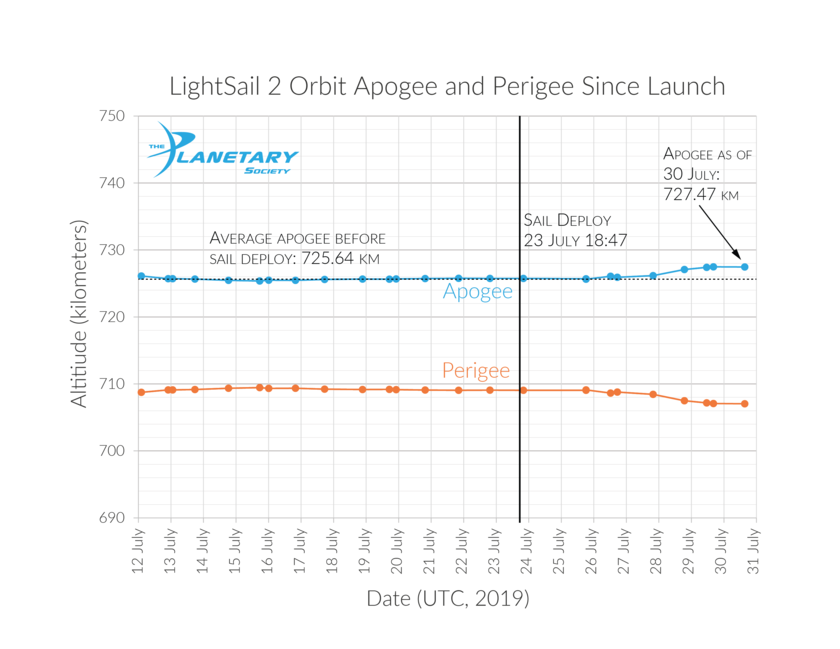

When it's moving away from the sun, the sail is being pushed "forward", which adds to it's velocity- this increases the apogee on the opposite side of the orbit. When it's moving towards the sun, the sail is being pushed "backwards", lowering it's current velocity and reducing the perigee. As the perigee comes lower, it spends less time in that end of the orbit, where it's gaining velocity, and when it's apogee is high it spends more time in that end of the orbit, where it's losing velocity. It's not a winning strategy I'm afraid.
But imagine! Imagine if we had a slightly different solar sail. One that could retract and expand at will, via solar powered electric motors. Then we could have it open it's sails when the "wind" is favorable, then close them when it's not. It could slowly but surely escape earth's gravity well, and gracefully travel around the solar system. A big enough one might even be able to accelerate right out of the solar system.